Most engines follow the same basic recipe: pistons, connecting rods, crankshaft. The Wankel rotary engine threw that recipe in the bin. What followed was one of the most fascinating — and chaotic — chapters in automotive history. This post covers every major car built around the rotary, why most of them failed, and why the engine refuses to die.
What Makes a Wankel Rotary Engine Different?
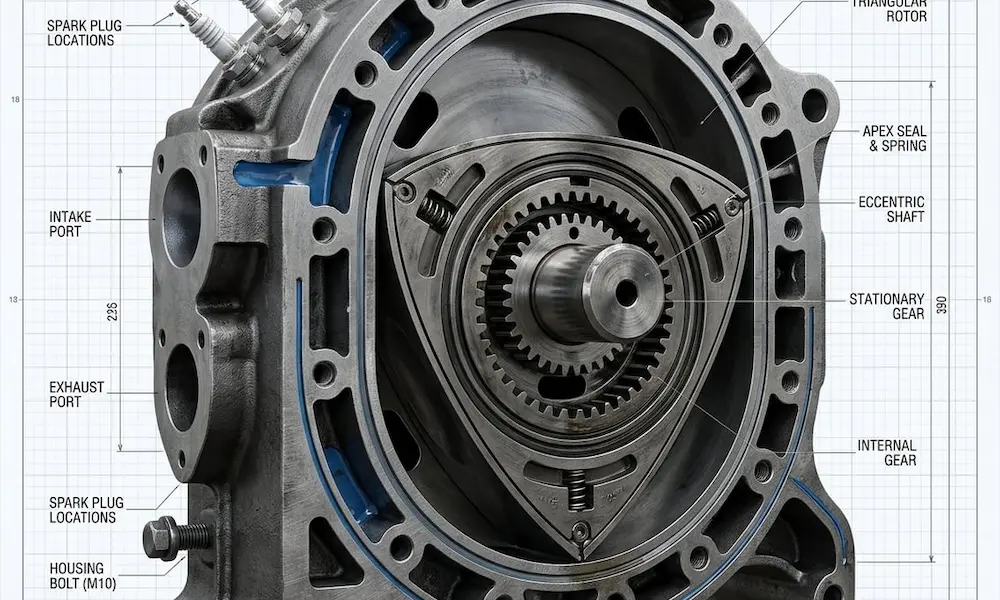
Forget pistons. The Wankel rotary engine uses a triangular rotor spinning inside a figure-eight housing. As the rotor turns, its three apex points seal against the housing walls, creating three separate chambers. Each chamber handles a different job — intake, compression, combustion, exhaust — simultaneously.
The result? An engine with far fewer moving parts than a conventional piston unit. No valves. No camshaft. No timing chain. Just a rotor, a housing, and an eccentric output shaft.
Here’s what makes it genuinely clever:
- The output shaft spins three times for every one full rotor revolution
- That gear ratio allows sky-high redlines without valve float
- The engine sits incredibly small and light — roughly half the parts of a comparable piston engine
- With no reciprocating mass, it runs with turbine-like smoothness
And here’s what makes it a nightmare to live with:
- The long, narrow combustion chamber burns fuel inefficiently
- Unburnt hydrocarbons pour out the exhaust — emissions regulators hate it
- Apex seals wear fast, especially in early designs
- The engine burns oil on purpose to lubricate those seals
- Low torque at low RPM means you have to rev it hard constantly
Understanding those trade-offs explains every success story — and every disaster — that follows.
The Cars That Started It All: NSU’s Bold Experiment
German manufacturer NSU launched the world’s first rotary production car in 1964: the NSU Spider. This tiny rear-engined convertible used a single-rotor 497cc engine making 50 horsepower. It weighed about 1,500 pounds and sold just 215 units in the United States. Apex seal failures plagued it from the start.
NSU followed up with something far more ambitious in 1967: the Ro 80. Designed by Claus Luthe, the Ro 80 was a genuinely revolutionary executive sedan. It featured:
- Front-wheel drive
- Four-wheel disc brakes
- Fully independent suspension
- A semi-automatic transmission
- A drag coefficient that shamed most cars of its era
It won European Car of the Year in 1968. Then the warranty claims started rolling in.
Engines needed replacing before 30,000 miles. Owners held up fingers at each other to signal how many replacement engines their car had eaten. The warranty disaster bankrupted NSU, forcing a buyout by Volkswagen. NSU disappeared into what eventually became Audi.
Citroën’s Rotary Gamble — And Quick Retreat
Citroën loved the idea of pairing rotary smoothness with their legendary hydropneumatic suspension. They partnered with NSU to form a joint venture called Comotor, built a dedicated factory, and launched two rotary models.
The Citroën M35 (1969): A fastback coupe based on the Ami 8, powered by a 49-horsepower single-rotor engine. Citroën handed 267 units to loyal customers as real-world test cars, then bought most of them back and destroyed them. Very few survive today.
The GS Birotor (1973): A twin-rotor compact car making 107 horsepower. It launched the same month as the 1973 oil crisis. Priced 70% higher than a standard GS, it guzzled more fuel than the flagship DS. Only 847 units sold before Citroën’s finances collapsed and Peugeot took over. Management bought back and crushed as many as they could find to escape parts and warranty obligations.
General Motors Almost Built a Rotary Corvette
GM’s president Ed Cole spent $50 million on rotary licensing rights in the early 1970s. He wanted rotary engines powering everything from the Chevy Vega to the Corvette. The compact dimensions made it perfect for the mid-engine Corvette layout engineers had always dreamed about.
GM built two spectacular concepts:
| Concept Name | Year | Engine | Estimated Power | Chassis |
|---|---|---|---|---|
| XP-897 GT (Two-Rotor) | 1973 | Twin-Rotor | 180 hp | Modified Porsche 914 |
| XP-895 (Four-Rotor) | 1973 | Quad-Rotor | 420 hp | Bespoke chassis |
| Aerovette | 1976 | V8 swap | N/A | XP-895 chassis |
The Four-Rotor Corvette literally bolted two twin-rotor engines together. It made 420 horsepower and featured gullwing doors and a fully digital instrument cluster. Then the 1974 oil crisis hit, emissions rules tightened, and GM killed the whole program. The Four-Rotor concept got a V8 dropped in and became the Aerovette. It briefly got green-lit for production before a management change killed it permanently.
Mercedes-Benz and the C111: The Rotary That Set Speed Records
Mercedes didn’t try to sell rotary cars to the public. Instead, they used the engine inside the C111 experimental series — stunning orange wedge-shaped testbeds with gullwing doors.
- C111-I (1969): Three-rotor Wankel making 275 horsepower
- C111-II (1970): Four-rotor Wankel making 349 horsepower, 0-60 in under 5 seconds, top speed of 186 mph
Mercedes encountered the same problems everyone else did — extreme exhaust heat, emissions impossibilities, and reliability issues. They scrapped the rotary program in 1970. But the C111 chassis was so aerodynamic they reused it with diesel and V8 engines to set world speed records at the Nardò test track in Italy.
The Rotary Engines Nobody Talks About
Rolls-Royce Built a Two-Stage Rotary Diesel
In the 1960s, the British Ministry of Defence commissioned Rolls-Royce to build a lightweight diesel rotary for military vehicles. The problem: standard Wankel geometry can’t achieve diesel compression ratios.
Engineer Fritz Feller’s solution was genuinely wild. He stacked two rotary units — a large low-pressure compressor rotor feeding a small high-pressure combustion rotor. Essentially, one rotary engine supercharged another. The prototype 2-R6 produced 350 horsepower and weighed just 939 pounds. It ran in an FV432 armored vehicle. Budget cuts after the Yom Kippur War canceled it in 1974.
The KGB Drove Rotary-Powered Ladas
The Soviet Union wanted fast pursuit cars for the KGB and traffic police. Rather than license Western technology, AvtoVAZ secretly developed their own rotary engines through a dedicated design bureau.
They eventually produced the VAZ-415 twin-rotor, installed in a Lada Samara. It made 140 horsepower and hit 100 km/h in 8 seconds — with a top speed over 120 mph. Nobody on Soviet roads saw a boxy Lada coming. Three-rotor versions making over 200 horsepower went into GAZ luxury sedans for senior intelligence officials. Terrible fuel economy was simply not their problem.
| Manufacturer | Model | Engine | Power | Fate |
|---|---|---|---|---|
| NSU | Spider | Single-Rotor | 50 hp | First production rotary; reliability disaster |
| NSU | Ro 80 | Twin-Rotor | 113 hp | Bankrupted the company |
| Citroën | GS Birotor | Twin-Rotor | 107 hp | Bought back and crushed |
| Mercedes-Benz | C111 | Quad-Rotor | 349 hp | Experimental only; canceled |
| Rolls-Royce | 2-R6 | Two-Stage Diesel | 350 hp | Military prototype; canceled |
| AvtoVAZ (Lada) | VAZ-415 Samara | Twin-Rotor | 140 hp | Soviet police pursuit vehicle |
Why Mazda Succeeded Where Everyone Else Failed
Every other manufacturer walked away from the rotary. Mazda formed a dedicated 47-engineer rotary research team — internally called the “47 Ronin” — and refused to quit.
Their biggest problem was what Japanese engineers called “the devil’s fingernails.” At high speeds, the apex seals vibrated and carved deep wave-like grooves into the chrome housing walls. Engines self-destructed.
Mazda solved it through material science. They moved from solid metal seals to hollow cast-iron designs with cross-shaped holes, then to aluminum-carbon composite materials. This eliminated the housing wear and made mass production viable.
In May 1967, they launched the Mazda Cosmo Sport 110S — the world’s first twin-rotor production car. It completed endurance testing at the Nürburgring and proved the engine could survive real-world use.
Mazda vs. the Clean Air Act
By 1970, Mazda exported rotary cars to the United States. Then the Clean Air Act landed, demanding massive emissions cuts. The rotary’s combustion characteristics made compliance look nearly impossible.
Mazda engineers built a thermal reactor — essentially injecting fresh air into the hot exhaust manifold to incinerate unburnt hydrocarbons before they left the tailpipe. It worked. Mazda passed the emissions tests.
The trade-off was brutal fuel consumption. When the 1973 oil crisis hit, American buyers fled. Mazda nearly went bankrupt. They launched “Project Phoenix” — an internal mandate to cut rotary fuel consumption by 40%. Through redesigned port timing, improved carburetion, and a heat-exchange system that recycled wasted thermal energy, they hit the target and survived.
The Wildest American Rotary: The Mazda REPU Pickup Truck
In 1974, Mazda brought something genuinely baffling to North America: the Rotary Engine Pickup — or REPU. A compact truck with a high-revving 1.3-liter 13B twin-rotor engine.
It had flared fenders, quad headlamps, sporty gauges, and “Rotary Power” stamped right into the tailgate. With 110 horsepower, it smoked every other compact truck on the road. Top speed approached 100 mph.
It was also a terrible truck. Pickups need low-end torque for towing and hauling. The rotary made power up high, forcing drivers to slip the clutch aggressively just to move a load. It averaged 16 miles per gallon during a gasoline shortage. About 15,000 sold before Mazda discontinued it in 1977. Today, clean examples fetch over $30,000 at auction. Absurd engineering, genuine collectors’ item.
The RX-7: Three Generations of Getting It Right
The sports car was always where the rotary belonged. The Mazda RX-7 proved that decisively across three generations.
| Generation | Years | Engine | Power (US) | Key Feature |
|---|---|---|---|---|
| First (FB) | 1978–1985 | 12A / 13B | ~135 hp | Lightweight, near-perfect balance |
| Second (FC) | 1985–1992 | 13B Turbo | ~200 hp | Twin-scroll turbo, independent rear suspension |
| Third (FD) | 1992–2002 | 13B-REW | 255 hp | Sequential twin-turbo, 0.29 drag coefficient |
The first-generation FB weighed barely 2,300 pounds. Over 470,000 units sold, making it the best-selling rotary car ever built. The third-generation FD is widely considered the pinnacle — sequential twin turbos eliminated traditional turbo lag, the body had a drag coefficient of 0.29, and 255 horsepower turned it into genuine supercar territory. Tightening US emissions rules forced it out of the American market by 1995.
The Triple-Rotor Eunos Cosmo: Japan Only, Maximum Everything
In 1990, Mazda built its ultimate rotary creation — the Eunos Cosmo — exclusively for Japan. It was the world’s first production car with built-in GPS navigation. More importantly, it offered the 20B-REW: a triple-rotor sequential twin-turbo engine officially rated at 280 horsepower (the real figure was meaningfully higher). It idled like a V12. Extreme fuel consumption and Japan’s economic collapse meant the triple-rotor engine never appeared in another production car.
The Rotary’s Surprising Modern Life
The RX-8 arrived in 2004 with four seats, rear-hinged freestyle doors, and the Renesis engine — a heavily revised naturally aspirated unit that moved exhaust ports to the side plates, slashing hydrocarbon emissions. It revved to 9,000 rpm and made 232 horsepower from 1.3 liters. But 16 mpg city and oil consumption couldn’t survive Euro 5 standards. Production ended in 2012.
Then came the real surprise.
The MX-30 R-EV: Generator Duty
In 2023, Mazda brought back the rotary in the MX-30 e-Skyactiv R-EV plug-in hybrid. The single-rotor 8C engine (830cc) has zero mechanical connection to the drive wheels. It runs purely as a generator, charging a 17.8 kWh battery at a steady, optimized RPM. That fixed-load operation pushes thermal efficiency past 40% — a remarkable figure for a rotary. Total range exceeds 400 miles.
The tricky part: Mazda confirmed the MX-30 R-EV won’t come to the United States. And after fewer than two years on sale in Europe, they discontinued it there too, restricting it to Japan. The range-extender concept works brilliantly in engineering terms. Finding a market for it proved harder.
What Comes Next: The Iconic SP Concept
At the 2023 Japan Mobility Show, Mazda revealed the Iconic SP concept. It looks like an FD RX-7 reimagined for today — pop-up headlights, curvaceous body, low center of gravity. Underneath sits a dual-rotor rotary generator paired with an electric motor making 370 horsepower.
The rotary in the Iconic SP is designed to run on carbon-neutral fuels, including hydrogen. Zero net carbon emissions, genuine sports car dynamics, and the rotary engine’s inherent smoothness. The concept won Best EV Concept at the 2024 Top Gear Electric Awards.
In October 2023, Mazda’s total rotary vehicle production hit two million units. Every other manufacturer gave up on this engine decades ago. Mazda keeps finding new things to do with it. That, more than anything, tells you everything about why cars with Wankel rotary engines still matter.