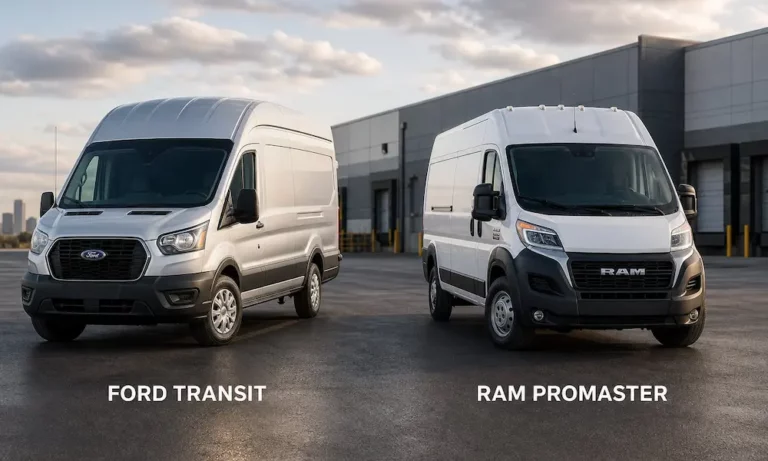
Picking between the Ford Transit and Ram ProMaster isn’t straightforward. Both vans look similar on a spec sheet but drive completely different businesses and lifestyles. This guide cuts through the noise and tells you exactly which van fits your real-world needs — stick around to the end before you sign anything.
Price, Warranties, and Long-Term Value
Money talk first. The Ram ProMaster starts at around $44,405, while the Ford Transit opens at roughly $47,400. That ~$3,000 gap per unit adds up fast when you’re buying a fleet of ten vans.
But here’s where it gets interesting.
Warranty Coverage
Ram’s powertrain warranty runs 10 years or 100,000 miles — double the Transit’s 5 years or 60,000 miles. Both offer identical 3-year bumper-to-bumper and 5-year roadside assistance coverage. For high-mileage operators, that extra powertrain protection from Ram is a serious financial cushion.
Resale Value
The Transit wins this round. Ford maintains stronger residual values thanks to its massive dealer network and high demand for AWD models. The ProMaster depreciates roughly 43% over five years, landing at around $28,867 — steeper than the Transit’s drop.
Build Quality
The J.D. Power 2025 Initial Quality Study gives Ford a clear edge — 25 fewer problems per 100 vehicles versus Ram initially, and 34 fewer problems per 100 vehicles at the three-year mark. If you cycle vans every 3–5 years, the Transit’s better resale and lower defect rate can easily offset its higher sticker price.
| Financial Metric | Ford Transit | Ram ProMaster |
|---|---|---|
| Base MSRP | ~$47,400 | ~$44,405 |
| Basic Warranty | 3yr / 36k miles | 3yr / 36k miles |
| Powertrain Warranty | 5yr / 60k miles | 10yr / 100k miles |
| 5-Year Depreciation | Strong retention | ~43% loss |
| J.D. Power Advantage | +34 fewer problems | Baseline |
Engine Options and Drivetrain: Where They Really Differ
This is the biggest engineering split between the two vans. And it shapes everything downstream — from towing to cargo space to off-road capability.
Engines
The ProMaster runs a single 3.6L naturally aspirated V6 producing 276 hp and 250 lb-ft of torque. Simple, proven, and cheap to fix. No upgrade option though.
Ford offers two gasoline engines:
- A 3.5L naturally aspirated V6 (275 hp / 260 lb-ft)
- A 3.5L EcoBoost twin-turbo V6 (310 hp / 400 lb-ft)
That EcoBoost delivers 150 more pound-feet of torque than the ProMaster’s V6 — a massive advantage at altitude, merging on highways, or hauling maximum loads. The Transit hits 60 mph in roughly 6.7 seconds versus 8.1 seconds for the ProMaster — a 21% performance gap.
Drivetrain Layout
The ProMaster uses front-wheel drive. All engine and drive components sit up front, which eliminates the rear driveshaft and differential. That engineering choice has a huge upside: a dramatically lower cargo floor (more on that shortly).
The Transit uses rear-wheel drive as standard, with an available Intelligent All-Wheel Drive system. RWD naturally handles heavy loads and trailer towing better since cargo weight pushes down on the drive wheels. The AWD system doesn’t raise the load floor or center of gravity — Ford engineered it cleanly. The ProMaster offers zero AWD option. Zero.
Alternator Capacity
This one matters a lot for upfitters. The Transit comes standard with a 250-amp alternator and offers an optional 500-amp dual-alternator setup. The ProMaster maxes out at 220 amps optionally, starting from 180 amps. That means the Transit can recharge large auxiliary battery banks — think mobile workshops or camper van house batteries — more than twice as fast.
| Powertrain Specs | Ford Transit | Ram ProMaster |
|---|---|---|
| Base Engine | 3.5L V6 NA | 3.6L V6 NA |
| Optional Engine | 3.5L EcoBoost TT | None |
| Max Torque | 400 lb-ft | 250 lb-ft |
| Drivetrain | RWD / AWD Optional | FWD Only |
| Transmission | 10-speed auto | 9-speed auto |
| Max Alternator | 500-amp (optional) | 220-amp (optional) |
Cargo Space and Interior Geometry
Raw volume matters — but so does usable geometry. These vans take very different approaches here.
Interior Volume
The largest Transit configuration offers 536.4 cubic feet of cargo space. The ProMaster’s biggest configuration yields 524 cubic feet. A slight Transit win on volume — but that’s not the whole story.
Wall Shape Matters
The ProMaster’s interior walls are nearly perfectly vertical from floor to ceiling. That boxy geometry makes shelving installation significantly faster and simpler — no custom scribing or contour cuts needed. The Transit’s walls taper inward as they reach the roof. Better for aerodynamics, but more complicated for upfitters.
Load Floor Height
This is the ProMaster’s single most impressive ergonomic advantage. The ProMaster’s load floor sits just 21 inches from the pavement. The Transit’s floor stands at roughly 28.9 inches thanks to its rear axle and differential. That’s an ~8-inch difference that compounds dramatically for delivery drivers entering and exiting the cargo hold 100+ times daily.
Lower floor height means:
- Less knee and back strain
- Shallower ramp angles for heavy equipment
- Fewer workers’ comp claims over time
Interior Width and Wheel Wells
The ProMaster’s interior spans 75.6 inches wall-to-wall with 55.8 inches between the rear wheel arches. Standard 4×8 plywood sheets lay flat on the floor with room to spare — a huge deal for contractors. The Transit measures roughly 74.5 inches wide, narrowing further due to wall curvature.
Roof Heights and Wheelbases
Ford Transit: Low (57″), Medium (72″), High (82″) — with 130″, 148″, and 148″ Extended wheelbases.
Ram ProMaster: Standard (65.4″), High (76″), Super High (86″) — across 118″, 136″, 159″, and 159″ Extended wheelbases. The ProMaster’s Super High roof at 86 inches beats every Transit option in vertical clearance. That’s real standing room for tall workers in hardhats and boots.
| Dimension | Ford Transit | Ram ProMaster |
|---|---|---|
| Max Cargo Volume | 536.4 cu ft | 524 cu ft |
| Max Interior Height | High: 82″ | Super High: 86″ |
| Interior Width | ~74.5″ (tapers) | 75.6″ (vertical walls) |
| Wheel Well Width | 54.8″ | 55.8″ |
| Load Floor Height | ~28.9″ | ~21″ |
Towing and Payload
Both vans carry serious weight. But their real-world behavior differs noticeably.
The ProMaster tows up to 6,910 pounds with its base engine. The Transit needs the EcoBoost engine plus the Heavy-Duty Trailer Tow Package to match that number at 6,900 pounds. Nearly identical on paper.
Off paper? The Transit’s RWD setup handles trailer towing with far more composure at highway speeds. The ProMaster’s FWD architecture can feel unsettled pulling heavy trailers uphill — the trailer’s weight pulls down on the rear, actively lifting weight off the drive wheels.
Maximum payload favors the Transit at up to ~5,110 pounds in optimal configurations versus the ProMaster’s ~4,820 pounds. Both numbers disappear quickly once you account for shelving, bulkheads, and flooring — always calculate your upfit weight before loading cargo.
Electric Vans: E-Transit vs ProMaster EV
Both manufacturers are pushing into zero-emission territory. Ford arrived first and shows it.
Ford E-Transit
The E-Transit’s 89 kWh battery feeds a rear-mounted motor producing 266 hp and 317 lb-ft of instant torque. Range hits up to 159 miles for low-roof variants. DC fast charging peaks at 176 kW — getting from 10% to 80% in about 28 minutes.
The standout feature? The Pro Power Onboard system outputs 2.4 kW through 120V cargo wall outlets. Electricians and construction crews can run power tools at remote job sites without hauling a generator. Ford also uses Smart Acceleration Truncation software to manage power based on cargo weight — preserving range and extending tire life.
Ram ProMaster EV
The ProMaster EV carries a larger 110 kWh battery with 268 hp and 302 lb-ft. City range reaches up to 161 miles. Strong specs. But it lacks auxiliary power output, and Ford’s years of real-world fleet integration with Ford Pro telematics and charging ecosystem give the E-Transit a practical operational edge for large fleets.
| Electric Specs | Ford E-Transit | Ram ProMaster EV |
|---|---|---|
| Motor Output | 266 hp / 317 lb-ft | 268 hp / 302 lb-ft |
| Battery Capacity | 89 kWh | 110 kWh |
| Estimated Range | Up to 159 miles | Up to 161 miles (city) |
| DC Fast Charge Peak | 176 kW | Not specified |
| Aux Power Output | 2.4 kW onboard | None |
| Drivetrain | RWD | FWD |
Van Life and Camper Conversions
This comparison matters just as much for the rapidly growing conversion van market as it does for commercial fleets.
Why DIY Builders Love the ProMaster
The ProMaster’s 75.6-inch interior width is the headline stat. It’s the only production van that lets a 6-foot adult sleep east-west (sideways across the back) without cutting the body. That single fact unlocks layouts that include large kitchen galleys, enclosed wet bathrooms, and dedicated work desks in the same build. Wayfarer Vans’ “Walt” model on the ProMaster 159-inch High Roof delivers a 6-foot 8-inch sleeping surface using this advantage.
The vertical walls also speed up cabinetry work enormously — less custom cutting, less wasted material. Lower entry price and a 21-inch step-in height seal the deal for budget-conscious DIY builders.
Why Adventurers Choose the Transit
The Transit’s factory AWD system changes the equation entirely for off-grid living. Snow-covered mountain passes, muddy forest roads, remote Bureau of Land Management campsites — the Transit handles terrain that would strand a ProMaster. A mature off-road aftermarket ecosystem from companies like Aluminess, Owl Van, and Quigley offers lift kits, winch bumpers, and aggressive tire packages specific to the Transit platform.
The Transit’s narrower interior requires workarounds for east-west sleeping — specifically fiberglass “bump-out” panels that extend the van’s width. These cost money, require cutting the body, and change the exterior look. Emery Custom Builds’ “Haven” model and Wayfarer Vans’ “Wilford” on the Transit High Roof both use this approach successfully — but plan for the added build cost.
Fuel Economy and Real-World Range
Neither van sits in a class requiring EPA testing, but real-world fleet data shows both average 14–17 mpg in mixed driving. The ProMaster’s lighter FWD setup edges ahead in city stop-and-go. The Transit’s 10-speed transmission recoups that gap at highway speeds with lower engine RPMs.
The Transit wins on fuel capacity: a 25.1-gallon standard tank with an optional 31-gallon extended tank versus the ProMaster’s single 24-gallon option. The Transit also includes a capless fueling system and a power-locked fuel door — small but useful anti-theft features.
Fully converted vans hauling 1,500–3,000 pounds of build weight see economy drop to 12–16 mpg across both platforms. A diesel Sprinter pulls 18–22 mpg but adds diesel exhaust fluid costs and complexity to the equation.
Maintenance, Reliability, and Fleet Uptime
Understanding what breaks — and what it costs — is essential for total cost of ownership calculations.
Common Ford Transit Problems
The EcoBoost engine’s complexity comes with real risks. Documented issues include timing chain stretch as early as 5,000–8,000 miles ($1,500–$4,500 to repair), turbocharger boost sensor failures or wastegate sticking ($1,200–$3,500 per turbo), and transmission shudder requiring valve body work ($250–$3,200). Brake wear on the front axle is also frequently reported, with service costs ranging $150–$900.
The Transit rewards strict maintenance schedules. Neglect oil changes on the EcoBoost and you’ll pay dearly for it.
Common Ram ProMaster Problems
The ProMaster’s simpler naturally aspirated engine avoids turbo-related complexity entirely. Its documented weaknesses tie directly to FWD stress: accelerated wear on ball joints, tie rods, and front tires is a well-known fleet complaint. Heavily rear-loaded cargo shifts weight away from the drive wheels, worsening tire wear and alignment.
One unusual vulnerability: the ProMaster’s engine bay design makes it susceptible to rodent intrusion, which can destroy wiring harnesses when parked in rural areas for extended periods. If you’re van-living in agricultural zones, budget for mesh protection kits.
Long-haul drivers also report that the ProMaster’s bus-style upright steering column and seat design causes significant fatigue on drives over 4–5 hours.
Dealer Network
Ford operates approximately 18% more dealership locations across the U.S. than Ram. That density matters when a breakdown happens 200 miles from the nearest city. Both networks are competent — Ford’s is simply more pervasive.
Technology, Safety, and Driver Features
Both vans offer modern infotainment and solid driver-assistance suites.
The ProMaster runs Uconnect 5 on a standard 10.1-inch touchscreen with wireless Apple CarPlay, Android Auto, and a standard backup camera. The Transit offers SYNC 4 on an available 12-inch screen with cloud-connected navigation and voice recognition — particularly useful for hands-free route updates during delivery runs.
Both vans include:
- Forward collision warning with automatic emergency braking
- Lane departure warning and lane keep assist
- Drowsy driver detection
- Backup camera
The Transit goes further with available 360-degree surround-view cameras featuring a front camera washer — critical for maintaining visibility in road salt and heavy rain. It also includes a Side-Wind Stabilization System that uses stability control brakes to counteract crosswind forces on the van’s tall profile. The ProMaster lacks both of these features.
For fleet management, Ford Pro Telematics tracks real-time location, fuel use, diagnostic codes, and driver behavior — all integrated tightly with EV charging network management. Ram Telematics offers similar core tracking capabilities but lags behind Ford’s commercial software investment.
So Which Van Should You Buy?
Here’s the honest breakdown:
Choose the Ram ProMaster if you:
- Run tight urban delivery routes with frequent stops
- Need maximum interior width for east-west van builds or flat-floor cargo
- Want the lowest acquisition cost for a large fleet
- Value the 10-year powertrain warranty for long-term risk management
- Prioritize easy DIY upfitting with vertical walls
Choose the Ford Transit if you:
- Operate in snowy climates or off-road terrain and need AWD
- Regularly tow heavy trailers at highway speeds
- Need the EcoBoost’s torque for high-altitude or max-payload performance
- Run a large commercial fleet and prioritize resale value and dealer access
- Want serious auxiliary electrical capacity for mobile workstation builds
- Need full-size passenger transport up to 15 seats
Neither van is a bad choice — they’re genuinely purpose-built for different jobs. Match the van to your actual route, build, and budget rather than chasing specs that don’t apply to your situation.