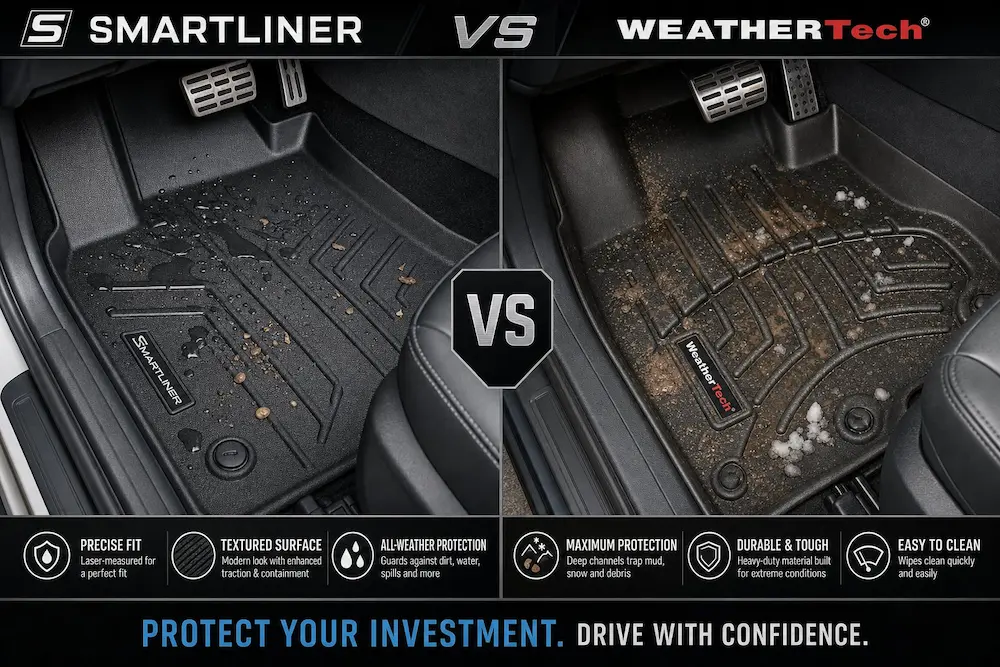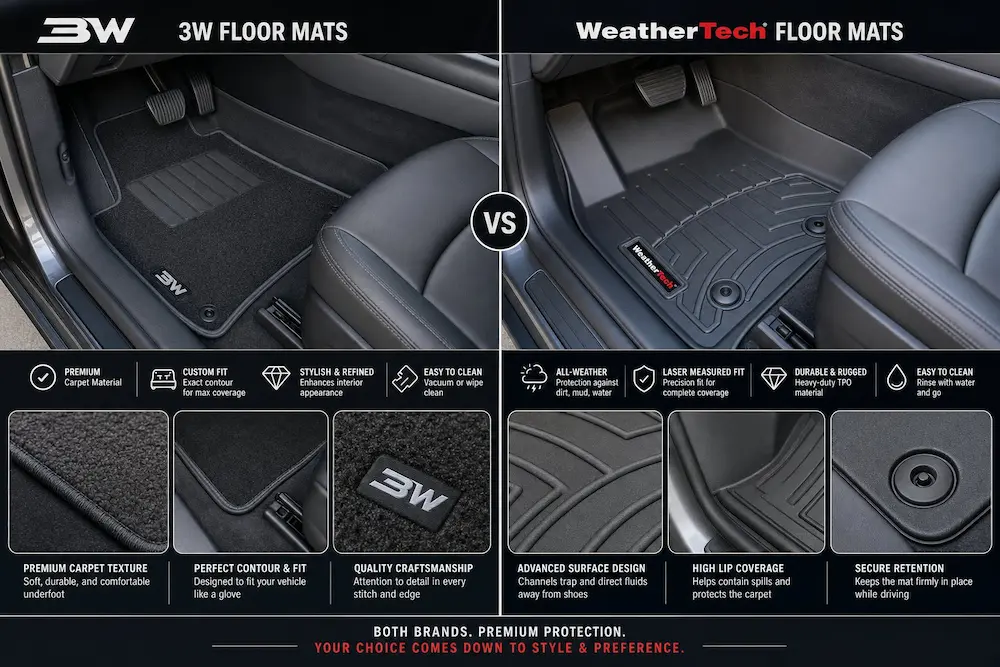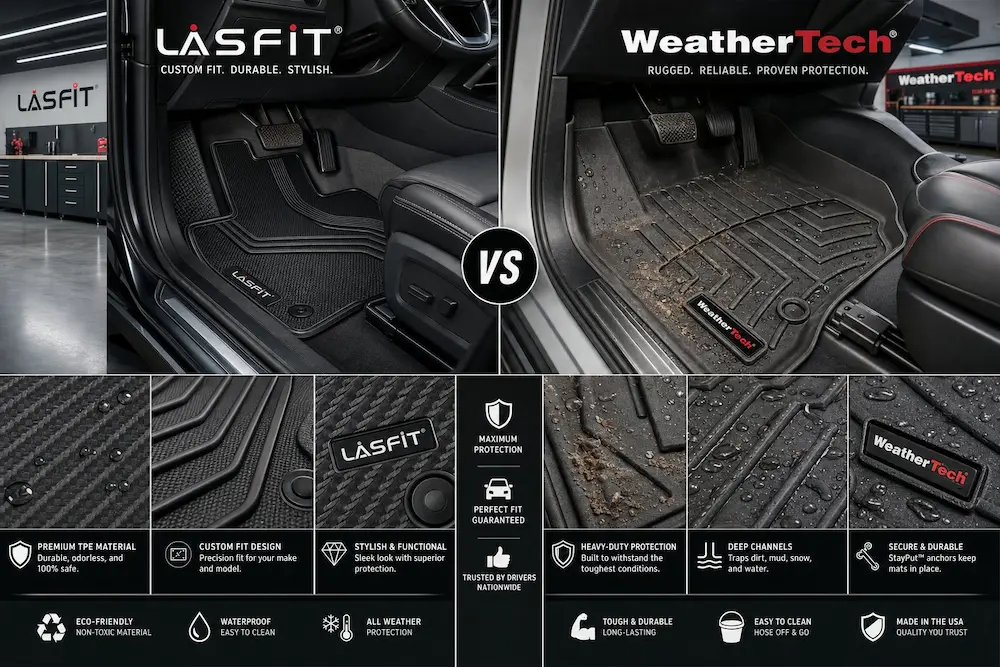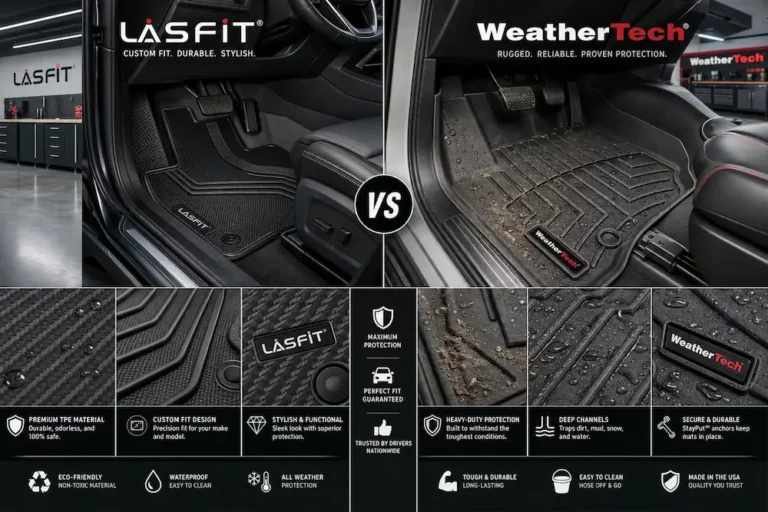
Your vehicle’s floor takes a beating every single day. Mud, snow, spilled coffee, dog paws — it adds up fast. Two brands dominate the conversation: Lasfit and WeatherTech. This post breaks down exactly how they compare, so you can stop guessing and pick the right one.
The Quick Version: What Makes These Two Different
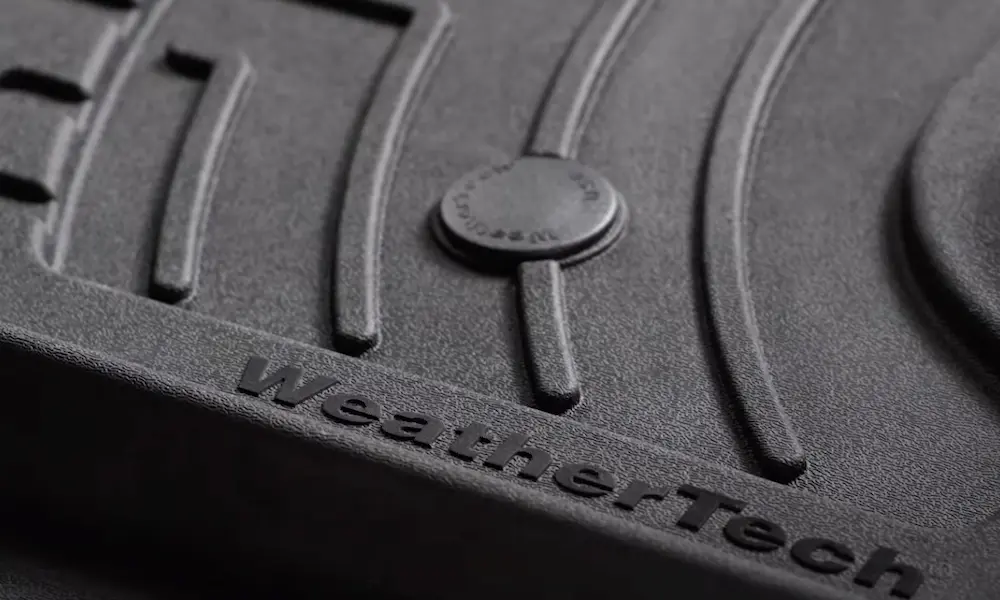
WeatherTech has been making floor liners since 1989. They’re built tough, made in Illinois, and designed for maximum fluid containment. Think industrial-grade protection for people who track mud and snow into their trucks daily.
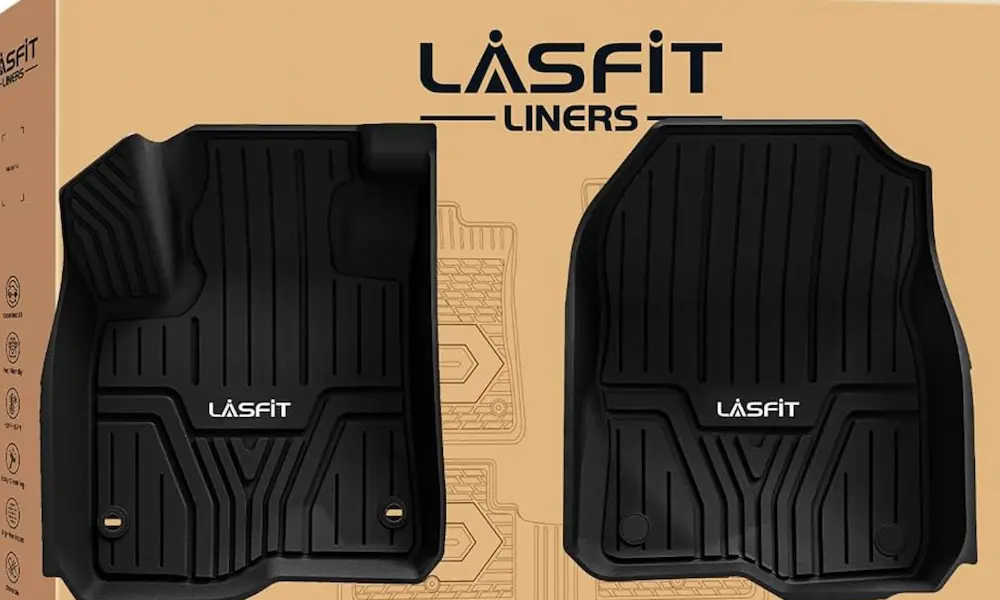
Lasfit launched its liner line in 2020, bringing injection-molded precision and flexible materials to a market that WeatherTech had dominated for decades. They’re designed for drivers who want solid protection and a clean, OEM-style look.
These two brands aren’t just different products. They’re built on completely different philosophies.
Material Breakdown: What’s Actually Under Your Feet
WeatherTech: High-Density Tri-Extruded Compound
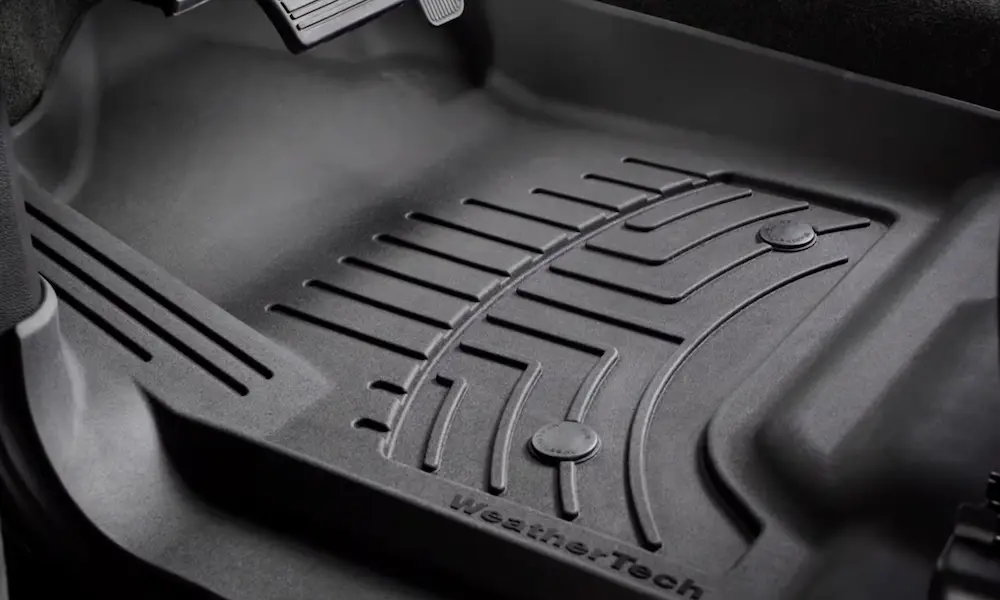
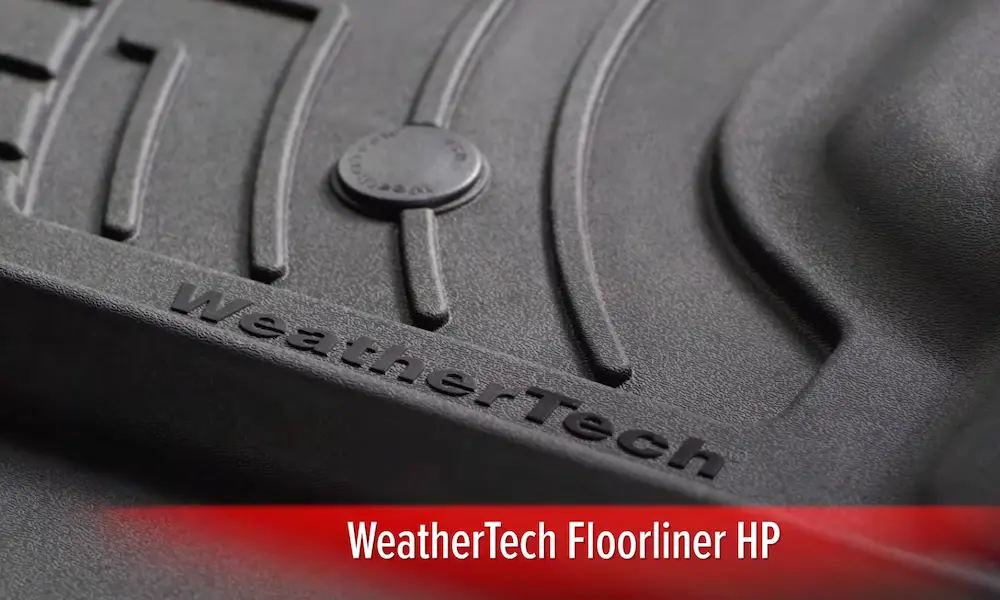
WeatherTech’s flagship FloorLiner uses a proprietary High-Density Tri-Extruded compound. It’s rigid, thick, and holds its bowl shape under heavy loads of water, slush, and debris.
Their secondary all-weather mats use a softer Thermoplastic Elastomer (TPE). Both materials are:
- Latex-free
- Free of PVC, cadmium, and lead
- Fully recyclable
- Rated to stay flexible in sub-zero temperatures
Lasfit: Pure Regenerated TPE from Sweden
Lasfit uses 100% pure regenerated Thermoplastic Elastomer, sourced from Sweden and certified to the Global Recycled Standard.
Here’s why that matters: cheap mats made from recycled rubber, PVC, or nylon fibers can off-gas toxic volatile organic compounds when a parked car heats up to over 100°F. Lasfit’s pure TPE doesn’t need chemical stabilizers, which means no smell, no off-gassing, and a food-grade safe surface — even in a scorching summer car.
Bottom line on materials: WeatherTech wins on raw rigidity. Lasfit wins on material purity, flexibility, and environmental credentials.
Manufacturing: Thermoforming vs. Injection Molding
This is the most important technical difference in the Lasfit vs WeatherTech debate. It affects everything from fit quality to long-term durability.
How WeatherTech Makes Its FloorLiners
WeatherTech’s flagship liners use thermoforming. Here’s the process:
- Flat sheets of HDTE compound are heated in large industrial ovens
- The soft sheet gets placed over an aluminum mold
- A vacuum pulls the material tight against the mold
- The sheet cools and sets in shape
- Excess edges get trimmed away
Thermoforming is fast and relatively cheap. An aluminum mold costs around $10,000 and takes about 10 days to develop.
How Lasfit Makes Its Liners
Lasfit uses high-pressure injection molding exclusively. Molten TPE gets injected under immense pressure into a closed, dual-sided steel mold. The mat cures directly into its final 3D shape.
The tooling costs $100,000–$200,000 per vehicle model and takes up to three months to develop. That’s 10–20x the investment of a thermoforming mold.
Why does that matter for you? Because injection molding:
- Produces zero waste (no trimmed edges)
- Allows variable material thickness for complex textures and channels
- Eliminates residual molecular tension — the root cause of mat curling
| Manufacturing Metric | WeatherTech (Thermoforming) | Lasfit (Injection Molding) |
|---|---|---|
| Tooling Material | Aluminum | Pure Steel |
| Tooling Cost | ~$10,000 | $100,000–$200,000 |
| Development Time | ~10 Days | ~3 Months |
| Material Waste | Requires edge trimming | Zero waste |
| Residual Stress | High (stretched material) | Minimal (cured in 3D shape) |
| Long-Term Shape | Prone to warping | Stays flat |
The Curling Problem: A Real Safety Issue
This section matters more than most people realize.
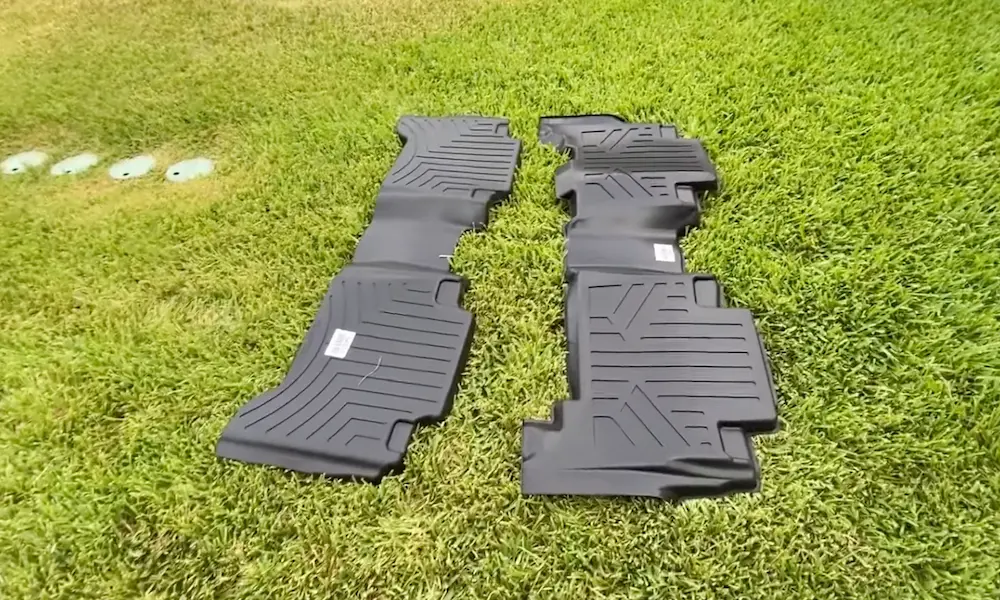
Plenty of WeatherTech owners report edge curling — where the liner’s edges lift away from the floorpan after months or years of use. It looks bad. It lets dirt sneak under the mat. And in serious cases, it’s genuinely dangerous.
Multiple owners have reported that a warped WeatherTech mat bowed outward and trapped the accelerator pedal at highway speed, forcing them to shift into neutral or physically pull the mat free. That’s a scary situation that shouldn’t happen with a premium product.
The science behind curling is straightforward. When flat plastic sheets get stretched over a mold, the material retains “memory” of its original flat state. Years of baking in summer heat and freezing in winter pull those stretched edges back toward flat — which means up and away from the floor.
When owners try to fix this, WeatherTech’s own support sometimes suggests placing mats in direct sunlight or weighing them down for 48–72 hours. Most users report that fix is temporary. Some have resorted to blow torches and heavy bricks.
Warranty claims for curling are frequently denied, with WeatherTech citing improper installation or maintenance.
Lasfit’s injection-molded mats cure in their final 3D shape. There’s no residual stress to resolve over time. Long-term owner reports consistently note that Lasfit liners stay completely flat against the floorpan after years of daily use.
Coverage: Dead Pedal and Under-Seat Areas
Fit quality isn’t just about the main footwell. The details matter.
The “dead pedal” — that angled footrest to the left of the brake — is a key coverage test. Many WeatherTech liners cover only part of the dead pedal due to structural constraints, leaving factory carpet exposed to mud and moisture dripping off your boot.
Lasfit’s injection-molded design follows the dead pedal to its apex, creating what they call a “complete seal.”
Rear coverage also differs. Lasfit mats commonly extend further under the front seats, protecting the hidden footwells where rear passengers rest their feet. In the Kia Carnival comparison specifically, WeatherTech liners left significant carpet exposed beneath the seats. Lasfit covered it.
Real-World Performance by Vehicle
Full-Size Trucks: F-150, Tundra, Ram 1500
F-150 owners comparing both brands note that Lasfit’s flexible edges snap cleanly onto factory retention posts and lie flat across the entire floorpan. WeatherTech is preferred by some in extreme snow regions for sheer rigidity, but a growing group prefers Lasfit’s grippy TPE feel over WeatherTech’s slicker plastic surface.
For the 2025 Toyota Tundra, Lasfit liners offer significantly improved coverage over OEM mats, with deep channels and raised edges that resist warping under heavy cabin heat.
Ram 1500 owners frequently pair Lasfit interior mats with Lasfit’s 5mm reinforced truck bed mat — 100% waterproof and rated to handle a two-ton load.
SUVs and Minivans: Kia Telluride, Kia Carnival, Honda CR-V
Kia Telluride owners describe WeatherTech as feeling stiff and oversized in the footwell — practical, but industrial-looking in a family SUV. Lasfit is consistently praised for looking like a factory upgrade while still trapping slush and rain effectively.
For the Honda CR-V, Lasfit proved their rapid development process. When early users flagged that seat-back protectors were shifting under cargo weight, Lasfit engineered integrated lanyards into a revised design — fast. They also ran a 13-day extreme heat test, coating mats in mud, yogurt, and ketchup, then baking them at over 100°F. A garden hose cleaned everything off perfectly.
Cleaning and Daily Usability
Both brands repel liquids and resist chemical contamination. Cleaning either mat follows the same basic steps:
- Remove the mat from the vehicle
- Rinse with a pressurized hose
- Scrub with mild soap for heavy soiling
- Air dry before reinstalling
The difference shows up during extraction. WeatherTech’s rigid, bowl-shaped liners are awkward to pull out when they’re holding melted snow or muddy water. Tip the wrong way and it pours onto your seat or exposed carpet.
Lasfit’s flexible TPE lets you fold or pinch the edges slightly during removal, keeping liquid controlled. Families and daily commuters consistently mention this as a practical advantage.
Price Comparison: What You’re Actually Paying
This is where Lasfit vs WeatherTech gets really clear.
- WeatherTech FloorLiners (2-row set): $200–$250
- Cargo liner: Additional $100–$160
- Lasfit full set (front + rear): $130–$150
- Lasfit bundles: Often include cargo liner, saving ~$50 vs. buying separately
A growing segment of repeat WeatherTech buyers is switching to Lasfit on their next vehicle. The combination of better fitment, no curling issues, and a $70–$100 lower price point makes it a straightforward decision for most daily drivers.
Warranty and Returns: Night and Day
WeatherTech
WeatherTech offers a Limited Lifetime Warranty covering defects in materials and workmanship. Returns must happen within 30 days, in unused condition, with the buyer paying return shipping. WeatherTech also deducts original shipping and packaging costs from refunds.
Warranty claims for warped mats are frequently disputed, with the brand attributing deformation to improper installation rather than a product defect.
Lasfit
Lasfit’s standard warranty is lifetime coverage with a 45-day return window. Lasfit Club Members unlock an extended 90-day money-back guarantee and a member lifetime warranty that covers things most companies wouldn’t touch:
- Abnormal wear and tear
- Pet damage (yes, if your dog chews the mat, Lasfit replaces it)
- Accidental damage from shutting it in a car door
- Damage from a vehicle collision
For returns due to defects or fitment issues, Lasfit covers return shipping and processes refunds with no restocking fees.
That’s a dramatically different level of consumer confidence from both sides of the transaction.
How They Stack Up Against the Competition
Lasfit and WeatherTech aren’t the only players. Here’s a quick look at the broader market:
| Brand | Material | Manufacturing | Warranty | Key Strength |
|---|---|---|---|---|
| WeatherTech | HDTE / TPE | USA | Limited Lifetime | Maximum rigidity, high sidewalls |
| Lasfit | Pure TPE (Sweden) | Global (USA Designed) | Lifetime + 90-Day MBG | Injection-molded precision, great value |
| Husky Liners | ProGard™ | USA | Limited Lifetime | Good dead pedal coverage, aggressive retention |
| 3W Auto-Life | Thorex TPE | Global (USA Designed) | Lifetime | Strong EV fitment coverage |
| TuxMat | Multi-layer PVC | Global | Limited Lifetime | Luxury look, clips under trim panels |
| 3D MAXpider | 3-Layer XPE Foam | Global | 3-Year Limited | Lightweight, carbon-fiber aesthetic |
Husky Liners is the closest legacy competitor to WeatherTech, but their sharp retention spikes raise concerns about carpet damage over time. 3W Auto-Life runs a nearly identical business model to Lasfit and is particularly strong in the EV segment. TuxMat wins on aesthetics but gets expensive fast. 3D MAXpider’s 3-year warranty makes it a risky long-term buy compared to lifetime-warranted options.
So, Which One Should You Buy?
Choose WeatherTech if you:
- Work in agriculture, construction, or other industries tracking heavy mud and debris daily
- Live somewhere with genuinely brutal winters and need maximum fluid containment
- Prioritize domestic manufacturing above all else
- Don’t mind the industrial look or the premium price
Choose Lasfit if you:
- Drive a daily commuter, family SUV, or modern truck
- Want full dead-pedal and under-seat coverage
- Care about toxic off-gassing (especially with kids or pets in the car)
- Want a mat that won’t curl or warp after two summers
- Want to spend $70–$100 less and get a better warranty
For the vast majority of drivers in 2025, Lasfit delivers more precision, better long-term shape retention, superior coverage in edge zones, and a warranty that actually has your back — all for less money. WeatherTech still earns its place in heavy-duty, high-volume environments. But for everyday driving? The gap has closed significantly, and Lasfit has crossed it.