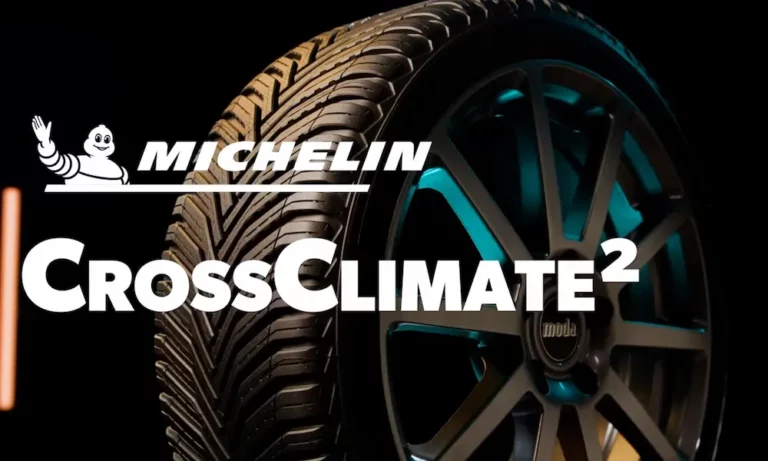
Choosing between the Michelin CrossClimate 2 vs Defender 2 isn’t as simple as picking the more expensive one. Both tires are excellent — but they solve very different problems. Get this wrong and you’ll either overpay for performance you don’t need or seriously compromise your safety in winter weather. Stick around — by the end, you’ll know exactly which tire fits your life.
They’re Both Michelin, But They’re Not the Same Tire
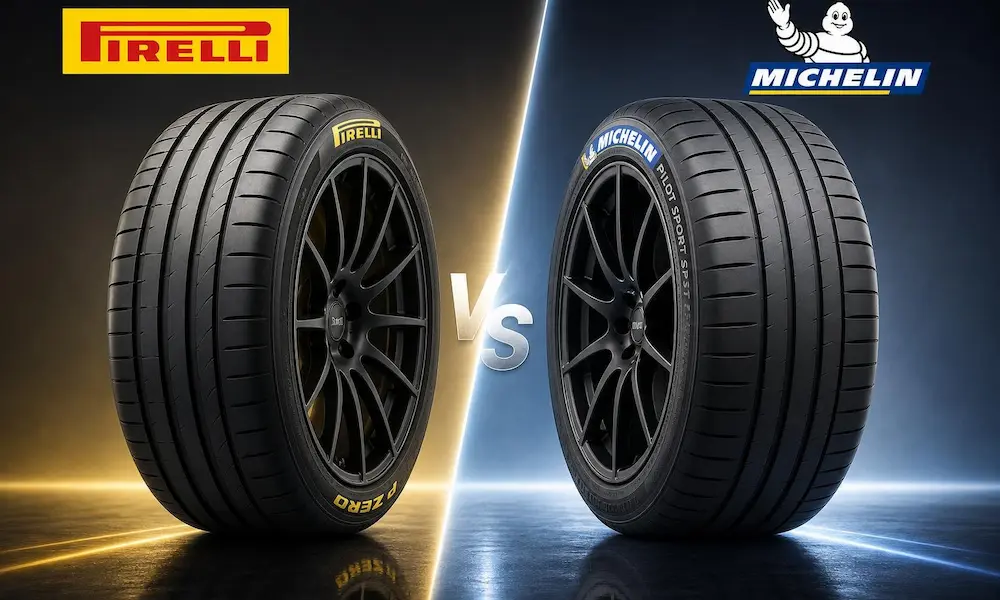
Here’s the thing people often miss: these two tires don’t compete with each other — they serve completely different drivers.
The CrossClimate 2 is an all-weather tire. It carries the Three-Peak Mountain Snowflake (3PMSF) certification, meaning it passed actual snow traction testing. It’s built for drivers who deal with real winters but don’t want to swap tires every season.
The Defender 2 is a grand touring all-season tire. It’s engineered for one thing above all else: lasting as long as humanly possible while keeping your ride smooth and quiet.
Same brand. Completely different missions.
How They’re Built (And Why It Matters)
CrossClimate 2: Stiffer, Heavier, More Aggressive
The CrossClimate 2 uses a two-layer polyester construction with two high-tensile steel belts and a full-width nylon reinforcement layer. That extra layer makes the sidewall stiffer — great for cornering in an SUV or EV, but it does add weight.
Its V-shaped directional tread is engineered to push water, slush, and snow away from the contact patch fast. The SipeLock 3D technology — tiny interlocking grooves — creates extra biting edges under braking pressure.
One important note: because it’s directional, you can only rotate it front-to-back on the same side of the car. Cross-rotations require unmounting and remounting the tires, which adds time and cost at the shop.
Defender 2: Lighter, Softer, Built to Last
The Defender 2 runs a single-layer polyester casing with two steel belts and a polyamide reinforcement layer. Lighter internal components mean less unsprung mass, which helps your suspension work better and reduces energy lost to inertia.
Its symmetric rib tread design with four deep circumferential grooves is optimized for straight-line stability. And because it’s symmetric, you can rotate these tires in any direction — front to back, side to side, full cross-rotation — which is key to hitting that 80,000-mile warranty.
| Specification | Michelin CrossClimate 2 | Michelin Defender 2 |
|---|---|---|
| Primary Category | All-Weather (3PMSF) | Grand Touring All-Season |
| Tread Pattern | Directional V-Shape | Symmetric Rib |
| Ply Construction | 2-Layer Polyester | 1-Layer Polyester |
| Rotation Capability | Front-to-Back Only | Full Multi-Directional |
| EV Compatibility | Certified EV Ready | Certified EV Ready |
The Rubber Compound Is Where the Real Difference Lives
CrossClimate 2’s Thermal Adaptive Compound
Standard all-season tires start to harden and lose grip when temperatures drop below 45°F. The CrossClimate 2 uses a high-silica EverGrip thermal adaptive compound that stays flexible well below freezing. The rubber conforms to road texture, giving you actual grip on ice and packed snow instead of skating across it.
In summer, the same compound resists excessive softening on hot asphalt — so it doesn’t wear out fast in the Sun Belt the way a dedicated winter tire would.
Defender 2’s EverTread 2.0 Compound
The Defender 2 uses EverTread 2.0, which is significantly harder than the CrossClimate 2’s rubber. Paired with MaxTouch 2.0 technology, it distributes the forces of acceleration, braking, and cornering evenly across the tread surface. No hot spots. No uneven wear.
That hardness is a trade-off — it won’t grip snow as effectively — but it’s exactly why the Defender 2 can survive 90,000+ miles.
Safety Performance: Wet Roads, Dry Roads, and Ice
Wet Braking
This is where the CrossClimate 2 pulls ahead in safety testing. Michelin claims it can stop up to 56 feet shorter than leading competitor tires in wet conditions when tested in a worn state. Its directional tread evacuates water from the contact patch faster than the Defender 2’s symmetric design.
The Defender 2 is no slouch — it recorded an average 50-0 MPH wet braking distance of 130 feet in testing with a Toyota RAV4. But it’s not built for slush or rain mixed with winter gunk. It’s built for clean, heavy rain on a maintained highway.
Dry Braking and Handling
On dry pavement, the CrossClimate 2 recorded a 60-0 MPH stopping distance of 86.1 feet in Tire Rack’s EV testing, with lateral grip reaching up to 0.9g on a skid pad. It feels sporty and responsive — more connected to the road than the average touring tire.
The Defender 2 posted a 60-0 MPH dry braking distance of 120.9 feet in the same RAV4 tests. It’s not as sharp, but it’s predictable, stable, and more than adequate for everyday driving.
| Performance Metric | Michelin CrossClimate 2 | Michelin Defender 2 |
|---|---|---|
| Wet Braking (50-0 MPH) | ~142.9 ft (avg) | 130.0 ft (RAV4) |
| Dry Braking (60-0 MPH) | 86.1 ft (Model 3) | 120.9 ft (RAV4) |
| Lateral Traction (Skid Pad) | 0.90g | ~0.85g |
| Wet Handling Score | 6.69 / 10 | 6.00 / 10 |
| Hydroplaning Resistance | Superior (directional) | Excellent (straight-line) |
Winter Performance: This Is the Big One
3PMSF vs. M+S — Not Even Close
The CrossClimate 2 is 3PMSF certified. That certification requires real-world snow traction testing — not just math about groove ratios. The tire’s zigzag sipes and wide grooves act like claws on packed snow.
The Defender 2 only has the M+S (Mud and Snow) rating. That label is earned by having at least 25% of tread area made up of grooves. No actual snow performance testing required. None.
The Numbers in Winter Conditions
Real-world testing reveals a serious gap between these two tires in cold conditions:
- The CrossClimate 2 stops 8.8 feet shorter on ice — a 16% safety advantage over the Defender 2
- In snow handling laps, the CrossClimate 2 posted 53.79 seconds vs. the Defender 2’s 61.36 seconds
- The Defender 2 can feel “slippery” and “twitchy” on truly icy or slick roads
| Winter Metric | CrossClimate 2 | Defender 2 |
|---|---|---|
| Certification | 3PMSF (Severe Snow) | M+S (Mud & Snow only) |
| Ice Braking Distance | 8.8 ft shorter | Baseline |
| Snow Handling Time | 53.79 sec | 61.36 sec |
| Cold Flexibility | High (Thermal Adaptive) | Moderate (Hardens in Cold) |
If you’re in Minnesota, Colorado, or upstate New York, the CrossClimate 2 is the only year-round Michelin option that makes sense. The Defender 2 isn’t built for your winters.
Tread Life and Total Cost of Ownership
Here’s where the Defender 2 fights back hard.
The Defender 2 carries a UTQG treadwear rating of 840. The CrossClimate 2 sits at 640. That gap shows up in the warranties:
- CrossClimate 2: 60,000-mile warranty, typically lasts ~70,000 miles
- Defender 2: 80,000-mile warranty, often reaches 90,000–100,000 miles with regular rotations
In terms of sticker price, a set of four CrossClimate 2 tires in 235/55R19 runs about $1,180, while the Defender 2 comes in around $1,016. But the Defender 2’s longer life brings its cost-per-mile significantly lower.
That said, many drivers who choose the CrossClimate 2 treat the price difference as an insurance premium — one avoided winter fender bender easily covers it.
Fuel Efficiency and EV Range
Both tires are designated EV Ready, but they behave very differently in efficiency testing.
The Defender 2’s lighter construction and harder compound mean lower rolling resistance. Michelin claims it can save up to 65 gallons of fuel over its lifespan compared to competing tires. For EV owners, that means more miles per charge.
The CrossClimate 2 tells a different story. Testing on a Tesla Model 3 showed a range reduction of approximately 34 miles after switching to the CrossClimate 2 — about a 12.5% efficiency loss. On gas vehicles, many owners report a drop of 1.5 to 2.0 MPG after installing the CrossClimate 2. The efficiency hit decreases as the tread wears down, but it never fully disappears.
If EV range is your priority, the Defender 2 wins this round clearly.
Ride Comfort and Road Noise
The Defender 2 is one of the quietest all-season tires in its class. Its symmetric tread and MaxTouch construction deliver smooth, vibration-free rides that hold up throughout the tire’s life. On long highway stretches, the cabin stays genuinely relaxed.
The CrossClimate 2 uses Piano Noise Reduction technology to tune the tread blocks against resonant humming. When new, it’s impressively quiet. But some owners report that a high-pitched noise or slight growl develops as the tire wears, particularly during deceleration.
In terms of ride feel, the CrossClimate 2 is tauter and more road-connected. The Defender 2 is softer, more compliant, and better at absorbing the shock from expansion joints and potholes. If you’ve got family in the back seat and commute daily, the Defender 2 will earn more compliments.
Where You Live Should Drive Your Decision
Your zip code matters more than anything else in this comparison.
Choose the CrossClimate 2 if you’re in:
- The Midwest: Minneapolis, Chicago, Cleveland
- The Northeast: Buffalo, Boston, Albany
- Mountain states: Denver, Salt Lake City, Bozeman
- The Pacific Northwest where slushy winters are common
Choose the Defender 2 if you’re in:
- The Sun Belt: Phoenix, Dallas, Miami, Los Angeles
- Southern California and desert states
- States where snow is rare and highways are your daily reality
For drivers in Seattle or Portland, it’s genuinely a toss-up. The CrossClimate 2 handles the occasional winter mix better, while the Defender 2 wins on highway comfort and long-term cost.
Michelin’s Promise Plan Covers Both Tires
Whether you go CrossClimate 2 or Defender 2, you get the Michelin Promise Plan, which includes:
- 60-day satisfaction guarantee — return them if you’re not happy
- 3-year roadside assistance — flat changes, jump starts, lockout help, emergency fluid delivery
- Mileage warranty — pro-rated credit toward replacements if the tire wears out before the warranted mileage
That’s a solid safety net regardless of which direction you go.
The Bottom Line: Two Great Tires, Two Very Different Drivers
The Michelin CrossClimate 2 is the right call if:
- You live where winters are real
- You want one tire to handle everything year-round
- Safety in wet and winter conditions is your top priority
The Michelin Defender 2 is the right call if:
- You live where snow is rare or non-existent
- You drive high mileage and want the best cost-per-mile value
- A quiet, comfortable highway tire is what gets you out of bed in the morning
Neither tire is a bad choice. They’re both at the top of their respective categories. The only wrong move is choosing based on brand loyalty alone without thinking about where you actually drive and what your roads actually look like in January.