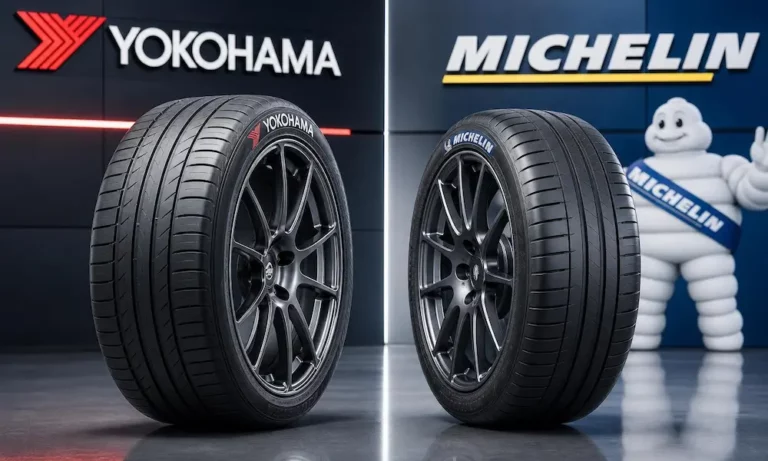
Picking tires shouldn’t feel like defusing a bomb. But walk into any tire shop, and the Yokohama vs Michelin debate will stop you cold. Both brands earn serious respect — yet they solve different problems. This guide cuts through the noise and tells you exactly which brand fits your car, your budget, and your roads.
Brand Philosophies: What Each Company Actually Stands For
Before comparing tread patterns and price tags, it helps to understand what each brand cares about most.
Michelin, founded in France in 1889, built its entire identity around safety and longevity. Their guiding principle — “Safe When Worn” — means a Michelin tire should protect you not just when it’s new, but for every mile of its life. The brand holds a global value of $8.8 billion in 2025, with a brand strength score of 92.6 out of 100.
Yokohama, Japan’s oldest tire maker (founded 1917), took a different road. Decades of motorsport partnerships shaped a “High-Value Performance” philosophy — delivering near-premium grip and handling without the premium price. Yokohama’s brand value surged 23% to $1.5 billion in 2025, making it one of the fastest-growing tire brands on the market.
| Attribute | Michelin | Yokohama |
|---|---|---|
| Founded | 1889 | 1917 |
| 2025 Brand Value | $8.8 Billion | $1.5 Billion |
| Core Focus | Safety, Longevity | Performance, Value |
| Key Technology | Radial & Run-flat | Motorsport & Orange Oil |
| Philosophy | Safe When Worn | High-Value Performance |
The Tech Behind the Tread
Both brands have developed proprietary technologies that do real, measurable work. Here’s what’s actually inside each tire.
Michelin’s Key Technologies
EverGrip Technology is one of Michelin’s smartest ideas. As the tire wears down, hidden grooves emerge from inside the tread. The existing rain grooves also widen as rubber wears away. The result? A worn Michelin tire can sometimes stop shorter on wet roads than some competitors’ brand-new tires.
MaxTouch Construction distributes the forces of acceleration, braking, and cornering evenly across the contact patch. This prevents uneven wear and supports treadwear warranties of up to 80,000 miles.
Acoustic Technology applies a foam layer inside the tire that reduces interior cabin noise by nearly 20%. For EVs and luxury cars, this is a genuine quality-of-life upgrade.
Yokohama’s Key Technologies
Orange Oil Technology infuses rubber compounds with oil derived from citrus peels. The oil keeps the rubber flexible in cold and wet conditions for grip, while maintaining firmness at normal temperatures to cut rolling resistance. It’s the backbone of both the BluEarth and ADVAN tire families.
GEO-SHIELD Technology targets truck and off-road tires. Multiple sidewall plies, a full nylon cover, and a high turn-up carcass combine to resist punctures and cuts on rough terrain without sacrificing highway durability.
4D Nano Design uses sub-microscopic simulation to engineer tread patterns that maximize wet-road contact without shortening the tire’s lifespan.
Yokohama vs Michelin: All-Season and Touring Tires
This is where most American drivers live. Commuters, families, and high-mileage road trippers — this category covers you.
Michelin Defender 2 vs Yokohama AVID Ascend LX
The Michelin Defender 2 is widely considered the industry benchmark for touring tires in America. It wins on wet braking, dry braking, and ice performance. Its 80,000-mile warranty and “set it and forget it” reliability make it a favorite for families and commuters.
The Yokohama AVID Ascend LX punches back with an 85,000-mile warranty — slightly more than the Michelin on paper. Tire Rack evaluations show it outperforms the Defender 2 in snow and rides noticeably more comfortably. The catch? It trails Michelin on wet and dry braking tests.
The price difference is real. Yokohama runs about 9% cheaper, starting around $112–$144 per tire versus Michelin’s $180–$200.
| Feature | Michelin Defender 2 | Yokohama AVID Ascend LX |
|---|---|---|
| Treadwear Warranty | 80,000 Miles | 85,000 Miles |
| UTQG Rating | 840 | 800 |
| Snow Performance | Moderate | Strong |
| Ice Braking | Superior | Average |
| Ride Comfort | Very Good | Excellent |
| Price Per Tire | $180–$200 | $144–$160 |
Grand Touring and Luxury Segment
The Michelin Primacy Tour A/S dominates the luxury car segment. Automakers choose it as original equipment on premium vehicles because of its near-silent ride and refined handling. Michelin engineers specific tread block spacing to cancel out certain sound frequencies — they literally tune it like a piano.
The Yokohama BluEarth-GT AE51 offers solid wet grip and comfortable highway manners at a lower price. It’s particularly popular among hybrid and EV owners who want to stretch range without spending Michelin money.
All-Weather and Winter Performance
Drivers in Colorado, Michigan, Utah, and the Northeast need tires that handle real snow. The Three-Peak Mountain Snowflake (3PMSF) symbol tells you a tire meets that standard.
Michelin CrossClimate 2: The Category Changer
The Michelin CrossClimate 2 genuinely shifted what drivers expect from an all-weather tire. Its V-shaped directional tread claws into snow while channeling water efficiently. In independent tests, it has outperformed many dedicated winter tires in snow braking and acceleration — while still handling summer heat.
For drivers in variable-snow states who don’t want to manage a second set of winter tires, the CrossClimate 2 is a compelling answer. The trade-off: slightly lower fuel economy and a shorter lifespan (~60,000 miles) compared to a standard touring tire.
Yokohama BluEarth and Winter Alternatives
The Yokohama BluEarth-4S AW21 provides certified snow-rated all-season performance. It’s a value-oriented choice compared to the CrossClimate 2 — solid, capable, and well-priced.
For extreme winter climates, the Yokohama BluEarth Winter V905 focuses entirely on ice and deep snow. Orange Oil keeps the tread flexible in sub-freezing conditions. It won’t replace the CrossClimate 2’s year-round versatility, but for drivers who prioritize nothing but winter safety, the V905 is a sharper tool.
Performance Tires: Track Days and Sport Driving
This is where Yokohama’s motorsport DNA really shows up.
Michelin Pilot Sport 4 S
The Michelin Pilot Sport 4 S is the gold standard for max-performance summer tires. A dual-compound tread places high-grip rubber on the outside shoulder for cornering, with a firmer compound inside for braking and durability. Dynamic Response Technology uses hybrid aramid and nylon belts to keep the contact patch stable at extreme speeds.
For drivers who want one tire that handles track days and daily commutes, this is the standard recommendation from virtually every automotive publication.
Yokohama ADVAN Apex V601
Yokohama built the ADVAN Apex V601 specifically for North America, targeting the gap between a track tire and a street tire. Testing notes describe it as “screaming” around corners with massive dry-weather grip.
The V601 delivers exceptional dry performance and costs significantly less than the Pilot Sport 4 S — a real advantage for enthusiasts who burn through tires with spirited driving. The trade-offs are a louder ride and slightly less wet-weather composure.
| Model | Key Advantage | Wet Grip | Best For |
|---|---|---|---|
| Michelin Pilot Sport 4 S | Balanced Dry/Wet | Excellent | Daily + Track |
| Yokohama ADVAN Apex V601 | Dry Track Grip + Price | Good | Track Enthusiasts |
| Michelin Pilot Sport AS 4 | Year-Round Sport | Very Good | All-Season Sport |
| Yokohama ADVAN Sport V107 | Steering Precision | Very Good | Luxury Performance |
SUV, Truck, and Off-Road: A Different Ballgame
America’s most popular vehicle category demands tires that handle towing, weight, and off-road abuse.
Michelin Defender LTX M/S
The Michelin Defender LTX prioritizes longevity on paved surfaces. Its EverTread compound resists wear from heavy loads and high-torque engines. It’s a capable tire for gravel roads and light dirt, but it’s fundamentally a highway tire. For luxury truck owners in F-150 Platinums or GMC Sierra Denalis, the Defender LTX Platinum variant adds extra ride cushioning and noise reduction.
Yokohama Geolandar: Built for Real Trails
Yokohama’s Geolandar series covers far more ground — literally. The lineup includes:
- Geolandar A/T G015 — All-terrain, severe-snow certified, smooth on highways
- Geolandar M/T G003 — Mud-terrain with aggressive tread blocks and GEO-SHIELD reinforced sidewalls
- Geolandar CV G058 — Highway touring for crossovers like the Subaru Outback
Whether you’re running forest roads or rock crawling in a Jeep, Yokohama has a specific model tuned for that need. And Geolandar tires typically cost 20–30% less than comparable Michelin truck tires.
Electric Vehicle Performance
EVs are heavier, torquier, and far more sensitive to tire noise than traditional cars. Both brands have responded seriously.
Michelin’s EV-Ready Approach
Michelin works directly as an original equipment partner with Tesla and Lucid. Their EV-Ready-labeled tires feature structural reinforcements to handle extra battery weight and instant torque. The dedicated e.Primacy All Season minimizes rolling resistance to measurably extend driving range — a critical factor for drivers managing range anxiety on long American highways.
Yokohama’s Sustainable EV Play
The ADVAN Sport EV A/S matches Michelin’s structural reinforcements and noise-reduction features. Yokohama’s edge here is sustainability. Plant-based oils and recycled materials appeal directly to the environmentally conscious demographic buying EVs. Their lower price point also benefits EV owners who replace tires more frequently due to the high torque output of electric motors.
Consumer Satisfaction: What the Data Shows
Real ownership data tells a more honest story than any tire spec sheet.
Consumer Reports ranks Michelin first among tire brands overall with a score of 72 out of 100, recommending all eight tested Michelin models. The publication notes that despite the higher upfront cost, Michelin delivers strong value when you factor in lifespan.
The J.D. Power 2026 Original Equipment Tire Satisfaction Study shows Michelin winning three of four segments: Luxury (833/1000), Passenger Car, and Performance Sport.
Interestingly, the 2025 J.D. Power study told a slightly different story. In the Passenger Car segment, Yokohama scored 807 versus Michelin’s 805 — suggesting that for everyday drivers, Yokohama’s combination of comfort and traction hits exactly the right notes.
| Segment | 2026 Winner | 2025 Winner |
|---|---|---|
| Luxury | Michelin (833) | Goodyear (821) |
| Passenger Car | Michelin (816) | Goodyear (815) |
| Performance Sport | Michelin (818) | Michelin (818) |
| Truck/Utility | Pirelli (801) | Hankook (812) |
Total Cost of Ownership: The Real Math
The sticker price at the tire shop doesn’t tell the whole story.
A set of four Michelin Defender 2 tires costs $150–$200 more upfront than comparable Yokohama AVID tires. But if the Michelin lasts 80,000 miles and the Yokohama needs replacing at 60,000 miles, the math shifts considerably. Add Michelin’s fuel efficiency benefits — the Energy Saver A/S can save up to $400 in fuel costs over the tire’s life — and the “expensive” Michelin sometimes costs less per mile driven.
Yokohama makes the most financial sense when:
- You don’t plan to keep your vehicle long enough to hit 80,000 miles
- You’re an enthusiast who replaces tires every few years regardless of wear
- You frequently damage tires off-road and need affordable replacements
- You want high performance right now on a tight budget
Warranty comparison:
- Michelin: 60-day satisfaction guarantee + roadside assistance + treadwear warranty
- Yokohama: 30-day satisfaction guarantee + treadwear warranty
Who Should Buy Which Brand
Choose Michelin if:
- You commute high miles and want to replace tires as infrequently as possible
- You live in rain-heavy or icy conditions where wet braking matters most
- You drive a luxury vehicle or EV and want the quietest possible ride
- Long-term total cost of ownership is more important than upfront price
Choose Yokohama if:
- You want high performance without paying the Michelin premium
- You drive a truck or SUV off-road regularly and need trail-ready capability
- You’re an automotive enthusiast who replaces tires frequently
- You own an EV and want eco-conscious materials at a fair price
The Yokohama vs Michelin decision isn’t about which brand is “better.” It’s about which brand is better for you. Both companies build tires to the highest global standards — the right choice just depends on what you’re driving, where you’re driving it, and what you’re willing to spend to get there.