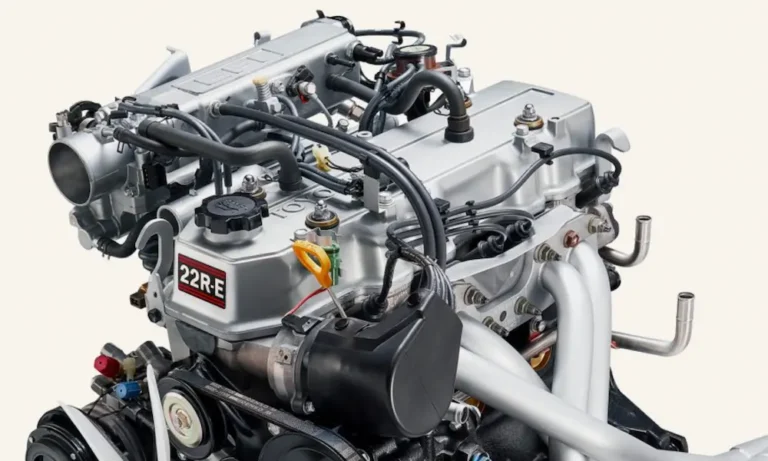
Your 22RE-powered Toyota Pickup or 4Runner was built to last forever — but factory power? That’s another story. If you’re crawling up highway grades, hauling gear, or spinning oversized tires, the stock output falls short fast. This guide breaks down the best 22RE performance upgrades, from basic bolt-ons to serious internal work, so you can squeeze every bit of performance from this legendary engine.
Start Here: Get Your 22RE Mechanically Sound First
Before you bolt anything on, make sure your foundation is solid. A sick engine won’t respond to performance mods — it’ll just stay sick.
Why Valve Adjustment Is Non-Negotiable
The 22RE uses a solid lifter valvetrain, which means the valve clearances drift over time. Toyota recommends checking them every 60,000 miles, but on a performance build, check them more often.
Here’s what goes wrong when you ignore it:
- Too loose: You lose valve lift and duration. Power drops. The engine ticks loudly.
- Too tight: Valves don’t seal fully. Heat destroys them from the inside out. You get burnt valves, lost compression, and a head rebuild.
Set valve lash with the engine fully warm. Factory specs are 0.008 inches for intake and 0.012 inches for exhaust. If you’re running an aftermarket cam, ditch those numbers and follow the cam card instead.
Engine Rebuild Tips You Can’t Skip
If your 22RE needs a full rebuild, don’t cut corners on parts. 22RE Performance and experienced builders like those in Chico, California strongly recommend using OEM-quality components for sensors, timing chains, and gaskets. Cheap parts cost more in the long run.
After a fresh rebuild, follow these break-in rules:
- Stay under 65 mph for the first 500 miles
- Don’t hold a steady RPM for long stretches
- Skip synthetic oil and friction modifiers for the first 5,000 miles — they prevent the rings from seating properly
- After 500 miles: change oil, re-torque head bolts, recheck valve lash
Bolt-On 22RE Performance Upgrades That Actually Work
These mods are your starting point. They’re affordable, reversible, and they work together as a system.
Cold Air Intake: Dense Air = More Power
The stock intake is designed to muffle noise, not flow air. A cold air intake system fixes that by pulling cooler, denser air from outside the engine bay.
Cooler air holds more oxygen per cubic foot. More oxygen means the ECU can inject more fuel. More fuel means a harder combustion event. You get better throttle response and a small bump in power across the board. As a bonus, a cooler intake charge reduces the risk of detonation.
Look for kits with high-flow washable filter elements and a mounting plate that works with your factory mass airflow sensor.
Throttle Body Upgrade and Supra AFM Swap
A larger throttle body reduces the pressure drop at wide-open throttle. The intake manifold reaches atmospheric pressure faster, and the engine breathes better in the upper RPM range.
Some builders also swap in the air flow meter from an early 1980s Toyota Supra. The Supra unit has a larger housing and a less restrictive flap door. Less restriction means less work for the engine to pull air in.
One heads-up: this isn’t plug-and-play. You’ll need to tune the internal spring tension on the cogwheel so the ECU reads air-fuel ratios correctly.
Exhaust Headers: The Best Bang-for-Buck Upgrade
Swapping the factory cast iron manifold for a tubular steel header is one of the most effective 22RE performance upgrades you can make.
Here’s why headers work so well:
The stock manifold dumps all four cylinders into one shared chamber. The exhaust pulses collide, creating backpressure. Your pistons waste energy pushing against it on every exhaust stroke.
A quality equal-length header gives each cylinder its own primary tube. The high-velocity pulse from each cylinder creates a vacuum behind it as it exits — this pulls exhaust gas from the next cylinder in the firing order. That’s exhaust scavenging, and it meaningfully reduces pumping losses across the powerband.
California or CARB-state residents: You must run a header with an approved Executive Order number. Without it, your truck fails the visual smog inspection. BBK Performance is one manufacturer that offers compliant options.
Oxygen Sensor Upgrade After Header Install
Installing a header moves the O2 sensor bung to the collector — further downstream. On pre-1988 22REs, the stock sensor is a single-wire unheated unit. It relies entirely on exhaust heat to reach its operating temperature of around 600°F.
Relocated downstream, the exhaust gases cool down before reaching the sensor. A cold sensor goes chemically inactive. The ECU detects no signal, assumes something’s wrong, and switches to open-loop mode — dumping extra fuel to “protect” the engine. Your mileage tanks, your plugs foul, and your emissions spike.
The fix is simple: upgrade to a four-wire heated Denso oxygen sensor. The internal heater brings the sensor to operating temp instantly, independent of exhaust temperature. Wire the heater circuit to a switched 12-volt source so it activates with the key. The ECU stays in closed-loop immediately and fuel trims stay accurate across all driving conditions.
Cylinder Head and Valvetrain Work: Where Real Gains Live
Bolt-ons are great. But if you want serious 22RE performance upgrades, the head is where the magic happens.
Port Matching: Don’t Just Make It Bigger
The junction between the intake manifold and the cylinder head is critical for airflow. Because the two parts are cast separately, the port openings rarely align perfectly.
If the manifold runner is smaller than the head port, the air expands slightly as it enters. That’s tolerable — airflow stays attached to the walls.
If the manifold runner is larger than the head port, the air slams into the exposed lip of the head casting. This creates a backward step, the airflow separates from the wall, and you get a turbulent dead zone right at the cylinder entrance. Effective port area drops significantly.
The fix is precision port matching — carefully grinding both surfaces to create a continuous, seamless taper. And here’s the critical mistake most people make: don’t open the ports to the full gasket size. Oversizing kills airflow velocity and destroys low-end torque. The goal is eliminating backward steps while preserving air speed, so the intake charge packs the cylinder with momentum even past bottom dead center.
Oversized Valves and Upgraded Springs
Larger valves complement the improved port flow. Many builders install 33mm intake and 27mm exhaust valves with undercut stems and polished heads to reduce drag inside the port.
With any high-lift camshaft, you must also upgrade the valve springs. Factory springs compress too far with a performance cam profile — the coils crash into each other at full lift, bending pushrods and shattering rockers. This is called coil bind, and it’s catastrophic.
LC Engineering’s Pro Dual Valve Spring Set offers around 70 lbs of seat pressure, preventing coil bind and eliminating valve float at higher RPM. Pair them with lightweight chromoly or titanium retainers to cut reciprocating mass and let the engine rev more freely.
Camshaft Selection: Match It to Your Build
For trucks, 4Runners, and rigs hauling gear or running large tires, RV-style camshafts in the 261- to 268-degree duration range are the go-to choice. They keep power in the low-to-mid RPM range where you need it most — towing grades, carrying loads, crawling trails.
High-RPM race cams kill low-end torque on a 22RE. Don’t chase peak horsepower numbers at the expense of driveability.
Internal Engine Upgrades: Building the Bottom End
2.6-Liter Stroker Kit
A stroker crankshaft increases piston stroke by 5mm, raising total displacement to approximately 2.6 liters. LC Engineering’s performance kits document gains of up to 25 ft-lbs of torque at the wheels.
The longer stroke increases the mechanical advantage on the crank with every combustion event. For a heavy truck, that low-end torque is worth more than any horsepower number.
Forged Pistons and the Knock Sensor Problem
Forged pistons handle heat and pressure far better than cast units. But there’s a catch: forged aluminum expands more with heat, so the cylinders must be bored with looser clearances to prevent seizing at operating temp.
When the engine is cold, those loose clearances cause the pistons to rock slightly. The noise — piston slap — mimics the acoustic frequency of engine knock. The factory knock sensor on the block picks it up and retards timing aggressively, crippling performance.
The solution: relocate the knock sensor to a different position on the block. It needs enough acoustic contact to detect real detonation but enough isolation to ignore piston slap.
Lightweight Flywheel: Sharp Throttle vs. Trail Stability
A billet aluminum flywheel can cut rotational mass by up to 60% compared to the stock cast iron unit. Less rotating mass means sharper throttle response, faster rev-matching, and quicker acceleration through the gears.
That said, this mod isn’t for everyone. Rock crawlers often prefer the heavy stock flywheel. Its stored rotational energy prevents stalling at idle speeds on technical terrain. Know your use case before you pull the trigger.
Electric Fan Conversion: Free Horsepower
The factory mechanical fan drains power from the crankshaft continuously. Because aerodynamic drag increases with the square of rotational speed, the fan is a massive parasitic load at higher RPM.
Removing it and installing a direct-fit electric fan — like the Flex-A-Lite 15-inch S-Blade kit for 1984-1995 Toyota 4x4s or TCP Performance’s custom setup — recovers real horsepower at the top of the rev range.
There’s also a thermal management benefit. Mechanical fans pull the least air at idle — exactly when a loaded engine needs cooling most. An electric fan runs at 100% when you’re sitting in traffic with a heavy load. Wire it to engage with the A/C compressor relay and you get smarter cooling in every scenario.
Advanced Engine Management
A stock 22RE ECU can’t keep up with heavily modified engines. If you’re running a stroker kit, a performance cam, or large-port head work, you need a standalone system.
Options like the Haltech Elite 750 or Megasquirt give you full control over fuel and ignition maps. They also let you eliminate the restrictive factory air flow meter entirely, replacing it with a MAP sensor and IAT sensor on a speed-density tune. No moving parts, no restriction.
Upgrade your injectors to match the new airflow volume. Multi-hole injectors atomize fuel far better than the factory single-pintle units, producing a cleaner, more homogenous mixture and smoother idle.
Regearing: The Upgrade Most People Skip (and Shouldn’t)
No engine mod matters if your differentials are still geared for stock tires. Running larger tires without regearing is like trying to ride a bike in the wrong gear — the engine lugs, overdrive becomes useless, and the transmission hunts constantly.
The tire acts as the final gear ratio in your drivetrain. A taller tire requires more torque to turn. Without the correct ring and pinion ratio, your 22RE never operates in its torque band.
Here’s a quick reference for choosing the right ratio:
| Tire Size | Daily Driver / Light Trail | Dedicated Off-Road | Notes |
|---|---|---|---|
| 31-inch | 4.10 or 4.30 | 4.56 | Restores factory feel for mild builds |
| 33-inch | 4.56 | 4.88 | 4.56 balances highway economy and low-end torque |
| 35-inch | 4.88 | 5.29 | 4.88 is the community standard for 35s |
| 37-inch+ | 5.29 | 5.29 | Required to protect clutch, trans, and crawl ratio |
If you’re running an automatic transmission, go one ratio higher than a manual equivalent. Older Toyota automatics have tall first gears and aggressive overdrive ratios that demand extra compensation.
One important note on extreme ratios: 5.29 gears use a very small pinion gear. Less material means less strength. Under shock loads on a heavy rig, that pinion is vulnerable. For most builds, 4.88 gears offer the best balance of torque multiplication and mechanical durability.
Build Smart, Not Just Big
The 22RE isn’t a high-revving horsepower motor and it never will be. But that’s not the point. The right 22RE performance upgrades turn a gutless stocker into a torque-rich, responsive, reliable rig that handles highway driving, trail work, and heavy loads without breaking a sweat. Start with the basics, build systematically, and always match your drivetrain gearing to your tires. The engine will thank you for it.