Is your 5.3L Silverado, Sierra, or Tahoe ticking, shuddering, or guzzling oil? A 5.3 AFM delete programmer might be the fix you need — before a collapsed lifter destroys your engine. This guide breaks down every option available, who each one suits, and what you need to know to make the right call. Stick around to the end — the section on Global B compatibility alone could save you from buying the wrong device.
What Is AFM and Why Does It Cause So Many Problems?
Active Fuel Management (AFM) is GM’s cylinder deactivation system. Under light throttle, it shuts off four of your eight cylinders to save fuel. It does this by using hydraulic lifters with a collapsible internal pin — pressurized oil collapses the pin, the lifter stops actuating, and the valve stays shut.
Sounds clever. The problem? Those pins wear out, seize, or shatter.
When a pin fails, the lifter collapses permanently. The roller wheel loses contact with the camshaft. The spinning camshaft then destroys itself — grinding metal debris straight into your engine oil. At that point, you’re looking at pulled cylinder heads, a new camshaft, 16 new lifters, and a bill that easily clears $5,000–$8,000.
Owners have reported failures at just 20,000 miles on brand-new trucks.
GM later introduced Dynamic Fuel Management (DFM) on 2019+ engines. Instead of switching between 8 and 4 cylinders, DFM runs on any combination of cylinders depending on load. More sophisticated — but with the same catastrophic failure potential.
The Three Main Types of 5.3 AFM Delete Programmer
Not all delete solutions work the same way. Here’s a quick overview before we go deeper:
| Programmer Type | How It Works | Warranty Risk | Best For |
|---|---|---|---|
| OBD-II Plug-in Disabler | Broadcasts override signals through the diagnostic port | Very Low | New or under-warranty trucks |
| Inline Interceptor Module | Intercepts sensor data between the engine and ECM | Low–Moderate | Trucks needing extra features like tire size recal |
| Handheld Flash Tuner | Rewrites the ECM’s calibration files permanently | High | Older trucks out of warranty wanting max performance |
OBD-II Plug-in Disablers: The Easiest Option
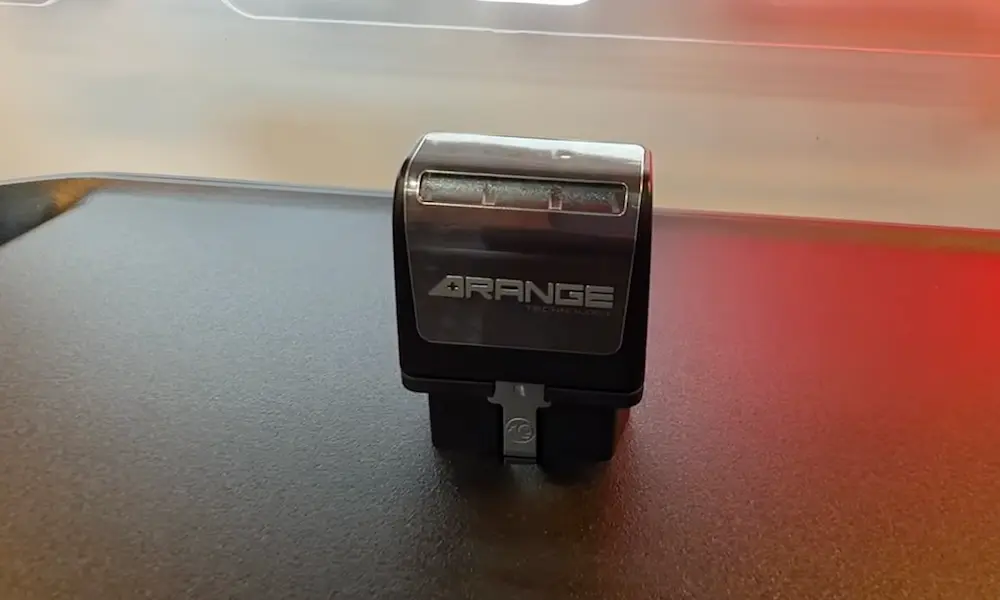
These are the most popular 5.3 AFM delete programmers on the market — and the easiest to use. You plug them into the OBD-II port under the dash, and they start working immediately. No tools. No wiring. No mechanical skill required.
How They Actually Work
They don’t rewrite your computer. Instead, they broadcast a continuous override signal onto the vehicle’s CAN bus — essentially telling your ECM that the conditions for cylinder deactivation have never been met. Your engine stays in 8-cylinder mode all the time.
Because they never flash the ECM, they leave zero trace if you unplug them before a dealer visit. Your flash counter stays at factory numbers. Dealership diagnostic tools won’t see a thing.
Top Picks
Range Technology AFM/DFM Disabler (RA003B) — The gold standard for most 5.3L trucks. It plugs directly into the OBD-II port and disables both AFM and DFM. Simple, proven, and widely trusted.
DiabloSport Sprint Module — Works on the same principle and adds Auto Start/Stop deactivation. If you hate that feature too, this one handles both problems at once.
The One Real Weakness: Battery Drain
The OBD-II port stays powered even when your ignition is off. These modules draw a small but constant current. If your truck sits for more than a few days — say, at an airport or in winter storage — that parasitic draw can fully drain your battery. The fix is simple: unplug the device before any extended storage.
Inline Interceptor Modules: More Features, More Flexibility
If you want more than just AFM deletion, an inline module is worth considering. These devices install directly into the ECM wiring harness under the hood, physically intercepting sensor data before it reaches the factory computer.
Edge Pulsar LT: What It Adds
The Edge Pulsar LT is the top inline option for the 5.3L platform. Beyond disabling AFM and DFM, it lets you:
- Fix your speedometer after installing larger tires or swapping differential gears
- Adjust throttle response to eliminate the factory electronic delay
- Recalibrate TPMS thresholds so you can run lower pressures off-road without warning lights
- Disable Auto Start/Stop permanently
You control all of this through the factory steering wheel buttons — no app, no screen, no remote needed.
One important caveat: if you do a physical gear swap, the inline module can correct your speedometer reading, but it can’t restore the cruise control your ECM disables after a ratio change. That fix requires a full flash tune.
Handheld Flash Tuners: Maximum Power, Maximum Risk
Flash tuners like the Superchips Flashpaq F5 permanently rewrite the calibration files inside your ECM. You plug it in, the device backs up your factory tune, and then writes a custom file in its place.
What You Gain
- Permanently disabled AFM — no module needed after the flash
- Real horsepower and torque gains from optimized timing and fuel maps
- Higher transmission shift pressures
- Raised rev limiters and adjustable speed limiters
- Shift point customization to prevent unnecessary downshifts while towing
On a 2015 Silverado, the Flashpaq F5 turns off AFM with a few button presses and delivers dyno-proven performance improvements at the same time.
The Warranty Problem
Flash tuners increment your ECM’s internal flash counter and alter its verification checksum. Dealership diagnostic tools check for exactly this during major warranty claims. If they find it, your powertrain warranty could be voided on the spot. For older trucks already out of warranty, this isn’t a concern. For a 2022 Silverado with 30,000 miles? Think carefully.
Critical Compatibility Warning: Global B Architecture
Here’s where a lot of buyers get burned. Starting with 2022 mid-year light-duty trucks and 2021 SUVs (Tahoe, Suburban, Yukon, Escalade), GM introduced Global B architecture — a heavily encrypted vehicle network designed to block unauthorized modifications.
Standard OBD-II disablers and the original Edge Pulsar LT do not work on Global B vehicles. The encrypted network simply ignores their signals.
How to Check Your VIN
Look at the 12th digit of your VIN (visible on the driver’s side dashboard):
- Digit 4 or lower → Legacy architecture → standard modules work fine
- Digit 5 or higher → Global B architecture → you need a Global B-specific device
For Global B trucks, Range Technology’s DFM Pro (RA010) is the solution. It’s engineered specifically to communicate with the encrypted network on 2023–2026 models. Flash tuning via OBD-II is completely blocked on Global B — owners who want a full tune often have to remove the ECM and mail it to a specialist like HP Tuners.
DFM-Specific Issue: The Zero-Cylinder Coasting Problem
If your truck has DFM (2019+ engines), there’s one more wrinkle. DFM can deactivate all eight cylinders during coasting. When early aftermarket modules disabled this alongside normal deactivation, something unexpected happened: the engine kept fueling during deceleration, creating forward push when the driver lifted off the throttle.
This created a genuine safety hazard — especially when towing heavy loads or descending steep grades — and killed fuel economy by 2–3 MPG.
Modern DFM-specific modules now allow zero-cylinder coasting to stay active during genuine deceleration, then instantly snap back to full 8-cylinder power when you touch the throttle again. This is the best balance of safety, economy, and mechanical protection. Make sure any DFM module you buy uses this logic — not all do.
Software Delete vs. Full Mechanical Delete
An AFM delete programmer is an excellent preventative tool — but it has a real limitation. The collapsible lifters are still inside your engine. Software keeps them from cycling, but if they fail due to age, oil degradation, or a manufacturing defect, you’re still dealing with internal damage.
A full mechanical delete is the nuclear option. It involves:
- Pulling the cylinder heads
- Replacing all 16 AFM lifters with solid-body performance rollers
- Swapping in an aftermarket camshaft with uniform lobe profiles
- Plugging the high-pressure oil relief valve
- Installing a smooth billet block-off plate in place of the lifter oil manifold
After a mechanical delete, you still need a flash tuner to remove the AFM software logic from the ECM — otherwise, the computer throws a check engine light searching for solenoids that no longer exist. If a flash tuner isn’t immediately available, a plug-in OBD-II disabler can temporarily prevent the ECM from requesting deactivation while the deleted hardware sits tucked aside.
For trucks that have already suffered a lifter failure — or performance builds that demand absolute reliability — a mechanical delete paired with a programmer is the definitive solution.
Is It Legal to Use a 5.3 AFM Delete Programmer?
Yes — in most states. The EPA’s Tampering Policy prohibits devices that defeat emissions controls. However, companies like Range Technology and Edge Products conduct independent laboratory testing to prove their devices don’t push emissions beyond legal thresholds. The EPA’s Memorandum 1A provision allows sales of devices with this “reasonable basis” documentation.
California is different. The California Air Resources Board requires a separate Executive Order for each device. Most AFM disablers don’t have one yet and explicitly state they’re not legal for California sale or use.
One notable exception: the Flowmaster Range DFM Module (RA007) earned CARB Executive Order D-115-32, making it fully legal in all 50 states — the only module in this category to achieve that certification.
Free Workaround Worth Knowing About
Before you spend money, try this. On most GM trucks, shifting into manual “L” mode and selecting one gear below overdrive suspends all cylinder deactivation and often disables Auto Start/Stop too. It’s completely free and great for testing how your truck feels without AFM.
The downside: you have to do it every single time you start driving, and you lose your highest overdrive gear — so fuel economy drops significantly. It’s a test drive, not a permanent fix.
FAQs About 5.3 AFM Delete Programmers
Does an oil catch can help with AFM-related oil consumption?
Yes. The high-volume oil pump required by the deactivation system forces excess pressurized oil through a crankcase relief valve, creating a dense oil mist that gets pulled into the intake manifold. A quality catch can intercepts that vapor, keeps oil off your intake valves, and reduces carbon buildup and oil consumption noticeably.
Is there a hardware trick to protect the lifters without a full delete?
Some owners remove a small wire mesh screen behind the oil pressure sensor to manipulate oil pressure at the solenoids, combined with a plug-in disabler. It’s a grassroots approach within enthusiast communities — but professional engine builders don’t recommend it. Removing that screen lets metal debris travel freely into the solenoid passages.
Can I get a module that increases AFM use instead of eliminating it?
Yes. Range Technology’s AFM Plus (RA002) does the opposite — it optimizes the AFM algorithm to keep the engine in 4-cylinder mode up to 80% of the time under light loads. It’s designed for hypermilers who prioritize fuel economy above all else and are willing to accept the long-term mechanical trade-offs.
Does cold weather affect lifter tick?
Temperature doesn’t change the software logic, but it directly affects oil viscosity. The deactivation system depends on rapid hydraulic pressure changes. In freezing weather, thick oil slows the system response — and lifter tick often disappears. In summer heat, thinner oil bleeds pressure faster, and the tick gets louder. Either way, audible ticking means mechanical wear is happening. Software deletion can’t reverse existing damage.
What happens to my cruise control after a gear swap if I’m running a Pulsar LT?
The Pulsar LT corrects your speedometer after a differential gear change — but it can’t restore cruise control. When wheel and transmission speeds no longer match GM’s factory programming, the ECM disables cruise automatically. Getting it back requires a permanent flash of both the engine and transmission control modules, which is beyond what any inline interceptor can do.