Skipping your 6.7 Powerstroke fuel filter replacement is one of the fastest ways to turn a $50 maintenance job into a $10,000+ nightmare. This guide walks you through exactly what you need, where the filters are, how to change them safely, and what happens if you don’t. Stick around — the priming section alone could save your injection pump.
Why the 6.7 Powerstroke Uses Two Fuel Filters
The 6.7 Powerstroke runs a dual-stage filtration system for one critical reason: the high-pressure fuel pump has almost zero tolerance for contaminated fuel.
Ultra-low sulfur diesel — the standard fuel at every pump in the US — stripped out most of the natural lubricity that older diesel had. That means your fuel pump relies entirely on clean, water-free diesel to lubricate itself internally. One filter alone isn’t enough protection.
The two filters work together:
- Primary filter (under the truck, frame rail): Catches water and large debris first
- Secondary filter (on top of the engine): Fine-polishes the fuel down to 4 microns before it hits the injection pump
Replace them together. Always. Replacing just one creates a pressure imbalance that forces the remaining filter to work harder — and fail faster.
Filter Locations by Model Year
The location and hardware changed between generations. Use this table to find the right parts for your truck:
| Generation | Model Years | Lift Pump Location | OEM Filter Kit |
|---|---|---|---|
| First Gen | 2011–2016 | Frame rail | FD-4615 |
| Second Gen | 2017–2019 | Inside fuel tank | FD-4625 |
| Third Gen | 2020–Present | Inside fuel tank | FD-4641 / FD-4647 |
The 2017 redesign moved the lift pump into the tank and gave the frame-mounted housing a different thread pitch. Don’t assume your neighbor’s filter kit fits your truck — check your model year first.
What You’ll Need Before You Start
Get everything ready before you crack open the housing. One trip to the engine bay with dirty hands or the wrong tool wastes time and risks contamination.
| Tool | What It’s For |
|---|---|
| 36mm socket or strap wrench | Primary filter spin-off (2017+) |
| 8mm socket with universal joint | Primary filter bolts (2011–2016) |
| Inch-pound torque wrench | Plastic housing bolts (max 84 in-lbs) |
| High-capacity drain pan (1+ gallon) | Catching fuel from primary housing |
| Clear glass container | Inspecting drained fluid for water |
| Compressed air + lint-free rags | Cleaning around housings before opening |
| Nitrile gloves + safety glasses | Protecting yourself from diesel spray |
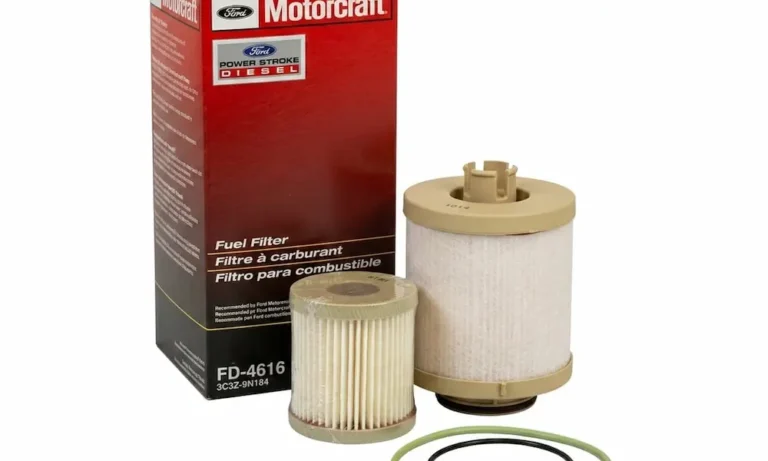
Stick to OEM Motorcraft filter kits or premium equivalents from Racor, Donaldson, or Bosch. Cheap aftermarket filters often miss the required 4-micron filtration rating and use O-rings that don’t seal properly — that’s how air gets in and pumps die.
How to Replace the Primary Frame-Mounted Filter
Step 1: Park on level ground. Ignition completely off. Position your drain pan under the Diesel Fuel Conditioning Module on the driver-side frame rail.
Step 2: Blast the exterior of the housing with compressed air. Don’t skip this — dirt falling into an open housing goes straight to your injection pump.
Step 3: Rotate the yellow drain valve a quarter-turn counterclockwise. Catch the first fluid in your clear container. Normal diesel looks like clear amber liquid. If you see a cloudy, milky layer or visible water droplets sitting at the bottom, your tank likely needs a full inspection and cleaning.
Step 4: Once the drip slows, rotate the valve clockwise to close it.
Step 5: On 2017+ trucks, use your 36mm socket to unscrew the filter body. On 2011–2016 trucks, remove the perimeter bolts with your 8mm socket in a crisscross pattern.
Step 6: Pull out the old filter element. Now inspect the inside of the housing carefully under a flashlight. Shiny metal flakes or gray metallic particles are a red flag. That debris means your high-pressure CP4 pump is already shedding material — don’t just change the filter and drive on.
Step 7: Wipe the housing interior clean with a lint-free rag.
Step 8: Install the new filter element. Replace every O-ring and seal that came in the kit. Lightly coat each O-ring with clean diesel or fresh engine oil before installing. A dry O-ring can roll, bind, or tear — and that lets air into your fuel system constantly.
Step 9: Thread the housing back by hand first to avoid cross-threading. Tighten bolts in a crisscross pattern to a maximum of 84 inch-pounds. Don’t crank it — the housing is plastic.
Step 10: Reconnect the water-in-fuel sensor wiring harness. Make sure the locking tab clicks.
How to Replace the Secondary Engine-Mounted Filter
This filter sits on the top left of the engine, near the firewall. It feeds directly into the injection pump. Cleanliness here is non-negotiable.
Step 1: Blow out all the dirt around the filter cap with compressed air. Lay lint-free rags around and under the area — you don’t want diesel soaking into your serpentine belt or hitting the alternator.
Step 2: Disconnect the three quick-connect fuel lines. The 6.7 Powerstroke has used several connector styles over the years. Here’s how to handle each:
- Squeeze tab fittings: Squeeze both plastic tabs inward, push slightly forward to release the latch, then pull back
- Lift tab fittings: Pry the colored tab upward, then squeeze the side buttons and pull
- Push button fittings: Press the integrated buttons while pushing toward the filter, then pull away while holding the buttons
Take your time here. These plastic quick-connect fittings become brittle after years of heat cycles. Snapping one means replacing the entire fuel line harness.
Step 3: Rotate the filter assembly counterclockwise to its stop, then lift it straight up and out.
Step 4: Drop the new filter in, rotate clockwise until it locks. Reconnect all three lines. Push each fitting firmly onto its port until you hear an audible click — then tug on it to confirm it’s locked. A loose fitting sprays high-pressure diesel across a hot engine the second you start it.
The Priming Sequence — Don’t Skip This
This is the step that trips up most people, and skipping it destroys injection pumps.
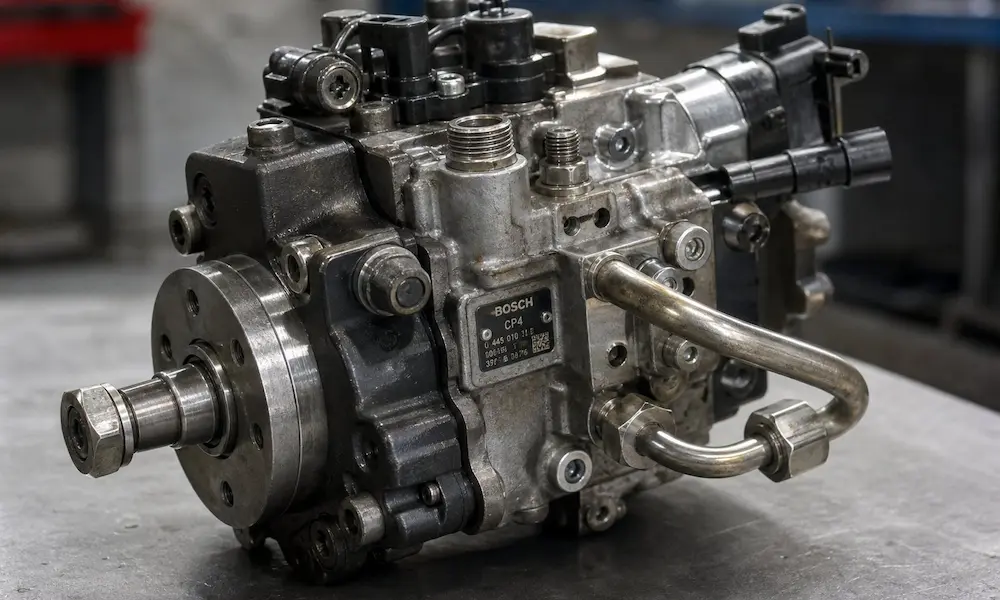
Both filter housings are now full of air. If you crank the engine, the CP4 pump runs dry. Without fuel to lubricate it, the metal rollers scrape against the cam lobes instantly. That friction sheds steel particles into your entire fuel system within seconds.
Here’s how to prime it correctly:
- Turn the ignition to the ON position (don’t start the engine)
- The lift pump energizes for 10–30 seconds — you’ll hear a gurgling sound under the truck as air purges out
- Turn the ignition completely OFF
- Repeat this cycle a minimum of 6–12 times — veteran technicians often do 20 cycles
- Listen carefully: the gurgling gurgle of the early cycles should gradually become a smooth, quiet hum
- Once the pump sounds steady and quiet, you’re ready to start
If the engine cranks but doesn’t start, or starts and immediately stumbles, there’s still air in the system. Shut it down immediately. Don’t keep cranking. Run more key cycles. Also check every O-ring and quick-connect fitting you touched — a leak there draws fresh air continuously.
One more rule: never pre-fill filters by pouring fuel into them manually. That bypasses the filter media entirely and sends unfiltered diesel straight to your injection pump.
Resetting the Fuel Filter Life Monitor
Once the engine’s running cleanly, reset the dashboard monitor so it tracks your new filter’s life accurately.
- Turn ignition to ON (engine off)
- Use the steering wheel directional pad to navigate left to the main menu
- Select Settings (or “Truck Information” on some years)
- Navigate to Vehicle → Maintenance → Fuel Filter Life
- Press and hold OK until the progress bar completes
- Confirm the display shows 100% and exit
The exact screen layout varies between the standard 4.2-inch cluster and the larger digital display, but the path is the same across model years.
Diagnostic Codes That Point to Filter Problems
Your Powertrain Control Module monitors fuel pressure continuously. These are the codes you’ll see when the filtration system starts failing:
| Code | Meaning | Most Likely Cause |
|---|---|---|
| P008A | Low-pressure fuel supply too low | Clogged primary filter, failing lift pump, or air leak through a bad O-ring |
| P0087 | Fuel rail pressure too low | Clogged secondary filter or failing CP4 pump already shedding metal |
| P0088 | Fuel rail pressure too high | Bad volume control valve on the HP pump |
| P2269 | Water in fuel | Primary separator needs draining, or contaminated fuel source |
P0087 deserves special attention. It can mean a simple clogged secondary filter — but it’s also the first sign of a failing HP pump. If changing both filters doesn’t clear P0087, park the truck and have the volume control valve inspected for metal debris before driving further.
How to Handle the Water in Fuel Warning
When your dashboard lights up the Water in Fuel warning (often alongside a P2269 code), it means roughly 200ml of water has collected in the primary filter housing. This isn’t optional maintenance — it’s urgent.
Pull over, shut the engine off, and drain the water trap by opening the yellow drain valve until only clean diesel flows out, then close it. Driving on with that warning active lets water overflow the separator and head straight toward the injection pump — causing instant rust, lost lubricity, and catastrophic failure.
Cold Weather and Biodiesel: Extra Precautions
Diesel gels in cold temperatures. When it does, it coats the filter media and cuts off fuel flow entirely. The risk jumps significantly if you’re running biodiesel blends (like B20), which start gelling at much warmer temperatures than standard winter-blend diesel.
Before temperatures drop below freezing:
- Switch to winter-blend diesel
- Add a quality anti-gel additive to the tank
- Replace both filters — dirty filter media holds extra moisture that speeds up gelling
What Happens If a Filter Fails — The Cascade
Here’s why this all matters so much. When the CP4 high-pressure pump fails from poor filtration, it doesn’t fail quietly. It sheds metal shards into the fuel rails and injectors. The contaminated return fuel loops back into the main tank. The lift pump recirculates it through the whole system.
The result: every injector, the fuel rails, the lift pump, and the tank itself need replacement. That repair bill frequently exceeds $10,000–$15,000.
Two filters changed every 10,000–15,000 miles prevents all of it.
Proper Disposal of Used Filters and Fuel
Used diesel filters and contaminated fuel are classified as hazardous waste under the EPA’s Resource Conservation and Recovery Act. You can’t legally toss them in the trash or pour the drained fluid down a drain.
Here’s what to do:
- Drain filter housings thoroughly before disposal
- Store used diesel and separator water in separate, labeled, leak-proof containers — never mix them with used engine oil or antifreeze
- Drop off solid filter bodies and waste fluids at a licensed recycling facility, a participating auto parts retailer, or a municipal hazardous waste collection event
Cross-contaminating fluids reclassifies the waste to a higher hazard tier, which makes disposal more complicated and more expensive.
Frequently Asked Questions
How often should I change the 6.7 Powerstroke fuel filters?
Ford recommends every 15,000–20,000 miles under normal conditions. If you tow heavily, idle a lot, run biodiesel blends, or operate in dusty environments, drop that to every 10,000 miles. Diesel technicians widely consider the aggressive interval the safest approach for protecting the injection pump.
Can I just replace one fuel filter and skip the other?
No. Replacing only one creates a pressure imbalance across the system. The older filter works harder, media degrades faster, and fuel starvation can start damaging the high-pressure pump. Both filters are engineered to work as a matched set and must always be replaced together.
Why won’t my engine start after changing the fuel filters?
Almost always, incomplete priming. If you didn’t run 6–12 ignition key cycles before cranking, the system is still air-locked. Stop cranking immediately — continued dry-cranking damages the CP4 pump. Run additional key cycles until the lift pump sounds smooth and quiet, then try starting again. Also inspect all O-rings and quick-connect fittings for air leaks.
What does the Water in Fuel warning mean, and is it serious?
It means about 200ml of water has accumulated in your primary filter housing. It’s serious — ignore it and the water overflows the separator and enters the injection pump, causing rust, loss of lubrication, and potential catastrophic failure. Pull over, drain the water trap by opening the yellow valve, and close it once clean diesel flows.
Are cheap aftermarket fuel filters safe on the 6.7 Powerstroke?
They’re a significant risk. Many low-cost filters don’t meet the 4-micron absolute filtration rating the secondary filter requires. Poor O-ring tolerances introduce air leaks, and brittle plastics can fracture under pressure, sending debris into the fuel pump. Stick to Motorcraft OEM kits or verified premium brands like Racor, Donaldson, or Bosch.
Should I pre-fill the filters with diesel before installing them?
No. Pre-filling pours unfiltered fuel directly into the clean side of the system, bypassing the filter media entirely. Any dust or contamination in that fuel goes straight to the injection pump. Always install filters dry and prime using the vehicle’s electric lift pump through the key-cycle sequence only.