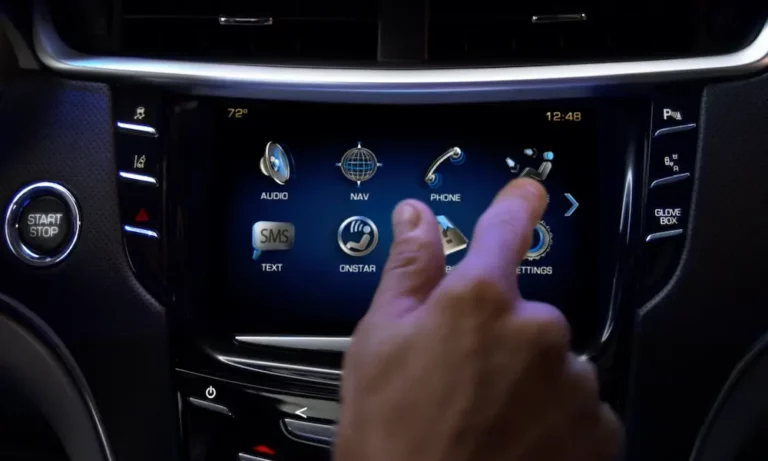
You’ve noticed your Cadillac’s touchscreen doing weird things—maybe it’s cracked without you touching it, or it’s registering phantom touches like a haunted iPad. You search “Cadillac CUE screen recall” hoping GM will fix it for free, but the results are confusing. Some sites mention recalls, others talk about lawsuits, and you’re left wondering what’s actually covered. Let’s cut through the noise.
The Short Answer: There’s No Federal Recall for Your CUE Screen (Probably)
Here’s the truth that’ll save you time: there’s no federal safety recall for the infamous CUE screen delamination that plagued 2013-2017 Cadillacs.
That spiderweb cracking? The bubbling under the glass? The screen that suddenly became a finger-painting chaos simulator? None of it triggered a mandatory recall from the National Highway Traffic Safety Administration (NHTSA).
GM handled this differently—through something called “Special Coverage” programs and Technical Service Bulletins. These aren’t recalls. They’re GM’s way of saying “we know there’s a problem” without admitting it’s a safety defect.
The confusion gets worse because there is a recent Cadillac screen recall—but it only affects 2023-2024 LYRIQ electric vehicles. That’s a completely different problem (software-based display failure) affecting a completely different vehicle. If you’re driving a 2015 Escalade or 2016 ATS, that recall doesn’t apply to you.
What Vehicles Have the Defective CUE Screens?
If you own one of these Cadillacs, you’re in the affected population:
| Model | Years | Screen Type |
|---|---|---|
| ATS | 2013-2017 | First-gen CUE |
| SRX | 2013-2016 | First-gen CUE |
| XTS | 2013-2017 | First-gen CUE |
| CTS | 2014-2017 | First-gen CUE |
| ELR | 2014-2016 | First-gen CUE |
| Escalade | 2015-2017 | First-gen CUE |
These models share the same fundamental flaw: GM used a gel-based adhesive to bond the touchscreen layers together. That gel doesn’t handle temperature swings well.
Why Your Screen Failed (The Science Part, Made Simple)
Your dashboard is basically a greenhouse. Summer temps can hit 176°F inside your car. Winter? Try -22°F in cold climates.
The CUE screen uses something called Liquid Optically Clear Adhesive (LOCA)—basically a gel that glues the touch sensor to the glass display. This gel was perfect for iPads used in climate-controlled living rooms. But in a car? It’s a disaster.
Here’s what happens:
- The gel dries out from repeated heat cycles
- It shrinks as it loses moisture
- The shrinking creates massive stress on the rigid glass layers
- The glass can’t handle it and either delaminates (bubbles) or cracks in that distinctive spiderweb pattern
The cruel part? This often happens spontaneously. You park with a perfect screen and return to find it shattered. No impact. No vandalism. Just physics destroying your $1,200 infotainment system.
The delamination creates another problem: ghost touches. The failing adhesive changes the electrical properties of the touch sensor, making your car think you’re touching buttons you’re not. Volume maxing out randomly? Climate controls going haywire? That’s the delamination talking.
The Class Action Lawsuit That Didn’t Help You
A lot of owners hoped the Goldstein v. General Motors lawsuit would force GM to fix everyone’s screens. It didn’t work out that way.
The suit argued GM knew about the defect (there were internal service bulletins dating back to 2014) but kept selling cars with defective screens anyway. The plaintiffs wanted GM to pay for repairs or replace the vehicles.
In 2023, the case was dismissed. But here’s the twist: the named plaintiffs (the specific people who filed the suit) got their cases dismissed “with prejudice.” That legal jargon usually means they settled privately—likely got paid to go away quietly.
The rest of the class (that’s you and every other Cadillac owner) got dismissed “without prejudice.” Translation: the case is over, there’s no settlement fund, no claim form, and no compensation for regular owners.
If you find websites claiming there’s a CUE screen settlement, they’re either outdated or referring to different GM settlements (like the ignition switch cases).
What About GM’s “Special Coverage” Program?
GM did offer limited help through something called the CUE Limited Special Reimbursement Program. It worked on a sliding scale based on your vehicle’s age:
| Vehicle Age | Mileage | GM Pays | You Pay |
|---|---|---|---|
| 0-5 years | Under 60,000 | 100% | Nothing |
| 5-6 years | Under 72,000 | 50% | 50% |
| 6-7 years | Under 84,000 | 25% | 75% |
| Over 7 years | Over 84,000 | 0% | Everything |
Here’s the problem: it’s 2025. If you have a 2013 model, your 7-year window closed in 2020. A 2017 model? That window closed in 2024.
Essentially everyone with a defective CUE screen is now past the coverage window. You’re on your own financially.
Some dealers might still honor it on a case-by-case basis if you’re nice and near the cutoff, but don’t count on it.
The 2025 LYRIQ Recall Isn’t Your Recall
When you search for Cadillac CUE screen recall, you’ll find references to NHTSA Recall 25V356. Don’t get excited—this doesn’t apply to your car.
This recall affects only 2023-2024 Cadillac LYRIQ electric vehicles (about 38,000 units). The problem is software-based: the instrument cluster and touchscreen can go completely blank while driving, which cuts off your speedometer and warning lights.
That’s a legitimate safety issue requiring a federal recall. Your delaminating screen? NHTSA apparently thinks you can still limp along with a cracked display since the backup camera image is technically still visible (even if you’re squinting through spiderweb cracks to see it).
What GM’s Technical Service Bulletins Actually Mean
GM issued several Technical Service Bulletins (TSBs) acknowledging the CUE problem. The most notable:
TSB PIT5304 (July 2014): GM told dealers that customers would report screens that appear “bubbled, cracked, or delaminating.” Dealers had to call GM’s Technical Assistance Center for authorization before replacing the unit. This was GM’s way of controlling how many replacements went out while avoiding the word “recall.”
TSB PIC6055C (August 2017): By 2017, the problem was so widespread GM removed the authorization requirement. But there’s a sneaky clause: it says the bulletin doesn’t apply if the screen “was damaged by cleaning agents or excessive force.” This gave dealers wiggle room to deny warranty claims by blaming you for pressing too hard—even though the defect was clearly systemic.
TSBs aren’t recalls. They’re instructions to dealers on how to fix a known problem if you bring the car in and if you’re still under warranty or special coverage.
Your Repair Options and What They Actually Cost
Since GM won’t help anymore, you’ve got three paths forward:
Option 1: Dealership Repair ($1,200-$1,600)
The dealer will order a replacement Integrated Center Stack (ICS) unit from GM. You get:
- Official service records
- 12-month/12,000-mile warranty
- Professional installation
The downside? You’re paying premium prices for what might still be “New Old Stock”—meaning the replacement could use the same defective gel adhesive. Some owners have gone through 2-3 replacements as each one fails within a few years.
Option 2: Independent Repair Shop ($200-$600)
Specialty shops (and mail-in services) offer CUE screen repairs using upgraded parts. Most use “gel-free” digitizers that eliminate the root cause of failure.
Pros:
- Significantly cheaper than dealer
- Often lifetime warranties on the screen itself
- Uses better technology than OEM
Cons:
- You might need to remove the unit yourself for mail-in service
- Your car sits idle while being repaired
- You need to trust the shop is using quality parts
Option 3: DIY Aftermarket Screen ($30-$150)
If you’re even slightly handy, aftermarket replacement screens are shockingly cheap. Companies like Cuescreens sell gel-free digitizers designed to prevent the delamination problem permanently.
This is the cheapest option—but it comes with serious risks if you’re not careful.
The DIY Route: How to Not Brick Your $1,000 Module
Replacing just the touchscreen digitizer (not the whole unit) can save you over $1,000. But mess it up, and you’ve just turned your CUE into an expensive paperweight.
Critical Mistake #1: Touching the White Cables
Inside the CUE module are white flexible flat cables connecting circuit boards. Installation guides explicitly warn: “DO NOT TOUCH ANY WHITE FLEX CABLE.”
These use Zero Insertion Force connectors that are incredibly fragile. Disconnect one accidentally, and you’ll need microsoldering equipment to fix it. Most DIYers who report a “black screen of death” after installation touched a white cable.
Critical Mistake #2: Installing the Ribbon Cable Backwards
The new digitizer connects via a ribbon cable with gold contacts. These contacts must face down toward the circuit board. Install it upside down, and nothing works.
The connector also has a tiny locking clip. Force it wrong, and it snaps off. No clip = no secure connection = no touch function = dead screen.
Critical Mistake #3: Skipping the Hard Reset
After installing a new screen, you might find it lights up but doesn’t respond to touch. Don’t panic—you probably just need to reset the HMI (Human Machine Interface) module.
Here’s the procedure:
- Turn ignition on, engine off
- Open the CUE faceplate (the motorized door)
- Turn vehicle off
- Open driver’s door and wait 60 seconds (this cuts power to the system)
- Close door, restart vehicle, lower faceplate
This forces the system to recognize the new hardware.
Why Aftermarket “Gel-Free” Screens Are Actually Better
The aftermarket figured out what GM apparently couldn’t: don’t use gel.
Gel-free digitizers use a perimeter bond instead, leaving a microscopic air gap between layers. No gel means:
- Nothing to dry out from heat
- Nothing to shrink and stress the glass
- No spiderweb failures
Early gel-free screens had more glare (the air gap creates reflections), but modern versions include anti-glare coatings that make them nearly identical to OEM in visibility.
The kicker? These aftermarket screens often outlast the vehicle. It’s a permanent fix to a design flaw GM never properly addressed.
Model-Specific Installation Quirks
The basic repair is the same across models, but accessing the CUE unit varies:
ATS and CTS (Sedans): The screen is part of the “waterfall” center console. You’ll fight with brittle gloss black trim pieces held by high-tension clips. These crack easily (“stress whitening”) if you pry wrong. The integrated air vents are especially fragile.
SRX: More modular design makes access easier, but the bezel is large and awkward to handle.
Escalade: The most complex due to the motorized storage compartment behind the screen. When reassembling, don’t pinch the motor wiring or ribbon cable in the slide mechanism, or your screen will work when static but fail when the door opens.
What This Means for Buying a Used Cadillac
If you’re shopping for a used 2013-2017 Cadillac, a cracked CUE screen is a negotiation goldmine.
Uninformed sellers think it’s a $1,500 repair (dealer pricing). You can demand that discount, then fix it yourself for $50. That’s a $1,450 arbitrage opportunity.
Informed sellers might have already done the aftermarket repair. Ask specifically: “Has the CUE screen been replaced? With what part?” If they used a gel-free aftermarket screen, that’s actually a selling point—the problem is permanently solved.
The Bigger Picture: What GM Learned (Maybe)
The CUE disaster taught GM—and the entire industry—that touchscreens-only design is a bad idea.
When the screen fails, you lose control of volume, climate, and even basic radio functions. Newer Cadillacs (CT5, XT6, and up) have brought back physical knobs and buttons for essential controls. It’s a tacit admission that the CUE philosophy was flawed.
The delamination issue also highlighted how consumer electronics engineering doesn’t translate directly to automotive. An iPad lives in your temperature-controlled house. A car dashboard is a torture chamber of thermal extremes. You can’t just slap smartphone tech into a vehicle and expect it to survive.
Should You Even Bother Fixing It?
That depends on what functions you’ve lost and how you use your Cadillac.
Fix it if:
- You rely on navigation regularly
- The backup camera display is illegible (safety issue)
- Ghost touches are driving you insane
- You’re keeping the car long-term
Skip it if:
- You mainly use your phone for navigation anyway
- The screen still mostly works despite cosmetic damage
- You’re trading the car in soon (just negotiate the trade value down)
- You’re comfortable living with the quirks
The DIY repair makes the most sense if you’ve got even basic mechanical skills and can follow instructions carefully. The aftermarket gel-free screens genuinely fix the problem permanently, which GM’s own replacement parts don’t.
The Bottom Line
There’s no Cadillac CUE screen recall for 2013-2017 models, despite what clickbait headlines might suggest. The recent LYRIQ recall is unrelated. The class action lawsuit ended without public compensation. GM’s Special Coverage programs have expired.
You’re left paying out of pocket—but at least the aftermarket has engineered a real solution that costs a fraction of dealer pricing and actually lasts.
If you’re going the DIY route, respect those white cables, install the ribbon connector correctly, and don’t skip the hard reset. Do it right, and you’ll have a screen that outlasts the rest of the car.
If you’re paying someone else, find a shop that specifically uses gel-free digitizers and offers a solid warranty. Paying $400 for a permanent fix beats paying $1,500 for a temporary dealer band-aid.
The CUE screen saga is a case study in how manufacturers can avoid recalls through clever legal maneuvering—and how the aftermarket can sometimes out-engineer the OEM when profit motives align with actual problem-solving.