Your 6.7 Power Stroke’s CP4 pump doesn’t just quit — it explodes internally and sends metal shards through your entire fuel system. The repair bill? Easily $10,000 to $17,000. But here’s the thing: you don’t have to let that happen. Read this before your truck decides for you.
Why the CP4 Pump Fails in the First Place
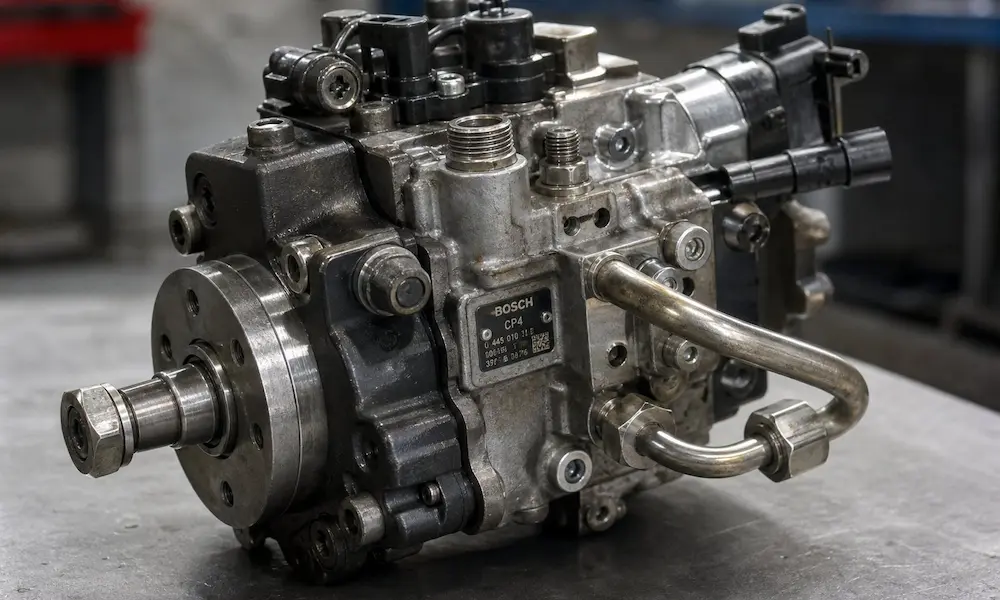
The 6.7 Power Stroke runs a Bosch CP4 high-pressure fuel pump that compresses diesel to up to 29,000 PSI before it hits your injectors. That’s an insane amount of pressure running through a pump that relies entirely on diesel fuel — not engine oil — for internal lubrication.
Here’s the problem: this pump was originally designed for European diesel, which has higher lubricity. U.S. ultra-low sulfur diesel (ULSD) strips out the natural lubricating compounds during refining. The result? A fuel-lubricated pump running on fuel that can’t properly lubricate it.
The Roller-Cam Death Spiral
Inside the CP4, a roller rides along a camshaft to compress fuel. Without enough lubricity, that roller starts dragging instead of rolling. It twists out of alignment. Then it’s metal grinding on metal — hard, fast, and destructive.
The pump doesn’t just wear out. It disintegrates. And because the pump is actively pressurizing fuel during this destruction, it sends metallic debris directly downstream into your injectors, fuel rails, and back through the return lines into your tank.
By the time your check engine light comes on, the damage is already done.
Warning Signs Your CP4 Is Dying
Don’t ignore these symptoms:
- Long crank times before the engine fires
- Rough idle or sudden power loss under load
- Low fuel rail pressure fault codes
- Ticking or knocking from the engine bay
- Check engine light combined with any of the above
Diesel experts note that for trucks doing heavy hauling or towing, a sudden CP4 failure while under load is a real safety hazard on public roads.
The Real CP4 Pump 6.7 Powerstroke Replacement Cost
This is where most truck owners get blindsided. You can’t just swap the pump and call it done. Because metallic debris has contaminated the entire fuel system, a new pump installed into a dirty system will destroy itself within minutes of startup.
The only correct fix is a complete fuel system overhaul.
What a Full Contamination Kit Includes
Dealerships and diesel shops call these “Fuel System Contamination Kits.” A complete kit must include:
- New or remanufactured high-pressure fuel pump
- All eight fuel injectors
- Left and right high-pressure fuel rails
- High-pressure rail-to-injector delivery lines
- Low-pressure return line assemblies
- Primary and secondary fuel filters
- Injector hold-down bolts and sealing gaskets
Parts costs vary significantly by model year:
| Model Year | Contamination Kit Cost | Core Charges | Estimated Parts Total |
|---|---|---|---|
| 2011–2014 | $3,500 – $4,000 | $950 – $1,500 | $4,450 – $5,500 |
| 2017–2019 | $4,250 – $6,000 | $950 – $1,500 | $5,200 – $7,500 |
| 2020–2022 | $6,000 – $8,000 | $950 – $1,500 | $6,950 – $9,500 |
Data sourced from ATL Diesel and Dale’s Super Store.
The Labor Side of the CP4 Pump 6.7 Powerstroke Replacement Cost
This repair is brutally labor-intensive. Mitchell On-Demand flat-rate guides quote roughly 18 hours. But experienced diesel technicians report real-world jobs routinely take 25 to 32 hours — especially when done correctly.
Why so long? Many techs physically remove the cab from the chassis using a hydraulic lift to access rear injectors properly. The process includes:
- Disconnecting batteries and draining coolant
- Removing intake piping and EGR components
- Dropping the fuel tank to extract settled debris
- Flushing all low-pressure lines with clean diesel
- Reassembling to strict factory torque specifications
Any shortcut in this process risks destroying the brand-new components immediately.
How Labor Rates Shape Your Final Bill
The national diesel technician shortage means skilled techs are expensive and hard to find. The Bureau of Labor Statistics puts the median wage at around $29/hour for diesel mechanics — but top-tier specialists in commercial hubs earn well over $80,000 annually.
Shops pass those costs directly to you. Here’s what independent shop labor rates look like by region:
| State / Region | Typical Labor Rate (per hour) |
|---|---|
| California | $155 – $200 |
| New York / Alaska | $135 – $180 |
| Florida / Colorado | $130 – $160 |
| Texas | $120 – $150 |
| North Carolina | $85 – $135 |
Dealership rates typically sit at the top of these ranges or higher. At $160/hour for 25 hours of labor, that’s $4,000 in labor alone — before a single part gets ordered. Add a modern contamination kit at $6,500, diagnostic fees, fluids, and tax, and you’re looking at $10,000 to $17,000 without blinking.
For older trucks, that repair bill can exceed the vehicle’s market value entirely.
What Ford Did (And Why It Wasn’t Enough)
In late 2024, Ford issued a federal recall under NHTSA campaign number 24V-957, covering 295,449 trucks from the 2020–2022 model years with the Bosch CP4 RP7 pump variant.
Ford’s internal investigation logged 3,070 warranty claims and 498 field reports over five years. Their conclusion? The failures were worsened by aged biodiesel sitting in tanks during COVID-19 pandemic lockdowns.
A Software Fix for a Hardware Problem
Here’s what made diesel owners furious: the recall remedy is just a software update. No physical pump replacement. Dealerships flash the PCM to adjust fuel system operating strategy — and that’s it.
Meanwhile, Ford quietly switched to an updated RP8 pump variant in production by August 2021 — featuring increased roller shoe and tappet body clearances. That physical hardware change strongly suggests the earlier RP7 had inadequate tolerances from the start.
A software patch can’t restore metal clearances that were never sufficient. And for owners of 2011–2019 trucks? This recall covers nothing. You’re on your own.
Your Options: Proactive Fixes Ranked by Cost and Effectiveness
Waiting for catastrophic failure is the most expensive strategy. Here’s what smart owners do instead.
Option 1: Replace with a Stock OEM Pump ($2,000–$3,000 Total)
Swap the aging pump for a brand-new factory unit before it fails. The pump itself runs $800–$1,200. Add gaskets, fresh fuel lines, and labor, and you’re at $2,000–$3,000.
The problem? You’ve just installed the same flawed design. The new pump faces identical lubricity and wear issues from day one. It’s a temporary solution that keeps the original risk fully intact.
Option 2: Disaster Prevention Kit — The Best Bang for Your Buck ($500–$1,000 Total)
A Disaster Prevention Kit (also called a Bypass Kit) doesn’t prevent pump failure — it stops the failure from destroying everything else.
Here’s how it works: the factory routing sends debris-laden fuel from the pump’s cam area directly into your high-pressure lines and injectors. The bypass kit reroutes that fuel through an external filter block and back to the tank, completely isolating your eight injectors and fuel rails from contamination.
- Basic kits start at around $67
- The S&S Diesel Gen 2.1 kit runs approximately $400 and uses easy-to-source Donaldson spin-on filter media
- Installation takes 1–2 hours
If the pump dies, you replace just the pump and flush the low-pressure lines. A potential $15,000 disaster becomes a $2,500 repair. That’s the best return on investment available for budget-conscious owners.
Option 3: S&S Diesel DCR Pump Conversion — The Permanent Fix ($2,500–$5,100 Total)
The S&S Diesel Motorsport DCR Pump Conversion replaces the factory roller-cam pump entirely with a Stanadyne DCR unit built around a two-piston radial design with a patented eccentric drive.
Unlike the CP4, the DCR’s cam and bushings are pressure-lubricated — not fuel-lubricated. That makes it genuinely resistant to ULSD’s low lubricity, air intrusion, and biofuel variations. It also delivers 1,250 mm³/revolution — 25% more flow than the stock unit.
Key advantages:
- No custom tuning required — works plug-and-play with your factory PCM
- Fully emissions-legal with CARB EO #D-756-7 and SEMA certification
- Covers 2011–2025 6.7 Power Stroke engines
The kit retails at $2,400. Add 6–12 hours of professional installation labor and total cost runs $2,500 (DIY) to $5,100 (shop install). This is the definitive solution for long-term owners, heavy towers, and fleet operators.
Option 4: CP3 Conversion Kit ($3,500–$5,500 Total)
The Bosch CP3 is a legendary pump with a rock-solid reliability reputation from older diesel platforms. Aftermarket kits adapt it to the 6.7 Power Stroke, and kits run $2,500–$3,019.
The catch? The CP3 often requires custom ECM tuning to communicate with the modern powertrain computer. Without it, you risk poor performance or engine damage. Some configurations also conflict with factory dual-alternator setups, and certain emissions components may need modification — making the vehicle off-road-only in many states.
Because the DCR conversion is plug-and-play and 50-state legal, most owners now choose it over the CP3 route.
Side-by-Side Comparison
| Strategy | Hardware Cost | Total Installed Cost | Does It Fix the Root Cause? | Emissions Legal? |
|---|---|---|---|---|
| OEM Pump Swap | $800–$1,200 | $2,000–$3,000 | No | Yes |
| Disaster Prevention Kit | $67–$400 | $500–$1,000 | No (but protects injectors) | Yes |
| S&S DCR Conversion | $2,400 | $2,500–$5,100 | Yes | Yes (all 50 states) |
| CP3 Conversion | $2,500–$3,019 | $3,500–$5,500 | Yes | Often no |
The Legal Landscape: Class Actions Are Winning
Truck owners aren’t just absorbing these costs quietly. Active class-action litigation alleges manufacturers knew the European-designed CP4 was fundamentally incompatible with North American ULSD before putting it in mass-market trucks.
In May 2025, a federal judge approved a $50 million settlement in a GM-related CP4 case — $30 million of which went directly to owners who paid out-of-pocket for contamination repairs. Similar Ford litigation remains active.
One critical thing to know: if your pump fails while under warranty, manufacturers often pull a fuel sample during diagnosis. Any trace of water, sediment, or aged biofuel gives them grounds to deny your claim as “fuel contamination.” If you’re fighting a denial, document everything — and consult attorneys familiar with CP4 mass tort cases.
The Bottom Line on CP4 Pump 6.7 Powerstroke Replacement Cost
The CP4 pump 6.7 Powerstroke replacement cost after a full catastrophic failure lands between $10,000 and $17,000 — that’s the reality of replacing an entire contaminated fuel system.
Here’s the smart play based on your situation:
- Own the truck short-term or on a budget? Install a Disaster Prevention Kit now. It’s the cheapest insurance you’ll ever buy for a diesel.
- Planning to keep the truck long-term or tow heavy? Invest in the S&S DCR conversion. It’s the only fix that actually solves the problem.
- Just replaced the factory pump with another OEM unit? Add a bypass kit immediately. You’ve reset the clock, but the risk is still fully there.
Don’t wait for the check engine light to make the decision for you.