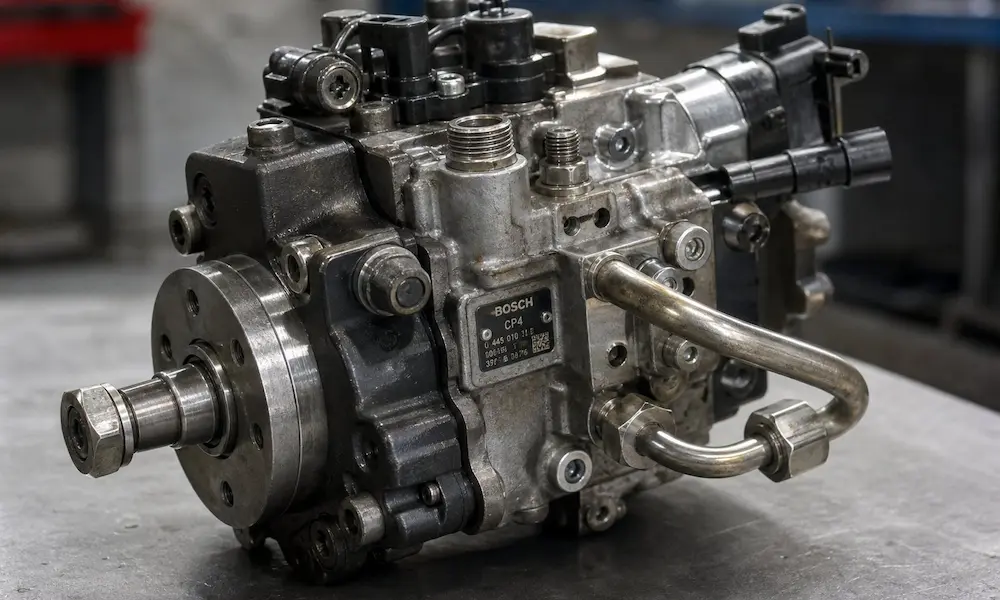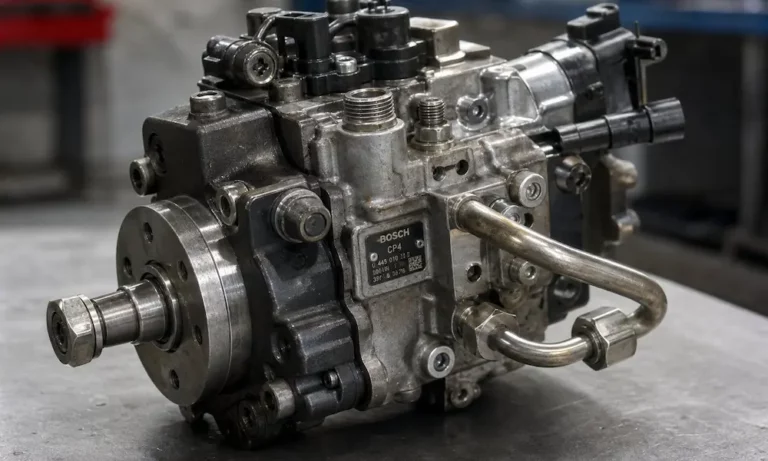
Your diesel truck might be sitting on a $10,000+ time bomb right now — and you might not even know it. The Bosch CP4 pump has destroyed engines in Ford, GM, Ram, Jeep, and Nissan trucks across America. This guide breaks down exactly why it fails, what your options are, and how a CP4 to CP3 conversion could save your engine — and your wallet.
Why the CP4 Pump Fails in American Diesel Trucks
Before diving into the fix, you need to understand the problem.
The CP4 was originally engineered for the European diesel market. European diesel fuel carries significantly higher natural lubricity than what you pump at American fuel stations. In the US, we run ultra-low sulfur diesel, which goes through a heavy refining process that strips out the sulfur — and unfortunately, most of the natural lubricating properties with it.
Here’s the brutal irony: the CP4 relies entirely on diesel fuel to lubricate its internal moving parts. Put a pump designed for “wet” European fuel into an American truck running “dry” US diesel, and you’ve created the perfect recipe for mechanical catastrophe.
The Unpinned Roller Tappet Problem
The core mechanical flaw is inside the pump itself. The CP4 uses roller-type tappets that ride directly against an aggressive rotating camshaft. There’s no guide pin, keyway, or physical barrier keeping those rollers correctly aligned. The only thing holding them in position is spring pressure and a microscopic film of diesel fuel.
When that fuel film breaks down — due to low lubricity, air bubbles, or water contamination — the roller tappets twist sideways in their bores. Instead of rolling against the camshaft, they skid. That skidding action shears off thousands of metal shavings at thousands of RPM, and those shavings travel straight into your fuel rails and injectors under 30,000+ PSI of pressure.
The result? A repair bill that typically runs between $10,000 and $15,000.
What Makes the CP3 Different
The CP3 takes a completely different mechanical approach. Instead of unpinned roller tappets on a spinning cam, it uses bucket-type followers riding against a non-rotating polygonal ring. That ring doesn’t spin — it simply orbits. Bosch also applied a specialized friction-reducing coating to every contact surface.
The CP3 also sits inside a heavy cast-iron or forged steel housing, not lightweight die-cast aluminum. This construction gives it a massive tolerance advantage when fuel lubricity drops. It can survive brief periods of poor lubrication without immediately destroying itself.
When a CP3 finally wears out — often past 300,000 miles — it simply loses pressure gradually. The engine cranks longer, idles rough, and eventually stalls safely. Compare that to the CP4, which catastrophically grenades itself and contaminates your entire fuel system in seconds.
| Design Specification | Bosch CP3 | Bosch CP4.2 |
|---|---|---|
| Cylinder Configuration | Three-piston radial | Two-piston V-twin |
| Housing Material | Cast iron / forged steel | Die-cast aluminum |
| Follower Mechanism | Non-rotating polygonal ring with coated bucket followers | Unpinned roller tappets on rotating cam |
| Max Pressure Rating | ~30,000 PSI / 1,800 Bar | ~39,000 PSI / 2,700 Bar |
| Volumetric Output | Supports 750+ horsepower | Plateaus around 500 horsepower |
| Failure Mode | Gradual pressure loss | Catastrophic metal contamination |
Which Trucks Have a CP4 Problem
Nearly every major domestic diesel platform got hit with the CP4. Here’s where things stand today.
General Motors — 2011-2016 Duramax LML: GM made the switch for the 2011 LML generation, chasing higher pressures to pair with new piezoelectric injectors. The LML didn’t even include a factory lift pump in the fuel tank, which forced the CP4 to pull fuel all the way from the rear of the truck under constant vacuum — a cavitation nightmare. GM quietly switched to the Denso HP4 pump for the 2017 L5P Duramax, which features a three-cylinder design with pinned rollers that physically can’t twist sideways.
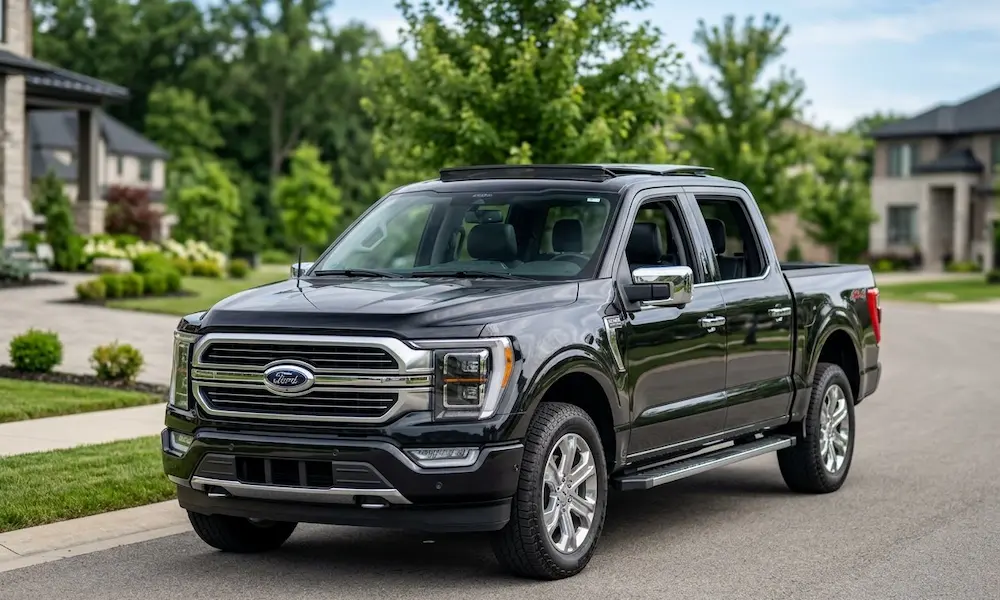
Ford — 2011-Present 6.7L Power Stroke: Ford included a factory lift pump from the start, which helped — but didn’t fully solve the lubricity problem. Ford is the only major manufacturer that has stubbornly kept the CP4 architecture through current production, which is exactly why the aftermarket for Ford CP4 solutions is massive.
Ram Cummins — 2019-2020 6.7L: Cummins dropped its legendary CP3 for the 2019 model year as part of a sweeping redesign that pushed output to 1,000 lb-ft of torque. The failures were so immediate and widespread that Cummins reversed course entirely, returning to the CP3 for 2021 — one of the rarest mid-cycle engineering retreats in modern truck history.
Jeep/Ram EcoDiesel — 2014-2022 3.0L V6: The light-duty EcoDiesel suffered highly publicized stall events on public highways when the CP4 failed. These failures triggered massive federal recalls covering over 138,600 vehicles.
Nissan Titan XD — 2016-2019 5.0L Cummins V8: Same pump, same failures, same result. Nissan discontinued the diesel engine option entirely.
| Manufacturer | Platform | CP4 Years | What Happened |
|---|---|---|---|
| General Motors | 6.6L Duramax LML | 2011–2016 | Switched to Denso HP4 for 2017+ |
| Ford | 6.7L Power Stroke | 2011–Present | Kept CP4; huge aftermarket developed |
| Ram (Cummins) | 6.7L Cummins I6 | 2019–2020 | Reverted to CP3 for 2021+ |
| Jeep/Ram | 3.0L EcoDiesel V6 | 2014–2022 | NHTSA safety recalls issued |
| Nissan | 5.0L Cummins V8 | 2016–2019 | Discontinued diesel engine entirely |
The Recalls and Lawsuits You Need to Know About
The CP4 failure crisis didn’t stay in the shop. It went federal.
NHTSA Recall Y78 — Ram Cummins 6.7L
When the 2019-2020 Ram HD trucks started failing in large numbers, the National Highway Traffic Safety Administration stepped in. A high-pressure fuel pump failure at highway speed means sudden loss of power, braking assist, and steering assist. That’s not a mechanical inconvenience — that’s a safety emergency.
FCA (Stellantis) issued Safety Recall Y78 (NHTSA campaign 21V-880), covering over 222,400 heavy-duty trucks. Dealerships were required to physically remove the CP4 and replace it with a Bosch CP3.3 pump. If the pump had already failed, the recall covered full fuel system replacement — rails, injectors, tank, and all.
The EcoDiesel Recall
The EcoDiesel story ran parallel. NHTSA campaign documents confirm over 138,600 vehicles from the Jeep Grand Cherokee, Wrangler, Gladiator, and Ram 1500 were recalled for CP4-related stall events. Dealerships inspected pumps and replaced failed fuel system components free of charge.
The $50 Million GM Class Action Settlement
GM owners didn’t get a federal recall. They got lawyers.
In Chapman, et al. v. General Motors LLC, plaintiffs argued GM knowingly sold trucks with pumps incompatible with American fuel — describing them as “ticking time bombs.” On May 6, 2025, US District Judge Terrence G. Berg granted final approval to a $50 million settlement.
Here’s what the settlement covered:
- Past repair reimbursements: A $30 million fund for owners who paid for CP4 repairs out of pocket. Estimated payouts ranged from $6,356 to $12,712 per claimant.
- Former owner compensation: A $5 million fund for owners who sold their trucks before a failure occurred, acknowledging lost resale value. Payouts ranged from $400 to $800.
- Future repair coverage: 50% reimbursement for any CP4 failure occurring on or after May 6, 2025, valid until May 6, 2026, or 200,000 miles — whichever came first.
- Geographic scope: The settlement covered purchasers in California, Florida, Illinois, Iowa, New York, Pennsylvania, and Texas only.
The deadline to file claims for past repairs was November 6, 2025. Future repair claims closed July 5, 2026. Initial settlement payments began processing on March 23, 2026.
Your Three Options for Fixing the CP4 Problem
The aftermarket has developed three distinct solutions. Which one you choose depends on your budget, your power goals, and how much risk you’re willing to tolerate.
Option 1: CP4 Disaster Prevention Bypass Kit (~$400)
A bypass kit doesn’t replace the CP4. It isolates the failure to protect everything downstream.
Here’s the problem it solves: in the stock CP4 configuration, fuel from the lower crankcase — where the camshaft and rollers live — is drawn directly up into the high-pressure pumping chambers. When the rollers start shedding metal, those shavings go straight into your fuel rails and injectors.
Companies like S&S Diesel Motorsport and SPE Motorsport engineered billet aluminum manifolds that sit on top of the pump and completely separate these two circuits. Clean, filtered fuel feeds the high-pressure plungers directly. Crankcase lubrication fuel gets routed separately.
The latest Generation 2.1 kits route that crankcase return fuel through a dedicated external spin-on filter — typically a 9-micron Donaldson P550943 — before it returns to the tank. If the pump fails, the metal shavings get trapped in that filter. Your injectors stay clean. Your $15,000 repair bill becomes roughly $1,500.
These kits use factory-style quick-connect fittings, require no line cutting, and install in a few hours. For the price, they’re the easiest insurance you can buy.
Option 2: Full CP4 to CP3 Conversion (~$1,500–$3,000+)
This is the complete solution. You physically remove the CP4 and retrofit the proven CP3 architecture into your engine bay.
Companies like Fleece Performance and S&S Diesel Motorsport build comprehensive kits that include precision-machined billet aluminum adapter plates, custom high-pressure fuel lines, low-pressure feed hoses, and modified overflow valves.
The CP3 naturally outflows the CP4, so dropping a stock CP3 onto a factory-calibrated CP4 engine can cause rail pressure spikes. To solve this, aftermarket builders developed “no-tune required” CP3 pumps with modified internal actuators that mimic the CP4’s output curve exactly. The factory ECM runs the engine without any issues.
For performance builds, the CP3 platform scales far beyond stock. Fleece Performance’s PowerFlo 750 uses a custom internal camshaft with a longer plunger stroke and removes the factory flow restriction active above 3,000 RPM. A single stroked CP3 can support 750+ rear-wheel horsepower — something the stock CP4 could never touch.
A note on the LML Duramax installation: Converting an LML Duramax to a CP3 requires 10 to 16 hours of labor. The pump is buried deep in the engine valley beneath the intake manifold, EGR piping, cooling fan, A/C compressor, and alternator. It’s not a Saturday afternoon job — budget for professional installation.
Option 3: DCR Pump Replacement — The Ford-Specific Solution (~$2,400)
Converting a 6.7L Power Stroke to a CP3 is geometrically tight and electronically complex. So S&S Diesel Motorsport partnered with PurePower Technologies to engineer a completely different solution: the Diesel Common Rail (DCR) pump.
The DCR is a direct, plug-and-play replacement for the Ford CP4. Instead of roller tappets, it uses a patented eccentric drive mechanism where the internal cam and bushings are pressure-lubricated — making it highly tolerant of low-lubricity American diesel.
It matches the factory CP4 output curve exactly, so no tuning is required. Despite that seamless integration, the DCR delivers 1,250 cubic millimeters per revolution — 25% more flow capacity than the CP4.2. It installs with original-equipment fit and finish, no custom plumbing required.
At $2,400, it costs more than a bypass kit but delivers a permanent mechanical fix with zero compromises for Ford Power Stroke owners.
The Real Cost of Doing Nothing
Skipping a bypass kit or CP4 to CP3 conversion to save a few hundred dollars is a gamble with terrible odds. A single CP4 failure triggers a chain reaction that destroys your fuel rails, all six or eight injectors, the crossover tubes, high-pressure lines, return hoses, and lift pump. Your fuel tank needs to come out, get drained, and get flushed to remove every metal particle.
The total damage runs $10,000 to $15,000. For many truck owners running their diesel as a work vehicle, that sudden expense wipes out an enormous chunk of the truck’s remaining equity.
The GM class action settlement alone totaled $50 million in damages. Two federal recalls removed the CP4 from hundreds of thousands of trucks. And Cummins — one of the most respected diesel engine manufacturers on the planet — did something almost unheard of in the industry: they publicly admitted the pump didn’t work in American conditions and bolted a CP3 back onto their engines mid-cycle.
That’s all the proof you need.
Whether you go with a bypass kit as affordable insurance, a full CP4 to CP3 conversion for permanent peace of mind, or a DCR replacement for your Power Stroke, taking action now costs a fraction of what inaction will cost you later.