If you’ve got a Jeep or an old Ford truck, you’ve probably heard axle guys argue about this nonstop. Some say the Dana 35 is junk. Others say it’s fine if you leave it alone. The truth sits somewhere in between, and it depends on what you’re doing with your rig.
This guide breaks down the real differences between these two axles. You’ll learn how to spot them, why one snaps way more often than the other, and what to do about it. No fluff, just the stuff that actually matters when you’re wrenching on your rig or shopping for your next build.
What’s the Difference Between Dana 44 and Dana 35?
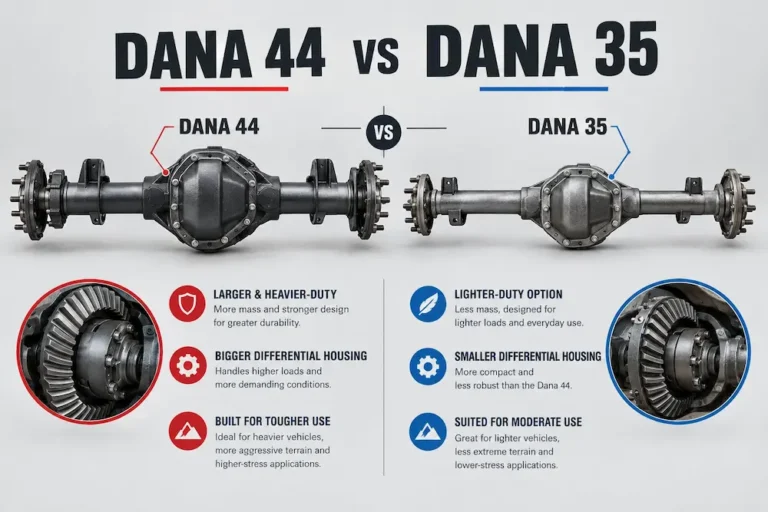
The Dana 35 is a lightweight axle built for daily driving and mild trails. The Dana 44 is a heavier, tougher axle built for trucks, towing, and serious off-roading.
Both come from Dana Spicer, and both showed up under tons of Jeeps, Fords, and Dodges over the decades. But their internal guts are worlds apart. The Dana 44 uses bigger gears, thicker shafts, and more material everywhere it counts. The Dana 35 skimps on all of it to keep things light and cheap.
Quick way to tell them apart: flip over the differential and look at the cover.
- Dana 35 cover: smooth, oval shape, 10 bolts
- Dana 44 cover: angular, hexagon-ish “muffin” shape, 10 bolts
The Dana 44 casting also has extra stiffening ridges on the housing near the pinion — usually three or more per side. The Dana 35 only has one. That’s not just cosmetic. It’s a hint about how much flex each housing can handle.
Want to get super precise? Check the ID tag or the stamped number on the axle tube. It’ll tell you the exact gear ratio, spline count, and build date.
Where You’ll Find Each Axle
Knowing which axle came under your vehicle helps you figure out what you’re working with before you even crawl underneath.
| Vehicle | Model | Axle Used | Years |
|---|---|---|---|
| Jeep | Wrangler (YJ, TJ, JL) | Dana 35 rear, Dana 44 rear (Rubicon/optional) | 1987–Present |
| Jeep | Cherokee (XJ) | Dana 35 rear standard, Dana 44 optional | 1984–2001 |
| Jeep | Grand Cherokee (ZJ, WJ) | Dana 35 rear, Dana 44 on V8/tow package | 1993–2004 |
| Ford | Explorer/Ranger | Dana 35 front (TTB/IFS) | 1990–2012 |
| Ford | F-150/Bronco | Dana 44 front | 1959–1996 |
| Dodge | Dakota/Durango | Dana 35 front (IFS) | 1997–2000 |
| AMC | Concord, Eagle, Hornet | Dana 35 (AMC-15 rear) | 1970–1988 |
The Dana 44 actually goes way back further than the 35. It replaced the older Dana 41 back in the 1940s and just kept getting used everywhere — even under the Corvette and the Dodge Viper in aluminum-housing versions.
Dana 44 vs Dana 35: Size and Strength Specs
Numbers don’t lie. Here’s where the real gap shows up.
| Spec | Dana 35 | Dana 44 (Traditional) |
|---|---|---|
| Ring gear size | 7.50–7.62 in | 8.50 in |
| Ring gear bolts | 8 | 10 |
| Pinion shaft diameter | 1.375–1.406 in | 1.375–1.625 in |
| Inner axle splines | 27 | 30 |
| Axle shaft diameter | 1.16–1.18 in | 1.31 in |
| Axle tube diameter | 2.48–2.64 in | 2.72–2.76 in |
| Weight (assembled) | ~175 lbs | ~230 lbs |
That extra inch of ring gear diameter matters way more than it sounds. More gear tooth contact area means more surface to spread out torque. The Dana 44 also runs bigger axle shafts, which is the single biggest reason it survives where a Dana 35 doesn’t.
The Dana 44’s torque capacity blows the 35 out of the water too. A standard low-pinion 44 handles around 3,460 ft-lbs. Go high-pinion and you’re at 4,170 ft-lbs. Heavy-duty 32-spline versions push past 5,340 ft-lbs. The Dana 35 doesn’t even get published numbers that high because it’s not built for that kind of abuse.
Why the Dana 35 Breaks So Easily
The Dana 35’s reputation isn’t a myth. It fails in a few very specific, very predictable ways.
Skinny Axle Shafts Snap Under Shock Load
Off-roading throws sudden shock loads at your axle shafts. Picture a spinning tire that suddenly grabs a rock ledge. All that torque slams into the shaft in an instant.
The Dana 35’s shaft is only about 1.16 inches thick with 27 splines. That’s just not enough material to handle a sudden hit. The shaft cracks right at the splines and snaps clean in half.
The C-Clip Problem Makes It Worse
Here’s the part that makes the Dana 35 genuinely dangerous. It uses a “C-clip” to hold the axle shaft in the housing. Once the shaft snaps, there’s nothing holding the wheel on anymore. The wheel, tire, and brake drum can slide right off the truck while you’re driving.
That’s not just an inconvenience. It usually rips the brake line and parking brake cable off the backing plate. You lose your brakes at the exact moment you need them most.
The Housing Flexes and Wrecks the Gears Too
Even when the shafts hold, the thin housing tubes on the Dana 35 bend under load. That sounds minor, but it’s not. When the housing flexes, the ring and pinion gears lose their proper mesh. That misalignment chews up gear teeth and can snap the spider gears or the cross-pin inside the differential.
So even if you upgrade the shafts, a flexy housing can still take out your gears. That’s why serious builders add a truss — a welded steel brace over the tubes — to stop the bending.
Why the Dana 44 Holds Up So Much Better
More material, bigger gears, thicker shafts. That’s really the whole story. The Dana 44 was built from the start for trucks that haul stuff and tow trailers, so it had to survive way more abuse than a compact car axle ever would.
The TJ Dana 44’s Hidden Weak Spot
Here’s a twist though. The Jeep Wrangler TJ’s factory rear Dana 44 uses the same skinny 2.6-inch tubes as the Dana 35. So even a “real” Dana 44 in a TJ can still flex under big hits.
The fix is the same one used on the Dana 35: weld on a truss. Once you brace the tubes, the TJ Dana 44 becomes about as tough as it gets for a solid axle.
Carrier Breaks: Why Regearing Isn’t Always Simple
If you throw bigger tires on your rig, you’ll probably need a new gear ratio to keep your engine from working overtime. But there’s a catch called a “carrier break.”
When you go to a smaller pinion gear (for a higher numerical ratio), it sits farther from the ring gear. To keep the mesh tight, the whole differential carrier sometimes needs a different shape. That threshold where the carrier design changes is the carrier break.
- Dana 35 carrier break: happens between 3.31 and 3.55. Anything 3.55 or higher needs the taller carrier.
- Dana 44 carrier break: happens between 3.73 and 3.92. Anything 3.92 or higher needs the taller carrier.
Crossing that break usually means buying a whole new carrier — unless you go with a “thick gear.” These are ring gears machined with extra material on the back so they bridge the gap without a new carrier. Way cheaper, and a common trick for anyone chasing a 4.56 or 4.88 ratio on a factory 3.73 carrier.
Upgrade Options If You’re Stuck With a Dana 35
So your Dana 35 keeps breaking, or you’re planning bigger tires. Here’s what people actually do about it.
Super 35 Kits
A “Super 35” kit swaps in a locker built for 30-spline shafts instead of the stock 27-spline setup. The new shafts match Dana 44 dimensions and are made from tougher alloys like chromoly or 1541H steel. This fixes the shaft-snapping problem.
It does not fix housing flex though. You’ll still want a truss if you’re running big tires or a locker.
Ford 8.8 Swap
A lot of builders skip the Dana 35 entirely and drop in a Ford 8.8-inch axle pulled from an old Explorer or Ranger. It’s cheap in junkyards, tough as nails, and comes with factory disc brakes.
Downsides: you’ll need to fabricate new spring perches, shock mounts, and possibly shorten your driveshaft. It’s a weekend project, not an afternoon swap.
Chrysler 8.25 Swap (For XJ Owners)
If you’ve got a Cherokee XJ, the late-model (1997+) Chrysler 8.25 axle is a solid bolt-in option. It’s got 29-spline shafts and a thicker pinion, putting it close to Dana 44 territory without any welding required.
Meet the Modern Dana 44: AdvanTEK
The Dana 44 you’ll find under a new Jeep Wrangler JL or Ford Bronco isn’t the same axle from the 1970s. It’s called AdvanTEK, badged as the M210 (front) and M220 (rear).
Dana redesigned it to be lighter, quieter, and way more efficient without losing strength. The ring gear shrank slightly to 220mm, but better gear tooth geometry and active oil lubrication let it match the torque numbers of older, heavier setups.
The tubes got bigger too — 70mm up front, 80mm in the rear — made from stronger, lighter steel. Shafts jumped to 32-spline. And the pinion offset dropped, which improves both efficiency and ground clearance. It’s basically Dana taking 75 years of lessons learned and building the axle they wish they’d made from the start.
Dana 44 vs Dana 35: The Quick Verdict
| Category | Dana 35 | Dana 44 |
|---|---|---|
| Best for | Daily driving, light trails | Towing, heavy loads, serious off-roading |
| Max tire size (stock) | Up to 32 in | Up to 35–37 in |
| Weak point | Shafts and housing flex | Tube flex on some Jeep TJ models |
| Upgrade path | Super 35 kit, axle swap | Truss, regear, locker |
| Repair cost | Lower parts cost, more frequent failures | Higher parts cost, fewer failures |
Final Thoughts
The Dana 35 isn’t a bad axle — it’s just built for a job that doesn’t include rock crawling or 35-inch tires. Push it past that, and it’ll let you know with a snapped shaft or a wrecked gear set.
The Dana 44 costs more, weighs more, and takes up more space. But it earns that extra weight by actually surviving the stuff off-road driving throws at it. If you’re building a rig for real trail work or towing, the Dana 44 (or a proper truss and Super 35 setup) is worth the investment.
Bottom line: match the axle to the job, not the other way around.