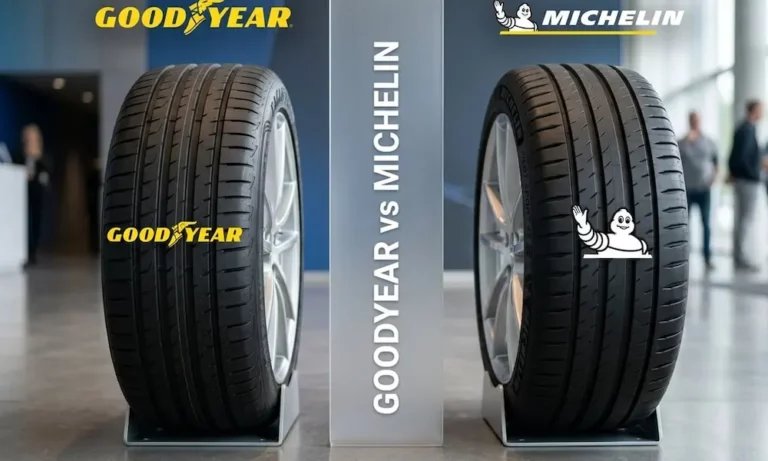
Picking the wrong tires costs you money, grip, and peace of mind. This Goodyear vs Michelin breakdown cuts through the marketing noise and gives you real performance data, price comparisons, and honest category winners. Stick around — the answer might surprise you.
The Two Brands at a Glance
These aren’t just tire companies. They’re two completely different philosophies wearing rubber.
Goodyear, founded in Akron, Ohio in 1898, built its reputation on volume, accessibility, and versatility. It’s the sole tire supplier for NASCAR. It sells tires that fit almost every budget. That’s the Goodyear promise.
Michelin, born in France in 1889, plays a different game entirely. Its core idea is “performance that lasts” — meaning a Michelin tire should grip, handle, and protect you just as well at 50,000 miles as it did on day one.
| Feature | Goodyear | Michelin |
|---|---|---|
| Founded | 1898 | 1889 |
| Headquarters | Akron, Ohio | Clermont-Ferrand, France |
| US Market Focus | Volume, Versatility, Off-Road | Premium, Longevity, Efficiency |
| Racing Presence | Sole NASCAR Supplier | Formula E, Endurance Racing |
| Global Sales Rank (2024) | Top 5 | #1 or #2 |
Who’s Actually Winning the US Market?
Here’s something worth knowing: Goodyear holds 14.6% unit share and 13.9% dollar share in the US market as of early 2025. That makes it the top-selling tire brand in America.
Michelin sits at 11.7% dollar share — but it claims 16% retailer shelf share. That means stores give Michelin premium display space even though Goodyear outsells it in raw units.
Why does Michelin get the premium shelf space? Because retailers know Michelin buyers are less price-sensitive. They walk in ready to spend more.
| Brand | US Unit Share | US Dollar Share | Retailer Shelf Share |
|---|---|---|---|
| Goodyear | 14.6% | 13.9% | High |
| Michelin | ~11.2% | 11.7% | 16% |
| Bridgestone | — | 9.2% | High |
| Firestone | 7.6% | 6.5% | Moderate |
One important trend: 52% of US tire shoppers pick a brand based on price. That’s why Goodyear keeps winning on volume. But 29% prioritize quality — and that’s Michelin’s territory.
Brand Value: It’s Not Even Close
Michelin’s brand value hit $8.76 billion in 2025, up 11% year-over-year. It carries an AAA+ brand strength rating — the highest possible score.
Goodyear’s brand value grew faster at 14%, reaching $2.27 billion. Still impressive, but a fraction of Michelin’s valuation.
Michelin has also collected more than 100 J.D. Power awards — more than every other tire brand combined.
| Brand | 2025 Brand Value | Rating | YoY Growth |
|---|---|---|---|
| Michelin | $8.76 Billion | AAA+ | +11% |
| Bridgestone | $8.25 Billion | AA+ | +8% |
| Continental | $3.90 Billion | AA- | -16% |
| Goodyear | $2.27 Billion | AAA | +14% |
All-Weather Tires: CrossClimate 2 vs. WeatherReady 2
This is the matchup most everyday drivers care about. Both tires carry the Three-Peak Mountain Snowflake (3PMSF) rating, meaning they handle serious snow while working fine in summer heat.
Here’s what the head-to-head testing actually shows:
- Dry braking: Michelin CrossClimate 2 stops 7.1 feet shorter. That’s a 5% safety margin on dry highways.
- Wet braking: Goodyear WeatherReady 2 stops 5.1 feet shorter. Goodyear wins wet.
- Snow braking: Michelin stops nearly a foot shorter.
- Ice braking: Michelin stops 2.5 feet shorter.
| Condition | Michelin CrossClimate 2 | Goodyear WeatherReady 2 |
|---|---|---|
| Dry Braking | ✅ 7.1 ft shorter | Baseline |
| Wet Braking | Baseline | ✅ 5.1 ft shorter |
| Snow Braking | ✅ 0.95 ft shorter | Baseline |
| Ice Braking | ✅ 2.5 ft shorter | Baseline |
| Rolling Resistance | ✅ Lower | Higher |
| Starting Price | ~$185.99 | ~$162.64 |
Bottom line here: If you drive in snow and ice regularly, the Michelin CrossClimate 2 is safer. If you’re mostly in rain with occasional light snow, the Goodyear WeatherReady 2 gives you more bang for your buck.
Long-Life All-Season: Defender 2 vs. Assurance MaxLife
Both tires target drivers who want to forget about tires for as long as possible. The approach each brand takes, though, is different.
Goodyear’s Assurance MaxLife offers an 85,000-mile tread warranty — one of the longest in the industry. It also includes a built-in Wear Gauge so you can check tread depth without any tools.
The Michelin Defender 2 carries an 80,000-mile warranty but routinely outlasts it. Independent tests project some Defender 2 sets reaching 100,000 miles. Michelin’s EverTread 2.0 compound resists heat and abrasion better in real-world conditions.
The Goodyear wins on upfront cost and easy monitoring. The Michelin wins on ride refinement and wet stopping distances.
Performance Tires: Eagle F1 vs. Pilot Sport 4S
Sports car owners and track-day enthusiasts obsess over this category. Here’s what matters.
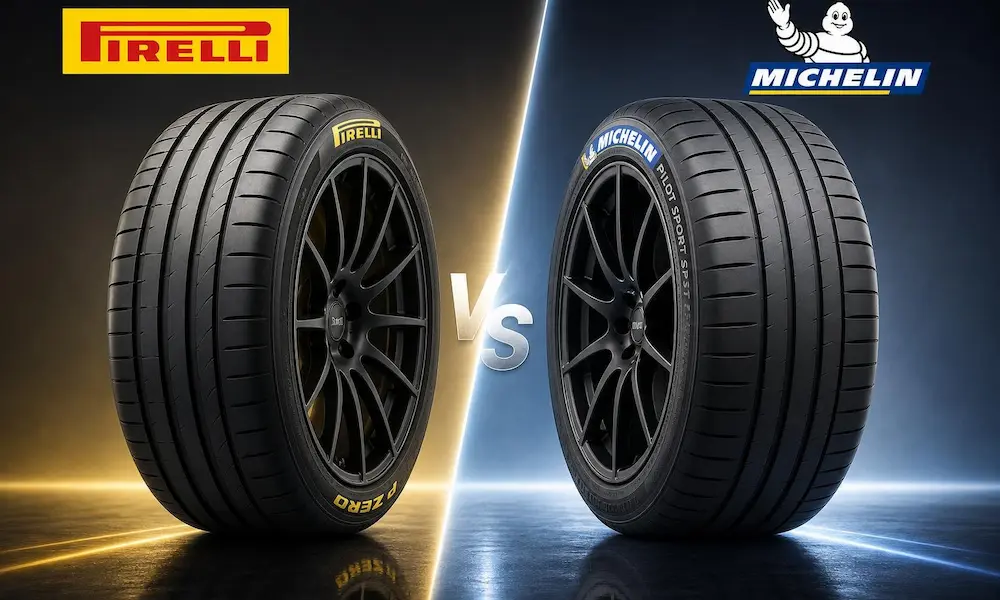
The Michelin Pilot Sport 4S has been the benchmark for ultra-high-performance summer tires for years. It uses a bi-compound tread — different rubber formulations on the inner and outer shoulders — to balance wet grip and dry cornering.
The Goodyear Eagle F1 Asymmetric 6 is newer and has actually outperformed the Michelin in some categories:
- Wet handling: Goodyear wins by a 1.5% lap-time advantage
- Dry braking: Goodyear edges Michelin by 0.1 meters
- Aquaplaning resistance: Michelin is better at higher speeds in deep water
One practical difference: the Goodyear reaches its optimal grip temperature faster — great for cold morning drives. The Michelin handles sustained track heat better — better for dedicated track days where tires get pushed hard for multiple laps.
| Segment | Michelin | Goodyear | Performance Winner |
|---|---|---|---|
| Ultra-High Performance | Pilot Sport 4S / 5 | Eagle F1 Asymmetric 6 | Wet Handling → Goodyear |
| Max Performance | Pilot Sport Cup 2 | Eagle F1 SuperSport R | Track Durability → Michelin |
| Performance All-Season | Pilot Sport All-Season 4 | Eagle Sport All-Season | All-Season Grip → Michelin |
Trucks and SUVs: LTX M/S2 vs. Wrangler Series
America drives trucks. This category matters more than most people realize.
Michelin Defender LTX M/S2
This tire is built for truck and SUV owners who mostly drive on pavement. Its ride quality is often described as car-like — smooth, quiet, refined. In winter testing, the Defender LTX M/S2 showed a 26% advantage in snow acceleration and a 17% lead in ice braking compared to more aggressive off-road alternatives.
If you tow, haul heavy loads, and do most of your driving on highways, this is probably your tire.
Goodyear Wrangler Series
The Wrangler line targets drivers who actually leave the pavement. It features aggressive tread blocks, reinforced sidewalls with Durawall technology, and Silent Armor layers of Kevlar for puncture resistance without added weight.
The Wrangler models typically cost about $20 less per tire than Michelin equivalents — a meaningful saving when you’re buying four tires for a fleet or multiple vehicles.
EV note worth mentioning: Rivian R1T owners comparing these tires have found that Michelin’s Defender series can add 15 to 20 miles of range compared to more aggressive all-terrain options. As trucks get heavier and cabin noise gets quieter, the tire becomes the loudest thing in the vehicle.
Noise Reduction Technology
Modern cars — especially EVs and hybrids — are so quiet that tire hum is now one of the top complaints from drivers. Both brands address this with foam-based solutions.
- Goodyear SoundComfort Technology: Open-cell polyurethane foam bonded to the inner liner. Targets air cavity resonance — the hum created by air vibrating inside the tire. Goodyear claims up to 50% noise reduction.
- Michelin Acoustic Technology: Similar foam inlay, but more structurally integrated. Michelin reports approximately 20% noise reduction.
Goodyear’s number sounds better on paper. Michelin’s integration is generally considered more refined in practice, though both make a noticeable difference.
The Real Cost Question: Which Is Cheaper Over Time?
This is where most people get the Goodyear vs Michelin decision wrong. They look at the sticker price and stop there.
Let’s do the actual math using real pricing and lifecycle data:
- Goodyear set: ~$640 upfront, lasts ~65,000 miles
- Michelin set: ~$800 upfront, lasts ~75,000–80,000 miles
- Michelin fuel savings: $50–$75 per year from lower rolling resistance
When you factor in mileage and fuel savings, the Michelin set can actually cost less per mile over its life — despite the $160 higher purchase price.
| Brand | Avg Price (Set of 4) | Typical Lifespan | Warranty | Annual Fuel Savings |
|---|---|---|---|---|
| Michelin | $720–$960+ | 70k–80k+ miles | Up to 80,000 miles | $50–$75 |
| Goodyear | $560–$800 | 60k–70k miles | Up to 65,000 miles | Baseline |
That said: If you’re selling your car in two years or only need 20,000 more miles out of a set, Goodyear’s lower price makes more sense. The math only favors Michelin if you’re keeping the car long-term.
Warranty and After-Sales Support
Both brands back their tires with a 60-day satisfaction guarantee — you can swap them if you hate the ride.
The real difference is what comes after:
- Goodyear: Solid mileage warranties, 60-day guarantee, standard roadside assistance options through dealers.
- Michelin Promise Plan: 60-day guarantee plus three years of roadside assistance covering flat tire changes, battery jump-starts, and lockout service. That’s a meaningful extra for solo drivers or long-distance commuters.
Run-Flat Tires: ZP vs. ROF
Both Michelin’s Zero Pressure (ZP) and Goodyear’s RunOnFlat (ROF) give you 50 miles at 50 mph after a puncture. The difference is in the feel.
| Feature | Michelin ZP | Goodyear ROF |
|---|---|---|
| Core Philosophy | Safety with Refinement | Safety with Performance |
| Ride Quality | More compliant | Firmer, sharper |
| Best For | Luxury vehicles | Performance vehicles |
| Post-Puncture Range | 50 miles / 50 mph | 50 miles / 50 mph |
Goodyear’s ROF tires, especially in the Eagle F1 line, feel sharper and more responsive. Michelin’s ZP tires feel closer to a regular tire — a key factor for luxury car owners who don’t want to sacrifice comfort.
Sustainability: Who’s Greener?
Both brands are pushing toward sustainable manufacturing, but Michelin leads:
- Michelin: Targeting 40% renewable or recycled materials by 2030, 100% by 2050. Its low-rolling-resistance tires actively reduce carbon output throughout the vehicle’s life.
- Goodyear: Uses soybean oil in tread compounds for cold-weather flexibility. Employs Tire Intelligence systems to help drivers maintain optimal pressure — which reduces wear and fuel use.
Michelin’s sustainability targets are more ambitious and publicly committed. Goodyear’s innovations are practical and already in production tires today.
So, Which Tire Brand Should You Actually Buy?
Here’s the honest answer — it depends on what you’re buying tires for:
Buy Goodyear if you:
- Want strong wet-weather performance at a lower price
- Drive off-road or on mixed terrain
- Need specialized performance (track grip, early warm-up)
- Plan to sell the vehicle within a few years
- Manage a fleet where upfront cost matters
Buy Michelin if you:
- Drive in snow and ice regularly
- Want the lowest cost-per-mile over the tire’s full life
- Own a luxury vehicle and care about ride refinement
- Value extended warranty support and roadside assistance
- Drive an EV and want to protect your range
The Goodyear vs Michelin decision isn’t about which brand is better. It’s about which brand is better for you, your car, and your roads.
Check your driving patterns, look at your budget, and pick accordingly. Both brands make excellent tires — they just make them for different kinds of drivers.