Facing a Honda Accord catalytic converter replacement? It’s expensive, confusing, and often hits at the worst time. This guide breaks down exactly what you’ll pay, what your warranty covers, why thieves love your car, and how to complete the repair correctly. Read to the end — there’s warranty information that could save you thousands.
What Does a Catalytic Converter Actually Do?
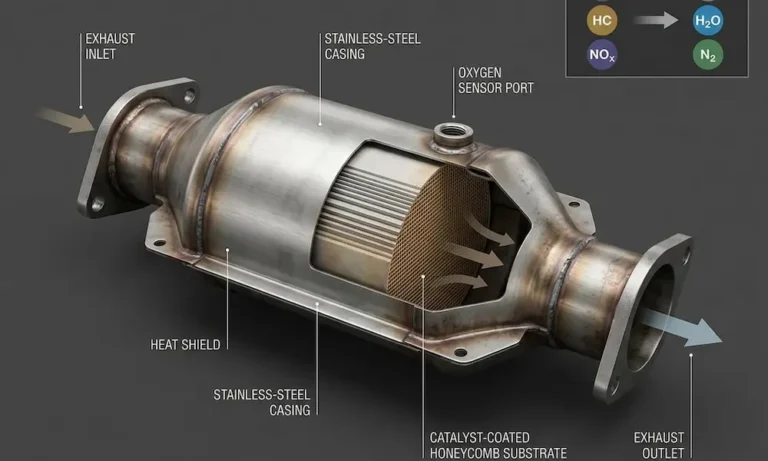
Your catalytic converter sits in the exhaust system and cleans toxic gases before they exit the tailpipe. Inside, a ceramic honeycomb structure gets coated with platinum, palladium, and rhodium. These precious metals trigger chemical reactions that convert harmful nitrogen oxides, carbon monoxide, and unburned hydrocarbons into harmless nitrogen, carbon dioxide, and water vapor.
That precious metal content is exactly why replacement costs so much — and why thieves target your Accord.
Where Honda Puts the Converter on Your Accord
Older Honda Accords placed the converter under the floorboards. Modern Accords use a close-coupled design, mounting the converter directly to the exhaust manifold on the cylinder head. This design heats up faster and reduces cold-start emissions dramatically.
Most 2.4-liter four-cylinder Accords use this integrated manifold design. Many models also add a secondary underfloor converter for extra emissions scrubbing. V6 models are more complex — they run dual converters near each engine bank, plus secondary underfloor units.
Signs Your Honda Accord Catalytic Converter Is Failing
Don’t ignore these warning signs. Catching failure early prevents expensive engine damage down the road.
Watch for these symptoms:
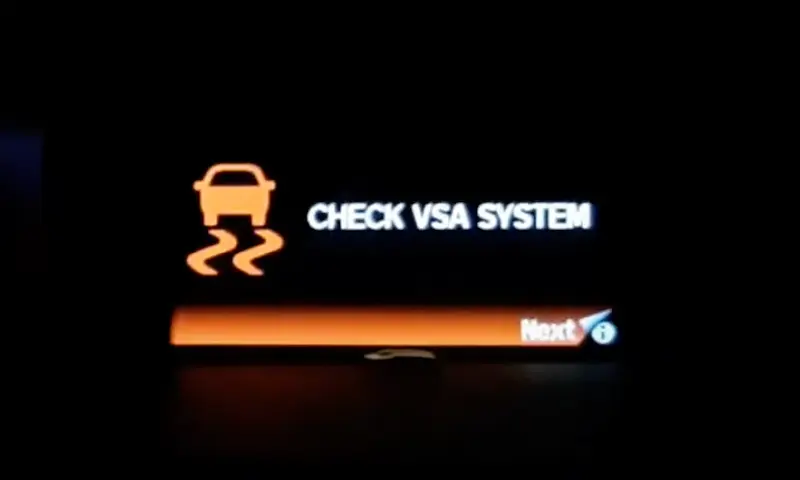
- Check Engine Light — The most common early warning. Your engine control module monitors upstream and downstream oxygen sensors. When both sensors read similar data, the computer knows the catalyst isn’t working and triggers a diagnostic trouble code
- Sluggish acceleration — A clogged converter chokes exhaust flow, strangling engine power
- Terrible fuel economy — The engine burns more fuel fighting backpressure
- Rotten egg smell — A failing converter can’t process sulfur compounds in gasoline
- Engine won’t start or stalls immediately — Total occlusion suffocates combustion instantly
- Engine misfires — Backpressure traps heat near the cylinder head, causing cascading damage
If the ceramic honeycomb collapses or melts, exhaust gases can’t escape. That backpressure forces extreme heat back into combustion chambers, risking permanent damage to piston rings and head gaskets. Stop driving and get it diagnosed immediately.
Honda Accord Catalytic Converter Replacement Cost
Here’s the honest answer: it’s not cheap. National averages for catalytic converter replacement range between $2,164 and $3,416 across all vehicles. For the Honda Accord specifically, expect to pay $1,000 to $2,700 depending on your trim, engine, and location.
Parts vs. Labor: Where Your Money Goes
The part itself drives most of the cost. Labor typically runs $70 to $300 — roughly one to two hours of work. The converter hardware is the expensive piece.
Here’s how the Honda Accord stacks up against similar vehicles:
| Vehicle | Estimated Cost (Low) | Estimated Cost (High) |
|---|---|---|
| Honda Accord | $1,000 | $2,700 |
| Honda Civic | $1,210 | $1,239 |
| Honda CR-V | $1,444 | $2,398 |
| Toyota Camry | $1,304 | $1,333 |
| Toyota Corolla | $1,038 | $1,835 |
| Nissan Altima | $2,127 | $2,169 |
| Ford Explorer | $1,700 | $1,744 |
| Chevrolet Silverado 1500 | $1,439 | $3,241 |
OEM vs. Aftermarket: Which Should You Buy?
Original Equipment Manufacturer (OEM) parts from Honda guarantee perfect fit and long service life. They also cost 40% to 70% more than aftermarket alternatives. A Honda dealership OEM converter frequently exceeds $1,400 for the part alone.
Aftermarket converters from brands like MagnaFlow, Walker, and AP Exhaust cost significantly less. Here’s a sample of current aftermarket pricing for Honda Accord converters:
| Part Number | Type | Emissions Standard | Retail Price |
|---|---|---|---|
| MagnaFlow 51893 | Integrated Manifold | Federal/EPA | $532.99 |
| MagnaFlow 49333 | Integrated Manifold | Federal/EPA | $578.99 |
| MagnaFlow 52306 | Integrated Manifold | Federal/EPA | $822.99 |
| MagnaFlow 51441 | Integrated Manifold | Federal/EPA | $429.99 |
| MagnaFlow 5461260 | Direct-Fit 2.4L | California/CARB | $1,050.00 |
| MagnaFlow 408034 | Universal Fit | California/CARB | $335.00 |
| MagnaFlow 51206 | Universal Fit | Federal/EPA | $211.00 |
Universal-fit converters cost least but require cutting and welding into your existing exhaust pipe. Direct-fit units bolt straight on, saving labor time despite a higher purchase price.
One critical point: If you live in California or a state that follows California Air Resources Board rules — including Colorado, Connecticut, Delaware, Maine, Maryland, and New York — mechanics are legally required to install a CARB-certified converter. These parts carry a California Executive Order number stamped into the metal shell and cost substantially more due to higher precious metal content.
Your Warranty Rights: This Could Save You Thousands
Before you pay anything, check your warranty coverage. Many Honda Accord owners don’t realize federal law may cover their entire repair cost.
The 8-Year/80,000-Mile Federal Warranty
The Clean Air Act of 1990 mandates that automakers cover catalytic converters, emissions control units, and onboard diagnostic systems for 8 years or 80,000 miles — whichever comes first. This covers parts and labor completely. If your Accord falls within this window, go straight to a Honda dealership. The repair costs you nothing.
Extended Hybrid Protection: 15 Years/150,000 Miles
Honda Accord Hybrid owners in CARB states get even stronger protection. Transitional Zero Emission Vehicles — which includes hybrid Accords — receive emissions warranty coverage for 15 years or 150,000 miles. That’s nearly the entire usable lifespan of the vehicle.
Aftermarket Converter Warranties
If you’re outside the manufacturer warranty window and buying an aftermarket unit, federal rules still protect you. Any new aftermarket converter sold in the United States must include:
- 5-year/50,000-mile structural warranty on the steel shell and end pipes
- 25,000-mile catalyst performance warranty when the vehicle is properly maintained
One important rule: federal law prohibits installing used converters from salvage yards unless they’ve been independently tested and certified. The certification process is so expensive that the legal used market barely exists. Any shop suggesting a cheap junkyard converter is offering you an illegal repair.
The Catalytic Converter Theft Epidemic
Mechanical failure isn’t the only reason Honda Accord owners face replacement costs. Theft is a massive driver of replacements nationwide.
In 2025 alone, more than 137,000 catalytic converters were stolen across the United States. Thieves use battery-powered reciprocating saws and can remove a converter in under five minutes from a parked car.
Why Your Accord Is a Prime Target
The Honda Accord consistently ranks among the most targeted vehicles in the West, Northeast, and Southeast regions. The 2003-2007 Accords with 2.4-liter four-cylinder engines are especially vulnerable — their converter sits centrally under the chassis with zero protection from skid plates or structural crossmembers.
The real prize for thieves? SULEV (Super Ultra Low Emissions Vehicle) Accords. These models contain highly enriched precious metal content and can fetch up to $500 on the black market. Thieves identify them by the factory SULEV sticker on the rear quarter panel window.
Here’s the current theft value breakdown:
| Converter Type | Estimated Black Market Value |
|---|---|
| Honda Oxygen High-Grade | $500 each |
| Honda Oxygen Regular | $300 each |
| Domestic High-Grade | $200 each |
| General Motors Regular | $120 each |
| Aftermarket Converters | $20 each |
| Diesel Converters | $13 each |
Rhodium prices drive this market. In early 2021, rhodium hit $17,000 per ounce. Prices fluctuated to around $5,000 before surging back past $11,000 in early 2026. Platinum trades near $2,000 per ounce. Palladium sits around $1,400 per ounce. When prices spike, theft spikes.
V6 Accords get targeted far less frequently. Their converters sit deep within the engine bay, making fast theft nearly impossible.
How to Protect Your Accord
You don’t have to make your car the easy target on the block. These tactics genuinely work:
- Install a catalytic converter shield — Heavy-duty aluminum or stainless steel plates bolt directly over the exhaust tunnel, blocking saw access. Miller Cat makes shields specifically for 2003-2007 Accords
- Remove your SULEV sticker — Don’t advertise that your converter is worth stealing
- Park strategically — Steep inclines, tight against walls, or on uneven surfaces make using a floor jack dangerous for thieves
- Consider a V6 emblem — Some owners affix V6 badges to four-cylinder models to suggest the converters are out of reach inside the engine bay
How the Replacement Actually Works
For a professional technician or a skilled DIYer, here’s how a Honda Accord catalytic converter replacement actually goes.
Tools You’ll Need
- Metric socket set (13mm, 14mm, 15mm)
- Specialized oxygen sensor socket
- Calibrated torque wrench
- Penetrating oil and wire brushes
- Reciprocating metal saw (for universal-fit converters requiring cutting)
- High-temperature anti-seize compound for sensor threads
The full replacement procedure for 2003-2007 Accords shows the top-down engine bay access required for close-coupled manifold designs.
Step-by-Step Process
Step 1: Let it cool completely. An active catalytic converter runs well over 1,000°F. This isn’t optional — it’s a serious burn hazard.
Step 2: Disconnect the oxygen sensors. Carefully unplug them from the wiring harness and unthread them from the converter shell.
Step 3: Unbolt the converter. Disconnect it from the cylinder head and the downstream exhaust flange. For universal-fit converters, cut along the original weld seams with a reciprocating saw.
Step 4: Clean all mating surfaces aggressively. Any carbon scoring, rust scale, or old gasket material left on the flanges creates exhaust leaks. Wire brush everything until it’s clean metal.
Step 5: Install the new converter. Check that the directional arrow on the converter shell points toward the tailpipe. Install fresh crush gaskets at every mating point.
Step 6: Torque in a crisscross pattern. Start from center bolts and work outward, torquing to Honda factory specifications. This prevents warping the aluminum cylinder head.
Step 7: Reinstall oxygen sensors. Apply high-temperature anti-seize to sensor threads. This saves you from a nightmare extraction job at the next service.
Completing the Honda Drive Cycle After Replacement
Installing the new part doesn’t finish the job. Your Honda’s engine control module needs to verify the new converter is working before it clears the readiness monitors. Without complete monitors, your Accord automatically fails a state emissions inspection.
When a technician clears the old diagnostic trouble codes — or when the battery gets disconnected during repair — all readiness monitors reset to “incomplete.” The Honda Accord drive cycle is notoriously specific.
The trickiest phase: you must decelerate from highway speeds to a complete stop without touching the brake pedal. This coasting phase lets the engine control module complete its final efficiency calculations. Touch the brakes, and the test aborts entirely.
Confirm your monitors are ready before heading to an inspection station. A basic Bluetooth OBD-II scanner shows monitor status. On many Honda models, turning the key to the “On” position without starting the engine causes the Check Engine Light to illuminate for 20 seconds — if it then blinks, your monitors aren’t ready yet.
Frequently Asked Questions
Can a failed catalytic converter permanently damage the engine?
Yes. If the internal ceramic honeycomb collapses or melts, severe backpressure builds in the exhaust system. Exhaust gases can’t escape, forcing extreme heat back into the combustion chambers. Over time, this degrades piston rings, compromises head gaskets, and can cause catastrophic internal engine failure. Stop driving immediately if you suspect total exhaust occlusion.
Do catalytic converter cleaning additives actually work?
Rarely, and only for minor issues. Chemical additives poured into your gas tank can occasionally dissolve light carbon soot deposits and temporarily clear a Check Engine Light. However, if your converter failed due to thermal melting, physical fracturing of the ceramic substrate, or contamination from oil or coolant leaks, no additive repairs that physical damage. You need a replacement.
Does car insurance cover a stolen catalytic converter?
Only if you carry Comprehensive coverage. Basic liability insurance — the legal minimum in most states — covers nothing. Even with Comprehensive coverage, you’ll pay your deductible first. Depending on your deductible amount, filing a claim might not make financial sense if it’s close to the cost of a budget aftermarket replacement.
Is removing the converter and installing a straight pipe legal?
No — it’s a federal Clean Air Act violation in all 50 states for any road-registered vehicle. Beyond the legal risk, it permanently triggers the Check Engine Light, guarantees an emissions inspection failure, and forces your engine computer into altered fuel-trim states that hurt acceleration and fuel economy.