Got a check engine light and a P0420 or P0430 code staring back at you? You’re probably looking at a Honda Pilot catalytic converter replacement — and it’s not cheap. But here’s the thing: if you don’t understand why it failed, you’ll be back in the same situation in a year. This guide covers everything from root causes to real costs, so read to the end before you spend a dime.
Why Honda Pilots Eat Catalytic Converters
Most people assume catalytic converters just wear out over time. On the Honda Pilot, that’s rarely the whole story.
The real villain is Honda’s Variable Cylinder Management (VCM) system. This fuel-saving technology shuts down two or three cylinders during light highway driving — you’ll see the green “ECO” light when it kicks in. The idea is smart on paper, but the execution creates a serious problem.
Here’s what actually happens:
- When cylinders deactivate, combustion pressure disappears
- Without that pressure, piston rings stop sealing tightly
- A vacuum forms inside those cylinders and sucks engine oil past the rings
- When VCM reactivates those cylinders, the trapped oil burns instantly
- That burned oil shoots straight into your catalytic converters
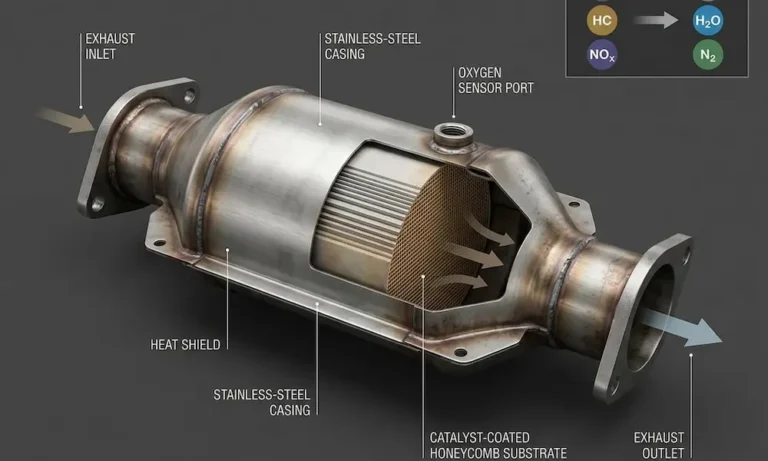
Some Honda Pilots burn up to a quart of oil every 1,000 miles because of this. The oil ash and carbon deposits coat the ceramic honeycomb inside the converter. Over time, that coating bakes into an impenetrable layer that blocks the chemical reactions the converter needs to function.
The problem got bad enough that a class-action lawsuit covered roughly 1.6 million vehicles from the 2008–2013 model years. Honda extended warranties temporarily, but never fully redesigned the system across all affected generations.
If you replace the converter without fixing the VCM problem, your new converter will fail the same way.
The Fix: VCM Bypass Devices
Aftermarket VCM bypass devices plug directly into the engine’s coolant temperature sensor. They add a tiny amount of electrical resistance to the sensor signal, tricking the engine computer into thinking the engine is running slightly cooler than it actually is.
Since VCM only activates after the engine hits a specific temperature threshold, this offset permanently prevents cylinder deactivation. Your engine runs on all six cylinders all the time.
Advanced versions use microcontrollers to keep your dashboard temperature gauge reading accurately while still blocking VCM. Installing one of these is considered a mandatory step when doing a Honda Pilot catalytic converter replacement — skip it and you’re wasting money.
Understanding the Honda Pilot’s Exhaust System
The Pilot uses a transverse engine layout, meaning the engine sits sideways across the engine bay. This creates a two-bank setup that directly affects how your catalytic converters are named, accessed, and replaced.
| Engine Bank | Location in Engine Bay | Cylinders | Common Name |
|---|---|---|---|
| Bank 1 | Rear — wedged against the firewall | 1, 2, 3 | Rear / Firewall-Side Converter |
| Bank 2 | Front — behind the radiator | 4, 5, 6 | Front / Radiator-Side Converter |
Both primary converters bolt directly to the cylinder heads — there’s no separate exhaust manifold. This integrated design helps the converters heat up faster after a cold start, which improves emissions performance. The tradeoff? They’re expensive and tricky to replace.
After the exhaust passes through both primary converters, it merges into a single pipe and flows through a secondary underfloor converter beneath the passenger cabin. This unit handles any remaining emissions before the exhaust exits the tailpipe.
Reading the Codes: What P0420 and P0430 Actually Mean
These two codes are the most common triggers for a Honda Pilot catalytic converter replacement.
| Code | Meaning | Affected Side |
|---|---|---|
| P0420 | Catalyst efficiency below threshold | Bank 1 (firewall side) |
| P0430 | Catalyst efficiency below threshold | Bank 2 (radiator side) |
| P0300 Series | Random or cylinder-specific misfire | Engine-wide |
| P0171 / P0174 | System running too lean | Bank 1 / Bank 2 |
The engine computer figures this out by comparing data from two oxygen sensors per bank. The upstream sensor reads exhaust gases before the converter. The downstream sensor reads them after. In a healthy system, the downstream sensor produces a steady, flat voltage signal around 0.6–0.8 volts. When the converter fails, that signal starts mimicking the erratic upstream sensor — and the code fires.
Don’t Replace the Converter Until You Rule These Out
Not every P0420 or P0430 means the converter is dead. Before spending $2,000, check:
- Faulty downstream oxygen sensor — A carbon-coated or heat-damaged sensor sends false readings
- Exhaust leaks upstream — A cracked flex pipe or blown manifold gasket sucks in fresh air, confusing the downstream sensor into thinking the converter isn’t working
- Active misfires — A P0300 series code means raw, unburned fuel is entering the converter and destroying it. Fix the misfire first, or you’ll ruin the new converter within days
Look for black soot marks around exhaust joints. A mechanic’s stethoscope along the exhaust flanges during a cold start can pinpoint leaks before you pull anything apart.
Physical Warning Signs
Beyond the check engine light, watch for:
- Rotten egg smell from the tailpipe — the converter isn’t processing hydrogen sulfide
- Power loss and hesitation — melted substrate is blocking exhaust flow
- Rattling sound when you tap the converter shell — broken ceramic pieces inside
- Worse fuel economy — the computer overcorrects by dumping extra fuel
Honda Pilot Catalytic Converter Replacement Costs
RepairPal estimates the average total cost at $1,919–$2,075 for a single converter, with labor running $303–$445 and parts making up the rest.
But actual costs vary a lot by model year:
| Model Year | Estimated Total Cost | Why |
|---|---|---|
| 2023–2025 | $371–$531 | Likely still under federal warranty — most repairs are covered |
| 2018–2022 | $2,435–$2,815 | Complex modern integrated manifolds with higher precious metal loads |
| 2009–2015 | $1,300–$1,800 | Strong aftermarket supply keeps parts costs down |
If your Pilot is under 8 years old or 80,000 miles, you may not owe anything. Federal emissions warranty law requires manufacturers to cover catalytic converters, the emissions control unit, and the onboard diagnostic computer for 8 years or 80,000 miles if the failure is a factory defect. Call your Honda dealer before paying out of pocket.
OEM vs. Aftermarket: Which Converter Should You Buy?
OEM converters from a Honda dealership offer perfect fitment and a factory warranty, but a single unit can cost over $1,378. Buying both Bank 1 and Bank 2 together pushes parts costs past $2,500 easily.
Aftermarket converters split into two tiers:
| Tier | Cost Per Unit | What You Get |
|---|---|---|
| Standard / HM Grade | $149–$250 | Lower precious metal load. Clears the code and passes basic tests, but less durable long-term |
| OEM Grade | $429–$595 | High precious metal concentration matching factory specs. Better longevity for sensitive engine management systems |
For a Pilot that’s already had VCM-related oil burning, go with OEM-grade aftermarket. The denser washcoat handles more contamination before failing.
Check Your State’s Rules Before Buying
If you live in California, New York, Maine, or Colorado, you need a CARB-compliant converter. Standard federal-spec parts are illegal in these states. CARB units carry an executive order number stamped into the shell — inspectors check for it during smog tests. They cost more, but installing the wrong part means an automatic inspection failure.
The Replacement Process (What’s Actually Involved)
This is a legitimate advanced repair. The firewall-side Bank 1 converter sits in a tight pocket between the engine and the firewall — you’re working mostly by feel. Seized fasteners are the biggest headache. Snapping a stud inside an aluminum cylinder head turns a $2,000 job into a much bigger one.
Essential tools:
- Metric sockets: 10mm, 12mm, 14mm, 17mm, 18mm, 22mm
- Slotted 7/8-inch oxygen sensor socket
- Torque wrench
- High-heat penetrating lubricant applied hours before you start
- Blowtorch for seized fasteners
- High-temperature anti-seize compound
Critical torque specs for the Honda Pilot:
- Upper converter nuts (cylinder head): 24 ft-lbs (32 Nm)
- Lower flange nuts (exhaust pipe): 33 ft-lbs (45 Nm)
- Oxygen sensors: 32 ft-lbs (44 Nm)
- Underfloor secondary converter nuts: 24 ft-lbs (33 Nm)
The Bank 2 (radiator-side) converter is accessible with direct line of sight. Bank 1 requires extensions, swivel joints, and patience. Both follow the same sequence: disconnect sensors, remove heat shields, separate the lower flange, then detach from the cylinder head.
Always use new crush gaskets and replace the self-locking nuts on the underfloor unit — those don’t re-lock reliably after one use.
After the Replacement: Clearing Codes and Drive Cycles
Once everything’s bolted up, connect an OBD-II scanner and clear the stored P0420/P0430 codes. The check engine light won’t go off on its own.
Then drive the vehicle through a complete drive cycle — cold start, city stop-and-go, steady highway cruising. The computer needs to run its internal readiness monitors against the new converters. If the downstream sensors read steady voltage and the monitors flip from “incomplete” to “passed,” you’re done. The vehicle is ready for an emissions inspection.
FAQs
What’s the scrap value of an old Honda Pilot catalytic converter?
Because converters contain platinum, palladium, and rhodium, they hold real value even when dead. A primary integrated converter from a Pilot typically fetches $50–$200+ depending on current precious metal markets. Always sell through licensed recyclers — this reduces demand for the thriving stolen converter black market.
Does insurance cover catalytic converter theft?
Yes — comprehensive coverage pays for theft and the surrounding exhaust damage, minus your deductible. Liability and collision policies don’t cover theft. Given how exposed the Pilot’s underfloor converter is due to the vehicle’s ground clearance, comprehensive coverage is worth having.
Is it safe to drive with a catalytic converter code?
If the engine runs smoothly and accelerates normally, short trips are generally fine while you schedule a repair. But if the vehicle struggles to accelerate or won’t rev past a certain point, the substrate has likely melted and is blocking exhaust flow. Tow it — driving with a blocked converter can destroy the engine.
Can a clogged converter cause a fire?
Yes. A severely blocked converter traps heat inside the housing. The exterior shell can glow red-hot. Parking over dry grass or leaves creates a real fire risk. If you notice unusual heat from under the vehicle, get it checked immediately.
Are the converters different between FWD and AWD Pilots?
The primary converters on the cylinder heads are generally the same across both drivetrains for the same model year. However, the underfloor secondary converter and its surrounding brackets often differ to accommodate the AWD transfer case and driveshaft. Always confirm your drivetrain when ordering underfloor components.