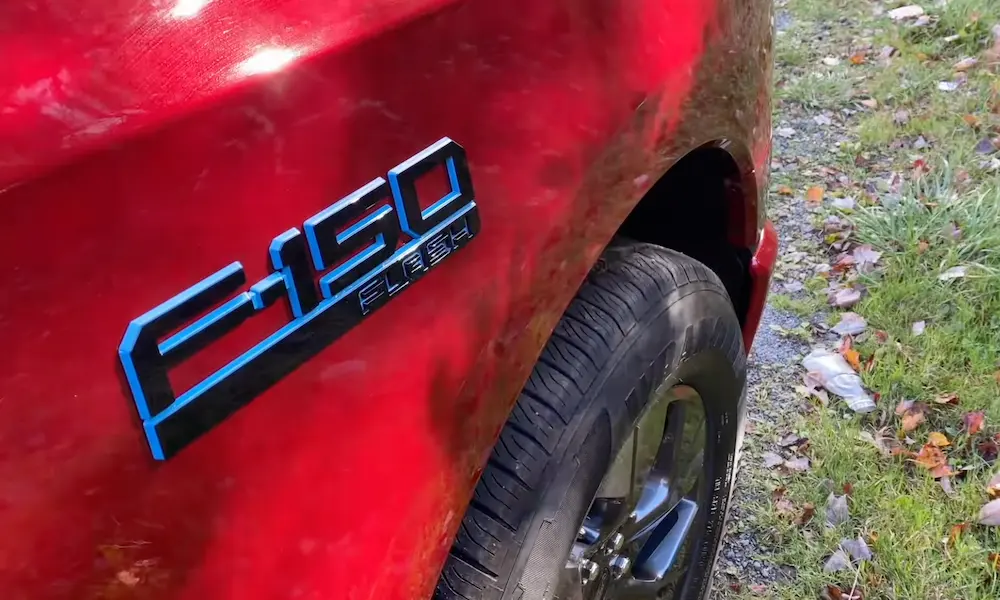
If you own a Ford 6.7L Power Stroke or a GM 6.6L Duramax, your factory fuel pump is already working against you. The CP4 to DCR conversion isn’t just an upgrade — it’s the structural fix that prevents a $10,000–$15,000 disaster. Keep reading to understand exactly why this matters and what your real options are.
Why the Factory CP4 Pump Fails (And It’s Not Your Fault)
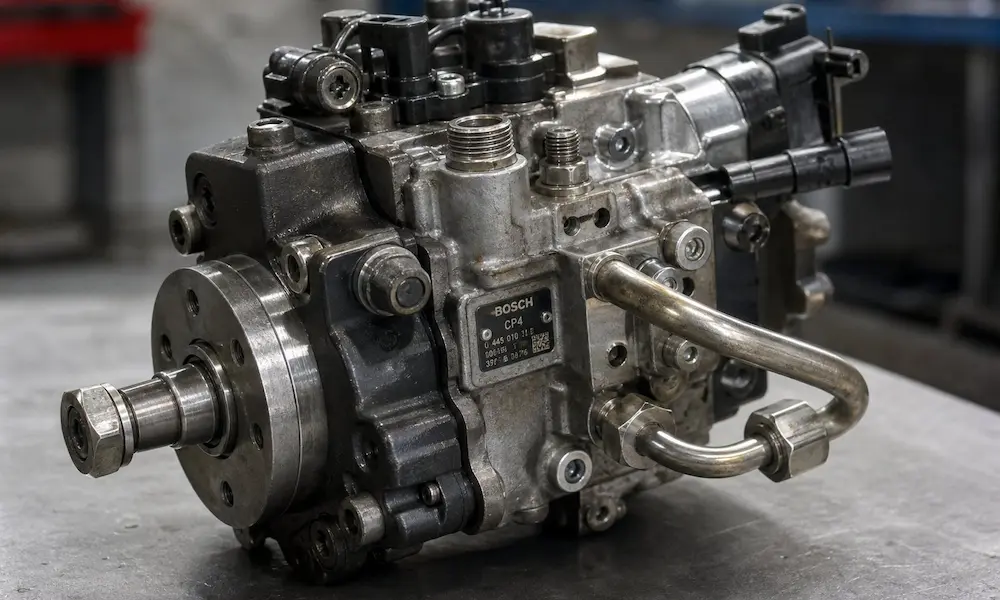
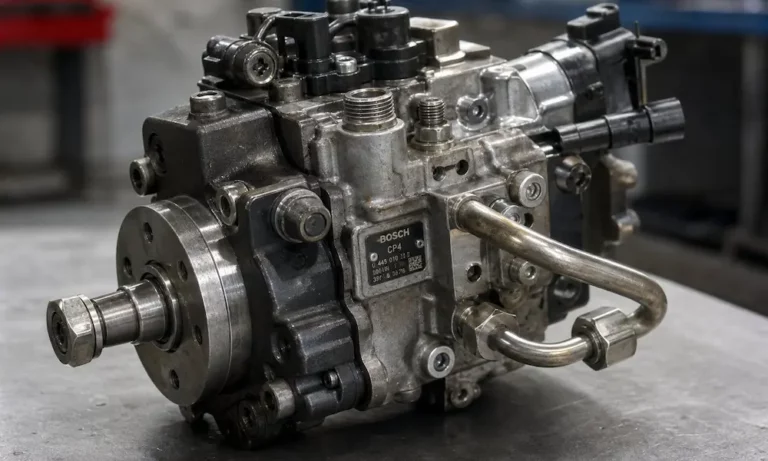
The Bosch CP4.2 pump is a brilliant piece of European engineering — designed for European diesel fuel. That’s the problem.
When Ford, GM, and Ram started installing the CP4.2 in U.S. trucks around 2011, they dropped a pump built for high-lubricity European diesel into a market running significantly thinner, less lubricating domestic fuel.
Here’s the chemistry behind it:
The EPA mandated ultra-low sulfur diesel (ULSD) to protect emissions systems. Removing sulfur also stripped the fuel’s natural lubricity. The CP4.2 relies entirely on fuel to lubricate its internal moving parts — no dedicated oil circuit, just diesel.
The industry already knew this was a problem. As far back as 2002, engine manufacturers warned that fuel injection equipment needs diesel with a maximum wear scar diameter of 460 microns. U.S. regulations allowed 520 microns. That gap — 60 microns — is what destroys your pump.
Class-action filings like Nunez v. Ford Motor Company allege Ford knew about this incompatibility before a single truck hit the road. Ford and GM historically blamed consumers for “fuel contamination,” voiding warranties and leaving owners with repair bills between $8,000 and $20,000.
What Actually Happens Inside a Failing CP4
The CP4.2 uses two pistons driven by a central camshaft. Lifter buckets sit between the cam lobes and the pistons, each with a hardened steel roller bearing at its base. Under perfect conditions, the roller spins smoothly along the cam lobe and everything stays aligned.
When fuel lubricity drops — or air gets pulled into the pump through cavitation — the fluid film between the roller and cam collapses.
Here’s the chain reaction that follows:
- Friction spikes between the roller and cam lobe
- The lifter bucket rotates violently inside its bore
- The roller drags sideways across the spinning cam
- Metal-on-metal grinding begins immediately
- Aluminum housing can crack or split from the forces involved
The worst part? The CP4 has no internal debris filter. Every metal shaving it generates gets pushed directly into the high-pressure fuel rails. From there, it travels straight into your injectors — which have tolerances measured in microns.
The contaminated fuel then recirculates back through the low-pressure return lines into your fuel tank, spreading destruction through the entire system.
A full catastrophic failure means replacing:
- The injection pump
- All 8 fuel injectors
- Both high-pressure fuel rails
- All high-pressure lines
- Complete fuel tank flush and decontamination
That’s why repair bills hit five figures fast.
What Makes the DCR Pump Different
S&S Diesel Motorsport partnered with PurePower Technologies — the aftermarket division of Stanadyne, a global diesel injection developer — to build a pump that eliminates the failure mechanism entirely.
The result is the Diesel Common Rail (DCR) conversion, built on Stanadyne’s proven Modular Diesel Common Rail (MDCR) platform — rated to 2,500 bar and already battle-tested in demanding commercial applications.
Eccentric Drive: The Key Architectural Difference
The DCR throws out the lifter bucket and roller bearing design completely.
Instead, it uses a patented eccentric drive system. A central eccentric cam lobe drives a continuous ring that actuates the pumping plungers. There are no independent buckets that can rotate in their bores. The primary failure mode of the CP4 is physically impossible in this design.
Better Materials, Better Lubrication
| Feature | Factory Bosch CP4.2 | S&S / PurePower DCR Pump |
|---|---|---|
| Pumping Mechanism | Lifter Buckets + Roller Bearings | Patented Eccentric Drive + Ring |
| Housing Material | Cast Aluminum | Forged Steel |
| Displacement | 895–995 cc/rev | 1,250 cc/rev (+25%) |
| Primary Failure Point | Lifter rotation → cam destruction | Engineered out entirely |
| Debris Path on Failure | Into high-pressure rails + injectors | Routed to low-pressure return circuit |
| Lubrication Strategy | Fuel lubricated; sensitive to low lubricity | Fuel lubricated; pressure-fed cams + bushings |
| Biofuel Compatibility | Poor | Excellent |
The forged steel housing won’t crack under stress. The pressure-lubricated cams and bushings stay wetted even when air enters the system. And if the DCR ever does fail — which is far less likely — its internal routing sends debris out through the low-pressure return circuit, not into your injectors.
25% More Flow Capacity
The DCR delivers 1,250 cubic millimeters per revolution versus the factory pump’s 895–995 cc/rev. That extra flow buffer keeps rail pressure stable as injectors wear over time. It also gives you headroom for moderate injector upgrades down the road.
No Tune Required — and It’s 50-State Legal
This is where the DCR separates itself from every other pump swap option.
Because the engineering team matched the DCR’s output curve precisely to the factory pump, your ECU never knows the pump changed. No custom tuning. No diagnostic trouble codes. No emissions tampering.
The DCR conversion carries:
- SEMA emissions certification (Certificate SC-SDM01-0034)
- CARB Executive Order D-756-7 — fully legal in California and all 50 states
For commercial fleets and daily drivers, that legal status isn’t a small thing. It means no failed inspections, no federal fines, and no voided insurance policies.
How the Installation Actually Works
The DCR conversion kit (Part Number 6.7F-DCR-1) covers 2011 to 2026 Ford Super Duty platforms with everything needed for a direct-fit install — billet aluminum adapter plate, custom high-pressure steel fuel lines, low-pressure supply and return lines with factory quick-connect fittings, mounting hardware, and a tail support bracket.
Installing it is not a weekend driveway job. Expect 8–10 hours of labor from a qualified diesel tech.
The pump sits deep in the engine’s lifter valley. To reach it, a technician must remove:
- Cold side intercooler piping
- Upper and lower intake manifolds
- EGR bypass pipe
- Engine-mounted fuel filter housing
- Cooling fan (requires specialized Ford holding tools)
- Vacuum pump on the front cover
On 2011–2016 trucks, removing the vacuum pump means installing a new crush gasket (BC3Z-2A572-A). Skip that step and you’ll have a major oil leak on your hands.
Torque Specs Matter Here
| Component | Torque Specification | Notes |
|---|---|---|
| Pump Gear Nut | 60 ft-lbs (81 Nm) | — |
| Adapter Plate to Block (T45 Torx) | 25 ft-lbs (34 Nm) | Blue Loctite 243; snug to 10 ft-lbs first |
| Pump Mounting Nuts | 18 ft-lbs (25 Nm) | — |
| High-Pressure Fuel Lines | 26 ft-lbs (35 Nm) | — |
| Fan Clutch to Pulley | 98 ft-lbs (133 Nm) | — |
After assembly, prime the low-pressure system by cycling the ignition to ON for 30 seconds — repeat up to five times to purge air from new lines before cranking the engine.
Duramax L5P Owners
PurePower and S&S also offer a DCR conversion for 2017–2025 GM 6.6L Duramax L5P engines (Kit 608990). The L5P runs a Denso HP4 pump from the factory — different brand, same vulnerability profile. The same eccentric drive philosophy applies, and it’s equally plug-and-play with no tuning required.
How the DCR Stacks Up Against Other Options
You’ve got four realistic choices for dealing with the CP4 problem. Here’s what they each actually do:
| Option | Prevents Pump Failure? | Protects Injectors? | Tuning Required? | Best For |
|---|---|---|---|---|
| Disaster Prevention Kit | No | Yes (if pump fails gently) | No | Budget-conscious mitigation |
| CPX Pump | Partially | Yes | No | Performance builds on CP4 platform |
| CP3 Conversion | Yes | Yes | Often required | High-horsepower or older platforms |
| DCR Conversion | Yes | Yes | No | Daily drivers needing OEM-grade reliability |
The Disaster Prevention Kit
S&S Diesel’s bypass kit reroutes the lubricating fuel that washes over the CP4’s cam and lifters through an external filter before sending it back to the tank. If the pump destroys itself, the debris gets trapped in that filter instead of your injectors.
It’s smart engineering for what it is — but it doesn’t stop the pump from failing. You still end up stranded, towing to a shop, and buying a new pump. It’s an insurance policy, not a cure.
The CPX Pump
River City Diesel’s CPX pump addresses the rotation problem by machining a pin into the lifter bore, physically preventing the bucket from spinning. It also offers up to 38% more flow and can support 800+ horsepower builds.
The pin is clever. But the roller bearing and cam lobe are still subject to the same catastrophic friction during low-lubricity events. Industry consensus leans toward viewing the CPX as a refined improvement on a flawed foundation — not a ground-up solution like the DCR.
The CP3 Conversion
The Bosch CP3 is legendary for durability and massive lubrication margins. For 2011–2016 Duramax LML and 2019–2020 Ram Cummins owners, it remains the dominant upgrade path and supports extreme horsepower figures with stroker configurations.
For Ford Power Stroke owners, though? The CP3 swap is invasive, complex, and frequently requires custom ECU tuning to avoid drivability issues and codes. That tuning requirement alone makes the DCR the smarter choice for any truck that needs to stay emissions-legal and drive clean every day.
Protecting the DCR: Lift Pumps and Filtration
Even with a DCR installed, the health of your high-pressure fuel system depends on what’s feeding it. Cavitation — air getting pulled into the pump under heavy load — is the enemy.
Frame-mounted FASS Titanium Signature Series or No-Drop Plus systems deliver up to 250 GPH of positive-pressure, air-separated fuel to the pump. Centrifugal air separation technology strips entrained air before it reaches the engine. Combined with 2-micron absolute filtration and 99%+ water separation, these systems create the ideal feeding environment for the DCR’s pressure-lubricated bushings.
If your factory pump has already failed, don’t install a DCR into a contaminated system. You’ll destroy the new pump immediately. Fuel contamination kits bundle the DCR conversion with eight new injectors, new rails, new lines, and all necessary hardware — a complete clean-slate rebuild.
The Financial Reality of Waiting
The DCR conversion kit runs $2,400–$2,800. Professional installation adds $800–$1,400. Total: roughly $3,500–$4,500 installed.
A post-failure repair — injectors, rails, lines, tank flush, labor — runs $10,000–$15,000. Factory warranties rarely cover it, and manufacturers have historically deflected blame onto the fuel supply.
The math is simple. The DCR conversion is cheaper than one catastrophic failure, and it comes with the peace of mind that the failure isn’t coming at all. For commercial fleet operators, it transforms an unpredictable liability into a scheduled capital improvement with a clear ROI.
The 2023 MOTOR Top 20 Award recognized the DCR conversion as one of the most significant aftermarket innovations of the year. That recognition reflects what diesel owners and technicians already know — it’s the one fix that actually solves the problem instead of managing it.