That flashing tire pressure light on your Lexus dashboard isn’t something to ignore. It could mean a dead sensor battery, a failing component, or a quirky software glitch — and each scenario needs a different fix. This guide walks you through everything: what the warning means, what parts to buy, what it’ll cost, and how to reset the system correctly.
What Your Lexus TPMS Warning Light Is Actually Telling You
Before you replace anything, read the light. Your Lexus uses a horseshoe-shaped icon with an exclamation point — and how it behaves tells you exactly what’s wrong.
Steady light on: At least one tire is more than 25% below the recommended cold inflation pressure. Check your tire pressures first. It might just be a nail or normal air loss from cold weather.
Flashing for 60–90 seconds, then staying on: This is a system communication failure. A sensor isn’t talking to your car’s computer. Nine times out of ten, it’s a dead sensor battery.
The TREAD Act mandates direct TPMS on all new U.S. vehicles. Unlike indirect systems that guess pressure from wheel-speed data, your Lexus uses dedicated battery-powered sensors inside each wheel. More accurate — but they do eventually die.
How Long Do Lexus TPMS Sensor Batteries Last?
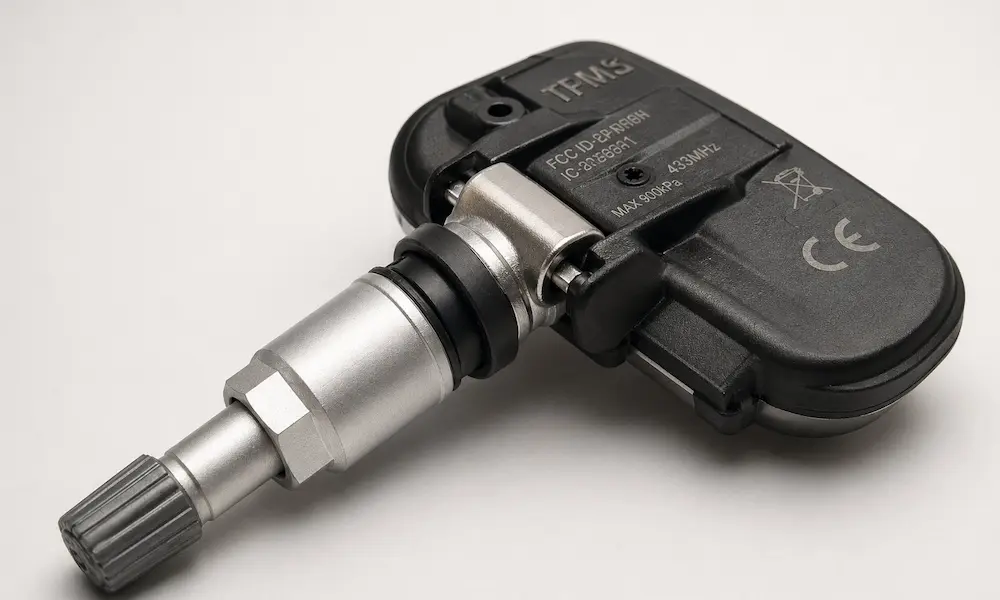
Each sensor runs on a sealed, non-replaceable lithium-ion battery. You can’t swap just the battery. When it dies, the whole sensor goes.
Typical lifespan: 5–10 years. But that range shifts based on:
- Driving style: Stop-and-go city driving drains sensors faster. Sensors wake up and transmit every time the wheel spins, so constant starts and stops burn through the battery quicker than a steady highway cruise.
- Climate: Extreme summer heat speeds up internal battery discharge. Cold climates cause pressure drops that can trigger false alerts, but they’re actually easier on the battery chemistry.
- Mileage: More miles = more transmissions = faster drain.
Here’s the important part: When one sensor dies, the others are likely close behind. They all went into the wheels at the same time. Replacing only the dead one means you’ll probably be back in the shop three more times over the next year. On any Lexus older than seven years, replace all four sensors at once.
Choosing the Right Lexus TPMS Sensor: OEM vs. Aftermarket
Lexus sensors run on either 315 MHz or 433 MHz frequencies, depending on the model year and platform. Get the wrong frequency and the sensor won’t communicate at all.
The factory supplier for most Lexus vehicles is Pacific Industrial Co., Ltd., with Denso also supplying direct-fit replacements. Both match factory specs exactly.
The problem with cheap aftermarket sensors: Many budget universal sensors lack the proprietary software your Lexus needs to display individual tire pressures on the dashboard. The warning light might go off, but your instrument cluster will show blank dashes or error fields where each tire’s pressure should appear. That’s annoying and defeats the point of having a premium system.
Stick with: Genuine Pacific, Denso, Huf, Schrader, or Autel programmable sensors.
Here’s the quick reference by model:
| Lexus Model | Frequency | OEM Part Numbers | Recommended Aftermarket |
|---|---|---|---|
| RX Series (RX350, RX450h) | 315 / 433 MHz | Pacific 42607-30060, 42607-0E020 | Denso, Pacific, Huf, Schrader, Autel |
| NX Series (NX200t, NX300) | 315 / 433 MHz | Pacific 42607-30060, 42607-48010 | Pacific, Huf, Autel, Schrader |
| IS Series (IS250, IS350) | 315 MHz | Pacific 42607-30060, 42607-06090 | Pacific, Huf, Schrader, Autel |
| GS Series (GS350) | 315 MHz | Pacific 42607-33021, Denso 550-0105 | Autel, Schrader, Bosch, Huf |
| GX and LX Series | 315 / 433 MHz | Pacific 42607-33021, 42607-0E020 | Pacific, Schrader, Huf, Autel |
| ES Series (ES350) | 315 / 433 MHz | Pacific 42607-48010, 42607-48020 | Denso, Pacific, Schrader, Autel |
Lexus TPMS Sensor Replacement Cost: What You’ll Actually Pay
Costs vary significantly depending on where you go. The labor involves breaking the tire bead, cleaning corrosion off the aluminum rim seat, installing fresh sealing washers, and rebalancing the wheel. That all adds up — unless you time it right.
Pro tip: Schedule your Lexus TPMS sensor replacement when you’re already buying tires or getting a rotation. Many national chains and warehouse clubs waive or heavily discount programming fees when the tire is already off the rim.
| Service Channel | Sensor Cost | Labor & Programming | Balancing | Total Per Wheel |
|---|---|---|---|---|
| Lexus Dealership | $100–$300 | $50–$150 | $40–$130 | $250–$500 |
| Independent Shop | $50–$200 | $50–$100 | $20–$70 | $120–$340 |
| National Tire Retailer | $40–$90 | $20–$50 | $10–$40 | $70–$180 |
| Warehouse Club (e.g., Costco) | $45–$65 (included) | Minimal surcharge | Included with tires | $45–$65 |
| DIY | $20–$90 | $0 | $5–$20 | $25–$110 |
Multiply by four for a full set. At a dealership, you’re looking at $1,000–$2,000 total. At a warehouse club or tire chain during a tire purchase, you might walk out spending under $300.
Two Lexus-Specific Quirks That Cause False TPMS Faults
Before you spend money on new sensors, check these two things. Either one can trigger a persistent dashboard warning with nothing actually wrong.
The Main/2nd Selector Switch
Many Lexus SUVs and sedans have a dual-memory system that stores two separate sets of sensor IDs — one for your regular wheels and one for winter wheels. A physical button labeled “Main/2nd” toggles between them.
This switch is tucked away in sneaky spots: under the passenger-side glove box, on the driver’s knee bolster, or near the OBD port. It’s easy for a passenger to accidentally kick it or a detail technician to bump it while cleaning.
If it’s switched to “2nd” and no secondary sensors are registered, your tire pressure light will flash and stay on indefinitely — even if every tire is perfectly inflated. Check this switch first. Always.
ECU Loop Lock
This one catches even experienced technicians off guard. If someone presses the manual TPMS reset button after new, unregistered sensors are installed but before their IDs are written to the ECU, the computer enters a continuous search loop. It keeps hunting for the old sensor IDs and locks out diagnostic tools completely.
To fix it, a technician connects a TPMS scan tool to the OBD port and runs a specific “Unlock ECU” command. That clears the loop, resets the communication channel, and lets the new sensor IDs get written properly. Don’t press that reset button until the sensor programming is complete.
How to Physically Replace a Lexus TPMS Sensor
If you’re doing this yourself, the process requires a bead breaker or tire machine — not just a floor jack and some patience. Here’s the step-by-step:
- Stabilize the vehicle. Level surface, parking brake engaged, lug nuts loose before jacking.
- Remove the wheel. Lift with a floor jack, secure on jack stands, pull the wheel.
- Deflate the tire completely. Use a valve core tool to remove the core.
- Break the bead. Use a bead breaker — starting on the opposite side from the valve stem. Then carefully work near the valve stem. Don’t let the bead crush the sensor housing.
- Remove the old sensor. Unscrew the external retaining collar nut, pull the sensor out through the inside of the rim.
- Clean the valve hole. Scrape off all corrosion, road salt, and aluminum oxidation. A clean seat prevents air leaks.
- Install the new sensor. Insert through the rim, thread on the fresh sealing washer and collar nut.
- Torque correctly. Tighten to 35–80 inch-pounds (4–7 Nm). Too tight = cracked grommet. Too loose = slow leak.
- Re-seat the tire, inflate, and balance. Inflate to the cold pressure spec on your driver’s door jamb. Spin-balance the assembly.
Lexus TPMS Relearn Procedures by Generation
Replacing the sensor is only half the job. Your Lexus ECU needs to learn the new sensor’s unique ID. Sensor programming and vehicle relearning are two different steps — and both matter.
- Programming (only for blank universal aftermarket sensors): You write the Lexus communication protocol onto the sensor chip using a TPMS tool before mounting it.
- Relearning (required for every sensor, OEM or aftermarket): You register the new sensor’s ID to the ECU and assign it a wheel position.
Here’s how relearning works across Lexus generations:
Older First-Generation Models (physical reset button):
Find the reset button on the lower driver’s knee bolster, above the accelerator, or inside the glove box. Inflate all tires to placard pressure. Turn the ignition to ON (engine off). Hold the button until the TPMS light blinks three times. Start the car and drive for up to 20 minutes.
Mid-Generation Models (steering wheel menus):
After inflating tires, turn on the vehicle and navigate to Settings → Vehicle Settings → TPMS → Set Pressure in the instrument cluster. Hold the center steering wheel button until the screen confirms recalibration.
Latest Generation (touchscreen):
Go to Settings → Vehicle Customize → Tire Pressure on the main touchscreen. Select “Set Current Air Pressure” and tap “Continue” to finalize calibration.
Automatic Rolling Reset:
Some models need nothing more than driving above 25 mph for 10–30 minutes. The sensors transmit updated coordinates automatically. The light clears on its own.
After Physical Sensor Installation — OBD Write Required:
If you installed a new sensor (not just adjusted pressure), you must connect a TPMS scan tool to the OBD port and write the new sensor IDs in sequence: Left Front → Right Front → Right Rear → Left Rear. Then trigger each sensor again to sync and activate. This clears the fault and locks in the new hardware.
Smart Ways to Cut Your Lexus TPMS Replacement Costs
Don’t pay full dealership prices if you don’t have to. A few simple moves save real money:
- Bundle with tire purchases. Labor fees often disappear when the tire is already off the rim.
- Replace all four at once on vehicles over 7 years old. One shop visit beats four.
- Skip cheap universal sensors that leave your dashboard display broken. High-quality programmable sensors from Denso, Huf, or Autel cost more upfront but keep every feature working.
- Check the Main/2nd switch before authorizing any diagnostic work. That five-second check could save you $100 in diagnostic fees.
- Go DIY if you have the tools. A sensor and a TPMS programmer can cost under $110 total versus $500 at a dealership.