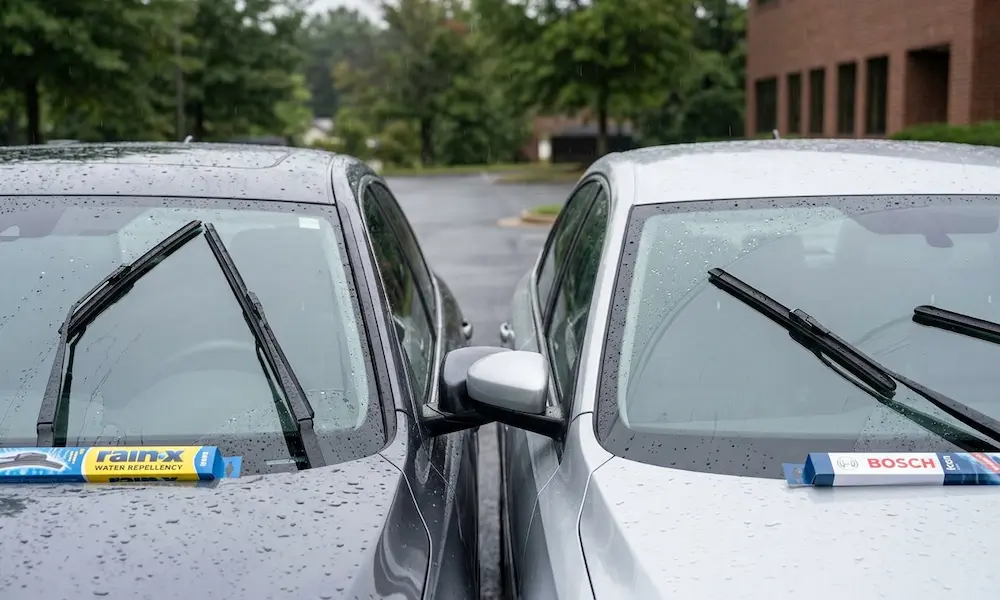
Picking the wrong wiper blades can genuinely cost you visibility when it matters most. This Rain-X wiper blades vs Bosch breakdown cuts through the noise so you can pick the right blade for your car, your climate, and your budget. Stick around — the answer might surprise you.
They’re Built on Two Very Different Ideas
Before we get into specs, you need to understand what each brand is actually trying to do.
Bosch pioneered the modern windshield wiper system and supplies original equipment to major car manufacturers worldwide. Their entire philosophy is built around mechanical precision — a blade that makes clean, consistent contact with the glass, every single stroke, for as long as possible.
Rain-X started as a chemical company. Their famous water-repellent spray came first. When they moved into hardware, they built blades that double as applicators for that same hydrophobic tech. Their goal isn’t just to wipe water off — it’s to make water not want to stick in the first place.
That single difference shapes everything: the materials, the features, the performance, and who each brand works best for.
Blade Types: What’s Actually on the Market
Both brands sell blades in three main designs. Here’s a quick look:
| Blade Type | How It Works | Best For |
|---|---|---|
| Conventional | Metal frame with multiple pressure points | Older vehicles, tight budgets |
| Beam (Bracketless) | Single spring strip, uniform pressure | Modern aerodynamic cars, all-season use |
| Hybrid | Conventional frame inside a sleek plastic shell | Newer vehicles wanting the OE look |
Both brands have strong beam-blade options. That’s where their premium products live — and where this comparison gets interesting.
How They’re Built: Engineering and Materials
Bosch ICON: Evodium Steel and Tension Memory
The Bosch ICON uses dual precision-tensioned Evodium steel springs, curved to match the exact radius of your windshield. This creates “tension memory” — the blade maintains even pressure across every inch of the glass, including the tricky curved edges where cheaper blades leave dry spots.
At highway speeds, Bosch’s asymmetrical aerodynamic spoiler pushes the blade into the glass rather than letting wind lift it away. Bosch claims the ICON resists wind lift up to 100 mph — a big deal during fast-moving storms.
The rubber itself uses ClearMax 365 technology: a dual-compound design with a soft inner core for quiet flipping at each stroke end and a hard polymer shell that resists ozone and heat cracking. Bosch says this adds up to 40% more service life compared to other premium rubber blades. A graphite-based Power Protection Plus coating reduces friction during light drizzle.
Rain-X Latitude and Silicone Lines: Hydrophobic Science
The Rain-X Latitude 2-in-1 uses a rubber-encased beam structure with a built-in aerodynamic spoiler. It’s structurally solid — but what sets it apart is the chemical transfer happening every time the blade moves.
As you drive, the squeegee deposits a thin hydrophobic layer onto the glass. Water beads up and rolls off — even between wiper strokes. During a heavy downpour at 70 mph, that’s a real advantage. Testing by Car Talk and GearJunkie consistently ranks the Latitude 2-in-1 near the top for immediate water removal.
For extreme climates, Rain-X’s Silicone Endura and AdvantEdge lines go further. Silicone elastomers handle temperature extremes better than rubber — no cracking in deep winter, no melting in brutal summer heat. And silicone naturally deposits a hydrophobic film as it wipes, so you get the water-beading benefit without any special activation process.
Material Comparison at a Glance
| Property | Bosch ClearMax 365 | Rain-X Silicone |
|---|---|---|
| Core Material | Dual-compound synthetic rubber | Solid silicone elastomer |
| UV/Ozone Resistance | High (polymer shell) | Superior (inherent) |
| Temperature Range | -30°C to 55°C | Excellent in extremes |
| Friction Reduction | Graphite coating | Inherent lubricity |
| Secondary Function | Mechanical clearing | Clearing + hydrophobic transfer |
| Expected Lifespan | 40% longer than standard premium | Up to 2–3x standard life |
Smart Features That Actually Matter
Rain-X 2-in-1 Activation
The Rain-X Latitude 2-in-1 needs a short activation before it hits its stride. Clean your windshield well — dish soap and a non-abrasive sponge work fine. Then run the blades for 2–3 minutes on a clean wet or dry surface. After that, the repellent builds up and water starts beading noticeably.
Once active, the reduced wiper frequency also cuts wear on your wiper motor. Less work, longer life.
Bosch NightFocus and SafeCheck
Bosch’s ENVISION and FOCUS lines tackle a problem Rain-X ignores: night driving glare. The NightFocus and NightView technologies reduce the blur and light refraction caused by micro-streaks on the glass — a real hazard when oncoming headlights scatter across a wet windshield.
The FOCUS blade adds a NightSpoiler with light-absorbing charcoal to cut reflections off the blade itself.
The SafeCheck indicator is a small built-in marker that turns from black to yellow when the blade has experienced enough environmental stress to warrant inspection. It’s a smart, passive reminder that doesn’t rely on you noticing reduced performance before it’s too late.
Installation and Fitment
Bosch: OE Precision
Bosch’s premium ICON line often comes in vehicle-specific OE configurations — no adapter juggling needed. The locking clasp snaps into place in one motion. It’s tight, low-profile, and matches your car’s original look.
One heads-up: some vehicles, like the Mazda CX-5, require a specific adapter (adapter #6) that isn’t always included. Always check the vehicle-specific catalog before buying.
Rain-X: Universal First
Rain-X uses a universal adapter system designed to fit 98–99% of vehicles on the road. Most blades ship with a pre-installed J-hook and a multi-adapter for other common arm types. The Uniclick system handles specialized European arm types with interchangeable pieces.
The trade-off: those multi-adapter assemblies can be slightly bulkier, and some drivers notice a small uptick in wind noise compared to an OE-fit Bosch design.
Common Wiper Arm Fittings
| Fitting Type | Common Vehicles | How It Connects |
|---|---|---|
| J-Hook | Older vehicles, Asian/domestic cars | Arm slots into a curve on the blade |
| Side Pin | Older domestic/European models | Pin inserts into a hole in the blade |
| Pinch Tab | Newer domestic/European vehicles | Tabs squeeze for release |
| Push Button | Modern European (VW, Ford) | Square button locks into the arm |
| Bayonet | Older European vehicles | Groove on arm slots into blade |
Real-World Performance
Heavy Rain
Rain-X Latitude wins this one. The hydrophobic coating clears water faster and keeps the glass cleaner between strokes. GearJunkie’s testing confirms this — the 2-in-1 is hard to beat in a downpour.
Long-Term Streak Resistance
Bosch edges ahead over time. The precision-tensioned spring maintains consistent pressure for months. Rain-X blades can develop mild chatter as the coating wears down, especially in hot climates.
Noise
Both perform well. Bosch’s dual-compound rubber and graphite coating make it exceptionally quiet. Rain-X’s Silicone Endura and Acoustix lines are competitive — but some users report more chatter from standard Rain-X rubber blades after several months.
Winter Performance
It’s close. Neither beam blade has the external hinges that ice up and fail. Bosch’s SnowDriver line adds extra cold-weather engineering. Rain-X Latitude stays flexible in sub-zero temps thanks to its rubber-encased structure. Pacific Northwest testing shows Rain-X Silicone actually improves over time as the silicone beds into the glass.
What Do They Cost?
| Brand | Model | Estimated Price (Single Blade) |
|---|---|---|
| Rain-X | Expert Fit Conventional | $10–$15 |
| Rain-X | Latitude 2-in-1 | $15–$25 |
| Rain-X | Silicone Endura / AdvantEdge | $26–$38 |
| Rain-X | Truck & SUV | $30–$40 |
| Bosch | Clear Advantage | $10–$18 |
| Bosch | ICON | $22–$35 |
| Bosch | FOCUS / ENVISION | $32–$50 |
| Bosch | Aerotwin OE Set | $30–$67 |
The sticker price gap closes fast when you factor in lifespan. A premium silicone or Bosch ICON blade can last 2–3x longer than a conventional blade. Fewer replacements, less hassle, better value.
Who Should Buy Which?
Pick Rain-X if:
- You drive in a high-rainfall region
- You want water beading off the glass between wiper strokes
- You live somewhere with extreme UV exposure or temperature swings (go silicone)
- You drive a truck or SUV with a large windshield (Rain-X Truck & SUV line)
Pick Bosch if:
- You want a blade that’s quiet, consistent, and lasts through every season
- You do a lot of highway or night driving (NightFocus is genuinely useful)
- You want OE-quality fitment that looks factory-installed
- You’d rather replace blades less often and forget about them
Both brands are a serious step up from cheap conventional blades. The right choice depends on your climate and what frustrates you most behind the wheel — streaks at night, or blurry glass in a rainstorm.