Choosing between Tesla camp mode vs dog mode isn’t obvious — they sound similar but work completely differently. Pick the wrong one and you’ll either freeze your pup out or wake up to a blaring alarm at 2 AM. This post breaks down exactly how each mode works, what it costs your battery, and the legal stuff you genuinely need to know.
What Both Modes Have in Common
Before diving into the differences, here’s what camp mode and dog mode share.
Both modes:
- Only activate when the car is in Park
- Automatically shut off when the battery drops to 20%
- Send push notifications to your Tesla app if the battery gets low
- Block over-the-air software updates while running
- Are unavailable in Low Power Mode
That 20% cutoff is a hard line. Tesla keeps that buffer so you can always drive to a charger. Don’t start either mode below 40-50% if you’re planning a long stay.
Tesla Dog Mode: Built to Protect Your Pet
Dog Mode (also called Pet Mode in newer Tesla documentation) does one thing really well — it keeps your dog safe while you’re gone and tells every passerby about it.
What the Screen Actually Shows
When you activate Dog Mode, the giant touchscreen flips into a public-facing display that shows:
- A bold message that the owner is coming back
- Confirmation the AC or heat is running
- The live interior temperature in big numbers
That display isn’t just a nice touch. Tesla built it specifically because concerned strangers were smashing windows on silent electric vehicles, assuming the car was off and the dog was roasting. The screen is Tesla’s answer to that problem.
Hardware Lockouts That Protect Your Pet
Dog Mode locks down specific controls your dog might accidentally trigger. The window switches are fully disabled by the vehicle’s Body Control Module. Your Labrador can’t roll down the window and bolt into a parking lot.
Walk-Away Door Lock also stays fully active. When you walk away with your phone key, the doors lock automatically, just like normal.
Dog Mode + Sentry Mode: How They Work Together
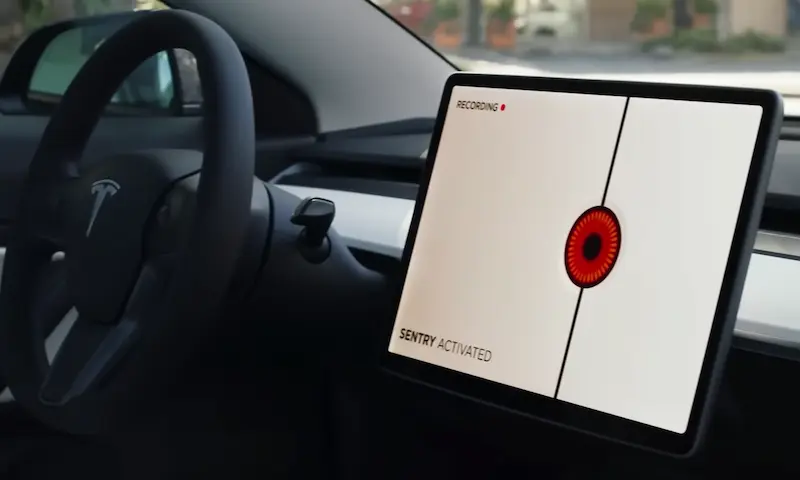
Early Tesla software forced you to choose between Dog Mode and Sentry Mode. Now they run simultaneously. When both are active, the car automatically silences the audible alarm. The exterior cameras still record threats and send silent alerts to your phone — but no horn honking, no flashing lights, no terrified dog.
Newer Tesla vehicles with interior cabin radar also temporarily disable Child Left Alone Detection alerts when Dog Mode is active, since the car knows you’ve intentionally left an occupant inside.
Remote Monitoring From Your Phone
The Tesla app turns your phone into a remote telemetry station. You can check the cabin temperature from anywhere with a data connection. If the climate system hits a hardware fault and the temperature drifts dangerously, you’ll get an alert.
On Tesla app version 4.15.0 or higher, you can access the interior cabin camera for a live video feed of your pet. It’s end-to-end encrypted and requires a Premium Connectivity subscription.
Using iOS 18 with Tesla app version 4.51.5 or newer? Dog Mode integrates with Apple Live Activities. The cabin temperature and battery status show up on your lock screen without opening the app. Quick note: vehicles with Hardware 2.0 or 2.5 self-driving computers don’t support live camera streaming. Camera use is also capped at roughly one hour per day.
Tesla Camp Mode: Your Car Becomes a Hotel Room
Camp Mode isn’t about keeping someone safe while you’re away. It’s about keeping you comfortable while you’re in the car overnight.
Continuous Power for All Your Gear
This is the biggest practical difference between the two modes. When Camp Mode is active, all USB ports and 12V outlets stay powered indefinitely. You can charge your phone, run a laptop, power a CPAP machine, or keep a portable light going all night without a separate power bank.
The full infotainment system stays live. Stream Netflix, play games, queue up a playlist — it’s all available from the rear cargo area while you’re stretched out on a mattress.
On the Cybertruck, Camp Mode keeps the high-voltage onboard inverter running, which powers the 120V and 240V outlets in the bed and cabin.
Security Gets Flipped Upside Down
Camp Mode deliberately disables most of Tesla’s security features. Here’s why that matters.
Sentry Mode turns off completely. If it stayed on while you slept in the back, your own movement would trigger the alarm and wake up every camper within 100 feet.
Walk-Away Door Lock is also disabled. If you step out at midnight to use the bathroom and the car auto-locks behind you, you’re standing in the woods without your keys. By disabling this feature, Tesla prevents that nightmare scenario.
Here’s the catch: you have to lock the doors manually before you sleep. Tap the padlock icon on the touchscreen. Don’t use the app to lock while your phone is inside the car — the Bluetooth proximity logic can get confused, and you might trigger the horn or fail to properly secure the door handles.
The Screen at Night
Camp Mode displays an animated campfire on the touchscreen when activated. It’s a warm ambient touch.
After about 10-15 minutes of inactivity, the screen automatically dims to near-black and shows only a faint Camp Mode indicator. A tap wakes it back up. That said, even the dimmed screen glows in pitch darkness. Many campers just drape a t-shirt over it.
The Carabiner Trick for SUV Tents
Many Tesla campers use an SUV tent that attaches to the open liftgate. The problem: an open liftgate tells the car a door is open, keeping the trunk lights on and preventing door locks.
The fix is the carabiner trick. Push a climbing carabiner into the liftgate’s physical latch. It trips the microswitch and fools the car into thinking the trunk is closed. The lights go off, the car locks normally, and your liftgate stays physically open for the tent. In the morning, hit the trunk release and the carabiner drops out.
Camp Mode vs Dog Mode: Direct Comparison
| Feature | Dog Mode | Camp Mode |
|---|---|---|
| Best for | Pets left alone briefly | Humans sleeping overnight |
| Touchscreen | Bright public message + live temp | Campfire animation → dims after 10-15 min |
| Walk-Away Door Lock | Active (locks automatically) | Disabled (manual lock required) |
| Window Switches | Disabled | Fully operational |
| Sentry Mode | Runs silently (alarms off) | Completely disabled |
| USB/12V Power | Standard (powers down) | Continuous all night |
| Audio/Media | Off | Fully active |
| Interior Camera | Live feed via app (Premium required) | Not highlighted |
| Auto shutoff | 20% battery | 20% battery |
How Much Battery Does Each Mode Actually Use?
Both modes draw power from the same thermal management system, so consumption depends heavily on the weather outside and your vehicle’s hardware.
| Conditions | Drain Per Hour | 8-Hour Overnight Total |
|---|---|---|
| Mild (50–75°F) | ~1% | 8–10% |
| Hot summer (90°F+) | 1.5–2% | 12–16% |
| Cold winter – heat pump | ~2% | 15–20% |
| Cold winter – PTC heater | 3–4% | 25–30%+ |
Older Tesla vehicles (early Model S, Model X, Model 3 pre-2021) use resistive PTC heaters — one unit of electricity in, one unit of heat out. Newer models with a heat pump and octovalve scavenge heat from the outside air and waste heat from the battery, making them far more efficient in cold weather.
5 Ways to Cut Battery Drain
- Set the target temperature close to ambient. A 65°F setting in 40°F weather drains far less than targeting 75°F. Use a sleeping bag to compensate.
- Drop fan speed to 1. It cuts blower motor draw and reduces noise.
- Use seat heaters instead of cabin heat in mild cold. They use a fraction of the energy.
- Cover the windows with reflective sunshades. Blocks solar gain in summer, retains body heat in winter.
- Plug in if you can. A standard 120V outlet at an RV park delivers roughly 1kW — enough to offset Camp Mode’s baseline draw completely.
The Legal Reality of Dog Mode in the U.S.
This is the part most owners skip — and it can get expensive.
States With “Good Samaritan” Window-Breaking Laws
Several U.S. states grant legal immunity to citizens who break a car window to rescue an animal they believe is in danger. These include California, Florida, Ohio, Arizona, Washington, Massachusetts, Indiana, and others. In Indiana, the person breaking the window must pay half the repair cost. Requirements typically include contacting emergency services first and staying with the animal.
Here’s the problem: a Tesla running Dog Mode is completely silent. No engine noise. No exhaust. To someone walking by, it looks like a dead car with a dog inside. The bright screen message is Tesla’s fix — but it only works if people can see it.
Heavy tint blocks the screen
Dark window tint can make the Dog Mode display nearly invisible in bright daylight. If your tint exceeds your state’s legal Visible Light Transmission limits, you’re also risking a citation. In Florida, for example, front side windows must allow over 28% of light through. Always check your state’s VLT rules.
A Tesla owner in Ireland faced actual criminal animal cruelty charges after a bystander reported his dog was in distress. He was cleared only after his legal team pulled the vehicle’s telemetry logs proving the cabin held steady at 68°F the entire time.
Protect Yourself With These Steps
- Put a physical sign on the dashboard. Big text, visible through the window: “I’m an EV. AC is running. Dog is safe.” Low-tech but effective.
- Keep tint within legal VLT limits so the screen stays visible.
- Don’t push it on duration. A shorter stop means fewer opportunities for a panicked stranger to escalate.
- Watch the Live Activities widget on your iPhone so you catch any system faults immediately.
What About “Keep Climate On” and “Keep Accessory Power On”?
Two more modes worth knowing:
Keep Climate On is the stripped-down baseline. It maintains cabin temperature for short errands — great for keeping groceries or electronics from overheating. The screen eventually sleeps, audio turns off, and Walk-Away Door Lock stays active. It shuts off at 20% like the others.
Keep Accessory Power On is newer and smarter for gear-heavy users. Found in the Charging menu, it keeps 12V sockets and USB ports live without running the HVAC at all. Perfect for keeping a car fridge running without burning through battery on an empty cabin. It draws roughly 1 mile of range per hour and shuts off at 20%.
The bottom line on Tesla camp mode vs dog mode is simple: Dog Mode is an outward-facing safety system for unattended pets, complete with public messaging, locked windows, and live remote monitoring. Camp Mode is an inward-facing comfort system for sleeping humans, built around continuous power, full entertainment access, and relaxed security protocols. They share the same hardware but solve completely different problems. Know which one you’re in — and always check that battery percentage before you walk away.