Got a scratch, a chip, or a full panel repair coming up? You need the right paint — and that means finding your car’s color code first. The tricky part? Every brand hides it somewhere different. This guide covers every major manufacturer so you can stop guessing and start fixing.
What Is a Car Color Code (and Why Does It Matter)?
Your car’s color code is a short alphanumeric string — usually two to five characters — that points directly to the exact paint formula used at the factory. It’s not the marketing name like “Midnight Black” or “Ocean Blue.” Those names get reused across different models and years, even when the actual formula changes completely.
The color code is the only reliable identifier. Without it, you’re guessing — and a wrong guess means a visible mismatch on your car.
Where to Find Color Code on Car: Quick Overview by Location
Before diving into specific brands, here’s a fast reference for the most common physical locations:
| Location | Common Brands | Label Type |
|---|---|---|
| Driver’s side door jamb (B-pillar) | Ford, Toyota, Honda, Tesla, GM (2018+) | Adhesive sticker |
| Glove box | GM (pre-2018), Isuzu | Paper SPID label |
| Engine bay (firewall, strut towers) | BMW, Mercedes-Benz, Nissan, Mazda | Metal plate or sticker |
| Trunk compartment | Volkswagen, Audi, Porsche, older Chevy | Paper sticker |
| Radiator support | Chrysler, Dodge, classic Jeep | Stamped metal plate |
Still unsure? Open your driver’s door and check the jamb first. It’s the right answer about 70% of the time on modern vehicles.
General Motors: Chevrolet, GMC, Buick, Cadillac
GM used the Service Parts Identification (SPID) label for decades. This is a white or silver placard packed with three-character RPO codes that cover every factory option on the car.
Pre-2018 models: Check the glove box first. Some models placed it in the trunk, under the spare tire cover, or on the rear face of a passenger door.
2018 and newer: GM replaced the glove box SPID label with a QR code on the driver’s side B-pillar. Scan it with any smartphone camera or an app like Decode RPO to pull the full build data including paint code.
Your GM paint code usually looks like WA1234 or comes after a BC/CC prefix (Base Coat/Clear Coat). Two-tone vehicles show a U code for the upper body and an L code for the lower.
| GM Model | Primary Location | Secondary Location |
|---|---|---|
| Silverado / Sierra / Tahoe / Suburban | Glove box (pre-2018) | Driver’s side door jamb |
| Camaro | Rear of center console | Door jamb, glove box |
| Corvette | Glove box | Trunk lid underside |
| Impala / Malibu / Cobalt | Glove box | Under trunk lid |
| Equinox / Trailblazer / S10 | Glove box | — |
Ford Motor Company: Ford, Lincoln, Mercury
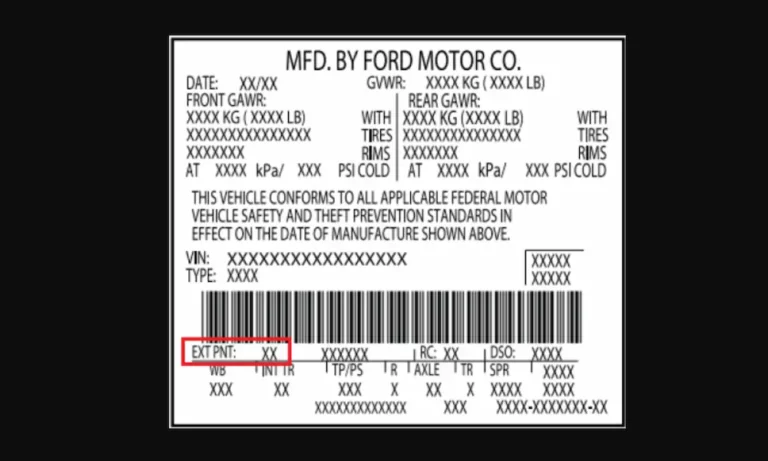
Ford keeps it simple. Look for the Vehicle Certification Label on the driver’s side door jamb or door edge — it’s there on virtually every modern Ford, Lincoln, and Mercury.
Find the field marked “EXT PNT” (Exterior Paint). The code sits right next to it. Ford paint codes are just two characters — often two letters. That brevity trips people up. Don’t mistake the longer interior trim or wheelbase string below it for the paint code.
| Color Name | Ford Code |
|---|---|
| Oxford White | YZ |
| Agate Black | UM |
| Race Red | PQ |
| Iconic Silver | JS |
| Lead Foot Grey | JX |
| Grabber Blue | CI |
Stellantis: Chrysler, Dodge, Jeep, Ram
Modern Stellantis vehicles follow the industry trend — driver’s side door jamb, near the bottom of the sticker, sometimes after “PNT:”
Classic and vintage models are a different story. Older Chrysler, Dodge, and Jeep vehicles stamped codes onto metal plates bolted to the radiator support or firewall. Expect to clean those with degreaser before you can read them.
The Stellantis paint code format is typically three characters and often starts with the letter P.
| Brand | Location | Format | Example |
|---|---|---|---|
| Chrysler | Door jamb | 3 characters (P, Q, G, T prefix) | PXR, PW7 |
| Dodge | Door jamb | 3 characters | PR4, FHG |
| Jeep (modern) | Door jamb | 3 characters, P prefix | PDM, PAU |
| Jeep (classic) | Firewall, radiator support | 2 characters | PX8, PS2 |
Toyota, Lexus, and Scion
Toyota is one of the most consistent manufacturers out there. Every model across Toyota, Lexus, and Scion puts the paint code on the driver’s side B-pillar or lower door edge.
Look for the field labeled “C/TR” (Color/Trim). The paint code is the first three characters after “C/”. Don’t copy the full string — the characters that follow relate to interior trim and have nothing to do with the exterior color.
For example: If the label reads C/TR 3P1 FA09, your paint code is 3P1. That’s it.
| Model Category | Examples | Standard Location |
|---|---|---|
| Sedans & compacts | Camry, Corolla, Prius | Driver’s side door jamb |
| SUVs & crossovers | RAV4, Highlander, 4Runner | Driver’s side door jamb |
| Trucks | Tacoma, Tundra, Land Cruiser | Driver’s side door jamb |
Honda and Acura
Honda and Acura always use the driver’s side door jamb. The code sits near the bottom of the label, often directly below the barcode.
Honda’s format is distinct: a two-letter prefix + three digits + one letter suffix. The suffix tells you the finish type — M for metallic, P for pearl. Common prefixes include NH for neutrals (black, silver, gray), B for blue, and R for red.
Nissan, Mazda, Subaru, and Hyundai/Kia
These brands share the driver’s side door jamb as the primary location, but each has quirks worth knowing:
Nissan: Most modern models use the door jamb, but some place the tag on the passenger-side firewall or under the driver’s seat on older models. Codes are typically three alphanumeric characters (e.g., KAD, Z10).
Mazda: Uses both the door jamb and engine bay firewall depending on the model. The label often reads “BODY Color Code” before the actual code. Codes like 41V (Soul Red) or 46G (Machine Gray) are two to three characters.
Subaru: This one’s different — check the driver’s side shock tower under the hood or the passenger side door jamb. Codes are three characters (e.g., 54A).
Hyundai/Kia: Door jamb or firewall. Look for the word “Paint” in the top right corner of the decal. The code is just two alphanumeric characters (e.g., S3, EB).
Volkswagen, Audi, and Porsche
The Volkswagen Group is famously inconvenient here. These brands historically hide the code in the trunk — specifically under the trunk carpeting, inside the spare tire well, or on the underside of the trunk lid.
The labels are often fragile paper stickers. If the trunk has ever leaked moisture or carried heavy cargo repeatedly, there’s a real chance the label is partially or completely destroyed. In that case, a dealership VIN lookup is your best move.
- Volkswagen codes: Two to four characters, older models often start with L (e.g., LD7X, C9A)
- Audi codes: Three to four characters (e.g., S9R, Y7C)
BMW and Mercedes-Benz
BMW: Check the driver’s side shock tower in the engine bay first, or the door jamb on newer models. BMW codes are always exactly three digits (e.g., 300 for Alpine White, 354 for Titanium Silver). If the label shows “354/7,” only use the first three digits.
Mercedes-Benz: Look at the radiator support bar or firewall under the hood. The metal plate is dense with data — the paint code sits in the bottom left corner. Format is three digits (e.g., 040 for Black, 702 for Smoke Silver). Vintage models may show a DB prefix (e.g., DB-040).
Tesla: Model S, 3, X, and Y
Tesla keeps the paint code on the driver’s side door jamb, in the lower left quadrant of the certification label, near the “PNT” designation.
All Tesla paint codes are four characters and start with “P” — for example:
- PPSW — Pearl White Multi-Coat
- PMNG — Midnight Silver Metallic
- PBSB — Solid Black
- PPMR — Red Multi-Coat
You can also find your code through the Tesla mobile app under your vehicle’s specification menu — no crawling around the door jamb required.
What If the Label Is Missing or Unreadable?
This happens more than you’d think. Trunk stickers rot, engine bay labels cake over with grease, and door jamb stickers disappear after collision repairs.
Here’s what to do:
1. Check your original documents. Your window sticker (Monroney label) lists the color name. Better yet, European luxury vehicles often have a duplicate factory sticker pasted inside the service booklet.
2. Use your VIN at a dealership. Your 17-character VIN doesn’t contain the paint code directly, but it links to your car’s original factory build sheet in the manufacturer’s database. Give the VIN to any authorized dealership’s parts department and they’ll pull the exact code instantly.
3. Use a spectrophotometer. If your car is old or heavily faded, the original code alone may not produce a perfect match. Spectrophotometers read the actual light wavelength of your existing paint and generate a custom formula that accounts for how the color has aged. Body shops use these tools regularly for high-fidelity repairs.
Once You Have the Code: What Comes Next?
The color code feeds directly into a paint mixing system that produces a precise formula — exact gram weights of pigments, metallic flakes, and binders. From there, the delivery format depends on the damage:
- Rock chips and small scratches: Touch-up pens or brush bottles
- Moderate panel scuffs: 12-ounce aerosol spray cans
- Full panel replacement: Mixed bulk paint applied with an HVLP spray gun
Don’t skip the primer if you’re down to bare metal, and always finish with a clearcoat. The basecoat alone won’t hold up — the clearcoat is what gives the finish its gloss, UV resistance, and durability.