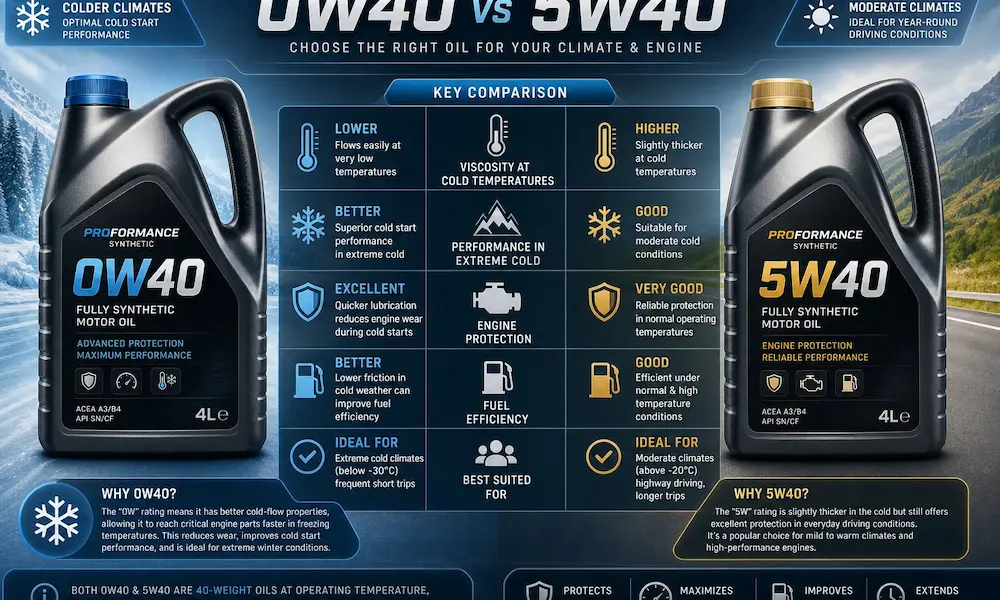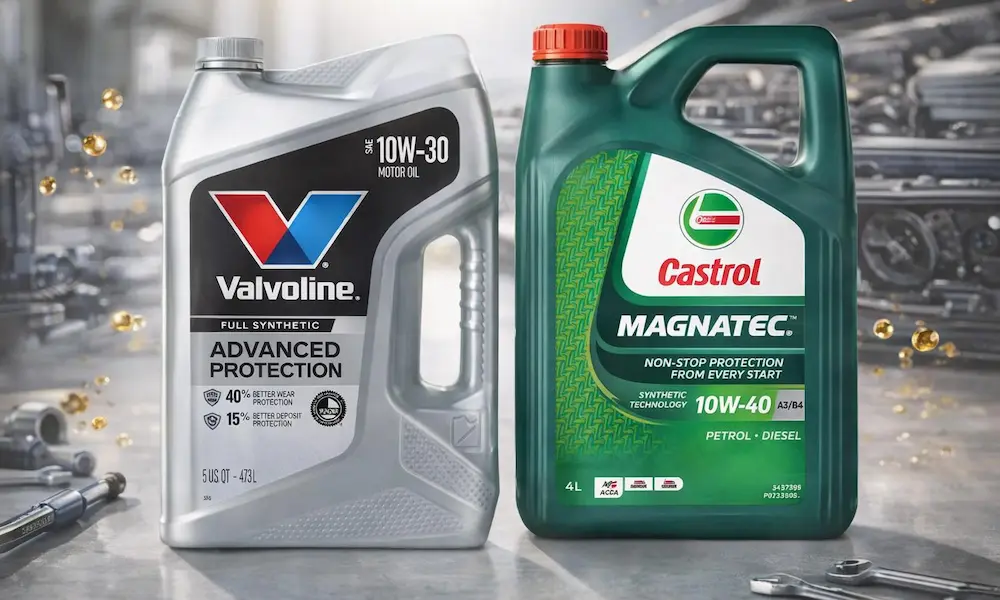
Picking the wrong engine oil is one of those mistakes you don’t notice until something expensive breaks. Whether you’re topping off your oil or planning a full change, choosing between 10W30 vs 10W40 matters more than most people think. This guide breaks down exactly what each oil does, when to use it, and why getting this wrong can quietly wreck your engine.
What Do Those Numbers Actually Mean?
Before you compare anything, you need to know what you’re reading.
Every multigrade oil label has two numbers split by the letter “W.” That “W” stands for Winter, not weight. According to Castrol’s viscosity guide, the number before the W tells you how the oil flows in cold temperatures. The number after tells you how thick it stays when your engine is running hot (around 212°F).
So for 10W30 vs 10W40:
- 10W = identical cold-start behavior for both oils
- 30 vs 40 = this is where they split — 10W40 stays thicker at high heat
Both oils flow the same way on a freezing morning. The difference kicks in once your engine warms up.
Cold Starts: Both Oils Tie Here
Here’s something most people get wrong — they assume 10W40 is always “thicker,” even in winter.
It’s not. Both 10W30 and 10W40 share the same cold-temperature rating. On a cold start, they pump and circulate at the same speed. Your valvetrain gets the same protection either way.
So if someone tells you 10W40 is worse in winter? That’s not accurate — at least not between these two grades.
High-Temperature Behavior: Where It Gets Interesting
Once your engine hits operating temperature, the two oils behave very differently.
Viscosity index improvers — long-chain polymers blended into the base oil — contract in the cold and expand as things heat up. This stops the oil from thinning out too fast.
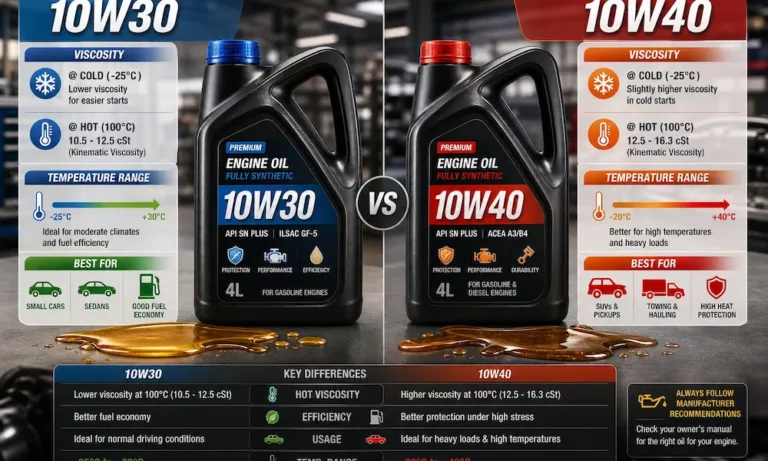
10W40 has more of these polymers, so it stays thicker at high temperatures. 10W30 thins out faster but flows more freely.
Here’s the trade-off:
- 10W30 → less internal drag → better fuel economy → thinner film under stress
- 10W40 → stronger film under heat and load → slightly more drag → minor fuel economy dip
Neither is wrong. It depends entirely on what your engine needs.
10W30 vs 10W40: Side-by-Side Comparison
| Performance Factor | 10W30 | 10W40 |
|---|---|---|
| Cold-start flow (0°F / -18°C) | Identical | Identical |
| Hot viscosity (212°F / 100°C) | Thinner | Thicker |
| Internal engine drag | Lower | Higher |
| Fuel efficiency | Better | Slightly reduced |
| Towing / high-load protection | Moderate | Superior |
| High-mileage engine suitability | Less effective | Highly effective |
| Modern engine compatibility | Preferred | Often too thick |
Why 10W40 Nearly Disappeared from New Cars
If you check your owner’s manual for any car built after 2000, you probably won’t see 10W40 listed. There’s a real reason for that.
During the 1980s and 1990s, automakers systematically dropped 10W40 in favor of thinner oils like 5W30 — and eventually 0W20 and lower. Two things drove this shift:
1. Stricter emissions rules. Thinner oils reduce friction. Less friction means less fuel burn. Less fuel burn means lower CO₂ output. Simple math, huge regulatory pressure.
2. Modern engines have tighter clearances. Today’s engines are machined to incredibly precise tolerances. Those tight clearances need low-viscosity oil to flow fast and reach every surface quickly. Running 10W40 in a modern engine can starve variable valve timing systems of the pressure they need to function — causing sluggish response, timing chain wear, and sludge buildup.
3. The General Motors bulletin that changed everything. In the mid-1980s, GM issued a service bulletin stating that engine damage from 10W40 use wouldn’t be covered under warranty. Early 10W40 formulas used cheap base stocks packed with unstable polymer additives. Under engine heat, those polymers broke down fast — forming carbon deposits, causing rings to stick, spiking oil consumption, and triggering pre-ignition. The industry pivoted hard to 10W30 almost overnight.
Engine Sludge: The Hidden Risk You Can’t See
Here’s where oil choice and oil change frequency collide.
Combustion naturally produces blow-by gases, water vapor, unburned fuel fragments, and organic acids. Normally, your oil’s detergent package holds these in suspension until you drain them out at an oil change. When you stretch oil change intervals too long, those by-products accumulate and clump together into thick, dark sludge.
Sludge clogs oil galleries, restricts flow, and blinds your oil filter. The result? Reduced lubrication, louder engine noise, and eventually catastrophic failure.
Severe driving conditions that speed up sludge formation include:
- Frequent short trips (engine never fully warms up)
- Heavy stop-and-go traffic
- Extreme heat or cold
- Dusty or coastal environments
- Extended idle time
Synthetic 10W30 and 10W40 both resist sludge far better than conventional oil. Chemically modified base stocks handle thermal oxidation and mechanical shear without breaking down as fast — meaning cleaner internals and a longer engine life.
Which Oil Fits Your Climate?
Both oils share the same cold-weather rating, so geography mostly affects your summer choice.
| Region / Condition | Temperature Range | Best Choice |
|---|---|---|
| Pacific Northwest / Northeast (mild summer) | 50°F–70°F | 10W30 |
| Southwest / Desert (extreme summer) | 100°F+ | 10W40 |
| Southern States (sustained heat) | 90°F+ | 10W40 |
| Mountainous regions / heavy towing | Variable under load | 10W40 |
| Urban stop-and-go (mild climate) | Moderate with heavy idle | 10W30 |
If you live in a moderate climate like the Pacific Northwest, 10W30 keeps your engine running efficiently year-round. Drive that same car through the Arizona desert in August, and 10W40 gives you a much safer oil film at operating temperatures.
High-Mileage Engines: 10W40’s Time to Shine
This is probably the most practical reason most drivers end up reaching for 10W40.
As engines age, clearances between bearings, pistons, and valvetrain components widen. Thinner 10W30 can struggle to fill those gaps, leading to:
- Low oil pressure at idle
- Audible ticking or tapping from the valvetrain
- Increased oil consumption as oil slips past worn rings
Switching to 10W40 fills those wider clearances, restores oil pressure, and quiets noisy components — without requiring an engine rebuild. It’s not a permanent fix, but it buys time and reduces wear on a budget.
Ford even backs this up. For certain vintage Mustang applications, Ford recommends Motorcraft 10W40 (part XO-10W40-Q1P) — a synthetic blend formulated to handle extreme heat in high-performance four-cylinder, V6, and V8 configurations.
Motorcycles and Powersports: A Different Story
10W40 never really left the motorcycle world, and for good reason.
Most motorcycles run air-cooled engines without a liquid cooling system. Operating temperatures run much higher and more erratically than in a car. The thicker high-temperature film of 10W40 prevents oil breakdown and protects metal surfaces under those conditions.
There’s another layer here. Most motorcycles share a single oil sump for the engine, gearbox, and wet clutch. Passenger car oils contain friction modifiers designed to improve fuel economy. If you use those in a motorcycle, those modifiers coat the clutch plates and cause slippage.
For motorcycles and ATVs, always use oils meeting JASO MA specifications — whether you choose 10W30 or 10W40. That rating confirms the oil won’t wreck your wet clutch.
Can You Mix 10W30 and 10W40?
In a pinch? Yes, mixing is fine. You’ll end up with an intermediate viscosity somewhere between the two, and your engine won’t blow up.
But for routine oil changes, pick one grade and stick with it. Consistent viscosity keeps your oil performing as designed and makes it easier to spot consumption changes over time.
The One Rule That Overrides Everything
Before you buy anything, check your owner’s manual.
Your manufacturer spec isn’t a suggestion — it’s an engineering requirement. Modern engines are built around specific oil pressure targets and hydraulic tolerances. Running the wrong viscosity doesn’t just reduce efficiency; it can damage variable valve timing actuators, accelerate timing chain wear, or cause cold-start pressure spikes that crack plastic oil pump components.
Your manual wins. Every time.
If you drive a newer car with tight clearances, 10W30 (or whatever the manual specifies) is the right call. If you’re running a high-mileage vehicle, driving in extreme heat, towing regularly, or riding a motorcycle, 10W40 earns its place.