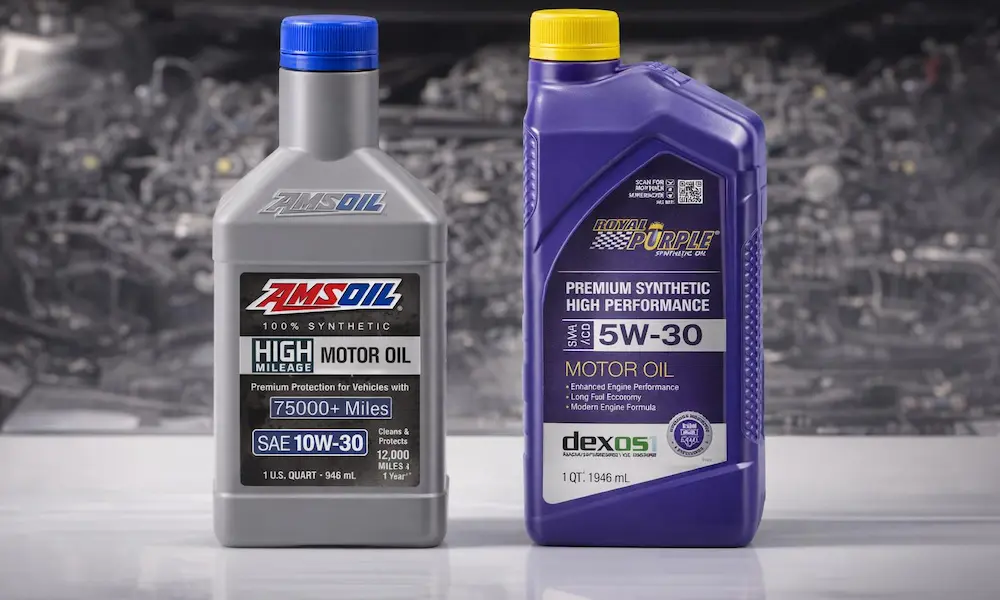
Picking the wrong engine oil feels like a trap. The numbers look similar, the bottles sit side by side on the shelf, and your owner’s manual doesn’t explain why it recommends one over the other. This post breaks down the real differences between 5W-30 vs 5W-20, what those numbers mean, and exactly which one belongs in your engine. Read to the end — the answer depends on factors most people overlook.
What Do Those Numbers Actually Mean?
The numbers on an oil bottle aren’t random. They’re governed by the SAE J300 standard, which classifies engine oils by their viscosity — that’s just a fancy word for how thick or thin the fluid is.
Here’s how to read the label:
- The first number + W — The “W” stands for winter, not weight. It tells you how the oil flows in cold temperatures. Both 5W-20 and 5W-30 share the same 5W rating, so they perform identically on a freezing morning.
- The second number — This tells you how thick the oil stays at normal engine operating temperatures. A 30-grade oil is thicker than a 20-grade at running temperature.
So right off the bat: these two oils start the same but behave differently once your engine warms up.
The Key Difference: What Happens When Your Engine Gets Hot
This is where 5W-30 vs 5W-20 actually splits. At 100°C (typical engine operating temperature), the viscosity ranges look like this:
| Property | 5W-20 | 5W-30 |
|---|---|---|
| Kinematic viscosity at 100°C | 6.9 – 9.3 centistokes | 9.3 – 12.5 centistokes |
| Min. high-temp/high-shear viscosity | 2.6 centipoise | 2.9 centipoise |
| Cold-cranking viscosity (–30°C) | Same: 6,600 cP max | Same: 6,600 cP max |
| Cold-pumping viscosity (–35°C) | Same: 60,000 cP max | Same: 60,000 cP max |
The takeaway? Cold-start behavior is identical. But once the engine reaches operating temperature, 5W-30 creates a thicker, stronger oil film between moving metal parts.
That thicker film matters more than most drivers realize.
Oil Film Thickness and Engine Wear
A thicker oil builds a wider physical barrier between metal surfaces. That barrier does two jobs: it cushions components under load, and it carries away microscopic contaminant particles without letting them scratch the metal.
If those particles are larger than your oil film, they bridge the gap and grind against the surfaces. 5W-30’s thicker film can handle larger particles safely. 5W-20’s thinner film leaves less margin — especially under hard use.
What Happens When the Engine Overheats?
Viscosity drops as temperature climbs. Roughly speaking, a 20°F rise in engine temperature requires one full SAE viscosity grade jump just to maintain the same film thickness.
Here’s the practical problem: a 5W-20 oil at 190°F behaves roughly like a 5W-30 oil at 220°F. Push a 5W-20-filled engine into hard towing, steep mountain grades, or brutal summer heat — and that oil film can get dangerously thin. When the film ruptures, you get rapid wear on piston rings, cylinder walls, and the valve train.
Why American Cars Switched to Thinner Oil
This is the part the bottle doesn’t tell you. The shift from 5W-30 to 5W-20 across US vehicles wasn’t purely about engine design — it was driven by Corporate Average Fuel Economy (CAFE) regulations.
Automakers face heavy fines if their fleet average fuel economy misses federal targets. Thinner oil reduces internal drag, so the oil pump works less hard, burning slightly less fuel. In standardized testing, 5W-20 delivers roughly a 1–2% fuel economy improvement over 5W-30.
That sounds small. But across millions of vehicles, it’s enough to shift the fleet average and avoid regulatory penalties.
The clearest proof? The same engines sold in Europe, Australia, and South America — where CAFE-style penalties don’t apply — are frequently specified for 5W-30 or heavier. Same engine, different oil recommendation, different country. The difference is the regulation, not the engineering.
Real-World Engine Cases: Why Viscosity Recommendations Aren’t Interchangeable
Chrysler 5.7L Hemi With MDS
Chrysler’s Multi-Displacement System (MDS) shuts down four cylinders under light load. It uses solenoid-controlled lifters that must vent oil pressure in milliseconds to deactivate valves.
If the oil is too thick, it slows that venting process. The result: rough transitions, vibrations, and a check-engine light. Using 5W-20 that meets FCA standard MS-6395 keeps the hydraulic response time within the engine control unit’s calibration.
Here’s the twist though. Ram 2500 and 3500 trucks with gross combined weight ratings above 14,000 lbs use the same 5.7L Hemi — but Chrysler specifies 5W-30 for those applications. These trucks don’t use MDS, and they operate under sustained heavy loads where film strength matters more than hydraulic response time.
Same engine family. Two different viscosity specs. Context is everything.
The notorious “Hemi tick” — a lifter noise that worries many owners — is often linked to inadequate lifter lubrication from the wrong viscosity oil. Use what the manual says.
Ford’s Back-Specification
In the early 2000s, Ford issued Technical Service Bulletins like TSB 02-1-9 that retroactively changed older engines — originally designed and tested on 5W-30 — to 5W-20.
The mechanical clearances in those engines hadn’t changed. The recommendation changed because of CAFE compliance, not engineering improvement. Those engines ran acceptably on 5W-20, but the switch was a regulatory move, not a performance upgrade.
Modern Oil Standards: API SP and ILSAC GF-6
Both 5W-20 and 5W-30 sold in the US today carry API SP and ILSAC GF-6A certification. These are the latest standards, and they’re specifically built around modern turbocharged direct injection engines and start-stop systems.
One critical upgrade in these formulations: protection against Low-Speed Pre-Ignition (LSPI). LSPI is an abnormal combustion event that can destroy pistons and connecting rods. It’s caused by hot carbon deposits in the combustion chamber. To fight it, modern oils reduce calcium-based detergents and replace them with magnesium-based alternatives.
Start-stop systems also create a unique challenge. Every time the engine shuts off, oil drains back from the upper valve train. On restart, there’s a brief window of boundary lubrication before oil pressure rebuilds. GF-6A oils carry enhanced dispersants to prevent the low-temperature sludge that builds up during frequent short-trip city driving.
Both grades benefit from these chemical upgrades equally — the difference between them is physical thickness, not chemical quality.
Can You Mix 5W-20 and 5W-30?
Yes, in an emergency. Mixing the two is chemically safe because they share the same winter rating and meet the same API/ILSAC standards. A 50/50 blend acts roughly like a 5W-25. Running a blended mix is always better than running the engine low on oil.
That said, don’t make it a habit. The hybrid blend won’t deliver the full fuel efficiency of 5W-20 or the full wear protection of 5W-30. If you top off with the wrong viscosity, shorten your next oil change interval to restore the correct spec.
Mixing synthetic and conventional? Major manufacturers confirm it’s physically compatible, but adding conventional oil to a synthetic fill dilutes the performance benefits of the synthetic.
Which Oil Should You Use?
Use 5W-20 if:
- Your owner’s manual specifies it
- Your vehicle has a cylinder deactivation system like Chrysler MDS
- You drive a modern small-displacement engine with tight tolerances
- Fuel economy is a priority and you drive mostly normal conditions
Use 5W-30 if:
- Your owner’s manual specifies it
- You tow regularly or haul heavy loads
- You live in a region with extreme summer heat
- Your engine has over 75,000–100,000 miles and you’re noticing increased oil consumption or a drop in pressure
- You’re driving a heavy-duty truck variant without MDS
High-Mileage Engines: The Case for Moving Up a Grade
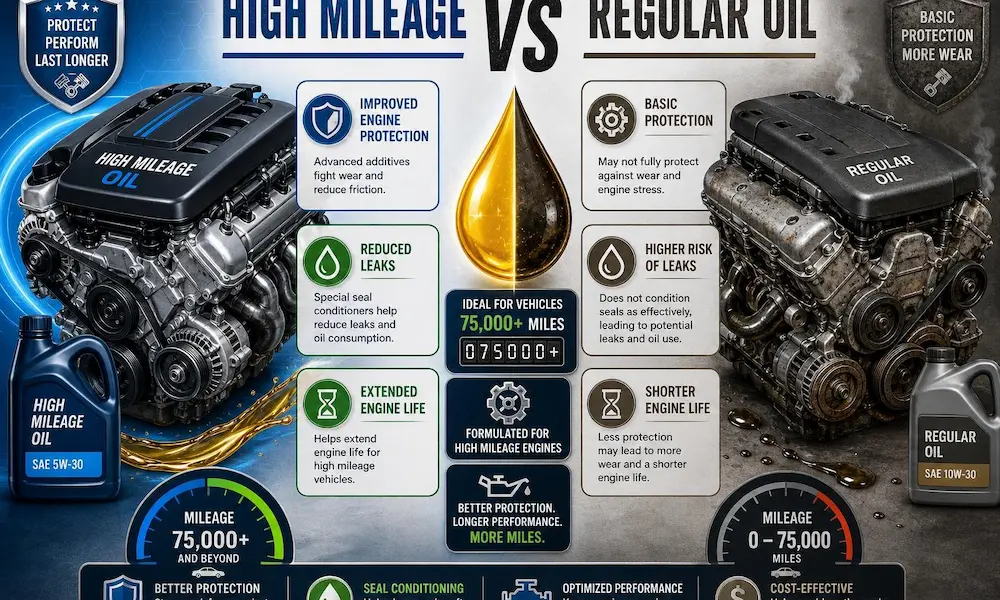
As engines age, bearing clearances and piston ring gaps widen. Oil pressure drops. Consumption goes up. Switching from 5W-20 to 5W-30 in a high-mileage engine helps fill those wider gaps, restore oil pressure, reduce oil burning, and quiet mechanical noise.
It’s not a permanent fix for worn-out components — but it’s a smart, low-cost maintenance move that many experienced technicians recommend.
Regional Climate Still Matters
Both oils handle cold weather equally well thanks to their shared 5W rating — they’re solid choices for harsh Northern winters. But if you’re in Texas, Arizona, or Florida running in summer heat with any kind of load, 5W-30’s stronger film strength gives you a meaningful safety buffer. And that buffer could be the difference between an engine that lasts 200,000 miles and one that doesn’t.