You’ve seen the price tag on Gladiator tires and you’re wondering if it’s too good to be true. Here’s the deal: the answer isn’t simple. Whether these tires work for you depends entirely on what you’re driving, how you’re using it, and what you’re willing to sacrifice for the savings. Let’s break down the real story.
What You Need to Know About American Pacific Industries
Gladiator isn’t a standalone tire company. It’s a private-label brand owned by American Pacific Industries (API), an Arizona-based company that’s been around since 1982. They make a big deal about being “American-owned” and “American-designed,” and that’s true.
But here’s where it gets interesting. The tires aren’t made in America. They’re manufactured in API’s facilities in China and Thailand. The company says these are their own employees, not just contract workers, which means API directly controls quality control. When something goes wrong, it’s on them.
API’s big selling point is speed. They claim they can design and manufacture a new tire in under 120 days, compared to the industry standard of about a year. Sounds impressive, right? Well, that breakneck pace might explain some of the problems we’ll get into later.
The Price Difference Is Massive
Let’s talk numbers because this is where Gladiator makes its case. Check out these real-world comparisons:
| Tire Model | Type | Size | Price Per Tire |
|---|---|---|---|
| Gladiator X Comp A/T | All-Terrain | LT275/70R18 | $169.84 |
| BFGoodrich All-Terrain T/A KO2 | All-Terrain | LT275/70R18 | $335.77 |
| Gladiator X Comp A/T | All-Terrain | LT315/70R17 | $194.56 |
| Falken Wildpeak A/T3W | All-Terrain | 315/70R17 | $348.00 |
| Gladiator X Comp M/T | Mud-Terrain | LT275/70R18 | $247.47 |
| Toyo Open Country M/T | Mud-Terrain | LT275/70R18 | $390.72 |
You can buy a full set of four Gladiators for roughly the same price as two premium tires. That’s a $600-$700 savings on a full set. For someone building out a truck or Jeep on a tight budget, that’s hard to ignore.
The X Comp Line: Gladiator’s Flagship
X Comp M/T (Mud-Terrain)
This is Gladiator’s most aggressive tire, and it looks the part. The chunky, blocky tread pattern screams “off-road” and the 3-ply polyester casing with steel and nylon belts is built tough.
Off-road, this tire delivers. Users consistently praise its performance in mud, on rocks, and in loose dirt. For budget-conscious enthusiasts who spend weekends on trails, the M/T punches way above its price point.
But there’s a catch. Actually, several catches. The stiff sidewalls and aggressive tread make it loud on the highway. Winter performance is poor, and it’s not recommended for snow or ice despite its M+S rating. Here’s the real kicker: there’s no tread life warranty on the M/T. Gladiator knows this tire wears quickly and won’t stand behind it.
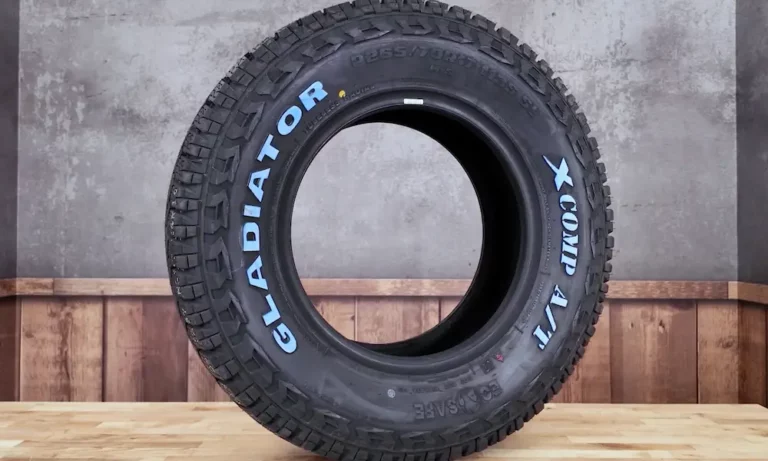
X Comp A/T (All-Terrain)
The A/T is supposed to be the “do-everything” tire. It’s got a less aggressive 2-ply construction for better on-road comfort, and it’s 3PMSF certified for winter traction, which the M/T lacks.
Gladiator backs this one with a 50,000-mile warranty (55,000 for P-metric sizes). That’s competitive with premium brands and makes the A/T look like a serious contender against the BFG KO2 and Falken AT3W.
But here’s what you need to know: this is the exact tire that was recalled in 2020. More on that in a minute.
Off-Road Performance: Actually Pretty Good
Let’s give credit where it’s due. For the price, Gladiator’s off-road performance is solid. The M/T especially earns high marks from users who hit the trails regularly. You’re getting aggressive traction in mud, dirt, and rocks without spending $400 per tire.
The X/T and R/T hybrid models follow current market trends, offering something between an all-terrain and mud-terrain. Gladiator’s even expanded into ATV/UTV tires with durable 10-ply construction.
For weekend warriors on a budget, these tires deliver the look and capability you want.
On-Road Reality: Noise and Comfort Issues
This is where things get dicey. The M/T is loud. Really loud. That’s expected with aggressive tread, but even the A/T gets consistent complaints about road noise. One owner noted their brand-new Gladiator A/Ts were “much quieter” than their 85% worn stock tires. That’s not exactly a ringing endorsement.
The ride quality is firmer than premium tires, and owners note that comfort “could have been better.” Here’s the interesting part: some users say the tires are quiet when new, but become significantly louder as they develop uneven wear patterns. That leads us to the next problem.
The Cupping and Balancing Problem
This is where owner complaints pile up. “Cupping” is a scalloped, uneven wear pattern that creates noise and vibration. Multiple Gladiator owners report their tires cupping badly, even with regular rotation.
Balancing is another issue. One owner running 40-inch M/Ts said bluntly: “they don’t balance worth a shit.” Another resorted to balance beads, a common workaround for tires that won’t balance with traditional weights.
This isn’t user error. It points to manufacturing inconsistencies from that rushed 120-day development cycle. When tires don’t balance properly, they wear unevenly. That creates cupping, which makes them loud and uncomfortable.
The 8,500-Mile Disaster
Here’s the story that should make heavy-duty truck owners pay attention. A Silverado 3500HD owner posted about his Gladiator X Comp A/T tires wearing down to the wear bars after just 8,500 miles. The fronts were cupping badly. This owner primarily pulled trailers.
Meanwhile, another user got 50,000 miles from X Comp M/Ts. What’s the difference? The successful user was meticulous about alignment, rotation, balancing, and air pressure. They also weren’t running a heavy-duty truck or towing.
Here’s what this tells us: Gladiator’s tread compound can’t handle the heat and load of heavy-duty applications, even though the tires are rated for it. On a lighter vehicle like a Jeep or half-ton truck, you might be fine. On a 3/4-ton or 1-ton truck used for towing, these tires can fail catastrophically fast.
The 2020 NHTSA Safety Recall
This is the most serious issue. In 2020, American Pacific Industries initiated NHTSA recall 20T011 for the Gladiator X-COMP A/T in size LT285/75R16 Load Range E.
The problem? A manufacturing defect that could cause sidewall separation. That’s a blowout. The tires failed to meet Federal Motor Vehicle Safety Standard No. 139. According to the recall notice, this could “result in loss of vehicle control that could lead to a crash without prior warning.”
This wasn’t a small batch. It covered tires produced from February 2018 through January 2020. That’s two full years of production in API’s own facilities.
Notice a pattern? Both the catastrophic 8,500-mile wear failure and the safety recall involved Load Range E tires. This strongly suggests Gladiator’s engineering and quality control aren’t up to the task of heavy-duty applications.
Winter Performance: The 3PMSF Question
The M/T is explicitly not suitable for winter. Reviews warn it won’t perform well “when the roads are covered with snow, ice, or even rain.”
The A/T has the Three-Peak Mountain Snowflake certification, which sounds reassuring. But here’s the reality check: 3PMSF only certifies that a tire meets minimum acceleration traction on medium-packed snow. It doesn’t guarantee braking or cornering performance, and it doesn’t test on ice.
While Gladiator’s marketing claims “certified traction improvements on snow and ice,” enthusiasts who’ve run multiple brands consistently prefer the proven winter performance of tires like the BFG KO2 and Falken Wildpeak AT3W.
The A/T is better than a non-winter tire, but don’t expect it to match premium competitors in snow and ice.
The Warranty Game
Gladiator offers a 30-day “Satisfaction Assured” trial, which is smart marketing. It removes the initial risk and makes skeptical buyers more willing to try the brand.
The A/T comes with that 50,000-mile warranty, while the M/T has no mileage warranty at all. That’s API telling you the M/T wears quickly.
But here’s the catch with the A/T warranty: it excludes damage from “improper alignment, improper inflation, wheel imbalance.” Remember those cupping and balancing issues? Those same problems can be used to deny your warranty claim. The warranty looks good on paper but might not protect you when you need it.
The QR Line: Actually Decent
It’s worth noting that Gladiator’s problems seem concentrated in the aggressive X Comp line. Their passenger CUV/SUV tires like the QR700-SUV get generally positive reviews for the price. They’re basic highway all-season tires backed by a 50,000 or 60,000-mile warranty, and owners call them a “great value.”
The QR25-TS trailer tires also get good feedback. One RV owner reported “NO issues” and tires that “still look nearly new” after 6,000 miles.
These simpler, commodity tires seem to be within API’s quality capabilities. It’s the complex, high-stress applications where things fall apart.
Who Should Buy Gladiator Tires
You’re a good candidate for Gladiators if:
- You own a light truck or Jeep (F-150, Tacoma, Wrangler, Gladiator)
- You rarely tow heavy loads or haul
- Your main priority is the aggressive off-road look on a budget
- You’re committed to religious maintenance: rotation every 3,500-5,000 miles, careful balancing, constant pressure monitoring
- You accept that these tires will wear faster than premium brands
For this specific user, Gladiators can work. You’re getting maximum visual impact per dollar, and if you stay on top of maintenance, you might get acceptable performance.
Who Should Avoid Gladiator Tires
Stay away if:
- You own a 3/4-ton or 1-ton truck (F-250, Ram 2500, Silverado 3500HD)
- You tow or haul regularly
- You drive significant highway miles
- You value long-term reliability and safety over upfront savings
The evidence is clear: Gladiator tires have documented failures in heavy-duty applications. The NHTSA recall for sidewall separation involved a Load Range E tire. The 8,500-mile catastrophic wear failure involved a Load Range E tire used for towing.
For heavy-duty users, the upfront savings disappear when you’re replacing tires after 10,000 miles. Worse, the documented risk of a high-speed blowout while towing isn’t worth gambling on.
The Bottom Line on Gladiator Tires
Are Gladiator tires good? Not by traditional standards of reliability, safety, and durability. The X Comp line has documented quality control issues, a safety recall, and systemic problems with heavy-duty applications.
But they’re “good enough” for a specific niche: light-duty enthusiasts who prioritize aesthetics over longevity and accept significant trade-offs for a 50% price reduction.
The rushed 120-day development cycle, manufacturing inconsistencies, and catastrophic failures in demanding applications make these tires a poor choice for anyone who needs dependable performance. You’re not just buying budget tires. You’re buying into a high-risk, high-maintenance relationship that requires constant attention and still might fail you when it matters most.
If you’re running a light vehicle for weekend adventures and you’re diligent about maintenance, Gladiators might work. But if you’re pulling trailers, hauling loads, or counting on these tires for daily reliability, you’re better off spending more upfront for a tire that won’t leave you stranded or worse.