Picking the right Nissan Frontier year can save you thousands in repairs — or cost you an engine. This guide breaks down every generation, highlights the best years for Nissan Frontier reliability, and tells you exactly which ones to skip. Stick around, because the answer isn’t always the newest model.
Why the Nissan Frontier Has Such a Complicated History
The Frontier has been around since 1998. That’s over 25 years and three very different generations of trucks. Some years are absolute legends. Others? Let’s just say they’ll teach you what a “Strawberry Milkshake of Death” is — and not in a fun way.
Before you hand over cash for a used Frontier, you need to know which generation you’re dealing with, what problems came with it, and why some model years cost dramatically less to own than others.
First Generation (1998–2004): Simple, Durable, and Aging Gracefully
The D22 generation is the granddad of the Frontier lineup. It’s compact, mechanically simple, and easier to wrench on than almost any modern truck.
What Made the First Gen Special
The base 2.4-liter four-cylinder engine was modest in power but hard to kill. When Nissan added the 3.3-liter V6, towing jumped to 5,000 pounds. And in 1999, the Frontier became the first compact truck with four full-sized doors on a crew cab. That was a big deal.
| Engine | Horsepower | Torque | Max Towing |
|---|---|---|---|
| 2.4L Four-Cylinder | 143 hp | 154 lb-ft | 3,500 lbs |
| 3.3L V6 | 170 hp | 200 lb-ft | 5,000 lbs |
| 3.3L Supercharged V6 | 210 hp | 246 lb-ft | 5,000 lbs |
The Best First-Gen Year: 2004
The 2004 Frontier is the sweet spot of this generation. As the last D22 produced in the US, it had seven years of refinements baked in. Recall counts dropped. Build quality improved. If you want an old-school truck that just works, this is it.
Watch out for: Corrosion on the lower steering column joint (2002–2004 models) and failing fuel sending units. These are fixable, but factor the age into your budget.
Second Generation (2005–2021): The Longest Run and the Biggest Drama
The D40 generation ran for 16 years. That’s almost as long as some marriages. And like a long relationship, it had real highs and genuine lows.
Nissan upgraded the Frontier to a midsize truck in 2005, adding a fully boxed ladder frame and a new 4.0-liter V6 producing 261 horsepower with 6,500-pound towing capacity. On paper, it was a leap forward. In practice, the first few years were rough.
The “Strawberry Milkshake of Death” Problem (2005–2010)
This is the single biggest reason to avoid early D40 models. The radiator on 2005–2010 Frontiers has an internal divider separating engine coolant from transmission fluid. When that divider fails — and it does, often after 100,000 miles — the two fluids mix. The result is a thick, pink sludge that destroys the transmission’s clutch packs and sensors.
Repair costs? You’re often replacing both the radiator and the entire transmission. That’s not a cheap Tuesday. Nissan extended warranties to address this, but those extensions have long expired.
Timing Chain Issues on the 4.0-Liter Engine (2005–2010)
Same era, different headache. The 4.0-liter engines in these years used plastic tensioner guides on the secondary timing chain. Those plastic shoes wear down, metal meets metal, and you get a high-pitched whining noise that signals expensive trouble ahead. Nissan later redesigned the guides with tougher materials.
Bottom line: Avoid 2005, 2006, and 2007 Frontiers unless you have documented proof the radiator was replaced with an aftermarket unit and the timing chain system was serviced.
The Turning Point: 2011 Onward
Here’s where things get good. By 2011, both the radiator and timing chain problems were corrected at the factory. The years 2012 through 2019 are frequently called the “golden era” of the Frontier — and for good reason.
Best Second-Gen Years: 2014 and 2015
The 2014 Frontier earned a perfect reliability score of 5 out of 5 from major consumer research organizations. That’s the only Frontier year to ever achieve that. The 2015 model had zero safety recalls and some of the highest owner satisfaction scores in the segment. These two years represent the most refined versions of the 4.0-liter V6 and five-speed automatic pairing.
If you’re shopping used and want the best balance of affordability and dependability, start here.
Best “Modern Classic”: 2019
The 2019 Frontier is the last year with the original 4.0-liter V6 and five-speed automatic. After almost 15 years of production, Nissan had smoothed out nearly every rough edge on this powertrain. It’s simple, proven, and parts are widely available and affordable.
For anyone who wants a no-frills workhorse without direct injection complexity or a nine-speed transmission to worry about, the 2019 is a strong pick.
One Year to Approach with Caution: 2012
The 2012 model gets flagged more than its neighbors. Some owners reported engine performance concerns and paint quality issues, including hood corrosion. It’s not a dealbreaker, but inspect carefully before buying.
The 2020–2021 Hybrid Era: New Engine, Old Body
Nissan did something unusual for 2020 and 2021. They dropped a brand-new 3.8-liter V6 paired with a nine-speed automatic transmission into the old second-generation body. Call it a preview of what was coming.
The result? A jump from 261 horsepower to 310 horsepower with better fuel economy and improved towing response. The 2020 had some early software-related shift quality complaints. The 2021 ironed those out.
Best Bang for Power: 2021
The 2021 Frontier is one of the most compelling used buys in the segment. You get modern engine output in a smaller, simpler body. Complaints are minimal. The powertrain has since proven itself reliable in the third generation. And prices for a used 2021 sit well below a comparable new third-gen model.
Third Generation (2022–Present): A Fresh Start
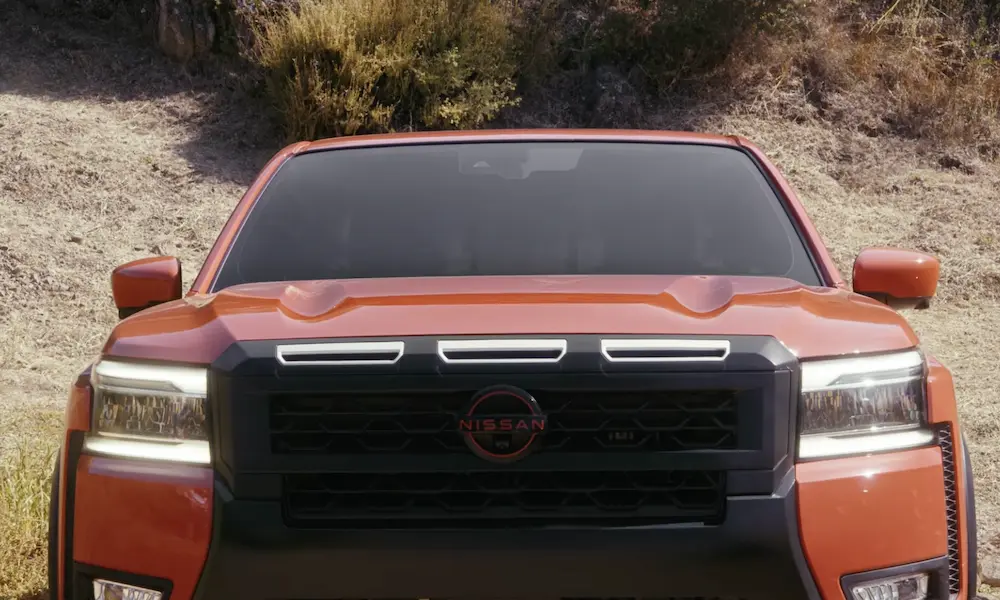
The D41 arrived in 2022 as a fully redesigned truck built specifically for North America. New body, new interior, same 3.8-liter V6. The exterior looks sharper and the cabin finally got the upgrade it needed.
What Changed Inside
Nissan replaced hard plastics with soft-touch surfaces, added Zero Gravity seats for long hauls, and made Apple CarPlay and Android Auto standard. The 2022–2024 models drew criticism for lacking a telescoping steering column — a glaring omission that Nissan finally corrected for 2025.
2025: The Best New Frontier You Can Buy
The 2025 Frontier brings:
- Telescoping steering column (finally)
- Maximum towing bumped to 7,150 pounds
- Long-bed configuration available across more trim levels
- Updated Safety Shield 360 standard across the lineup
| Model Year | Horsepower | Max Towing | Key Additions |
|---|---|---|---|
| 2021 | 310 hp | 6,720 lbs | New engine, old body |
| 2022 | 310 hp | 6,720 lbs | Redesigned interior, Auto Braking |
| 2024 | 310 hp | 6,640 lbs | 360-degree camera, Lane Departure |
| 2025 | 310 hp | 7,150 lbs | Telescoping wheel, towing upgrade |
If you’re buying new, skip straight to 2025. The 2023 model also makes a solid used buy — first-year bugs from 2022 were addressed, and prices are dropping.
What Does Frontier Ownership Actually Cost?
Here’s where the Frontier wins quietly. RepairPal ranks it first out of seven midsize trucks for reliability, with an average annual repair cost of just $470.
| Metric | Nissan Frontier | Midsize Truck Average |
|---|---|---|
| Annual Repair Cost | $470 | $548 |
| Repair Frequency | 0.2 visits/year | 0.2 visits/year |
| Severe Repair Probability | 12% | 13% |
That $78 annual difference adds up fast over 10 years. Combined with widely available parts, the Frontier costs less to keep running than most of its competition.
Preventative Maintenance Worth Doing on Any Frontier
Don’t wait for these to become problems:
- Rear differential breather: The factory unit clogs in humid or dusty conditions, which causes axle seal failure. Relocating it is a simple and common fix on second and third-gen models.
- Plastic heater core inlet (2005–2019): This plastic fitting cracks and dumps coolant suddenly. Swap it for an aluminum unit before it strands you.
- Paint care: Some 2012 and 2016 models showed early paint chipping and hood corrosion. Regular washing and waxing aren’t optional if you live near the coast or in a salted-road climate.
Safety: How the Frontier Evolved
Early first-gen models offered basic protection but showed significant cabin intrusion in frontal crash tests. The second generation added side curtain airbags and stability control, earning four-star NHTSA ratings for most of its run — though the aging D40 structure earned a “Marginal” score from the IIHS in small overlap testing by 2017.
The third generation (2022+) changed the story. Standard Safety Shield 360 brings automatic emergency braking with pedestrian detection, blind-spot monitoring, and rear cross-traffic alert. IIHS testing shows the D41 earning “Good” in the moderate overlap test — a major jump from its predecessor.
| Era | NHTSA Frontal Rating | IIHS Moderate Overlap | Standard Safety Tech |
|---|---|---|---|
| 1998–2004 | Not Rated | Marginal | Dual Airbags |
| 2005–2012 | 4 Stars | Good (Original) | ABS, Front Airbags |
| 2013–2021 | 3 Stars (Driver) | Good (Original) | Side Curtain Airbags |
| 2022–2025 | 4 Stars | Good (Updated) | Auto Braking, FCW |
The Quick-Reference Guide: Best and Worst Years
Here’s a fast summary so you don’t have to scroll back:
✅ Best years for Nissan Frontier:
- 2004 — Best of the first gen, refined and simple
- 2014 — Perfect reliability score, golden era of the D40
- 2015 — Zero recalls, high owner satisfaction
- 2019 — Final and most refined 4.0L V6 model
- 2021 — Modern 310hp engine, old-school body, great value
- 2023 / 2025 — Best third-gen options, especially 2025 for new buyers
🚫 Years to avoid:
- 2005, 2006, 2007 — Radiator/transmission failure risk and timing chain issues
- 2008, 2009, 2010 — Same radiator problem until corrected; verify repair history
- 2012 — Engine concerns and paint quality flags
The best years for Nissan Frontier aren’t just about picking the newest truck. They’re about matching your budget, use case, and risk tolerance to the right generation. Whether you go back to a dependable 2014 or drive home a loaded 2025, you’re getting one of the most cost-effective midsize trucks on the market — as long as you know which years to trust.