Your check engine light is on, the code says P0420, and now someone’s throwing around the words “catalytic converter replacement.” Before you panic or sign off on a repair you don’t fully understand, read this. You’ll find out exactly what’s happening, what it costs, and how to avoid making an expensive mistake twice.
What Does the Catalytic Converter Actually Do?
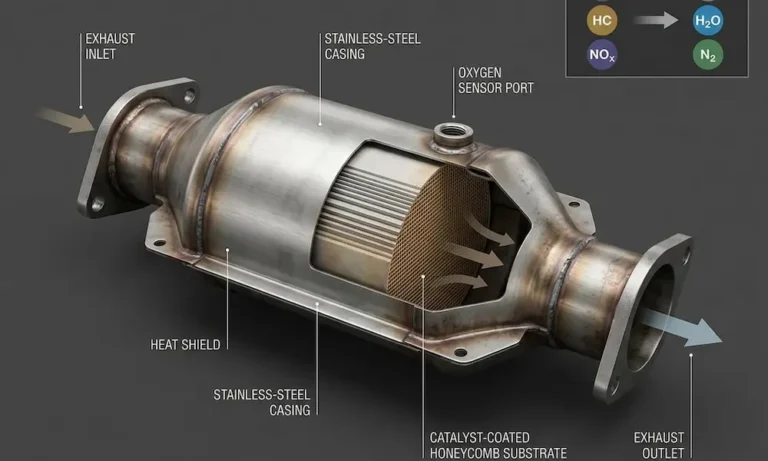
Think of the catalytic converter as your Cruze’s exhaust cleanup crew. Hot, toxic gases exit the engine after combustion — nitrogen oxides, raw hydrocarbons, carbon monoxide — and the converter intercepts all of it.
Inside the steel housing sits a ceramic honeycomb coated with precious metals: platinum, palladium, and rhodium. These metals trigger chemical reactions that transform the toxic gases into harmless nitrogen, oxygen, water vapor, and carbon dioxide. The whole process happens at temperatures above 800°F, continuously, every time you drive.
When those precious metals get contaminated, melted, or physically shattered, the converter stops working — and the P0420 code shows up.
Why the Chevy Cruze Catalytic Converter Fails So Often
The converter rarely fails on its own. On the Cruze, it’s almost always a cascade of upstream problems that destroy it.
The PCV System Is a Ticking Time Bomb
The 1.4-liter turbocharged engine has a well-documented design flaw in its Positive Crankcase Ventilation system. A tiny rubber check valve lives inside the plastic intake manifold. Over time, it degrades and disappears entirely. Once it’s gone, the turbocharger pushes pressurized boost into the crankcase, which ruptures the valve cover diaphragm.
Now the engine starts sucking oil through the intake valves and burning it. That oil travels through the exhaust, coats the ceramic honeycomb, and bakes into a carbon layer that permanently blinds the precious metals. This is called catalyst poisoning.
If you replace the catalytic converter without fixing the PCV system first, you’ll destroy the new one in weeks.
Spark Plugs and Ignition Coil Failures
The Ecotec engine is sensitive to spark plug wear. As the plug gap widens over time, the ignition coil works harder until it eventually fails. A misfiring cylinder pumps raw, unburned fuel directly into the hot converter. That fuel ignites inside the ceramic honeycomb and the thermal shockwave cracks or melts the substrate — sometimes into a solid block that completely chokes the exhaust.
Turbocharger Fluid Leaks
The turbocharger sits directly above the converter and relies on rubber-sealed coolant and oil lines. Heat makes those seals brittle. When a coolant line weeps onto a converter running at nearly 1,000°F, the instant thermal shock can crack the housing and trigger exhaust leaks.
Factory Software Fueling Problems
Here’s something most shops miss. The factory ECM software on the 1.4-liter Cruze commands a rich fuel mixture during deceleration. That raw fuel hits the hot converter and ignites, spiking internal temperatures repeatedly over thousands of miles. General Motors released software calibration updates specifically to fix this. If the technician doesn’t verify and update the ECM software before finishing the job, your new converter faces the same problem.
Understanding the P0420 Code
The P0420 code means the ECM has detected catalyst efficiency below the federal minimum on bank one. Here’s how it catches it:
- The upstream oxygen sensor sits before the converter and shows a fast, oscillating voltage signal during normal operation
- The downstream oxygen sensor sits after the converter and should show a flat, stable signal — because a healthy converter absorbs and buffers oxygen
When the converter fails, the downstream sensor starts mimicking the upstream sensor’s erratic signal. The ECM sees both sensors oscillating identically and flags the converter as dead.
Don’t Skip the Smoke Test
A P0420 code doesn’t automatically mean you need a new converter. A cracked exhaust manifold or a leaking turbocharger gasket pulls outside air into the exhaust stream. The downstream sensor reads that extra oxygen and the ECM misinterprets it as converter failure. Rigorous diagnosis requires a smoke test across the entire exhaust tract before anyone orders parts. Skipping this step is how people spend $1,500 on a converter they didn’t need.
What Does Chevy Cruze Catalytic Converter Replacement Cost?
The total bill combines parts and labor. Neither number is small.
| Financial Variable | Estimated Cost Range (USD) | Key Factors |
|---|---|---|
| OEM Catalytic Converter | $1,400 – $2,500 | High precious metal loading, exact factory fitment |
| Aftermarket Converter | $100 – $500 | Minimal precious metals, generic housing |
| Professional Labor | $300 – $550 | Location, independent shop vs. dealership |
| Scrap Value Recovery | -$41 to -$249 | Current platinum, palladium, rhodium market prices |
Industry data puts labor time at roughly two to two-and-a-half hours, with rates ranging from $144/hour at independent shops to over $200/hour at dealerships.
Don’t throw away your old converter. Scrap recyclers like Recohub purchase failed units to recover the precious metals, typically paying between $41 and $249. That money comes off your net repair cost.
OEM vs. Aftermarket — Which One Should You Buy?
This decision matters more on the Cruze than on most vehicles.
OEM converters carry a high concentration of platinum, palladium, and rhodium. Even as they naturally degrade over 100,000+ miles, they retain enough catalytic capacity to stay clean. That’s why they cost so much.
Aftermarket converters from budget manufacturers use the bare minimum precious metals to pass initial EPA testing. Multiple technicians document that aftermarket units on the Cruze frequently trigger a returning P0420 code within a year. The Cruze’s aggressive fuel delivery strategy overwhelms the thin metal coating quickly.
If you go aftermarket to save money, budget for potentially doing this repair again within 12 months.
Check Your Warranty Before You Pay Anything
This is the most overlooked money-saving step in the entire process. Federal law mandates an 8-year or 80,000-mile warranty on major emissions components.
More importantly, some Cruze models carry a Partial Zero Emissions Vehicle (PZEV) certification. If your Cruze has that label under the hood and you live in a state following California emissions standards, state law may require the dealer to replace the catalytic converter free of charge for up to 15 years or 150,000 miles.
Check the emissions label under your hood before authorizing any paid repair. This single step can save you thousands.
Tools You’ll Need for a DIY Replacement
The Chevy Cruze catalytic converter replacement is a demanding job. The converter sits vertically at the front of the engine, bridging the turbocharger and the exhaust downpipe, and every fastener on it lives in a high-heat, high-corrosion environment.
| Tool Category | Specific Requirement | Why You Need It |
|---|---|---|
| Standard Sockets | 7, 10, 11, 13, 17mm | Heat shield bolts, brackets, turbo hardware |
| Specialized Sockets | E-Torx (E7, E10, E12, E14), oxygen sensor socket | Factory star-head studs; sensor socket protects wiring |
| Leverage Tools | 17mm wrench, pry bar | Confined spaces, spreading the V-band clamp |
| Torque Wrench | Foot-pounds and inch-pounds capable | Precise fastener loads to prevent cracks and leaks |
| Extraction Tools | Impact wrench, bolt extractors, breaker bar | Breaking seized, rusted lower flange nuts |
| Chemical Aids | Penetrating fluid, brake cleaner, propane torch | Dissolving corrosion, heating seized nuts to break rust bonds |
| Specialty Pliers | Bent-nose, hose clamp pliers | Releasing spring clamps on turbo coolant and oil lines |
Safety basics: let the vehicle sit for several hours before touching the exhaust system — converters retain severe heat long after shutdown. Wear eye protection and heavy gloves. Always use jack stands on the subframe before going under the car.
Step-by-Step Replacement Overview
Here’s the logical sequence for a front catalytic converter replacement on a 2011–2015 Chevy Cruze:
1. Disconnect the negative battery cable to neutralize the electrical system.
2. Remove the cooling fan assembly. Two Torx screws and one electrical plug. This generates critical clearance between the radiator and the exhaust manifold. Without this step, you’ll likely crush the radiator fins when pulling the converter out.
3. Unplug and remove both oxygen sensors using the slotted sensor socket. Store the sensor tips clean — contamination ruins their calibration.
4. Remove the heat shields. Multiple 10mm bolts. These bolts are brittle from heat cycling. Use hand tools with penetrating fluid and gentle, reciprocating turns to avoid snapping them.
5. Loosen and spread the V-band clamp at the turbocharger-to-converter junction. One tensioning nut, then use a pry bar to open the collar.
6. Attack the lower three-stud flange from underneath. These nuts are almost always seized. Soak them in penetrating fluid. If they won’t move, heat them directly with a torch to expand the metal and break the corrosion bond, then hit them with an impact wrench.
7. Unbolt the mid-body support bracket from the engine block. With all three connection points free, carefully extract the converter assembly downward through the chassis.
8. Clean all mating surfaces with razor blades and abrasive pads. Any remaining old gasket material will prevent the new gasket from sealing and create an immediate exhaust leak that fakes a P0420 code.
9. Install the new converter with new gaskets. Tighten in order: upper V-band clamp first, mid-bracket second, lower flange nuts third in a circular pattern for even gasket compression.
10. Torque to spec:
- Heat shield bolts: 71 inch-pounds
- Oxygen sensors: 31 foot-pounds
- Turbo oil feed banjo bolt: 22 foot-pounds
11. Reinstall the fan, reconnect the battery, and clear the P0420 code with a scan tool.
12. Run the drive cycle. Cold start, idle, moderate city driving, sustained highway cruising at 55 mph. Confirm on a live data scanner that the upstream O2 sensor oscillates rapidly and the downstream sensor reads flat and stable. That flat line confirms the new converter is working.
Frequently Asked Questions
How does a failing wastegate affect the catalytic converter’s lifespan?
The turbocharger wastegate controls boost pressure by routing exhaust gases around the turbine wheel. If the wastegate actuator binds and fails to open, the turbo over-spins and pushes excessive volumes of super-heated exhaust straight into the converter continuously. That sustained thermal overload accelerates ceramic substrate degradation and precious metal burnout far ahead of schedule. You’ll likely see boost-related codes alongside the P0420.
Does using low-octane fuel damage the catalytic converter?
Yes, indirectly but seriously. The 1.4-liter turbo engine needs higher-octane fuel to resist pre-ignition knock under boost pressure. When you run low-octane fuel, the ECM retards ignition timing to prevent knock. Retarded timing means fuel is still burning as the exhaust valves open, sending active combustion directly into the converter and causing massive, repeated thermal spikes that destroy the substrate.
Can a clogged catalytic converter cause transmission shifting problems?
It can. A severely restricted converter builds exhaust backpressure that chokes the engine’s airflow. The ECM reads skewed load data from the mass airflow and MAP sensors. That bad load data feeds into the transmission control module, which uses it to calculate shift points. The result is delayed upshifts, harsh engagements, or an inability to reach overdrive as the system tries to keep engine RPM up to fight the restriction.
Do remote starters accelerate catalytic converter wear?
Over years of use, yes. Cold-start emissions strategy runs a rich mixture and retards timing intentionally to heat the converter quickly. Remote starters extend that rich idle phase without the increased exhaust flow from actually driving. The prolonged rich condition builds carbon soot on the upstream oxygen sensor face and the inlet of the converter, gradually insulating the precious metals and reducing efficiency over time.