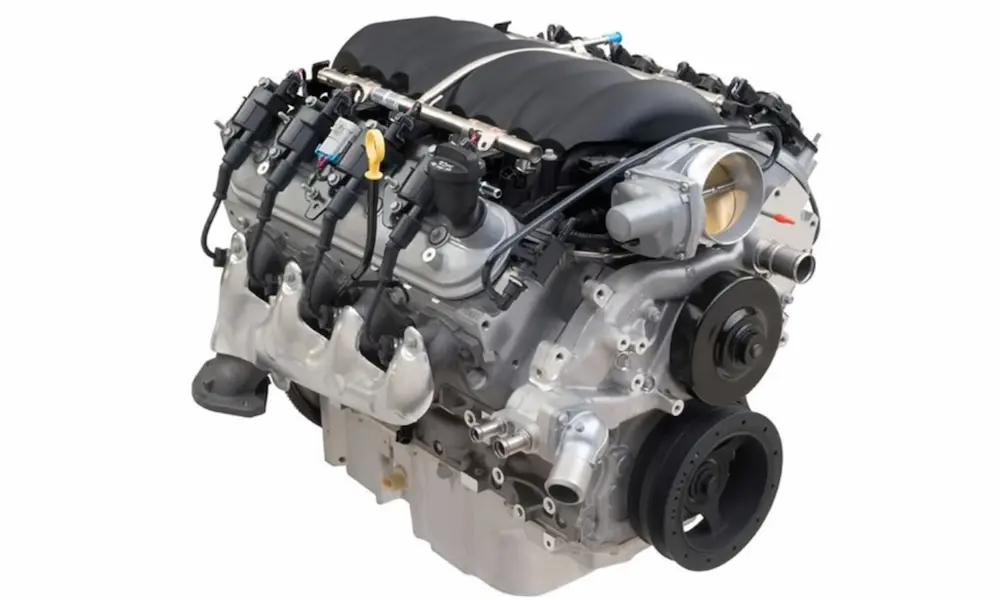
Got a misfire, a wiring mix-up, or just want to understand what makes your Chevy V8 tick? The firing order controls everything from power delivery to engine longevity. Get it wrong and you’ll know fast. Get it right and your engine runs like it should. Stick around — this covers every Chevy V8 firing order you’ll actually encounter.
What Is a Firing Order and Why Does It Matter?
The firing order is the exact sequence your engine’s cylinders ignite. It’s not random. Engineers calculate it to balance forces, manage heat, and keep vibrations from tearing the engine apart.
Change it carelessly and you get rough idle, misfires, overheating, and premature wear. Understand it and you can diagnose problems faster, set timing accurately, and even unlock extra performance.
Chevy V8 Cylinder Numbering: Get This Right First
Before touching any wires, know where your cylinders actually are.
GM numbers its V8 cylinders like this:
- Left bank (driver’s side): 1, 3, 5, 7 — front to rear
- Right bank (passenger’s side): 2, 4, 6, 8 — front to rear
Cylinder 1 sits at the front-left of the engine. That’s your starting point for everything.
| Bank | Side | Cylinders (Front to Rear) |
|---|---|---|
| Left | Driver | 1, 3, 5, 7 |
| Right | Passenger | 2, 4, 6, 8 |
This layout differs from Ford, which runs 1-2-3-4 on the passenger side. Mix them up and you’ll chase gremlins for hours.
The Classic Chevy V8 Firing Order: 1-8-4-3-6-5-7-2
This is the one most people mean when they say “Chevy V8 firing order.” It covers the original small block and big block engines — the 283, 327, 350, 396, 454, and more.
The sequence: 1 – 8 – 4 – 3 – 6 – 5 – 7 – 2
Summit Racing confirms this as the standard early Chevy V8 firing order, used consistently across decades of production.
The pattern alternates between banks as much as the crankshaft design allows. Notice it starts front-left, jumps to rear-right, moves forward, then crosses banks — that’s intentional load balancing across the main bearing journals.
The 5-7 Consecutive Firing Problem
Here’s one flaw baked into the classic sequence. Cylinders 5 and 7 both sit at the rear of the driver’s side bank. They fire back to back.
That’s a problem because:
- The rear of the block gets less coolant flow than the front
- Consecutive rear-bank firing concentrates heat in one corner
- Two exhaust pulses crash into each other inside the manifold, creating backpressure
This consecutive pulse collision limits high-rpm breathing efficiency. It’s manageable on a street engine. On a race engine, it’s a real handicap.
The W-Series Exception Worth Knowing
The 348 and legendary 409 used a radically different combustion chamber design. The deck angle was machined at 74 degrees, and the combustion chamber sat in the block rather than the head.
Despite that mechanical difference, the W-series kept the same 1-8-4-3-6-5-7-2 firing order. The rotating assembly geometry didn’t change, so neither did the sequence.
Companion Cylinders: The Diagnostic Shortcut You Need
Every Chevy V8 has companion cylinder pairs. These are cylinders that share the same crankshaft journal, meaning their pistons reach top dead center simultaneously — just in opposite stroke phases.
Split the firing order in half and stack it to find the pairs:
| Phase One | Phase Two | Companion Pair |
|---|---|---|
| Cylinder 1 | Cylinder 6 | 1 and 6 |
| Cylinder 8 | Cylinder 5 | 8 and 5 |
| Cylinder 4 | Cylinder 7 | 4 and 7 |
| Cylinder 3 | Cylinder 2 | 3 and 2 |
This companion cylinder relationship makes valve adjustment fast. When cylinder 1 is rocking its valves at the end of the exhaust stroke, cylinder 6 is sitting perfectly at top dead center on compression — both valves closed and ready to adjust.
For misfire diagnosis, an infrared thermometer pointed at exhaust ports tells the story. Cylinders firing correctly heat up together. A cold port means no spark or a crossed wire.
The Optispark System and Wire Routing Complexity
The Gen II LT1 and LT4 engines (1992–1997 Corvette, Camaro, Firebird) kept the 1-8-4-3-6-5-7-2 firing order. But they ditched the rear-mounted distributor entirely.
GM introduced the Optispark system, mounted at the front of the engine directly behind the water pump. It was driven by the nose of the camshaft — no gear backlash, no timing scatter.
Inside the Optispark sits a spinning optical disc with two track types:
- 360-slot outer track: Gives the ECM crankshaft position down to one degree
- 8-slot inner track: Unique slot widths identify each specific cylinder in the firing order
The result was far more precise timing control than any traditional distributor could deliver. Sequential fuel injection became genuinely accurate.
The downside? It’s buried under the water pump and serpentine belt. Replacing it is a significant job, and the optical sensors fail if coolant leaks from above reach the housing. Always vent the system properly — ozone from high-voltage sparks degrades the internals.
The 4/7 Swap: What Racers Figured Out Before GM Did
Long before GM changed its production firing order, drag racers were already doing it themselves. The 4/7 swap became the go-to fix for the classic sequence’s thermal and mechanical flaws.
Standard order: 1-8-4-3-6-5-7-2
4/7 swap order: 1-8-7-3-6-5-4-2
Swap the cam lobes for cylinders 4 and 7. Then swap those spark plug wires at the distributor cap. That’s it mechanically.
Why does it work? Cylinders 4 and 7 are companion cylinders — their pistons reach TDC at the same time. Swapping their firing roles doesn’t disturb engine balance. It just moves the consecutive firing event from the rear of the driver’s bank (hot, restricted coolant flow) to the front (cooler, close to the water pump).
The performance benefits are real and measurable:
- Cooler combustion chambers allow more ignition timing advance
- Back-to-back firing moves closer to the timing chain, reducing camshaft twist at high RPM
- More even air/fuel distribution across the intake manifold
Summit Racing’s Pro SBC 4/7 cam lineup ranges from mild street profiles to dedicated bracket racing grinds:
| Stage | Duration at 0.050″ | Lift | LSA | RPM Range |
|---|---|---|---|---|
| Stage 1 (Street) | 204°/212° | .420″/.428″ | 110° | 750–5,250 |
| Stage 4 (Performance) | 228°/236° | .473″/.495″ | 108° | 2,000–6,200 |
| Stage 8 (Racing) | 252°/258° | .533″/.540″ | 107° | 3,200–7,200 |
The LS and LT Firing Order: 1-8-7-2-6-5-4-3
When GM launched the Gen III LS platform in 1997, they took the lessons learned from racing and baked them into the factory spec. The new firing order became 1-8-7-2-6-5-4-3.
That’s essentially the 4/7 swap plus a simultaneous 2/3 swap applied at the factory level. Computer modeling confirmed that this sequence significantly smoothed crankshaft torsional vibration — meaning less twist, less harmonic stress, and longer bearing life.
The LS also ditched the distributor entirely. Individual coil-near-plug ignition, commanded by an ECM reading a reluctor wheel on the crankshaft, replaced it. Because the new firing order reduced crankshaft twist, the reluctor wheel maintained a more stable rotational velocity. That gave the position sensor cleaner, more accurate data for every spark and every injector pulse.
The 8.1L Vortec (496 cubic inches) used the same modern 1-8-7-2-6-5-4-3 sequence despite being built on the traditional big block architecture. It combined old-school torque — over 450 lb-ft at 3,200 RPM — with modern ignition precision.
Marine Reverse Rotation: 1-2-7-5-6-3-4-8
Twin-engine boats have a specific problem. Two propellers spinning the same direction cause severe torque pull to one side. The cleanest fix is running one engine in reverse rotation.
Spinning the crankshaft backward reverses the firing sequence entirely:
| Rotation | Viewed From Flywheel | Firing Order |
|---|---|---|
| Standard | Counter-clockwise | 1-8-4-3-6-5-7-2 |
| Marine Reverse | Clockwise | 1-2-7-5-6-3-4-8 |
This isn’t just a wiring change. Building a reverse-rotation engine requires:
- A custom camshaft ground with reversed lobe positions — but with an opposite-pitch distributor drive gear so the oil pump still spins clockwise
- Directional crankshaft seals machined for reverse rotation
- A reverse-polarity starter motor
- A remarked timing tab, because TDC timing events now fall on the opposite side of zero
The distributor still spins clockwise on a reverse-rotation engine. The cam drives it backward relative to the crank, but the gear cut compensates. The oil pump depends on that clockwise direction — get it wrong and you have zero oil pressure.
Duramax Diesel V8: The Firing Order That Can Destroy Crankshafts
The 6.6L Duramax diesel V8 runs a factory firing order of 1-2-7-8-4-5-6-3. That works fine in stock applications, but high-horsepower sled-pulling builds exposed a serious flaw.
Diesel ignition is compression-fired, not spark-fired. The force hitting the connecting rods is far more violent than in a gasoline engine. The factory sequence concentrates consecutive high-pressure events in a pattern that loads the front portion of the crankshaft with extreme torsional stress. Over time, that harmonic fatigue cracks and shears the crankshaft snout completely off.
The fix is an aftermarket alternate-firing-order camshaft that changes the sequence to 1-5-6-3-4-2-7-8. That redistributes combustion loads more evenly across all main bearing journals and essentially eliminates the failure mode.
| Application | Firing Order | Engineering Goal |
|---|---|---|
| Duramax Factory | 1-2-7-8-4-5-6-3 | Standard production balance |
| Duramax Alternate | 1-5-6-3-4-2-7-8 | Crankshaft stress mitigation |
Installing this requires physically swapping injector wiring harness connector pins to match the new mechanical sequence. The ECM detects cylinder position from the tone wheel and expects a specific injection pattern — get the pinout wrong and the engine won’t run correctly.
The Flat-Plane Firing Order: 1-4-3-8-7-6-5-2
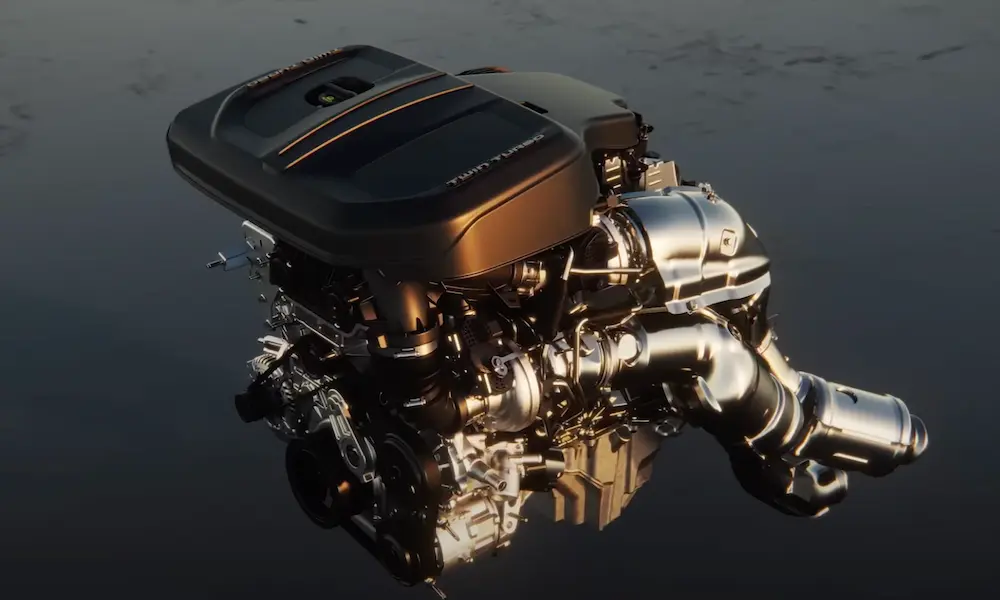
The C8 Corvette Z06’s 5.5L LT6 and the ZR1’s twin-turbo LT7 use a completely different crankshaft architecture. Instead of journals at 90-degree offsets forming a cross shape, the flat-plane crank places all journals on a single 180-degree plane.
The firing order: 1 – 4 – 3 – 8 – 7 – 6 – 5 – 2
Look at that sequence. It alternates perfectly between the driver’s side and passenger’s side on every single firing event. That’s something a cross-plane crank physically can’t do.
The result? Exhaust pulses exit each manifold at perfectly even 180-degree intervals. No collisions, no backpressure, and a powerful scavenging effect where each exiting pulse pulls the next cylinder’s exhaust gases out behind it. This dramatically improves high-RPM breathing without any forced induction on the Z06.
The same pulse timing works in the intake manifold. Pressure waves from closing intake valves reflect back down the runners at precisely the right moment to force extra air into the next opening cylinder — resonance supercharging — pushing volumetric efficiency past 100% naturally.
The tradeoff is vibration. Two pistons traveling upward at the same time while two others travel downward creates a secondary shaking force that cross-plane cranks don’t have. GM’s solution: an extremely short 3.1-inch stroke, forged titanium connecting rods, lightweight pistons, and a rotating assembly light enough that the vibrations stay manageable. The LT6 redlines at 8,600 RPM — the highest ever for a naturally aspirated American production V8.
Quick Reference: Every Chevy V8 Firing Order
| Engine Family | Examples | Firing Order |
|---|---|---|
| Gen I Small Block / Big Block | 350, 396, 454 | 1-8-4-3-6-5-7-2 |
| W-Series | 348, 409 | 1-8-4-3-6-5-7-2 |
| Gen II (LT1/LT4) | 5.7L Corvette, Camaro | 1-8-4-3-6-5-7-2 |
| Gen III/IV LS | LS1 through LS9 | 1-8-7-2-6-5-4-3 |
| Gen V LT (cross-plane) | LT1, LT4, LT2 | 1-8-7-2-6-5-4-3 |
| 8.1L Vortec | L18 truck/marine | 1-8-7-2-6-5-4-3 |
| 4/7 Swap (SBC) | Modified small blocks | 1-8-7-3-6-5-4-2 |
| Marine Reverse Rotation | Twin-engine boats | 1-2-7-5-6-3-4-8 |
| Duramax Diesel (factory) | 6.6L LB7–L5P | 1-2-7-8-4-5-6-3 |
| Duramax Diesel (alt cam) | High-HP sled pull builds | 1-5-6-3-4-2-7-8 |
| Gen V LT (flat-plane) | LT6 Z06, LT7 ZR1 | 1-4-3-8-7-6-5-2 |
Whether you’re chasing a misfire on a classic 350, wiring a marine engine, or just geeking out over what makes the C8 Z06 scream to 8,600 RPM, the firing order is the thread that runs through all of it. Get the sequence right. Know your cylinder numbering. Everything else follows from there.