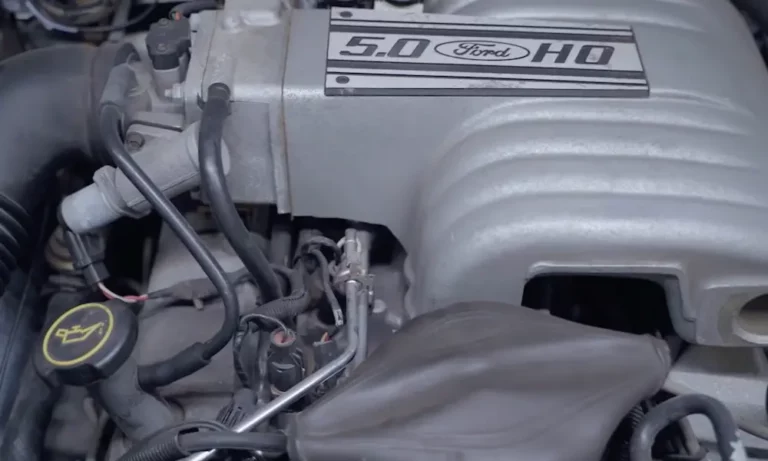
Getting the Ford 302 firing order wrong isn’t just an annoyance — it can split your engine block in half. Whether you’re rebuilding a classic 289, swapping cams in a Fox Body Mustang, or diagnosing a rough idle, this guide covers everything you need to know. Stick around, because the difference between the two firing orders is smaller than you’d think — and the consequences of mixing them up aren’t.
What Is the Ford 302 Firing Order?
Here’s the short answer: there are actually two Ford 302 firing orders, not one.
- Standard / Non-H.O. 302: 1-5-4-2-6-3-7-8
- High Output 302 / 351 Windsor: 1-3-7-2-6-5-4-8
Which one your engine uses depends entirely on the year, the application, and — most importantly — the camshaft sitting inside the block. The small-block Ford family has used both sequences across decades of production.
Confuse the two, and you’re not just looking at a rough idle. You’re looking at backfires, bent rods, or a cracked block.
Ford 302 Cylinder Numbering: Get This Right First
Before you touch a single spark plug wire, understand how Ford numbers its cylinders. This trips up more people than the firing order itself.
Ford uses a sequential, front-to-back system divided by bank:
| Engine Bank | Cylinder Numbers (Front to Rear) |
|---|---|
| Passenger Side (Right Bank) | 1, 2, 3, 4 |
| Driver Side (Left Bank) | 5, 6, 7, 8 |
That’s it. Simple, sequential, side by side. But here’s the trap: General Motors numbers their V8s differently, alternating odd numbers on one bank and even numbers on the other. If you apply a GM layout to a Ford block, the engine won’t run — and worse, it can damage itself the moment you hit the starter. This is one of the most documented cross-wiring errors in small-block diagnostics.
Always confirm you’re using Ford’s numbering before routing a single wire.
The Standard Firing Order: 1-5-4-2-6-3-7-8
This is the original sequence Ford used for the entire small-block family — the 221, 260, 289, and early 302 engines. It carried through passenger cars and trucks from the 1960s all the way into the mid-1990s for non-H.O. truck applications.
Where You’ll Find the Standard Order
- All 289 cubic-inch engines
- Standard 302s produced before 1982
- Non-H.O. 5.0-liter truck engines through approximately 1994
- The legendary Boss 302 (1969–1970)
The Boss 302 is a fun footnote here. Despite being a fire-breathing Trans-Am homologation special with Cleveland-derived heads, it used the same 1-5-4-2-6-3-7-8 sequence as a garden-variety 289. Even better — early 1969 Boss 302 intake manifolds were cast with the phrase “FIREING ORDER” stamped into the metal. Ford quietly corrected the spelling by 1970.
The Problem With This Sequence
In the standard order, cylinders 7 and 8 fire consecutively. They’re physically next to each other at the rear of the driver-side bank. That back-to-back combustion hammers the same spot on the block repeatedly, creates concentrated heat at the rear of the engine, and sets up a significant electromagnetic crossfire risk between those two wires.
There’s also a beating the number 1 main bearing takes. Cylinder 1 fires, then cylinder 5 fires 90 degrees of crankshaft rotation later. Two violent downward forces hit the front main bearing in rapid succession, which accelerates wear and can cause audible knock at idle.
The High Output Firing Order: 1-3-7-2-6-5-4-8
Ford introduced this sequence on the 351 Windsor in 1969, then adopted it for the 5.0-liter H.O. engine starting with the 1982 Mustang GT. It became the defining sequence of the Fox Body era.
Where You’ll Find the H.O. Order
- 1982–1993 Fox Body Mustangs with the 5.0 H.O.
- 1994–1995 SN-95 Mustangs
- 1993–1995 F-150 SVT Lightning (351 Windsor)
- 5.0-liter mass-air fuel-injected trucks from 1994 onward
- Ford’s later Modular V8s, including the 4.6 and 5.4-liter engines
Why Ford Made the Switch
Ford’s engineers didn’t change the firing order for fun. There were three concrete reasons, and all of them are well-documented:
1. Main bearing protection. By firing cylinder 3 after cylinder 1 instead of cylinder 5, Ford shifted the second combustion event rearward on the passenger bank. The number 1 main bearing now had more time to rebuild its oil film before absorbing another combustion load. Ford even issued technical service bulletins requiring technicians to fit main bearings to precise one-thousandth-of-an-inch clearances on 5.0-liter engines.
2. Eliminating piston-destroying crossfire. In the standard order, electromagnetic induction between adjacent wires on the right bank frequently caused premature spark in cylinder 4 under heavy load. The result? A hole burned clean through the aluminum piston dome. Ford denied warranty claims on remanufactured engines if spark plug wire routing wasn’t followed exactly. The H.O. sequence rearranged the right bank’s combustion pattern and eliminated this vulnerability entirely.
3. Better sound. Ford engineers officially documented that the 351 Windsor firing order gave the 5.0 Mustang its iconic, aggressive exhaust note. The revised sequence changed harmonic frequencies in the intake runners, and the result is the sound that made the Fox Body famous.
| Engine Type | Firing Order | Consecutive Cylinders on Driver Bank |
|---|---|---|
| Standard / Non-H.O. 302 | 1-5-4-2-6-3-7-8 | 7 and 8 |
| High Output 302 / 351 Windsor | 1-3-7-2-6-5-4-8 | 6 and 5 |
The Camshaft Is What Actually Sets the Firing Order
Here’s something that surprises a lot of people: the crankshaft doesn’t determine the firing order. The camshaft does.
The crankshaft in a 1970s standard 302 and a 1990s H.O. 302 are physically identical. Same geometry. Same counterweights. Same throws. If you swap to an H.O. camshaft and reroute the plug wires to match, you’ve effectively converted the engine to the H.O. firing order. That’s exactly how it works.
Comp Cams makes this straightforward with their naming system:
- Prefix “31” = standard 302 camshaft (1-5-4-2-6-3-7-8)
- Prefix “35” = H.O. / 351 Windsor camshaft (1-3-7-2-6-5-4-8)
One critical detail when swapping: flat-tappet vs. roller cam blocks aren’t interchangeable without modification. The 1985–1995 5.0-liter blocks feature taller lifter bosses to accommodate hydraulic roller lifters. Roller cams use a smaller base circle to compensate. Always check your block casting number before ordering a cam.
Marine 302 Firing Orders: Standard and Reverse Rotation
The Ford 302 spent decades powering boats made by manufacturers like Penn Yan and Correct Craft through marine systems from Mercruiser and OMC. Twin-engine setups introduce a completely different wrinkle: reverse rotation.
When two props spin in the same direction, they create torque steer — the stern literally walks sideways. The fix is running one engine in reverse rotation, which requires a reversed camshaft and a backward starter.
The two marine firing orders are:
- Standard Rotation Marine 302: 1-5-4-2-6-3-7-8
- Reverse Rotation Marine 302: 1-8-7-3-6-2-4-5
Notice something? The reverse rotation order is just the standard order read backwards. Start at 1 and count backward: 1, 8, 7, 3, 6, 2, 4, 5.
One critical detail: even in a reverse-rotation marine engine, the distributor must still spin counterclockwise. Engineers solved this by cutting the distributor drive gear at an inverse angle, so a backward-spinning cam still drives the distributor the correct direction. Always crank the engine manually to confirm rotation direction before ordering parts.
Installing and Timing the Distributor Correctly
The Ford 302 distributor rotor spins counterclockwise. That’s your baseline for everything that follows.
Finding TDC on Cylinder 1
- Pull the number 1 spark plug (front of the passenger bank)
- Rotate the crankshaft slowly by hand with a socket on the balancer bolt
- Place your finger over the plug hole and feel for pressure building — that’s the compression stroke
- Watch the harmonic balancer until the timing pointer aligns with the zero-degree mark
- The crankshaft keyway should point straight up to 12 o’clock
If the harmonic balancer’s rubber dampener ring has aged and slipped, the timing marks are unreliable. Replace the balancer before setting timing.
Setting Base Timing
Once TDC is confirmed, drop the distributor so the rotor tip points toward the cap’s number 1 terminal. Standard base timing for a 302 is 10 degrees before TDC.
- To advance timing: Rotate the distributor body clockwise (opposite rotor travel)
- To retard timing: Rotate the distributor body counterclockwise (same as rotor travel)
On EFI Fox Body and SN-95 Mustangs, pull the SPOUT connector before using your timing light to disable the computer’s timing adjustments. Reinstall it after locking in mechanical base timing.
Gear material matters too. Roller cam engines use hardened steel distributor gears. A cast iron gear on a roller cam will destroy itself quickly. Match the gear to the cam type.
Spark Plug Wire Routing and Crossfire Prevention
Routing plug wires isn’t just about looking clean. It’s about preventing inductive crossfire — a real phenomenon where high-voltage pulses in one wire induce a rogue spark in an adjacent wire.
The risk changes with each firing order:
- Standard order (1-5-4-2-6-3-7-8): Cylinders 7 and 8 fire back to back. Their wires run close together at the rear of the driver bank. High crossfire risk in that area.
- H.O. order (1-3-7-2-6-5-4-8): Cylinders 6 and 5 fire back to back. The vulnerability shifts toward the front of the driver bank.
To prevent crossfire:
- Use wire looms to physically separate sequential-firing wires
- When wires must cross, route them at 90-degree angles — not parallel
- Use quality 8mm or 10mm spiral-core silicone wire sets rated for low resistance (as low as 270 ohms per foot)
- Choose 135-degree or 45-degree angled boots to clear exhaust manifolds and headers without melting
Ford’s own engineers denied warranty claims on remanufactured engines where wire routing wasn’t followed. This isn’t optional.
What Happens When the Firing Order Is Wrong
Getting the firing order wrong produces consequences that scale from annoying to catastrophic.
Mild cross-wiring (two wires swapped):
- Rough, shaky idle
- Major power loss under acceleration
- Raw fuel smell from the exhaust
- Excessive heat under the vehicle
- Misfire codes like P0302 stored in the PCM
On EFI engines, the computer shuts down fuel injectors for misfiring cylinders to protect the catalytic converter. Raw fuel in a hot converter melts the substrate and kills exhaust flow.
Severe mismatch (wrong cam + wrong wiring):
- Spark arrives while intake valves are open → violent backfire through the intake, destroying MAF sensors and air filter housings
- Spark arrives while exhaust valves are open → deafening exhaust explosions that split tubing
- Early ignition fights piston travel → immediate kickback that shatters starter housings, bends connecting rods, or fractures the crankshaft
Technicians have documented cases where a freshly built engine cross-fired on the first starter engagement — and the crankshaft came out in three pieces with the block split in half.
The Ford 302 firing order isn’t a technicality. It’s the difference between a healthy engine and an expensive pile of metal. Know your cam, number your cylinders correctly, route your wires with care, and this engine will reward you with decades of reliable, aggressive performance.