That “Active Air Dam System Fault See Manual” message just lit up your F-150’s dashboard. Before you panic or book a dealership appointment, you need to know what’s actually broken, why it happens constantly, and what your real options are. This guide covers every cause, every fix, and a few tricks Ford won’t tell you about.
What Is the Ford Active Air Dam System?
The active air dam sits under your front bumper. It’s a deployable plastic blade that drops down automatically at highway speeds to block air from churning under your chassis.
Here’s the simple version: at 45 mph and above, your F-150’s Powertrain Control Module (PCM) sends a signal to two small electric motors. Those motors push the blade downward, reducing your front ground clearance from about nine inches to roughly five inches. Below that speed threshold, the blade retracts so you keep full clearance for parking, trails, and curbs.
Ford introduced the system on 2021-2025 F-150 models across gas, PowerBoost hybrid, and F-150 Lightning variants. The goal? Reduce aerodynamic drag to improve fuel efficiency by up to 4% and help Ford hit federal fuel economy targets.
It’s clever engineering. It’s also mounted five inches off the ground on a truck people use like a truck.
Why the Ford Active Air Dam System Fault Warning Appears
The dashboard message means the system can’t complete its job. Either communication broke down between the PCM and the actuators, or the blade couldn’t physically move when commanded.
Two main fault codes trigger this warning.
U0645: Lost Communication With Active Air Dam Module
This code means your PCM sent a command and heard nothing back. The LIN bus — the single-wire communication network connecting the PCM to your actuators — went silent.
The usual culprit is physical damage to the wiring. The harnesses run along the lowest part of the chassis. Road salt, deep puddles, and debris chafe through the insulation. A common failure point is a short circuit near the left engine mount. You’ll need continuity tests along the wiring loom before replacing any parts.
C0604:00: Active Air Dam Actuator Performance
This is the most common code F-150 owners see. Communication works fine, but the blade won’t move — or the actuator’s internal firmware thinks it’s jammed when it isn’t.
Physical causes:
- Snow or ice packed between the blade and bumper valance
- Mud caked into the mechanical linkage
- Impact damage from road debris or a parking curb
Digital causes:
- Defective firmware hardcoded into the actuator’s circuit board
- The firmware misreads its own sensors and reports a false jam
- Software mismatches between the PCM and other vehicle modules
When the blade hits resistance, the actuator’s motor draws a current spike. The system detects this, shuts down, and logs the fault. Problem is, bad firmware triggers the exact same shutdown even when nothing is physically blocking the blade.
| DTC Code | What It Means | Common Cause | First Step |
|---|---|---|---|
| U0645 | No communication with actuator module | Wiring short, corroded connector, chafed harness near left engine mount | Run continuity pinpoint tests on the LIN circuit |
| C0604:00 | Actuator can’t reach commanded position | Ice/mud blockage, impact damage, or defective actuator firmware | Clear codes, inspect blade, check for TSB 25-2236 software update |
Ford’s Official Fix History: A Timeline of TSBs
Ford didn’t get this right on the first try. The pattern of service bulletins tells a story of an automaker scrambling to manage a widespread problem.
Step 1: “Just Ignore It” (SSM 51323)
Early F-150 Lightning owners started flooding dealerships with fault complaints in late 2022. Ford’s first response was Special Service Message 51323: tell customers to disregard the message, a software fix is coming.
That approach lasted until it became obvious the hardware was genuinely failing.
Step 2: PCM Reprogramming (TSB 23-2126)
By mid-2023, Ford issued TSB 23-2126 for 2022-2023 F-150 Lightning vehicles. Dealership technicians could now perform a software flash to update the PCM. This repair qualified under the New Vehicle Limited Warranty.
It helped some trucks. It didn’t fix the problem fleet-wide.
Step 3: Multi-Module Software Overhaul (TSB 25-2236)
This is the big one. TSB 25-2236 covers 2021-2023 F-150s across all powertrains showing the C0604:00 code.
The scope is massive. Standard F-150s need only a PCM flash. Hybrid and Lightning models require coordinated reprogramming of:
- Anti-lock Braking System module
- Battery Energy Control Module
- Generic Function Module 2
- Multiple Secondary On-Board Diagnostic Modules (SOBDM, SOBDM B, SOBDM C)
Technicians must connect a battery maintainer directly to the 12-volt chassis ground during the procedure to prevent voltage drops mid-flash. The scale of this update confirms the active air dam’s control logic is deeply tangled with the truck’s broader operating architecture.
Step 4: Replace the Actuators (SSM 51718 and SSM 52349)
Software couldn’t save every truck. SSM 51718 and SSM 52349 directed technicians to physically replace both actuators when codes returned after cleaning and software updates.
If no physical blockage exists and the fault keeps coming back, the firmware is permanently defective inside the actuator hardware. Both the driver-side (ML3Z-17626-U) and passenger-side (ML3Z-17626-E) actuators get replaced together.
The Real-World Problem: It Keeps Getting Smashed
Here’s the core issue. A blade hanging five inches off the ground on a pickup truck is a liability.
At highway speeds, semi-truck tire treads, small animals, and road debris pass under a car’s bumper easily. They hit the deployed air dam dead-on. Pull nose-first into a parking space too fast, and the blade crushes against the curb before it can retract.
The Cost Problem Nobody Warned You About
The math here is brutal:
- Replacement blade alone: ~$192.95
- Blade replacement with dealership labor and taxes: ~$386.73
- Actuator pair (parts only): ~$460
- Full system replacement (blade + actuators + labor): over $1,100
Meanwhile, the efficiency gain the system provides is roughly 0.30 miles per gallon. A single impact event wipes out years of fuel savings.
Ford classifies impact damage as external damage, not a warranty defect. So that $1,100+ bill lands entirely on you.
The F-150 Lightning Problem Is Worse
On a gas F-150, a broken air dam costs you some fuel economy and a dashboard warning. On the Lightning, it’s a bigger deal.
Highway aerodynamic drag directly burns battery range. If the air dam fails to deploy on a long trip, especially in cold weather, you could run short of the next charging station. That’s not a minor inconvenience.
When Air Dam Faults Overlap With Battery Codes
Lightning owners regularly report something alarming: a simple C0604:00 air dam fault triggers a “Service Vehicle Soon” or “Powertrain Malfunction” warning — the kind that signals a serious EV problem.
Pull the codes and you might see this combination alongside the air dam fault:
- P0D1B(00): Battery Pack Coolant Control Valve ‘B’ Performance or Stuck Off — this valve manages thermal control of the high-voltage pack
- P0B24: Hybrid Battery A — Voltage Unstable — this suggests potential battery module failure
The air dam actuators and the coolant diverter valves sit in the same front lower chassis zone. Both face identical threats from impacts and corrosion. If the thermal valve actually fails — not just the air dam — and you dismiss it as an aerodynamic glitch, you’ll cause permanent high-voltage battery degradation.
Lightning owners: never assume a “Service Vehicle Soon” light is just the air dam. Get the codes pulled and verify the thermal management system independently.
Three Ways to Delete the System Entirely
Many F-150 owners decide the repair cycle isn’t worth it. A healthy aftermarket has built three distinct solutions.
Method 1: Zip-Tie the Actuators (Mechanical Bypass)
Remove the plastic blade and lower valance. Leave the actuators bolted somewhere behind the bumper with zip-ties or a small bracket, still fully wired and plugged in.
When the PCM sends a deploy command at highway speeds, the actuators spin freely with no blade attached. The internal sensors confirm “successful deployment,” no codes get logged, and no warning appears. It works. It’s not elegant, but it works.
Method 2: 3D-Printed Dummy Plugs (Electrical Bypass)
Remove everything — blade, actuators, and harnesses. Cap the exposed factory connectors with precision-molded 3D-printed bypass plugs that match the ML3Z-17626 actuator socket geometry exactly.
Fill the connectors with marine-grade dielectric grease first, then snap the caps on. At roughly $18 a pair, this keeps road salt and moisture out of the open LIN bus circuits permanently. Without an accompanying software change, the dashboard fault message may still appear — but your wiring is protected.
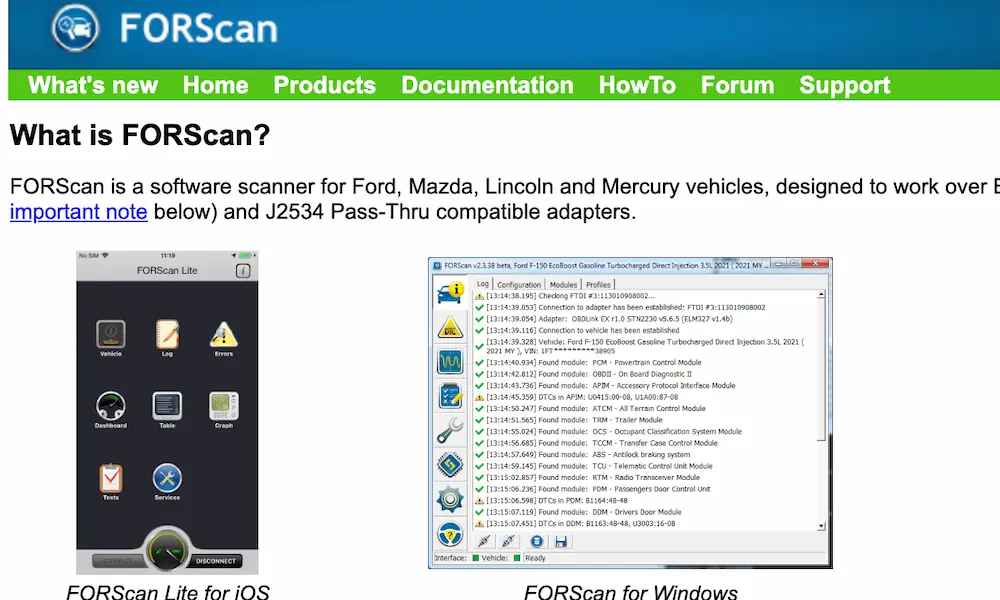
Method 3: FORScan Software Delete (Digital Bypass)
This is the complete solution. FORScan lets you connect a laptop to your OBD-II port and rewrite the vehicle’s as-built module data directly.
The process involves modifying two modules:
- Body Control Module: Change the air dam data string so the system no longer exists in PCM logic
- Instrument Panel Cluster: Set the front active air dam to “not configured”
Once complete, you can remove every piece of air dam hardware, including the wiring harnesses, with zero consequences. The PCM never broadcasts a deployment command because it thinks the truck was built without the system. No codes, no warning messages, no issues — ever.
This is the gold standard approach for anyone doing a full delete.
Warranty and Legal Considerations
Firmware faults and manufacturing defects are covered under the New Vehicle Limited Warranty. Software flashes under TSBs fall under standard warranty provisions.
A few things to know:
- Impact damage is almost never covered. Ford will call it external damage, period.
- The 3.0L diesel F-150 gets extended TZEV emissions warranty coverage (10 years/150,000 miles) that explicitly includes the active air dam. Other powertrains don’t get this.
- FORScan modifications carry real risk. If you’ve altered your BCM or PCM data and a related module later fails, Ford has grounds to deny warranty coverage on that module. Know that risk before you flash anything.
Your Quick Diagnostic Checklist
Before booking a dealership appointment, work through this list:
- Check for physical damage — inspect the blade and linkage for cracks, packed mud, or ice
- Clear the codes — sometimes a single obstruction event logs a fault that doesn’t return
- Check your VIN against TSB 25-2236 — your dealer should confirm whether this multi-module flash has been performed
- Ask about SSM 51718 and SSM 52349 — if you’re on a 2021-2023 F-150 and the C0604:00 keeps coming back after cleaning, you likely need both actuators replaced under warranty
- Lightning owners only — independently verify coolant valve function before assuming the fault is aerodynamic
The active air dam system fault is annoying, but it’s manageable. Whether you fix it, flash it, or delete it entirely, you’ve got real options — and now you know exactly which one fits your situation.