Got a chip, scratch, or scuff on your Tuxedo Black Ford? Finding the right paint match feels harder than it should be. This guide breaks down everything about Ford paint code UH — what makes it unique, which vehicles wear it, and exactly how to fix it right the first time. Stick around, because skipping any step here costs you money.
What Is Ford Paint Code UH?
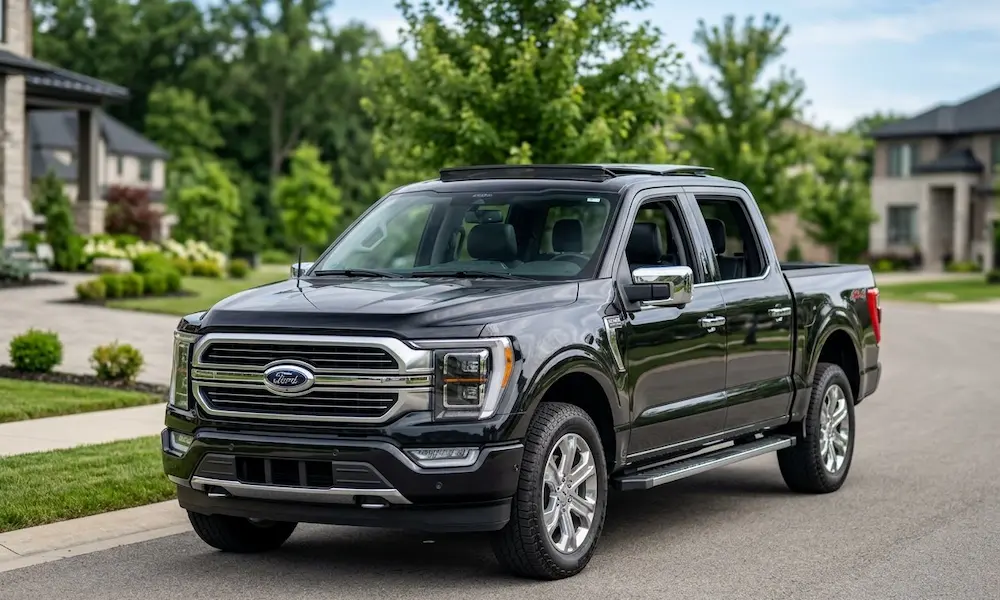
Ford paint code UH is the official designation for Tuxedo Black Metallic (also called Tuxedo Black M). It’s not your standard flat black. In the shade, it reads deep and formal. Step into direct sunlight, and the finish explodes with a multi-colored, diamond-like shimmer.
That dramatic shift happens because Ford didn’t use ordinary aluminum flakes. Instead, the UH formula uses a specialized pearl additive called Xirallic — tiny synthetic glass-like platelets of aluminum oxide coated in titanium dioxide. These microscopic prisms refract light differently depending on the angle, giving the paint far more depth than a standard metallic finish.
Think of it as black paint that secretly moonlights as a light show.
How to Find Your Ford Paint Code UH
You don’t need to guess whether your vehicle wears code UH. Ford prints the paint code directly on the driver’s side door jamb sticker. Look for a label marked EXT PNT or EXT TR — the two-character code right next to it is your paint designation. If it says UH, you’ve confirmed Tuxedo Black Metallic.
You can also cross-reference using:
- Your VIN number
- Your Ford dealer parts department
- Online paint code lookup tools at retailers like PaintScratch
Which Ford, Lincoln, and Mercury Vehicles Use Code UH?
Ford applied Tuxedo Black Metallic broadly across its Ford, Lincoln, and Mercury lineups, primarily between 2008 and 2017. On trucks like the F-150 and Super Duty, it anchored premium packages including the FX4, Tremor, King Ranch, Platinum, and Raptor. On Lincoln vehicles, it served as a luxury differentiator. Mercury used it on final-generation platforms before the brand folded.
Here’s the full compatibility breakdown:
| Brand | Model | Production Years |
|---|---|---|
| Ford | F-Series (F-150, Super Duty) | 2008–2016 |
| Ford | Fusion | 2009–2016 |
| Ford | Taurus / Taurus X | 2009–2016 |
| Ford | Edge | 2009–2016 |
| Ford | Expedition | 2009–2016 |
| Ford | Explorer | 2009–2016 |
| Ford | Flex | 2009–2016 |
| Ford | Escape | 2009–2016 |
| Ford | Focus / Focus Electric | 2009–2016 |
| Ford | Fiesta | 2009–2016 |
| Ford | C-MAX | 2012–2016 |
| Ford | Transit | 2014–2016 |
| Ford | Mustang | 2009–2015 |
| Lincoln | MKS | 2009–2015 |
| Lincoln | MKT | 2009–2015 |
| Lincoln | MKX | 2009–2015 |
| Lincoln | MKZ | 2009–2015 |
| Lincoln | MKC | 2015–2016 |
| Lincoln | Navigator | 2009–2015 |
| Mercury | Milan | 2009–2011 |
| Mercury | Sable | 2009 |
| Mercury | Mariner | 2011 |
For Lincoln-specific touch-up products, PaintScratch’s Lincoln UH page is a solid starting point.
Why Ford Paint Code UH Is Harder to Match Than Regular Black
Here’s the part most people miss — and it’s why bad touch-up jobs look so obvious.
The Xirallic glass platelets in Tuxedo Black Metallic are significantly denser than standard aluminum flakes or organic pigments. In a liquid paint suspension, heavy particles sink. Fast. If you apply the paint too thickly, or skip agitation, the flakes drift to the bottom of the wet film, clump together, and create dark blotchy patches. Painters call this mottling.
Mottling on a black metallic panel is immediately obvious in sunlight. Instead of uniform sparkle, you get dark shadow patches that look like the paint was applied with a sponge.
The fix is straightforward — but only if you know what to do:
- Shake aggressively before every application (minimum 60 seconds)
- Apply light coats, not heavy ones
- Allow full flash-off time between coats (10–15 minutes minimum)
- Keep the spray gun moving parallel to the panel at all times
Skip any of these and you’re repainting the panel again.
The 2011 Japanese Tsunami That Nearly Killed Tuxedo Black
This part of the story sounds like it shouldn’t involve car paint — but it absolutely does.
On March 11, 2011, the Great Tohoku Earthquake and Tsunami devastated northeast Japan, killing approximately 25,000 people and triggering the Fukushima Daiichi nuclear crisis. Located just 35 miles south of the nuclear facility, in Onahama, was a single chemical plant operated by German conglomerate Merck — the only facility in the world that produced Xirallic pigment.
When that plant went dark, Ford’s paint supply for five major colors — including Tuxedo Black and Royal Red — stopped immediately.
Within two weeks, Ford’s U.S. sales chief Kenneth Czubay sent an urgent memo to dealerships on March 24, 2011, suspending all new orders for Tuxedo Black and other Xirallic-based finishes. Production of Tuxedo Black versions of the F-150, Super Duty, Expedition, and Lincoln Navigator halted entirely during April 2011. The Explorer, Taurus, and Lincoln MKS faced severe restrictions at the Chicago Assembly Plant.
Ford’s design team, led by chief designer Susan Swek, tested alternative pigments to replicate the Xirallic sparkle. Lab results came back clear: nothing matched it. No substitute could reproduce the exact optical depth of the original formula.
The Onahama plant resumed normal output in June 2011. To prevent a repeat, Merck established a second Xirallic production facility in Germany by the end of that year. One tsunami exposed a single-point failure that affected global automotive production — and forced the whole industry to rethink supply chain geography.
The Best Products to Fix Ford Paint Code UH
Whether you’re touching up a door ding or respraying a full panel, product choice matters. Here’s what’s available, and who each option suits:
| Product | Manufacturer | Part Number | Best For |
|---|---|---|---|
| Genuine OEM Touch-Up Bottle | Ford Motorcraft | PMPC-19500-7211A | Small chips and narrow scratches |
| Scratch Fix All-in-1 Pen | Dupli-Color | AFM0412 | DIY small repairs |
| Perfect Match Aerosol | Dupli-Color | BFM0415 | Medium panel touch-ups |
| Expert Color Pro Grade Aerosol | U-POL | UPFM102 | Semi-professional spot repairs |
| MBC Acrylic Basecoat | PPG Omni | Pint/Quart/Gallon | Professional spray gun work |
| MTK Acrylic Urethane Single-Stage | PPG Omni | Pint/Quart/Gallon | Pro work without separate clear coat |
| Specialist Paints Urethane Basecoat | Custom Paints Inc. | FOR-48/G | Professional full-panel respray |
| Ford Tuxedo Powder Coat | Prismatic Powders | PMB-6994 | Wheels and trim components |
For Small Chips and Scratches
The Ford Motorcraft OEM touch-up bottle (PMPC-19500-7211A) is the most precise match available. It features a four-stage design: an abrasive fiberglass prep tip, a needle-point pen for narrow scratches, an internal brush for larger chips, and a separate foam-brush clear coat in the base. It holds exactly 0.25 fl oz of color and 0.25 fl oz of clear coat — and it includes an internal mechanical agitator. Use it.
The Dupli-Color Scratch Fix All-in-1 pen (AFM0412) mirrors the same design at a lower price point. Users note that the dense Xirallic flakes can clog the tip if you don’t shake it thoroughly first. Shake it for longer than you think you need to.
For Larger Areas
The Dupli-Color Perfect Match aerosol (BFM0415) covers more surface area in the same acrylic lacquer formula. It dries to the touch in 20 minutes and handles safely in 40 minutes.
For a more professional finish, the U-POL Expert Color aerosol (UPFM102) uses Axalta color technology and a flat nozzle that mimics a spray gun pattern. It dries to touch in 30 minutes — but it dries matte. You must apply a quality clear coat afterward to activate the gloss and reveal the metallic depth.
For Professional Resprays
PPG Omni’s MBC Acrylic Basecoat requires a 1:1 reduction with urethane reducer before spraying. The MTK Single-Stage option skips the separate clear coat step, using a 4:1:1 ratio of paint, hardener, and reducer instead. Both deliver factory-grade results in a professional spray setup.
For powder coating wheels, bumper brackets, or exterior trim, Prismatic Powders PMB-6994 cures to over 85 gloss units and matches the optical properties of the UH formula.
Step-by-Step Application Guide for Ford Paint Code UH
Follow these steps whether you’re doing a DIY chip repair or a professional panel respray.
Step 1: Prep the Surface
Clean the area with an automotive wax and grease remover. Road grease and silicones cause paint defects — clean first, sand second. If bare metal, plastic, or body filler is exposed, apply a high-quality gray primer. Specialist Paints recommends following primer with a grey sealer to establish uniform surface depth before applying color.
Step 2: Mix the Paint Correctly
- Two-stage urethane basecoat: Mix 1:1 by volume with urethane reducer (such as Omni Plus Reducer)
- Single-stage acrylic urethane: Mix 4 parts paint : 1 part hardener : 1 part reducer
- Touch-up pen or aerosol: Shake for at least 60 seconds before use — don’t cut this short
Step 3: Apply in Light Coats
Spray two to three light, even coats. Keep the gun or can moving parallel to the panel. Don’t linger in one spot. Apply lightly — heavier coats push the glass flakes to the bottom of the wet film, which causes mottling.
Step 4: Flash Off Between Coats
Wait 10–15 minutes between each basecoat layer. Full solvent evaporation between passes keeps the Xirallic flakes suspended and uniformly oriented. This is the step most DIYers skip — and it’s the step that separates a clean finish from a blotchy one.
Step 5: Apply Clear Coat
Once the basecoat has dried for 30–60 minutes, apply two to three coats of a UV-resistant, two-component clear coat. TheCoatingStore recommends a high-solids 2K glamour clear like UreChem UC-210, which includes UV inhibitors that protect the Xirallic layer from oxidation and fading.
Key Application Parameters at a Glance
| Phase | Specification |
|---|---|
| Surface cleaning | Automotive wax and grease remover |
| Primer | Gray primer if bare metal exposed |
| Shaking time | Minimum 60 seconds |
| Basecoat reduction | 1:1 with urethane reducer |
| Single-stage ratio | 4:1:1 (paint : hardener : reducer) |
| Coats | 2–3 light, even passes |
| Flash-off time | 10–15 minutes between coats |
| Pre-clear coat dry | 30–60 minutes |
| Clear coat system | 2K UV-resistant, 2–3 coats |
A Note on VOC Regulations
If you’re in Canada or certain U.S. jurisdictions like Utah, local environmental laws may require Low VOC coating systems for automotive refinishing work. Most passenger vehicles, truck cabs, and RVs qualify for standard urethane exemptions — but check your local regulations before you buy. Your paint supplier can point you toward compliant options if needed.
Final Thoughts on Getting Ford Paint Code UH Right
Ford paint code UH isn’t a paint you can fake. The Xirallic glass platelets that give Tuxedo Black Metallic its depth and sparkle demand specific handling — thorough agitation, controlled coats, and proper flash-off time. Shortcut any part of the process and the mottling will show up the moment sunlight hits the panel.
Use OEM or quality aftermarket products, follow the mixing ratios exactly, and let each coat dry fully before moving on. Do that, and your repair will blend in seamlessly with the surrounding factory finish.