Buying a used PCM, ordering a custom tune, or replacing a failed module — any of these tasks can go sideways fast without the right code. The Ford PCM tear tag number is a small detail that carries enormous weight. Get it wrong, and your truck won’t run right. Get it right, and everything clicks. Here’s exactly what you need to know.
What Is a Ford PCM Tear Tag Number?
A Ford PCM tear tag number is a four-character alphanumeric code that identifies the software calibration loaded into your Powertrain Control Module. Think of it as a fingerprint for your PCM’s programming.
The format is always three letters followed by one number — like NVK0, MVF3, or DBZ2.
Here’s how to read it:
- First three letters → identify the software family (engine size, drivetrain configuration, vehicle weight class)
- Trailing number → marks the specific revision level within that family
So if Ford’s engineers patched a fuel delivery bug in the NVK calibration family, the updated version jumps from NVK0 to NVK1, then NVK2. Simple, sequential, and easy to track — once you know what you’re looking at.
The name “tear tag” comes from old-school assembly line practice. OEM modules shipped with a two-part perforated decal. Assembly workers tore one half off and stuck it somewhere visible on the chassis — the shock tower, cowl, or door jamb — so the calibration code could be read without pulling the module. The other half stayed on the PCM housing. That’s your tear tag.
Tear Tag vs. DPC Number: Know the Difference
People mix these up constantly, and it causes real problems. The tear tag and the DPC number are two separate things that work on two separate layers.
| Parameter | Tear Tag | DPC Number |
|---|---|---|
| What it identifies | Software calibration | Physical circuit board |
| Typical format | Three letters, one digit (NVK0) | “DPC-” plus three digits (DPC-422) |
| What happens if mismatched | Shift lag, idle issues, fuel errors | No-start, open circuit faults, hardware damage |
Here’s a real example of why this matters. A DPC-422 board is the physical hardware used in late-model 7.3L Power Stroke platforms. But if you flash the VXY4 calibration — designed for an F-550 with a 5.13 rear axle ratio — onto a DPC-422 destined for an F-250 with a 3.73 rear axle ratio, the transmission shift points go completely out of range. The boards are physically identical. The software makes all the difference.
Both the hardware class and the software calibration must match your specific vehicle. No exceptions.
Where to Find the Ford PCM Tear Tag Number on Your Vehicle
Location depends heavily on your model year and vehicle line. Finding your PCM sometimes means a quick glance under the hood. Other times, you’re removing kick panels. Here’s a clear breakdown:
| Vehicle & Era | PCM Location | Tear Tag Location | Access Notes |
|---|---|---|---|
| F-Series 7.3L (1994.5–1997) | Driver’s side firewall, engine bay | Near the harness connector on the module label | Direct visual from the engine bay |
| F-Series 7.3L (1999–2003) | Left rear engine bay, slides through firewall | Main connector label and plastic port cover | Loosen the 10mm harness bolt; slide module from interior footwell |
| F-150/F-250/F-350/Raptor (2004–2014) | Passenger side firewall, engine bay | White label on the metal module housing | Older models slide out under the glove box; newer models need a weather shield removed |
| Mustang (1987–2004) | Passenger footwell, behind kick panel trim | Sticker on the wiring harness connector or module body | Remove the passenger kick panel and release the mounting bracket |
| Mustang (2005–2014) | Passenger side engine bay, near the fuse box | White tag on metal housing or bracket | Usually direct visual access from the engine bay |
| Mustang (2015–Present) | Under the engine bay fuse box | Not printed on the housing | Query via OBD-II or the Ford As-Built portal |
That last row is important. Ford stopped printing physical tear tags on 2015 and newer modules. The software is now treated as a dynamic payload managed electronically, not a static label on a box. For these vehicles, you need a digital retrieval method.
How to Read the Active Calibration Electronically
Here’s a problem that catches people off guard. When a dealer updates your PCM’s software, the physical label doesn’t change. It still shows the factory calibration. But the active code running in the module is different. If you’re ordering a custom tune, you need the active strategy, not the label.
The fix is connecting an SCT tuning device to your OBD-II port with the key in the RUN position (engine off). Here’s how it works across different device models:
| SCT Device | Navigation Path | Key Position | What You See |
|---|---|---|---|
| X4 | Main Menu → Vehicle Info | RUN, engine off | Active ECU Strategy code |
| Livewire TS+ | Swipe right → third screen → Vehicle Info | Key ON | Active strategy and software part numbers |
| BDX / Rev-X | Main Menu → scroll to Vehicle Info | Key ON | Exact calibration flashed to the EEPROM |
| X3 / SF3 | Main Menu → Vehicle Info (select twice) | RUN position | Scrolls VIN and protocols, then displays Strategy |
This tells you what’s actually running right now — not what Ford originally loaded at the factory.
Finding Your Tear Tag Through the Ford As-Built Portal
No label? Module replaced? You can still pull the tear tag using just your VIN. The Ford Motorcraft Service website hosts a free “Module Build Data (As-Built)” tool that retrieves factory calibration data.
Here’s the process:
- Go to the Motorcraft Service portal and find the free resources section
- Select the “Module Build Data (As-Built)” query tool
- Enter your 17-digit VIN and complete the security check
- The system generates a detailed module profile
- Find the line labeled “Tear Tag” — it’ll show something like MVF3
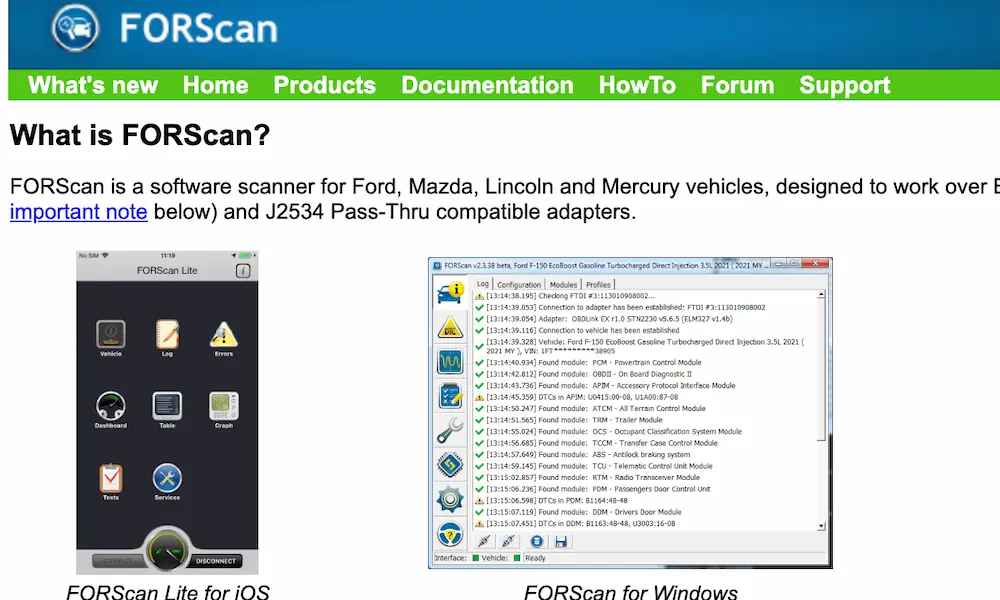
This data sheet also includes raw hexadecimal configuration blocks needed for Programmable Module Installation (PMI) using Ford IDS software or FORScan. It’s your go-to resource when the physical label is missing, damaged, or outdated.
Decoding Ford PCM Part Numbers
The tear tag tells you the software version. The part number tells you what part you’re physically holding. Ford structures all part numbers in three segments:
Prefix → Base Number → Suffix
The base number for every Ford PCM is 12A650. That number appears across virtually every passenger car and truck platform and specifically identifies the component as a powertrain controller.
The prefix encodes the design era, model line, and engineering group. Ford updated its numbering system in 1998 to a worldwide format:
| Segment | Pre-1998 | Post-1998 |
|---|---|---|
| Decade | Letter (F = 1990s, E = 1980s) | Alphanumeric year code (X = 1999, 1 = 2001, A = 2010) |
| Model | A = Full-Size, T = Truck, Z = Mustang | Platform/vehicle model code (C3 = Super Duty) |
| Dept | E = Engine, F = Electronics, P = Auto Trans | Engineering division identifier |
The suffix tracks revision levels. As calibrations update, the suffix letters increment — from BB to BC to BD — mirroring the tear tag revision sequence.
One more distinction worth knowing: engineering numbers get stamped on the part during manufacturing for internal tracking. Service part numbers appear on the retail packaging at the dealership parts counter and typically represent a current backward-compatible unit. If you see a “Z” or “Y” in the fourth prefix position, you’re looking at a service number.
PATS Security Sync After PCM Replacement
Swap your PCM and your Ford might not start. That’s not a defect — it’s the Passive Anti-Theft System (PATS) doing its job. A new module triggers DTC P1260, which tells you the engine has been disabled due to a security mismatch.
The sync process depends on which PATS generation your vehicle runs:
- PATS Type A and D: No scan tool needed. Insert the original transponder key, turn to RUN, wait 20 seconds, turn off. Done.
- PATS Type B, C, F, and G: Connect a scan tool, enter the Anti-Theft PATS menu, request security access, wait the mandatory 10-minute delay, then execute “Parameter Reset.” Follow with a KAM reset.
- PATS Type E: Enter security access, wait 10 minutes, run “Ignition Key Code Erase,” then cycle two distinct keys through the ignition. The system requires a minimum of two registered keys to exit anti-scan mode.
Watch for these common PATS fault codes during the process:
| Code | Meaning | Fix |
|---|---|---|
| B2139 / U2510 | Security handshake ID mismatch | Perform Parameter Reset |
| B1342 | Internal PCM hardware failure | Replace the PCM |
| B1600 | Non-PATS or damaged key | Program a new OEM transponder key |
| B1601 | Unprogrammed key detected | Run key addition procedure |
| B1681 | Transceiver signal not detected | Check wiring continuity at the transceiver |
| P1260 | Engine disabled by PATS | Resolve the underlying PATS fault first |
Getting the PATS sync right is the final step in any PCM replacement. Skip it, and your correctly calibrated module will still leave you stranded.
Whether you’re sourcing a used module, dialing in a custom tune, or replacing a failed PCM, the Ford PCM tear tag number is the code that ties hardware to software. Find it on the module, pull it digitally, or retrieve it through the As-Built portal — but don’t skip it. That four-character string is what separates a smooth-running truck from a truck that won’t leave the driveway.