The Ford GT isn’t your average sports car purchase. Prices range from $140,000 at original retail to nearly $2 million at auction today. Whether you’re researching the 2005 classic or the carbon-wrapped 2022 finale, this guide breaks down exactly how much a Ford GT costs — and why. Read to the end; the numbers get wild.
The Original Ancestor: What Does a 1960s Ford GT40 Cost?
Before we tackle the modern GT, you need to understand the car that started it all.
The original Ford GT40 won Le Mans four straight times from 1966 to 1969. Ford built just 105 of them. That’s it. That scarcity, combined with half a century of motorsport legend, puts these cars in another financial universe entirely.
The average GT40 auction sale price sits at approximately $7.65 million. Exceptional examples? Much higher.
Here’s what recent GT40 sales look like:
| Model / Variant | Provenance | Sale Price | Auction House |
|---|---|---|---|
| 1966 GT40 Mk II | Sebring 2nd Place, Holman-Moody | $13,205,000 | RM Sotheby’s (Feb 2025) |
| 1966 GT40 Mk II | Alan Mann Lightweight Racer | $12,375,000 | Mecum (Jan 2025) |
| 1968 GT40 | Steve McQueen Le Mans camera car | $11,000,000 | RM Sotheby’s (2012) |
| 1969 GT40 Mk III | 1,524 original miles | $7,865,000 | Mecum (Aug 2024) |
| 1966 GT40 Mk I | Road legal, FIA identity form | $7,040,000 | Mecum (Jan 2025) |
The P/1032 chassis that sold for $13.2 million carried Walt Hansgen and Mark Donohue at the 1966 Sebring 12 Hours. Documented race history isn’t just bragging rights — it’s a direct multiplier on price.
These eight-figure sales aren’t just cool trivia. They anchor the pricing power of every modern Ford GT that followed.
First Generation (2005–2006): Ford’s Centennial Tribute
What Was the Original MSRP?
Ford launched the first-generation GT as a centennial celebration, and it hit showrooms with a starting price of $139,995. That was later adjusted to a base of $151,245 as production ramped up.
The options list was deliberately minimal. Ford offered just four factory upgrades:
| Option | Approximate Original Cost |
|---|---|
| Painted racing stripes (over-body, not vinyl) | $3,000 – $5,350 |
| BBS forged aluminum wheels (18″/19″) | $4,000 |
| McIntosh audiophile sound system | $2,500 – $4,000 |
| Painted Brembo brake calipers | $900 (or no cost) |
A fully optioned “four-option car” topped out around $156,000 to $160,000.
Dealers, however, had other ideas. Early cars sold for $100,000 over sticker in many cases. The very first production chassis (number 10) sold at Pebble Beach for $557,000 at charity.
How Much Do First-Gen GTs Sell For Today?
Here’s where it gets interesting. The average first-gen Ford GT now sells at auction for roughly $463,000 to $481,000 — about triple its original retail price.
Mileage matters a lot:
- A 990-mile 2005 GT sold for $576,000 on Bring a Trailer
- A 6,800-mile example traded closer to $349,000
- A rare “stripe delete” Quick Silver example — one of just 16 built that way — sold for $434,000 despite 2,400+ miles on the clock
Low miles and rare specifications equal serious money.
What Makes the 2006 Heritage Edition Worth So Much More?
The Heritage Edition was a 2006-only variant with Gulf Oil–inspired Heritage Blue and Epic Orange paint, directly referencing the GT40’s 1968 and 1969 Le Mans victories.
Ford built just 343 units with this livery. The Heritage Livery Package originally added around $13,000 to the purchase price.
Today, that $13K option is worth exponentially more. Heritage Editions now benchmark at $740,555, with pristine examples clearing $793,500 to $1,320,000 at auction. That’s nearly a 100% premium over a standard first-gen GT in equivalent condition.
The collector market doesn’t just pay for history. It pays heavily for visuals that look like history.
Second Generation (2017–2022): Carbon Fiber and Legal Warfare
How Much Did the 2017 Ford GT Cost New?
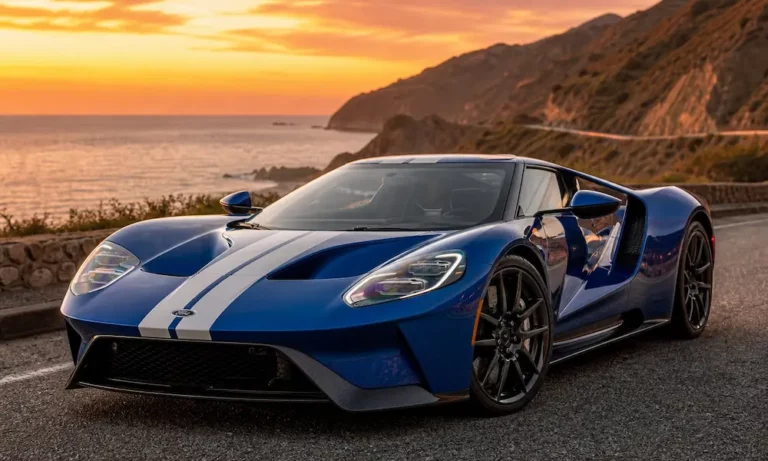
The second-generation GT was a completely different animal. Ford built it to race at Le Mans in 2016, exactly 50 years after the iconic 1966 sweep. It used a full carbon fiber monocoque, active aerodynamics, and a 3.5-liter twin-turbo EcoBoost engine producing 647–660 horsepower.
The base price? Approximately $450,000 to $500,000. Triple the first generation’s entry point.
Ford initially planned 250 units per year for two years. Demand forced an extension. Total second-gen production ran to 1,350 units built between 2016 and 2022, hand-assembled by Multimatic in Ontario, Canada.
To buy one, you didn’t just write a check. You filled out a detailed application. Ford selected buyers based on social media following, brand affinity, and public profile. They wanted ambassadors — not flippers.
The John Cena Lawsuit: Why Ford Got Serious About Resale Restrictions
Every selected buyer signed a contract with a two-year no-resale restriction and a right of first refusal clause. Violate it, and Ford could pursue legal action.
That’s exactly what happened when John Cena sold his 2017 GT shortly after delivery. Ford filed a federal lawsuit in Detroit citing breach of contract, fraudulent misrepresentation, and unjust enrichment.
Cena’s defense argued the final dealership paperwork from Elder Ford of Tampa didn’t include the resale restriction — even though Cena had signed it directly with Ford earlier. It exposed a real vulnerability: relying on franchise dealers to execute the binding paperwork.
The case settled out of court in 2018. Cena paid an undisclosed amount (donated to charity) and issued a public apology. Ford had made its point — loudly.
The chilling effect on the secondary market was immediate. Buyers held their cars. Supply froze. And when the 24-month embargoes expired, demand erupted.
What Do Second-Gen GTs Sell For Today?
Base second-gen models now average roughly $893,000 at auction. Low-mileage examples regularly clear $1 million.
- A 4,300-mile 2017 GT sold for $805,000 on Bring a Trailer
- Delivery-mileage examples (under 100 miles) consistently push past $1 million
Most of these cars live in climate-controlled garages. They’re financial instruments as much as they are cars.
Second-Gen Special Editions: Where Prices Really Launch
Carbon Series and Liquid Carbon
The Carbon Series ran from 2019 to 2022. It added exposed carbon striping, carbon wheels, and a titanium exhaust. Original MSRP: roughly $630,845. A 23-mile 2022 Carbon Series sold for $1,128,000 — nearly $500K over sticker.
The Liquid Carbon edition took things further. Ford skipped paint entirely, applying a clearcoat resin directly over raw carbon fiber weave. Every single panel required perfect alignment from a single batch of material. The process took over 1,200 hours of hand-finishing per vehicle.
Only 25 to 30 Liquid Carbon units exist globally. Original price: $750,000 to $822,000. Today’s benchmark sits at $1,767,750. An 84-mile 2020 Liquid Carbon GT sold for $1,791,000 — generating a $1 million profit for the original owner in under three years.
Heritage Editions
Ford released a Heritage Edition for several model years, each celebrating a specific historic victory:
- ’66 Edition — Shadow Black with silver stripes, honoring the 1966 Le Mans win
- ’67 Edition — Race Red with white stripes, honoring the Mk IV’s 1967 win
- ’68 and ’69 Editions — Gulf Blue and Orange, back to the iconic livery
- ’66 Daytona Edition (2021) — Frozen White and Race Red for the 1966 Daytona race
- Alan Mann Edition (2022) — Limited to 30 units, Alan Mann Red with gold graphics, MSRP $769,500
- Holman Moody Edition (2023) — Gold and red, honoring the third-place car from the 1966 1-2-3 Le Mans sweep
Heritage Editions benchmark at $1,153,459, with auction results consistently between $1.1 million and $1.375 million.
Studio Collection and LM Edition
The Studio Collection offered a bespoke color customization program across just 20 units in 2021 and 2022. Original price: ~$651,450. Today they trade between $863,000 and $895,000.
The LM Edition was the farewell. Twenty units. A hand-finished 3D-printed titanium exhaust with a cyclonic design. Original price: $775,750. Recent auction bids have crossed $1,029,000.
| Special Edition | Global Production | Original MSRP | Current Market Value |
|---|---|---|---|
| Carbon Series | Limited | $630,845 | ~$1,128,000 |
| Studio Collection | 20 units | $651,450 | $863,500 – $895,000 |
| Liquid Carbon | 25–30 units | $750,000 – $822,000 | $1,435,000 – $1,791,000 |
| Alan Mann Heritage | 30 units | $769,500 | $1,127,500 – $1,199,900 |
| LM Edition | 20 units | $775,750 | $1,029,000+ |
Track-Only GTs: The Mk II and Mk IV
GT Mk II
The Mk II wasn’t street legal. That freed Ford’s engineers to push the twin-turbo V6 to 700 horsepower, strip the interior, and bolt on serious downforce aero. Ford built just 45 units worldwide. Price: $1,200,000.
GT Mk IV
The Mk IV was the final curtain call — 67 units, built in 2023, honoring the GT40 Mk IV that won Le Mans in 1967. The wheelbase grew. The body went long-tail. Power exceeded 800 horsepower. The gearbox came straight from motorsport.
Ford charged $1,700,000 before options. At auction in January 2025, a Mk IV sold for $1,870,000 — a new record for the modern GT platform.
What’s Next: The Mustang GTD Inherits the Playbook
The Ford GT is no longer in production. But its legacy lives on in the 2025 Mustang GTD. Ford built this as a street-legal GT3 homologation car — 815 horsepower, active aero, rear transaxle, starting at $325,000.
Sound familiar? It should. Ford copied the GT playbook exactly: a two-year no-resale contract to freeze flippers out of the early market. And production is deliberately glacial — just 118 units built through August 2025.
Restricted supply, legal enforcement, hand assembly. The GT formula didn’t retire. It just got a Mustang badge.
How Much Does a Ford GT Cost? The Full Picture
Here’s the short answer by generation:
- 1960s GT40: $7 million – $13+ million at auction
- 2005–2006 first gen (standard): $350,000 – $576,000
- 2006 Heritage Edition: $793,500 – $1,320,000
- 2017–2022 second gen (base): $805,000 – $1,100,000+
- Carbon Series: ~$1,128,000
- Liquid Carbon: $1,435,000 – $1,791,000
- Heritage Editions: $1,100,000 – $1,375,000
- LM Edition: $1,029,000+
- GT Mk II (track only): ~$1,200,000
- GT Mk IV (track only): $1,700,000 – $1,870,000
The Ford GT isn’t a car you buy off a lot. It’s a car you apply for, sign contracts for, and — if you’re smart about it — hold for years. Every generation has appreciated. Every special edition has beaten its original sticker price. And the rarest examples keep setting new records.