The GM 14 bolt rear end has a well-earned reputation as one of the toughest axles ever bolted under a truck. Whether you’re building a rock crawler, swapping into a Jeep, or just trying to understand what’s under your heavy-duty Chevy, this guide covers it all. Stick around — by the end, you’ll know this axle better than most mechanics do.
What Is the GM 14 Bolt Rear End?
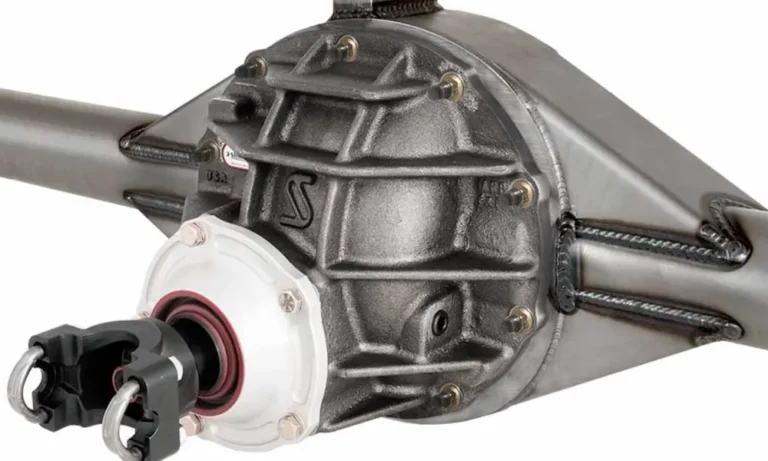
The GM 14 bolt rear end gets its name from the 14 bolts that secure the differential cover to the cast-iron axle housing. General Motors introduced it in 1973 as part of a corporate standardization initiative — a move to eliminate the costly chaos of each GM division building its own unique axle. The result was one bulletproof, universally adaptable rear differential that’s been in production for over 50 years.
Originally manufactured in Saginaw, Michigan, production transferred to American Axle and Manufacturing in 1994 when GM spun off its axle division. American Axle still builds modern versions today.
The Two Main Variants: Full Float vs. Semi Float
Not all 14 bolt axles are the same. There are two fundamentally different designs, and confusing them is an easy mistake to make.
10.5-Inch Full-Floating Axle
This is the one everyone talks about. The 10.5-inch full-floating 14 bolt came standard in ¾-ton and 1-ton Chevrolet and GMC trucks, full-size vans, and commercial chassis cabs starting in 1973. You’ll also find it in military vehicles like the Commercial Utility Cargo Vehicle.
Here’s what makes it special: in a full-float design, the axle housing and wheel bearings carry the vehicle’s weight, not the axle shafts. The shafts only transmit torque. If a shaft snaps, the wheel stays on the truck. That’s a serious safety advantage.
Key specs at a glance:
- Ring gear: 10.5 inches
- Axle shaft diameter: 1.5 inches / 30 splines
- Ring gear bolted by: 12 high-strength bolts
- Axle tube outer diameter: 3.375 to 3.5 inches
9.5-Inch Semi-Floating Axle
GM introduced the 9.5-inch semi-floating 14 bolt in 1986 to fill the gap between light-duty 10-bolt axles and the massive full-float. You’ll find it in Suburbans, Tahoes, lighter 2500 trucks, and even specialty vehicles like the TrailBlazer SS and SSR.
In a semi-float design, the axle shaft bears the vehicle’s weight and transmits torque. The shafts are retained by C-clips internally. If one breaks near the bearing journal, the wheel can slide right out of the housing — a genuinely dangerous situation. The 9.5-inch variant features 33-spline axle shafts and came in six-lug, eight-lug, and even a rare five-lug configuration for the 454 SS pickup.
Production ended around 2009.
11.5-Inch and 11.8-Inch Modern Variants
As diesel engines pushed torque output to new heights, GM needed something bigger. Starting with the 2001 model year, the American Axle 11.5-inch 14 bolt began replacing the classic 10.5-inch in HD trucks. Chrysler adopted it for Ram ¾-ton and 1-ton trucks in 2003.
The 11.5-inch runs a full-float design with an 11.5-inch ring gear and a 6,900-pound GAWR. The even beefier 11.8-inch variant lives under high-output Ram 3500s. Meanwhile, the original 10.5-inch full-float still rolls off the line today — it’s still used in the Chevrolet Express and GMC Savana commercial vans.
What Makes the 10.5-Inch Full Float So Strong?
Three engineering details separate this axle from nearly everything else on the road.
The Straddle-Mounted Pinion
Most differentials support the pinion gear with two bearings on the shaft. Under extreme torque, the pinion head deflects away from the ring gear, concentrating the load on the gear edges and causing failure. The 10.5-inch 14 bolt eliminates this with a straddle-mounted pinion — a third bearing seated deep in the housing captures the nose of the pinion gear.
The result? Zero pinion deflection. The gear mesh stays perfect even under serious shock loading in low-range four-wheel drive.
Threaded Carrier Preload Adjusters
Setting up ring and pinion gears in most axles means pressing bearings on and off repeatedly while fitting precision steel shims. It’s tedious, time-consuming work. The 14 bolt skips all that with threaded adjuster rings built directly into the housing. Turn the rings with a spanner wrench to dial in backlash (target: 0.005 to 0.008 inches) and bearing preload, then lock them down. Done.
Removable Pinion Support
The entire pinion assembly bolts out of the housing for bench-top setup. Gear ratio changes, bearing replacements, crush sleeve eliminations — all of it becomes dramatically easier compared to an axle where you’re working blind inside the housing.
Full Torque Specs and Dimensions
| Component / Measurement | Specification |
|---|---|
| Ring Gear Bolts | 120 ft-lbs |
| Bearing Cap Bolts | 135 ft-lbs |
| Differential Cover Bolts | 35 ft-lbs |
| Axle Shaft Flange Bolts | 115 ft-lbs |
| Carrier Adjuster Lock Bolt | 20 ft-lbs |
| Pinion Bearing Preload (New) | 25–35 in-lbs |
| Pinion Bearing Preload (Reused) | 5–15 in-lbs |
| Ring Gear Backlash | 0.005–0.008 inches |
| Right Axle Shaft Length | 37.625 inches |
| Left Axle Shaft Length | 31.625 inches |
| Ring Gear Outer Diameter | 10.5 inches |
Track Widths and Hub Configurations
The 10.5-inch housing came in several widths to suit different vehicle applications. The internal shafts stay the same — only the external hubs and drum offsets change.
- Single Rear Wheel: 67.5 inches between mounting surfaces — standard pickup configuration
- Dual Rear Wheel: 72 inches — deeply offset hubs to fit dual tires
- Cab and Chassis: 63.5 inches — narrow setup for commercial bodies and flatbeds
- Full-Size Van: 70 inches — uses unique shaft lengths (39.375-inch right, 33.375-inch left)
Drum Brakes vs. Disc Brakes on the 14 Bolt
From 1973 through the late 1990s, the 14 bolt ran drum brakes exclusively. Early versions used a stud-mounted drum design — removing it meant pulling the entire wheel hub assembly off the spindle, which exposed the wheel bearings to contamination every time you serviced the brakes. Not ideal.
In 1988, GM switched to slide-on drums that pull straight off the wheel studs without disturbing anything else. Both designs coexisted in production through the late ’90s, so you’ll want to check which one you’re dealing with before ordering parts.
The 1999 Silverado and Sierra 2500 introduced factory four-wheel disc brakes. Vans kept drums until 2003.
If you’re running an older drum-brake 14 bolt in an off-road build, converting to disc brakes is practically mandatory. You gain better stopping power, faster mud and water drainage, and drop roughly 80 pounds of unsprung rotating mass.
Understanding the Carrier Break
The 14 bolt uses two different carriers depending on gear ratio, and getting this wrong is an expensive mistake.
- 4.10 carrier: Designed for gear ratios of 4.10 and numerically lower (3.73, 3.42, etc.)
- 4.56 carrier: Designed for gear ratios of 4.56 and numerically higher (4.88, 5.13, 5.38, etc.)
If you want to run 5.13 gears on a 4.10 carrier, you need a specialized aftermarket “thick” ring gear that bridges the offset gap. Gears cut for the 4.10 carrier won’t physically fit a 4.56 carrier — period. Know your carrier before you order gears.
Traction Options: Lockers, Spools, and the Gov-Loc
The G80 Gov-Loc (and Why It Fails)
Many factory 14 bolts came with the Eaton G80 automatic locking differential. It runs open under normal conditions and locks up when one wheel spins roughly 100 RPM faster than the other. It works fine for boat ramps and snowy driveways. But pair it with big off-road tires and serious power, and the sudden shock of engagement frequently shatters the cast-iron carrier housing. Enthusiasts call it “grenading” the diff. In a built rig, replace it.
Drop-In Automatic Lockers
The factory carrier on the 10.5-inch full-float is massively strong, which makes drop-in automatic lockers like the Detroit Locker, Yukon Grizzly Locker, and Torq Locker a straightforward upgrade. They replace the spider gears inside the existing carrier, lock up under power, and ratchet open in turns. Since you’re keeping the factory carrier, you don’t need to redo the gear setup. This makes the 14 bolt one of the cheapest axles to upgrade for serious traction.
ARB Air Locker (Selectable)
For the best of both worlds, the ARB Air Locker runs open on-road and locks solid when you flip a switch in the cab. It replaces the factory carrier completely, so a full gear setup is required. It’s the most expensive option, but also the most versatile.
Spools and Lincoln Lockers
A full spool permanently locks both axle shafts together — no moving parts, absolute reliability. But it makes every paved corner a tire-scrubbing exercise. A “Lincoln Locker” welds the spider gears solid for the same effect on a budget, but weld failures under shock loading are a real possibility.
Lubrication: What Gear Oil Do You Actually Need?
The full-floating 14 bolt holds approximately 3.6 quarts of gear oil. The semi-float takes about 2.75 quarts. Fill from the plug hole until fluid seeps out — that’s your correct level.
| Use Case | Recommended Viscosity |
|---|---|
| Daily driving, mild climate | 75W-90 API GL-5 |
| Heavy towing, high loads | 75W-140 synthetic or 85W-140 |
| Extreme off-road, rock crawling | Synthetic 75W-140 |
| Limited-slip differential | Any of the above + friction modifier |
Synthetic gear oil maintains viscosity across a wider temperature range and resists breakdown under the shearing forces of hypoid gears. For a hard-working 14 bolt, synthetic 75W-140 is the smart call. Whatever you choose, the oil must carry an API GL-5 certification — hypoid gears demand it.
Shave Kits: Gaining Ground Clearance
The 14 bolt’s biggest off-road weakness is that massive cast-iron center section hanging down low. It catches rocks, digs into mud, and costs you clearance you really can’t afford on the trail.
13-Bolt Shave
The entry-level fix: cut the lowest bolt hole and protruding lip off the housing bottom, then bolt on a flat-bottomed steel cover using 13 bolts. You gain about 1.25 inches of clearance directly under the ring gear with zero internal modifications.
15-Bolt Shave
This is the full commitment. Fabricators remove nearly two inches of material from the housing bottom, machine the outer edge of the ring gear on a lathe to clear the new profile, weld a heavy steel plate to the cast-iron housing (with careful pre-heat and post-heat procedures to prevent cracking), and bolt on a 15-bolt custom cover. The result is a smooth, flat belly that slides over obstacles effortlessly. You’ve effectively given a 550-pound workhorse the ground clearance of a much smaller axle.
GM 14 Bolt vs. Dana 60 vs. Dana 70: How Do They Stack Up?
| Specification | GM 14 Bolt (10.5 FF) | Dana 60 (Rear) | Dana 70 |
|---|---|---|---|
| Ring Gear Diameter | 10.5 inches | 9.75 inches | 10.5 inches |
| Pinion Support | 3 Bearings (Straddle) | 2 Bearings | 2 Bearings |
| Removable Pinion Support | Yes | No | No |
| Carrier Adjustment | Threaded Adjusters | Shims | Shims |
| Factory Axle Shafts | 1.5 in / 30 spline | 1.3 in / 30 spline | 1.5 in / 35 spline |
| Approximate Weight | ~550 lbs | ~400 lbs | ~550 lbs |
| Stock Ground Clearance | Poor | Excellent | Moderate |
The Dana 60 is lighter and clears better, which is why it dominates as a front axle. But its smaller ring gear and thinner axle shafts mean it breaks sooner under serious torque. The Dana 70 is a closer peer, matching the 14 bolt’s ring gear diameter and offering 35-spline shafts, but it still lacks the straddle-mounted pinion.
The Ford 9-inch is legendary in racing for its removable center section and lightweight design, but it needs serious aftermarket upgrades (35 or 40-spline custom shafts) to come close to the factory strength of a 14 bolt.
For rear axle applications where you’re running big tires and serious power, the 14 bolt wins on cost-to-strength ratio every single time. Drop-in locker options and threaded carrier adjusters make it cheaper and faster to set up than any Dana alternative.
Universal Joints: Don’t Get These Wrong
Swapping a 14 bolt into a custom build? Pay close attention to U-joint sizing. The 10.5-inch full-float typically uses 1350 or 1410 series joints. The 11.5-inch American Axle variant uses uniquely sized 1415 and 1485 series joints, and the naming is confusing:
| U-Joint Series | Cap Diameter | Overall Width |
|---|---|---|
| 1410 | 1.188 inches | 4.188 inches |
| 1415 | 1.188 inches | 4.178 inches |
| 1480 | 1.375 inches | 4.188 inches |
| 1485 | 1.475 inches | 4.178 inches |
A 1415 joint is actually slightly narrower than a 1410, not larger. Forcing a 1410 into a 1415 yoke bows the retaining clips out and guarantees early failure. The good news: the 10.5-inch and 11.5-inch pinions share the same spline count, so a standard damper-free 14 bolt yoke bolts right onto the 11.5-inch axle — just account for a pinion seal inner diameter change from 2.200 to 2.370 inches on models after 1998.
FAQ: GM 14 Bolt Rear End
How do I tell if I have a full-float or semi-float 14 bolt?
Look at the center of the rear wheels. A full-floating 10.5-inch axle has a large hub that protrudes outward from the wheel face, with the axle shaft bolting directly to it. A semi-float is flat — the axle terminates flush with the wheel mounting surface. All six-lug 14 bolt axles are semi-float, though eight-lug semi-floats exist too.
What gear oil does the GM 14 bolt rear end take, and how much?
The full-floating axle takes about 3.6 quarts; the semi-float takes around 2.75 quarts. For daily driving, use 75W-90 API GL-5. For towing, heavy loads, or off-road use, step up to synthetic 75W-140 or conventional 85W-140.
What’s the carrier break on a GM 14 bolt?
The 14 bolt uses two carriers. The 4.10 carrier handles gear ratios of 4.10 and lower. The 4.56 carrier handles 4.56 and higher. If you want deeper gears on a 4.10 carrier, you need an aftermarket thick ring gear to bridge the gap — otherwise the gears simply won’t fit.
Why does the G80 Gov-Loc fail in off-road builds?
The G80’s flyweight mechanism engages the clutch packs suddenly when wheel speed differences reach about 100 RPM. Under the traction of large off-road tires or high engine output, that abrupt shock load frequently cracks the cast-iron carrier. Replace it with a Detroit Locker or ARB Air Locker for serious trail use.
How do I tell if my 14 bolt has stud-mounted or slide-on drums?
Pull the wheel and look. Stud-mounted drums are trapped behind the hub flange — the wheel studs pass through the drum itself. Slide-on drums come straight off the studs without touching the hub. Either way, upgrading to a bolt-on disc brake conversion kit dramatically improves stopping performance and drops significant unsprung weight.
Is the GM 14 bolt stronger than a Dana 60?
Yes, in factory form. The 14 bolt’s 10.5-inch ring gear, 1.5-inch 30-spline axle shafts, and straddle-mounted pinion give it a significantly higher torque threshold than a stock rear Dana 60, which runs a 9.75-inch ring gear and smaller 1.3-inch shafts. The Dana 60 wins on weight and ground clearance, but the 14 bolt wins on raw strength per dollar spent.