Not sure what gears are hiding in your axle? Whether you’re planning a tire upgrade, adding a trailer, or swapping an axle, knowing your exact rear end gear ratio matters more than you’d think. This guide walks you through every reliable method — from spinning tires in your driveway to decoding factory stickers. Stick around, because the wrong ratio can destroy your drivetrain.
Why Your Rear End Gear Ratio Matters
Your rear end gear ratio controls how many times your driveshaft spins to turn the wheels once. That single number shapes your truck’s towing muscle, fuel economy, and off-the-line punch. Get it wrong after a tire swap or axle replacement, and you’re looking at sluggish performance at best — and a blown transfer case at worst.
First, Know What Differential You Have
Before you figure out how to determine rear end gear ratio, you need to know what type of differential you’re dealing with. The test method changes depending on your diff type.
Open Differential
Most stock passenger cars and trucks run an open differential. It splits torque evenly but sends all wheel spin to the tire with the least traction. Great for smooth roads, not so great in mud.
Limited-Slip Differential (LSD)
A limited-slip differential adds clutch packs, viscous fluid, or helical gears that resist wheel speed differences. When one tire slips, it pushes torque to the tire that grips. Ferdinand Porsche recognized this problem in early racing, which sparked the development of slip-limiting designs still used today. GM marketed theirs as Positraction — a name so sticky it became the generic term.
Important: LSD clutch packs wear out. A high-mileage LSD may behave like an open diff during testing if the friction material has degraded. Cross-reference physical tests with documentation whenever possible.
Locking Differentials and Spools
Lockers physically bind both axle shafts together. Spools eliminate all differential action entirely — great for drag strips, dangerous on public roads. They’ll scrub your tires raw in any turn.
Method 1: The Tire Spin Test (Physical Diagnostic)
This is the fastest hands-on way to confirm your differential type and start calculating your ratio. You don’t need special tools — just jack stands and a marker.
Step 1 — Identify Your Differential Type
- Safely lift the entire rear of the vehicle so both tires hang free
- Shift the transmission into neutral and release the parking brake
- Rotate one tire forward by hand
- Watch what the opposite tire does
Here’s what the results tell you:
| Opposite Tire Movement | What It Means |
|---|---|
| Spins backward (opposite direction) | Open differential |
| Spins forward (same direction) | Limited-slip or locking differential |
In an open differential, the spider gears reverse the force through the housing — spinning one shaft backward relative to the other. In a limited-slip unit, the clutch packs bind both shafts together, so they rotate the same way.
Step 2 — Count Driveshaft Rotations
Once you’ve identified your diff type, mark your driveshaft and tire sidewall with chalk. Then rotate the tire and count how many full turns the driveshaft makes.
For a limited-slip or locking diff:
Rotate the tire one full revolution. Count the driveshaft turns. That number is your ratio. Three and three-quarter turns = 3.73 ratio.
For an open differential:
The spider gears double the wheel speed relative to the carrier. So rotate the tire two full revolutions instead. Count the driveshaft turns over both rotations. That count equals your actual gear ratio. Or rotate one full turn, count the driveshaft spins, and double the number.
Pro tip: Distinguishing a 3.55 from a 3.73 by eye takes careful attention to your chalk marks. Always cross-reference this test with manufacturer documentation for confirmation.
Method 2: Decode the Factory Sticker (Fastest Method for Stock Vehicles)
If your drivetrain is original and unmodified, the factory sticker gives you a definitive answer in under two minutes.
General Motors — RPO Codes on the Service Parts ID Label
GM tracks every factory-installed component using Regular Production Option (RPO) codes. Look for the Service Parts Identification sticker inside the glove box. Older models may have it on the door jamb, trunk lid, or spare tire cover. 2018 and newer GM trucks use a scannable QR code on the driver’s door pillar that pulls the full option list digitally.
Look for codes starting with “G” — those are your axle codes.
| GM RPO Code | Gear Ratio | Notes |
|---|---|---|
| GU4 | 3.08 | Common highway ratio |
| GU6 | 3.42 | Balanced all-around |
| GT4 | 3.73 | Popular towing ratio |
| GT5 | 4.10 | Heavy-duty / off-road |
| G96 | 3.55 | Light truck common |
| G82 | 4.56 | Severe-duty |
| G80 | Indicator only | Locking/limited-slip diff present |
The G80 code doesn’t indicate a gear ratio — it flags a traction-aiding differential, specifically the Gov-Lock automatic locker on GM trucks. Your sticker might show both GT4 and G80, meaning you have 3.73 gears in a locking differential.
Ford — Axle Code on the Door Jamb Certification Label
Ford’s axle code lives on the Safety Compliance Certification Label on the driver’s door jamb. Find the section labeled “AXLE.” The two-character code tells you both the ratio and whether you have a limited-slip unit.
| Ford Axle Code | Gear Ratio | Differential Type |
|---|---|---|
| 19 | 3.55 | Open |
| H9 / L9 | 3.55 | Limited-Slip |
| 26 | 3.73 | Open |
| B6 / L6 | 3.73 | Limited-Slip |
| L4 | 4.10 | Limited-Slip / Electronic Locker |
| W5 | 4.10 | Open |
| BB (Mustang) | 3.73 | Open |
On Ford trucks, codes with a letter typically confirm a limited-slip differential. Numeric-only codes usually mean an open diff.
Chrysler, Dodge, Jeep, and Ram — Build Sheet by VIN
Stellantis brands don’t print decoded axle ratios on physical door stickers. You’ll need the factory build sheet instead. Enter your 17-character VIN into the FCA Equipment Listing tool or use a VIN build sheet lookup for Ram or Jeep.
On the build sheet, look for three-letter sales codes like:
- DMD = 3.55 axle ratio
- DMH = 3.92 axle ratio
- DSA = Anti-Spin (limited-slip) differential
Method 3: Read the Hardware — Tags, Castings, and Stampings
Salvage axles, custom builds, or modified vehicles don’t have usable stickers. Here you go straight to the metal.
Dana/Spicer Axles — Bill of Materials Tag
Dana axles (Dana 44, Dana 60, Dana 80) carry a Bill of Materials number stamped on a metal tag bolted to the differential cover. It’s also permanently stamped into the axle housing tube, usually on the right side.
The tag shows a six-digit number like 605561-1. Cross-reference that number with Dana’s aftermarket technical library to confirm ratio, spline count, carrier type, and bearing specs. Some older stampings dropped the first two digits — so 5561-1 equals 605561-1.
Ford Differential Tags
Ford bolts a stamped metal tag to one of the upper differential cover bolts. Read the bottom line. A tag reading 3 55 88 = 3.55 ratio, 8.8-inch ring gear. If it reads 3L73 975, you’ve got a 3.73 Traction-Lok differential with a 9.75-inch ring gear. The L confirms limited-slip.
Visual Housing Identification
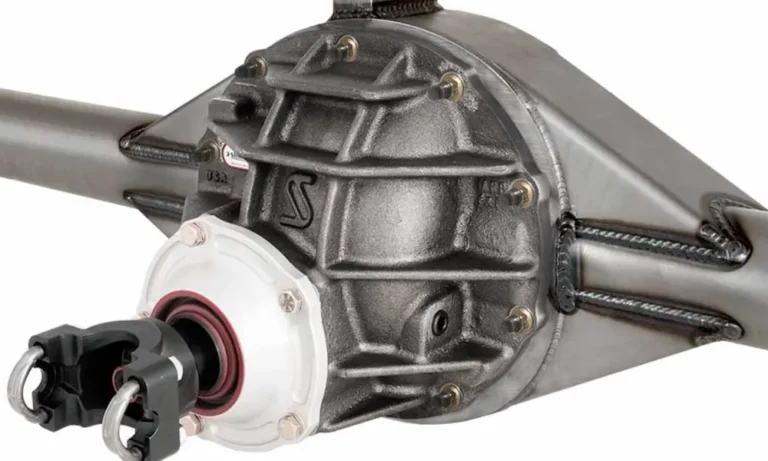
No tag? The cover shape itself narrows your options fast.
| Axle | Cover Shape | Bolt Count |
|---|---|---|
| Ford 8.8-inch | Mildly square, symmetrical | 10 bolts |
| Ford 9-inch | No rear cover — front dropout | N/A |
| GM 8.5/8.6-inch | Round with squared lower ears | 10 bolts |
| GM 14-Bolt (10.5″) | Large oval, heavily ribbed | 14 bolts |
| Dana 44 | Irregular hexagon, straight sides | 10 bolts |
| Dana 60 | Asymmetrical polygon, angular bottom-right | 10 bolts |
| Chrysler 8.25-inch | Oval with flat bottom lip | 10 bolts |
The Ford 9-inch is instantly recognizable — no cover at all. The whole gear assembly drops out the front of the housing.
Ring Gear Tooth Count — Last Resort Method
If every tag is missing or illegible, open the diff and read the ring gear stamps. Gear manufacturers stamp tooth counts directly onto the ring gear circumference.
Divide ring gear teeth by pinion gear teeth to get your ratio:
- 41 teeth ÷ 10 teeth = 4.10
- 39 teeth ÷ 11 teeth = 3.55
- 43 teeth ÷ 11 teeth = 3.91
If the stamps are unreadable, count every tooth manually on both gears. It’s tedious, but it’s accurate.
Gear Ratio Trade-Offs: What the Numbers Actually Mean
| Ratio Type | Numerical Range | Best For | Trade-Off |
|---|---|---|---|
| High (numerically) | 4.10, 4.56, 5.13 | Towing, off-road, drag | Poor fuel economy, limited top speed |
| Balanced | 3.55, 3.73 | Mixed use, moderate towing | Middle ground on everything |
| Low (numerically) | 2.73, 3.08, 3.23 | Highway cruising, fuel economy | Sluggish acceleration, weak towing |
The Tire Size Trap
Bigger tires act like taller gears. If you bolt on 35-inch tires without re-gearing, your 3.73 axle suddenly behaves like a 3.08. The truck feels lazy, towing capacity drops, and your speedometer reads low. Re-gearing to a higher numerical ratio restores factory performance and gets your calibration back on track.
The Danger of Mismatched Ratios in 4WD Systems
This one can destroy your truck. When you engage four-wheel drive, the transfer case locks the front and rear driveshafts together at identical speeds. If your front and rear axles run different gear ratios, those locked shafts fight each other constantly.
On loose surfaces — mud, sand, snow — the tires slip enough to relieve the tension. On dry pavement, they can’t slip. The trapped mechanical energy builds fast. This is called driveline windup, and the symptoms hit hard:
- Heavy steering
- Violent shaking
- Braking sensation with no brakes applied
Left unchecked, it shears U-joints, cracks transfer case housings, and grenades ring gears. The same problem develops when you run mismatched tire sizes on an AWD system — even identical ratios can’t compensate for different rolling circumferences.
Before any axle swap or re-gear, verify both front and rear ratios match exactly. It’s not optional.
Carrier Breaks — Order the Right Parts
Here’s one more reason knowing how to determine rear end gear ratio saves you money. Axle manufacturers build different differential carriers for different ratio ranges. A Dana 30, for example, uses one carrier for ratios up to 3.54, and a completely different carrier for 3.73 and above.
Install the wrong carrier and the gear set won’t even fit together. Confirm your exact ratio before ordering any internal components — not after.