Paying $85+ at a dealership for a five-minute job? That stings. This guide covers everything about Hyundai cabin air filter replacement — when to do it, how to do it, and how to stop overpaying. Stick around, because the money-saving section alone is worth it.
What Does a Cabin Air Filter Actually Do?
Your Hyundai’s cabin air filter sits between the outside world and your lungs. It traps pollen, dust, mold spores, exhaust particles, and road grime before they blow through your dashboard vents.
A clean filter does three important jobs:
- Protects your health — especially if you have allergies or asthma
- Keeps your HVAC running efficiently — less strain on the blower motor and AC compressor
- Clears your windows faster — critical on foggy winter mornings
Skip this maintenance, and your airflow drops dramatically. Your AC works harder. Your windows fog up slower. In electric models like the Ioniq 5, a clogged filter even reduces driving range by forcing the HVAC system to drain more from the battery.
How Often Should You Replace Your Hyundai Cabin Air Filter?
Hyundai’s official maintenance schedule calls for cabin air filter replacement every 15,000 miles or 12 months — whichever comes first. Here’s a quick overview of the full service timeline:
| Mileage Interval | Time Interval | Cabin Air Filter Action |
|---|---|---|
| 5,000–7,500 miles | 6–12 months | Visual inspection only |
| 15,000 miles | 12–18 months | Replace filter |
| 30,000 miles | 24 months | Replace filter |
| 60,000 miles | 48 months | Replace filter |
| 90,000–100,000 miles | Varies | Replace filter |
Some Hyundai owner’s manuals also recommend a strictly time-based swap every 24 months, even if you haven’t hit the mileage mark.
Do You Drive in “Severe” Conditions?
Replace yours more often if you regularly deal with:
- Heavy stop-and-go city traffic
- Dusty roads or agricultural areas
- Short commutes where the engine never fully warms up
- High-pollen regions during spring
If you tick any of these boxes, don’t wait for the 15,000-mile mark.
Cabin Air Filter vs. Engine Air Filter: Don’t Confuse the Two
These aren’t the same thing, and that confusion costs people money.
| Filter Type | Location | Protects | Replacement Interval |
|---|---|---|---|
| Cabin air filter | Behind glove box or in frunk (EVs) | Passengers | Every 15,000 miles |
| Engine air filter | Under the hood in the airbox | Engine cylinders | Every 30,000 miles |
The cabin air filter keeps your air clean. The engine air filter keeps your engine clean. Fully electric Hyundais — like the Ioniq 5 and Kona Electric — don’t have an engine air filter at all. The cabin filter is the only atmospheric filtration component on those vehicles.
How to Replace a Hyundai Cabin Air Filter: Step-by-Step
The process differs depending on whether you drive a gas model or an EV. Both are straightforward. Neither requires special tools.
Gas Models (Elantra, Sonata, Tucson, Palisade)
These models house the filter behind the passenger-side glove box. Here’s how the process works:
- Open and empty the glove box completely
- Unhook the dampener arm on the right side of the box
- Squeeze and remove the two retention stoppers from the side walls
- Let the glove box hinge down to expose the filter housing
- Unclip the plastic filter housing door
- Slide the old filter out horizontally
- Insert the new filter — arrow pointing down (more on that below)
- Snap the housing door shut and reverse all steps
Total time: 10–15 minutes for your first attempt.
Electric Models (Ioniq 5, Ioniq 6, Kona Electric)
Hyundai engineers did something brilliant here. They moved the filter to the front trunk (“frunk”), making it one of the easiest filter replacements in any car on the market. No tools. No dashboard dismantling.
Here’s how to do it:
- Open the front hood
- Pull up the plastic frunk trim panel
- Squeeze the pinch tabs on the left side of the filter housing door
- Pull the filter straight out
- Insert the new filter — arrow pointing down
- Snap the housing door closed (right side first, then left)
- Replace the trim panel
Total time: Under 5 minutes. Seriously.
The Arrow Matters More Than You Think
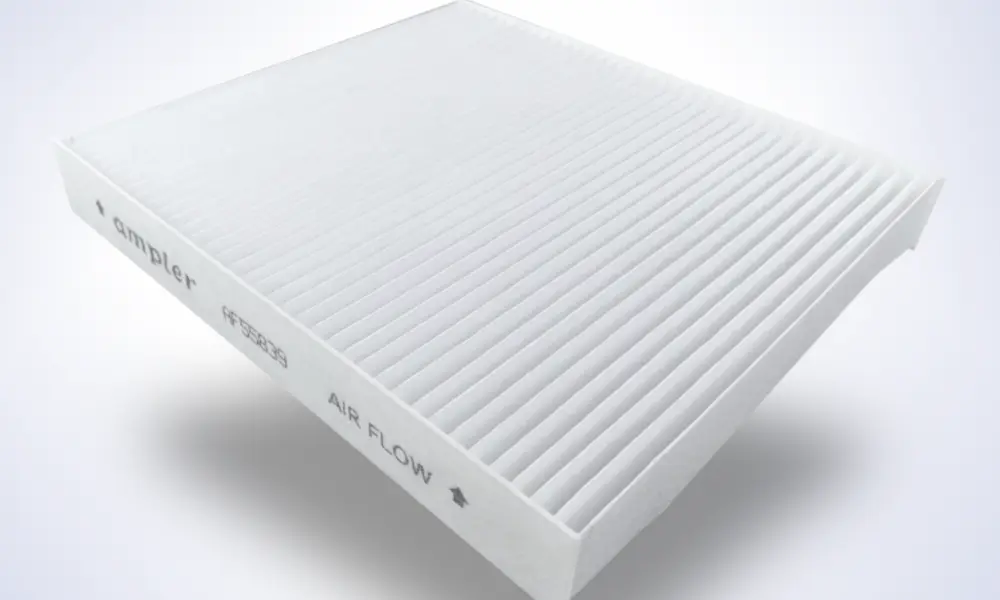
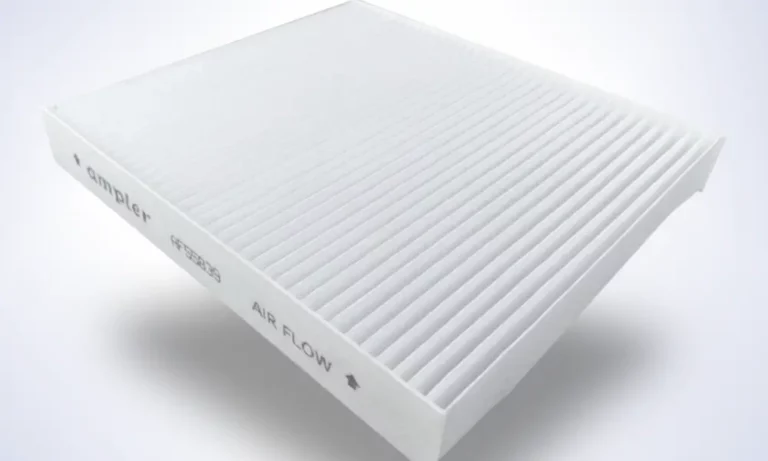
Every cabin air filter has a directional arrow printed on its side. It tells you which way the air flows through the filter. For all Hyundai models, that arrow must point downward.
Installing the filter backwards causes real problems:
- Reduced filtration — the pleats bend the wrong way and let dust through
- Whistling noise — vibrating pleats create an annoying high-pitched sound through your vents
- Blower motor strain — the restricted airflow forces the motor to work harder
- Premature motor failure — left long enough, this gets expensive
Don’t ignore the arrow. It’s there for a reason.
How Much Does Hyundai Cabin Air Filter Replacement Cost?
This is where things get interesting. The price gap between DIY and dealership is genuinely shocking.
| Option | Filter Type | Total Cost | Labor Time |
|---|---|---|---|
| Authorized dealership | OEM filter | $85–$163+ | Included in service |
| AutoZone / local store | Premium aftermarket | ~$24 | 5 minutes (DIY) |
| RockAuto / online retailer | Standard aftermarket | $6–$12 | 5 minutes (DIY) |
One Hyundai driver went viral for exactly this reason: she was quoted $87 at the dealership, drove to AutoZone, bought a filter for $26, and changed it herself. It took minutes.
Popular Aftermarket Part Numbers to Know
These are widely used in the Hyundai community:
- PureFlow PC99594X
- FRAM CV12820
- STP CAF15054P
- OEM part number 97133-L1000 (if you want factory specs without dealership labor costs)
For Ioniq 5 owners, the Champ CAF10079P — originally spec’d for the 2021 Sonata Hybrid — fits with only a millimeter or two of dimensional difference. It’s available for under $7.
Will DIY Replacement Void Your Warranty?
No. The Magnuson-Moss Warranty Act protects you federally. Under this law, a dealership can’t void your warranty just because you replaced the cabin filter yourself or used an aftermarket part. They’d need to prove the part you installed directly caused the failure they’re refusing to cover.
That means installing a $12 filter from RockAuto in your Palisade won’t touch your suspension warranty, your powertrain warranty, or anything unrelated to the filter itself. The AutoCare Association covers this law in detail if you want the legal specifics.
One smart habit: Keep your receipts. Write down the date and mileage when you do the swap. If you ever trade the car in, documented DIY maintenance still holds value — especially with a clean service history.
Signs Your Cabin Air Filter Needs Replacing Now
Don’t wait for the mileage marker if you notice these warning signs:
- Weak airflow even on maximum fan speed
- Musty or stale smell from the vents
- Foggy windows that take forever to clear in winter
- Louder blower motor than usual
- Allergy symptoms while driving that disappear outside the car
That last one catches people off guard. If your eyes water or your nose runs every time you drive, the filter might be the culprit — not the season.
Watch Out for Critters
This one sounds strange, but it’s a real issue. Ioniq 5 owners have documented cases of mice nesting in the frunk area directly on top of the cabin air filter. The filter blocks rodents from entering the cabin, but the nesting material and waste creates serious air quality and odor problems. Check your filter if your car’s been sitting in a garage or outside for an extended period.
Hyundai’s Complimentary Maintenance Program
If your Hyundai was purchased after February 1, 2020, you likely qualify for Hyundai’s Complimentary Maintenance program. It covers factory-scheduled maintenance for 3 years or 36,000 miles.
Key rules to keep in mind:
- Services must be done within 1 month or 1,000 miles of the scheduled interval
- Work must be performed at an authorized Hyundai service center
- The program covers oil changes, tire rotations, and multi-point inspections
The cabin filter replacement at 15,000 miles may be included. Check your specific coverage details before paying out of pocket during that window.
FAQs About Hyundai Cabin Air Filter Replacement
Can a clogged cabin filter affect phone call quality in my car?
Yes. A restricted filter forces the blower motor to run at high speeds for longer. That loud rushing air gets picked up by your car’s overhead microphones and degrades Bluetooth call clarity significantly.
Does a clogged filter affect winter driving safety?
It does. In cold weather, a clean filter allows high airflow to sweep condensation off interior glass quickly. A blocked filter slows that process down, leaving you with foggy windows longer — a real visibility hazard in bad conditions.
Can I buy filters in bulk and store them?
Yes, as long as you keep them sealed in their original packaging and store them somewhere dry. Moisture will warp the media and can introduce mold spores before the filter ever touches your car.
How do I spot a low-quality aftermarket filter?
Flimsy, widely spaced pleats that flex easily are a red flag. Any quality filter will have a clearly printed airflow direction arrow and a stamped part number. No arrow? Don’t buy it.
What do I do with the used filter?
Standard cabin filters — paper, synthetic fiber, plastic frame — go in regular trash unless you’ve been driving through heavily industrial or chemically contaminated areas. No special recycling needed in most cases.