Is your Mercedes shifting rougher than usual? Maybe you’ve just bought a used Benz that doesn’t quite match your driving style. A simple transmission reset might be just what your luxury vehicle needs. This procedure can restore smooth shifting without an expensive trip to the dealership—and you can do it yourself in under 10 minutes.
What Is a Mercedes-Benz Transmission Reset?
Your Mercedes features an adaptive transmission that learns your driving habits over time. This smart system adjusts how and when it shifts gears based on how you drive. But sometimes, this learning process needs a fresh start.
Think of a transmission reset as hitting the “restart” button on your transmission’s memory. It clears the learned behavior patterns and allows the system to readapt to your driving style. This isn’t fixing mechanical problems—it’s simply resetting the electronic adaptive learning system.
Mercedes models with 5-speed (722.6), 7-speed (7G-Tronic), and 9-speed (9G-Tronic) transmissions can all benefit from this procedure. That covers most Benz vehicles from 1996 to current models.
Signs Your Mercedes Transmission Needs a Reset
Not sure if you need to perform a transmission reset? These symptoms suggest it might be time:
- Hesitation during gear changes
- Rough or jerky shifting
- Delayed engagement when putting in Drive or Reverse
- Recent transmission fluid change
- Recently purchased used Mercedes
- Generally poor shift quality
If your transmission is physically damaged or has mechanical issues, a reset won’t fix those problems. In those cases, professional diagnosis is needed.
Transmission Reset Procedure for Key Ignition Mercedes
The reset process is surprisingly simple for traditional key ignition Mercedes:
- Park on level ground and turn the engine off
- Insert the key and turn to position 2 (where dash lights come on but engine doesn’t start)
- Push the accelerator pedal completely to the floor (past the kickdown click)
- Hold the pedal down for 5-10 seconds
- While keeping the pedal down, turn the key back to the “off” position
- Release the accelerator pedal
- Wait 2 minutes without touching anything in the vehicle or opening doors
- Start the engine normally
This procedure works for most C-Class, E-Class, S-Class, and SUV models with traditional key ignition systems.
Reset Procedure for Push-Button Start Mercedes Models
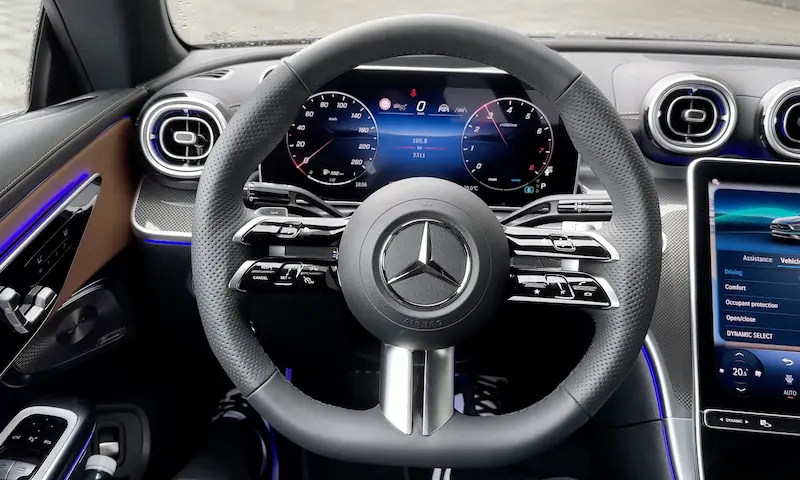
For newer Mercedes with keyless ignition (push-button start), the process is slightly different:
- Make sure the car is in Park and turned off
- Without pressing the brake pedal, press the start button twice to activate the accessory mode (dash lights on, engine off)
- Press the accelerator pedal completely to the floor
- Hold the pedal for 20 seconds
- While keeping the pedal depressed, press the start button once to turn off the ignition
- Continue holding the pedal for another 20 seconds after turning off the ignition
- Release the pedal and wait approximately 2 minutes until all systems shut down
- You can now exit the vehicle or restart it normally
This method works for newer W205 C-Class, W213 E-Class, and other models with push-button ignition.
Using a Diagnostic Scanner for Transmission Reset
If you prefer a more direct method, you can use an OBD-II diagnostic scanner:
- Connect a compatible scanner to your vehicle’s OBD-II port (usually under the dashboard)
- Navigate to the Transmission Control Module (TCM)
- Select the adaptation reset function
- Follow the scanner’s instructions to complete the process
This method can provide more specific feedback and may be preferred by those comfortable with automotive diagnostics.
After the Reset: The Learning Period
After performing a Mercedes-Benz transmission reset, your vehicle enters a relearning phase:
- Drive normally—the transmission is now in “learning mode”
- Be patient through approximately 40 gear shifts as the system relearns your habits
- Drive consistently during this period, as this teaches the transmission your preferred style
During this adaptation time, you might notice slightly different shifting patterns. This is normal and will improve as the system learns your driving habits.
Mercedes Models That Benefit from Transmission Reset
This procedure works on most Mercedes-Benz models, including:
| Vehicle Class | Compatible Models |
|---|---|
| C-Class | W204, W205 |
| E-Class | W212, W213 |
| S-Class | W221, W222 |
| SUVs | GLC, GLE, GLS, ML, GL-Class |
| Transmission Types | 5-speed (722.6), 7G-Tronic (722.9), 9G-Tronic |
The reset works on models from approximately 1996 through current production.
Common Questions About Mercedes Transmission Reset
Will this fix a transmission in limp mode?
No. Limp mode usually indicates a more severe problem that requires professional diagnosis. A transmission reset only clears adaptive learning, not fault codes or mechanical issues.
How often should I reset my Mercedes transmission?
There’s no scheduled interval, but some owners perform this reset every few months as preventative maintenance. Most commonly, it’s done after fluid changes, when purchasing a used vehicle, or when shifting quality deteriorates.
Does the procedure erase transmission fault codes?
No. This reset only clears adaptive learning data. To clear fault codes, you’ll need an appropriate diagnostic scanner that can access the transmission control module.
Is the transmission reset procedure safe for my Mercedes?
Yes, when performed correctly. The procedure simply resets the adaptive learning without affecting any mechanical components or safety systems.
Pro Tips for a Successful Transmission Reset
- Turn off all vehicle electronics before beginning (climate control, radio, lights)
- Ensure the battery is in good condition before attempting the reset
- Don’t rush the waiting period—allow the full 2 minutes for systems to fully power down
- For best results after a reset, drive in various conditions (city, highway) during the relearning phase
- If you’ve changed transmission fluid, perform the reset afterward for optimal adaptation
DIY vs. Professional Service
One of the best things about the Mercedes-Benz transmission reset is that it’s completely DIY-friendly. There’s no need to visit a dealer or mechanic for this simple procedure.
However, if you’re not comfortable performing the reset yourself or if transmission problems persist after the reset, Mercedes-Benz service centers can perform this procedure as part of regular maintenance.
Remember that persistent transmission problems likely indicate a mechanical issue requiring professional attention from a qualified Mercedes technician.
The Benefits of Regular Transmission Resets
Performing a transmission reset periodically can:
- Maintain optimal shift quality
- Improve overall driving experience
- Potentially extend transmission life
- Adapt the vehicle to changes in your driving style
- Clear unwanted adaptations that develop over time
Many Mercedes owners report smoother shifting, improved fuel economy, and a more responsive driving experience after performing a transmission reset.
Transmission Reset as Part of Routine Maintenance
Consider adding the transmission reset to your maintenance routine:
- After transmission fluid changes
- When switching between summer/winter driving conditions
- When multiple drivers use the vehicle
- Every 10,000-15,000 miles as preventative maintenance
- Any time you notice shift quality declining
This simple procedure takes minutes but can significantly improve your driving experience with minimal effort and zero cost.
The Mercedes-Benz Transmission: A Technical Marvel
Mercedes-Benz transmissions represent some of the most advanced automotive technology on the road. The adaptive learning system continuously monitors:
- Throttle position
- Vehicle speed
- Engine load
- Temperature
- Driving patterns
This data creates a personalized shift profile tailored to your driving style. The reset procedure allows this sophisticated system to start fresh when needed.
The transmission in your Mercedes is designed to deliver both performance and comfort. When it’s properly calibrated to your driving style, you’ll experience the perfect balance of quick response and smooth operation that Mercedes-Benz is known for.