That little amber light just popped on your dash, and you don’t have a scanner nearby. Don’t panic — your Nissan actually has a built-in way to tell you exactly what’s wrong. You just need to know how to ask. This guide walks you through every method for reading Nissan check engine light codes without a scanner, from modern pedal tricks to old-school jumper wire techniques.
Does Your Nissan Really Talk Without a Scanner?
Yes, it does. Nissan built a self-diagnostic system called the Electronic Concentrated Control System (ECCS) directly into their vehicles. Your Engine Control Module (ECM) stores fault codes every time something goes wrong. It can transmit those codes through your dashboard’s check engine light — no scanner needed.
The method you use depends on when your Nissan was built:
- 1984–1995 models → Use the jumper wire or physical ECU switch method (OBD-I)
- 1996 and newer models → Use the “Pedal Dance” method (OBD-II)
Let’s start with the most common one.
The Nissan “Pedal Dance”: How to Read Codes on 1996+ Models
The Pedal Dance is the most reliable way to pull Nissan check engine light codes without a scanner on modern vehicles. It uses a specific sequence of ignition and accelerator pedal inputs to trigger Diagnostic Test Mode II. Timing is everything here — a half-second off and the ECM ignores you.
Before You Start
Get these right first or the sequence won’t work:
- Engine must be off
- Accelerator pedal must be fully released
- Battery should be above 12.6 volts
- Turn off all electrical loads — headlights, AC, rear defogger
Step-by-Step Pedal Dance Sequence
| Step | Action | Timing |
|---|---|---|
| 1 | Turn ignition to ON (don’t start engine) | Wait exactly 3 seconds |
| 2 | Fully press and release the gas pedal | 5 times within 5 seconds |
| 3 | Release pedal and wait | Exactly 7 seconds |
| 4 | Press and hold gas pedal to the floor | Hold for 10 seconds |
| 5 | Watch the check engine light blink | Release pedal immediately |
Use a stopwatch for the 7-second and 10-second intervals. Counting “one Mississippi, two Mississippi” works fine too. When the check engine light starts blinking, that’s your ECM talking.
How to Read the Blinks
Your ECM sends four-digit codes through the check engine light using two types of flashes:
- Long flash (0.6 seconds) = first digit
- Short flash (0.3 seconds) = remaining three digits
- Ten flashes in a row = the digit “0”
- 1.8-second pause = separates multiple codes
Example: Ten long flashes + pause + one short + seven short + one short = Code 0171 (P0171: System Too Lean, Bank 1)
Write every code down as they blink. Multiple codes cycle through in numerical order and keep repeating until you turn the ignition off.
Some Nissan Models Show Codes on the Odometer
Some newer Nissan platforms skip the blink counting entirely. Try these two shortcuts first:
- Odometer method: Hold the trip reset button while turning the ignition to ON. The code may appear directly in the digital odometer display.
- Key cycle method: Rapidly cycle the ignition from OFF to ON (without starting) three to five times. Watch the odometer window for codes.
Not every model supports this, but it’s worth a 30-second try before doing the full pedal sequence.
What the Codes Actually Mean
Once you’ve got your codes written down, here’s what the most common ones point to on Nissan vehicles.
Fuel and Air Codes (P0100 Series)
These are the most frequently seen codes on Nissan platforms. They almost always involve sensors in the intake system or the fuel delivery circuit.
| Code | What It Means | Likely Cause |
|---|---|---|
| P0102 | Mass Air Flow Sensor Low Input | Dirty or oil-contaminated MAF sensor filament |
| P0113 | Intake Air Temperature Sensor High | Open circuit in sensor harness |
| P0128 | Coolant Temp Below Threshold | Thermostat stuck open |
| P0171 | System Too Lean, Bank 1 | Vacuum leak, weak fuel pump, or clogged filter |
| P0172 | System Too Rich, Bank 1 | Leaking injector or restricted air intake |
P0171 is one of the most notorious Nissan codes. It usually means unmetered air is sneaking past the MAF sensor through a cracked vacuum hose or a failing intake manifold gasket.
Misfire Codes (P0300 Series)
The ECM detects misfires by watching for tiny drops in crankshaft rotation speed. A P0300 means random or multiple cylinder misfires. Codes P0301 through P0306 point to a specific cylinder.
On high-mileage Nissan V6 engines, misfires usually trace back to:
- Worn ignition coil packs
- Fouled spark plugs from oil intrusion
- Leaking valve cover gaskets
Catalytic Converter Code (P0420)
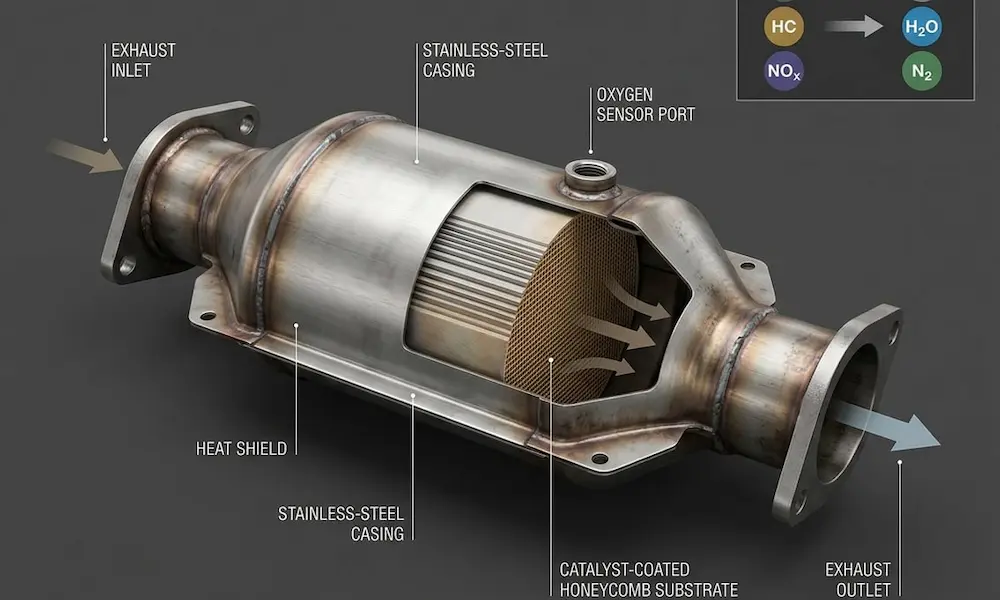
P0420 means your catalytic converter’s efficiency has dropped below the required threshold. The ECM figures this out by comparing the front and rear oxygen sensors. When the rear sensor starts mimicking the front sensor, the converter has lost its oxygen storage capacity.
This one usually means the cat needs replacement. It won’t go away with a reset alone.
Chassis Code C1155
If you see a C1155 alongside your check engine light — and notice a “SLIP” or “VDC OFF” light on the dash — that’s a brake fluid level or wheel speed sensor fault common on the Altima and Maxima platforms. The ABS system and ECM are tightly connected on these cars, so ABS faults often trigger the check engine light too.
Reading Nissan Check Engine Light Codes Without a Scanner on Older Models (1984–1995)
The Pedal Dance doesn’t apply to pre-1996 Nissans. These vehicles use OBD-I, which means two-digit codes and physical hardware interfaces.
The 14-Pin Connector Jumper Method
Most 1986–1995 Nissan trucks and SUVs have a 14-pin diagnostic connector near the interior fuse panel. You bridge two specific pins with a paperclip or jumper wire to enter diagnostic mode.
Here’s how:
- Turn ignition to ON (engine off)
- Bridge Pin 1 (CHK) and Pin 8 (IGN) with a jumper wire
- Wait two seconds — the check engine light should go out
- Remove the jumper wire
- Watch the check engine light blink out your codes
In these older systems, a Code 12 means an Air Flow Meter fault. Code 55 means no faults stored — you’re clean.
Physical ECU Switch Method (1987–1995 Pathfinder and Hardbody)
On certain V6 applications, the ECM sits under the passenger seat and has a physical toggle switch or a small potentiometer screw. This gives you five diagnostic modes.
| Mode | What It Does |
|---|---|
| Mode 1 | Monitors oxygen sensor switching (lean/rich) |
| Mode 2 | Checks fuel system feedback status |
| Mode 3 | Retrieves stored fault codes |
| Mode 4 | Monitors starter, throttle, and speed signals |
| Mode 5 | Real-time timing and airflow monitoring |
For Mode 3, turn the screw clockwise then counter-clockwise until the LEDs blink three times, then flip the switch to ON. The red LED flashes the tens digit; the green LED flashes the ones digit. Seven red flashes + six green flashes = Code 76.
How to Clear Nissan Check Engine Light Codes Without a Scanner
Fixed the problem? Now erase the code. You’ve got three options.
Clear With the Pedal (While Codes Are Blinking)
After the codes appear during the Pedal Dance, press and hold the gas pedal for more than 10 seconds. Release it. The ECM should flash code 0000, confirming the memory is wiped.
Disconnect the Battery
Disconnect the negative terminal first to avoid sparking. How long you leave it disconnected matters:
- Older models may need up to 24 hours to drain internal capacitors
- Newer models typically reset in 30 minutes
One downside: a battery disconnect also wipes your radio presets, power window settings, and idle memory. Which leads us to the next part.
After Clearing Codes: Relearning Procedures
Clearing codes isn’t always the last step. If you’ve cleaned the throttle body, replaced it, or disconnected the battery for a while, your ECM loses its adaptive memory. Idle can get rough and stumble until it relearns.
Idle Air Volume Learning
This procedure teaches the ECM how much air to let in at idle. For it to work, you need:
- Coolant temp between 70°C and 100°C
- All electrical loads off
- Steering wheel in the neutral position
- Battery voltage above 12.9V while idling
The timing mirrors the Pedal Dance sequence. If any of these conditions aren’t met, the ECM cancels the learning process silently. If your idle is still rough after clearing codes, this is probably why.
Accelerator Pedal Released Position Learning
Do this any time you disconnect the accelerator pedal harness. It’s quick:
- Turn ignition ON for 2 seconds
- Turn ignition OFF for 10 seconds
- Repeat once
This recalibrates the pedal’s resting voltage so the ECM doesn’t misread a slight sensor drift as actual throttle input.
Why Your Diagnostic Sequence Might Fail
Sometimes the Pedal Dance doesn’t work, and it’s not your timing. Here are the two most common culprits.
Blown Fuse
Your OBD-II port needs constant battery power on Pin 16. On many Nissans, Pin 16 shares a circuit with the cigarette lighter or auxiliary outlets. If someone blew that fuse with a high-draw accessory, the ECM won’t have the reference voltage it needs to start blinking. Check that fuse first if nothing happens during the sequence.
14-Pin to 16-Pin Adapter Issues
If you’re on an early 2000s Nissan with a 14-pin diagnostic port, generic adapters often fail. Nissan’s pin mapping doesn’t line up with standard OBD-II layouts. The ground pins and CAN bus communication lines are routed differently. You need a Nissan-specific adapter for any digital tool to connect properly.
Quick Reference: Conditions for Diagnostic Success
| Element | What You Need |
|---|---|
| Battery voltage | Above 12.6V for code reading; above 12.9V for relearn |
| Engine temp | 70°C–100°C for Idle Air Volume Learning |
| Electrical loads | All off — lights, fans, AC |
| Timing accuracy | Use a stopwatch for 7s and 10s intervals |
| Reset confirmation | Code 0000 confirms memory is cleared |
Your Nissan’s built-in diagnostic system is genuinely useful — and it’s been there the whole time. Whether you’re dealing with a modern Altima or a classic Pathfinder, reading Nissan check engine light codes without a scanner is a real skill that saves you time, money, and a trip to the shop just to find out what a blinking light means.