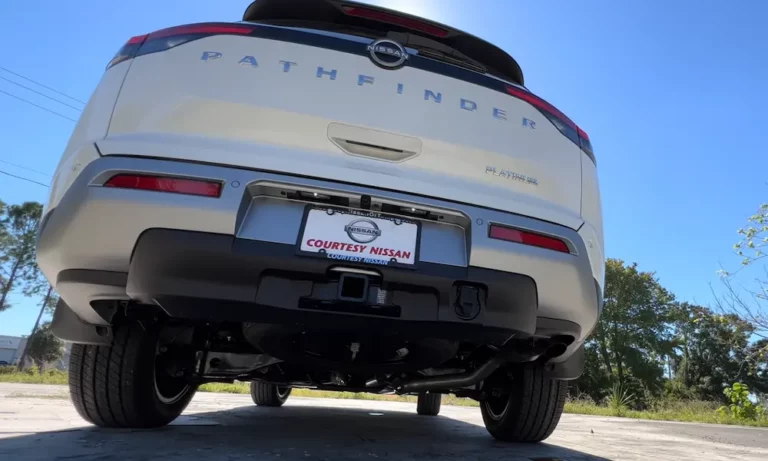
Shopping for a 3-row SUV but worried about fuel costs? The Nissan Pathfinder gas mileage might surprise you—especially if you’re choosing the right trim. Here’s everything you need to know about how this V6-powered family hauler performs at the pump, from official EPA ratings to real-world numbers that actually matter.
What’s the Official Nissan Pathfinder Gas Mileage?
The current 2025 Pathfinder delivers 20-21 mpg city, 23-27 mpg highway, and 21-23 mpg combined, depending on your trim choice. That’s pretty solid for a 3.5-liter V6 engine hauling seven passengers.
Here’s the twist: not all Pathfinders get the same mileage. The drivetrain and trim level create a complex efficiency puzzle that most buyers don’t see coming.
All FWD models (S, SV, SL, and Platinum) share identical ratings: 20 mpg city, 27 mpg highway, and 23 mpg combined. Simple enough, right?
But the 4WD lineup tells a different story. The 4WD S and SV trims actually achieve 21 mpg city—that’s 1 mpg better than their FWD counterparts in stop-and-go traffic.
This breaks every rule about all-wheel drive. Typically, adding a 4WD system means hauling extra weight and fighting more mechanical resistance. Yet Nissan engineered these specific trims with tuning that helps the 9-speed automatic transmission hit its sweet spot during city driving cycles.
The premium SL and Platinum 4WD models don’t get this benefit. They drop to 20 mpg city, 25 mpg highway, and 22 mpg combined. You’re trading 2 highway mpg for features like panoramic moonroofs and 20-inch wheels.
Then there’s the Rock Creek edition. This off-road-focused trim posts the lowest numbers in the lineup: 20 mpg city, 23 mpg highway, 21 mpg combined. Those aggressive all-terrain tires and rugged styling elements create serious aerodynamic drag.
How Different Pathfinder Trims Stack Up for Fuel Economy
Let’s break down exactly what you’re getting (or giving up) with each configuration.
| Trim | Drivetrain | City MPG | Highway MPG | Combined MPG |
|---|---|---|---|---|
| S | FWD | 20 | 27 | 23 |
| SV | FWD | 20 | 27 | 23 |
| SL | FWD | 20 | 27 | 23 |
| Platinum | FWD | 20 | 27 | 23 |
| S | 4WD | 21 | 27 | 23 |
| SV | 4WD | 21 | 27 | 23 |
| SL | 4WD | 20 | 25 | 22 |
| Platinum | 4WD | 20 | 25 | 22 |
| Rock Creek | 4WD | 20 | 23 | 21 |
The data’s clear: if you’re doing mostly city driving, the 4WD S or SV gives you the best efficiency. If you’re racking up highway miles, any FWD model or the base 4WD trims will maximize your range from the 18.49-gallon fuel tank.
What You’ll Actually Get: Real-World Nissan Pathfinder Gas Mileage
EPA stickers tell one story. Your dashboard tells another.
Professional testing backs up Nissan’s claims—and then some. When Car and Driver ran a 75-mph highway test, their all-wheel-drive Pathfinder returned 28 mpg. That’s actually better than the official 27 mpg highway rating.
But owner reports paint a more complicated picture, especially for new buyers.
Fresh-off-the-lot Pathfinders often disappoint. One 2023 Platinum 4WD owner reported 18-19 mpg around town and 22-25 mpg on highways. Another driver with a 2023 4WD model saw city numbers under 20 mpg. A detailed owner review clocked just 22.15 mpg combined after nearly 1,000 miles.
Here’s what’s happening: your Pathfinder needs a break-in period.
A comprehensive video review documented this phenomenon perfectly. During the first 1,000 miles, the same in-town route averaged just 17-19 mpg. After the engine passed 3,000 miles, that identical route delivered 23 mpg in Eco mode—a 4-5 mpg jump.
Highway driving showed the same pattern. Early road trips averaged 23 mpg, but post-break-in trips hit 26-28 mpg depending on terrain.
Your engine’s internal components need time to properly seat and mesh. Piston rings, bearings, and cylinder walls are all settling into their optimal positions. Don’t panic if your brand-new Pathfinder seems thirsty. Give it 3,000 miles.
How to Maximize Your Pathfinder’s Fuel Efficiency
Beyond the break-in period, you’ve got real control over what your trip computer displays.
Use Eco Mode religiously. This driving mode adjusts throttle response and transmission shift points to prioritize efficiency. Owner testing showed it can add several mpg in mixed driving.
Check your tire pressure monthly. Underinflated tires create rolling resistance that forces your V6 to work harder. The difference between properly inflated and 5 psi low can cost you 1-2 mpg.
Clear out the cargo area. That camping gear you’ve been hauling around since summer? It’s burning your gas. Every 100 pounds of extra weight reduces fuel economy by about 1%.
Ease off the throttle. Aggressive “lead-foot” acceleration is the fastest way to tank your mileage. The Pathfinder’s 284 horsepower is fun, but smooth inputs keep the fuel gauge from dropping.
Stay current with maintenance. Follow Nissan’s service schedule, especially for oil changes. Fresh oil reduces internal friction and helps your engine operate as designed.
Pathfinder vs. Pilot vs. Highlander: The Gas Mileage Battle
The 3-row SUV market is ruthless. Here’s how the Nissan Pathfinder gas mileage compares to its two biggest rivals.
Pathfinder vs. Honda Pilot
The Pathfinder wins this matchup clearly.
FWD configurations: Pathfinder (20/27/23) beats the Pilot (19/27/22) by 1 mpg in city and combined ratings. Not huge, but it adds up over 15,000 miles.
The gap widens with all-wheel drive. The most efficient Pathfinder 4WD (21/27/23) crushes the standard Pilot AWD (19/25/21) by 2 mpg across all three metrics.
Even the off-road trims favor Nissan. The Pathfinder Rock Creek (20/23/21) edges out the Honda Pilot TrailSport (18/23/20).
If you’re choosing between these two V6-powered family haulers, the Pathfinder will cost you less at the pump.
Pathfinder vs. Toyota Highlander
This comparison gets tricky because Toyota ditched the V6. The current Highlander runs a 2.4-liter turbocharged 4-cylinder, fundamentally changing the performance equation.
The turbo-4 Highlander wins on pure efficiency:
- FWD: Highlander (22/29/25) beats Pathfinder (20/27/23) by 2 mpg across the board
- AWD: Highlander (21/28/24) edges Pathfinder 4WD (21/27/23) in highway and combined ratings
You’re trading Nissan’s naturally aspirated V6 smoothness for Toyota’s smaller, more efficient turbo engine. Some drivers prefer the V6’s linear power delivery. Others want the fuel savings.
The Hybrid Elephant in the Room
Then there’s the Toyota Highlander Hybrid, which doesn’t just win—it dominates with 35 mpg city, 35 mpg highway, and 35 mpg combined.
That’s more than 50% better than the Pathfinder’s 23 mpg combined. Neither Nissan nor Honda currently offers a hybrid powertrain in their 3-row SUVs.
Here’s the reality: if maximizing fuel economy is your top priority, the Pathfinder isn’t your answer. But if you want 6,000-pound towing capacity, proven V6 performance, and better efficiency than the Pilot, it’s a solid middle ground.
| Vehicle | Drivetrain | Powertrain | City | Highway | Combined |
|---|---|---|---|---|---|
| Nissan Pathfinder | FWD | 3.5L V6 | 20 | 27 | 23 |
| Nissan Pathfinder | 4WD | 3.5L V6 | 21 | 27 | 23 |
| Honda Pilot | FWD | 3.5L V6 | 19 | 27 | 22 |
| Honda Pilot | AWD | 3.5L V6 | 19 | 25 | 21 |
| Toyota Highlander | FWD | 2.4L Turbo I4 | 22 | 29 | 25 |
| Toyota Highlander | AWD | 2.4L Turbo I4 | 21 | 28 | 24 |
| Toyota Highlander Hybrid | AWD | 2.5L Hybrid I4 | 35 | 35 | 35 |
How Nissan Pathfinder Gas Mileage Has Evolved Over Time
Today’s respectable 23 mpg combined rating wasn’t always the standard. The Pathfinder’s journey from gas-guzzler to competitive crossover spans decades.
The Truck Days (2005-2012)
The third-generation Pathfinder was built body-on-frame like a pickup truck. It shared the Frontier’s platform and offered either a 4.0-liter V6 or a massive 5.6-liter V8.
The V6 4WD managed a pathetic 14 mpg city, 20 mpg highway, and 16 mpg combined. The V8 was worse: 13/18/14.
Real-world owner reports from this era are brutal. Some V8 owners reported 9 mpg city and 12 mpg highway. Others barely cracked 12.5 mpg combined.
That’s 8-9 mpg worse combined than today’s model. The R51 generation was a gas station’s best friend.
The Unibody Revolution (2013-2020)
Nissan completely reimagined the Pathfinder for 2013. Out went the truck frame. In came a unibody crossover platform shared with other car-based SUVs.
The powertrain switched to a 3.5-liter V6 paired with a Continuously Variable Transmission (CVT). Efficiency jumped dramatically:
- FWD: 20 mpg city, 26 mpg highway, 22 mpg combined
- 4WD: 19/25/21
That’s a massive 5-6 mpg combined improvement over the old truck-based model. The transformation repositioned the Pathfinder as a modern family crossover.
The Modern Era (2022-Present)
The current generation kept the unibody platform but ditched the widely criticized CVT for a conventional 9-speed automatic.
This should’ve hurt efficiency—geared automatics typically can’t match CVT fuel economy. Instead, Nissan improved both driving experience and mileage:
- FWD: 20/27/23 (gaining 1 mpg combined)
- 4WD: 21/27/23 (gaining 2 mpg combined)
That’s a genuine engineering achievement. The R53 Pathfinder proves you don’t need a CVT to deliver competitive fuel economy.
Which Pathfinder Trim Gets the Best Gas Mileage?
If you’re shopping purely on efficiency, two models stand out: the S 4WD and SV 4WD.
These trims deliver the lineup’s best 21 mpg city rating while maintaining 27 mpg highway and 23 mpg combined. You’re getting all-wheel-drive capability without the typical fuel penalty.
The S 4WD trim starts around $37,000 and includes everything most families need: three rows of seating, modern safety tech, and capable AWD. The SV 4WD adds convenience features like a power liftgate and upgraded cloth seats while maintaining identical fuel economy.
Skip the premium trims if efficiency matters. The SL and Platinum 4WD models add luxury but cost you 1 mpg combined and 2 mpg highway. Those 20-inch wheels and extra weight from panoramic sunroofs add up.
And unless you’re actually hitting trails, avoid the Rock Creek. Its 21 mpg combined rating is the worst in the family, thanks to aggressive tires and aerodynamic compromises.
For highway-heavy drivers, any FWD model or the S/SV 4WD trims max out at 27 mpg highway. Professional testing confirms 28 mpg is achievable in real-world cruising.
The bottom line? The Nissan Pathfinder gas mileage hits a sweet spot in the 3-row SUV market. It won’t match a hybrid, but it beats the Honda Pilot, offers proven V6 power, and rewards smart buyers who choose the right trim. Give it 3,000 miles to break in, stay on top of maintenance, and you’ll get the EPA numbers—maybe better.