V10 engines sit in a strange, wonderful place in automotive history. Too exotic for mass production, too iconic to ignore. If you’ve ever wondered what cars have V10 engines — and why they sound absolutely otherworldly — you’re about to get the full story. Stick around, because the list might surprise you.
Why V10 Engines Are So Rare
Before diving into the cars, it helps to understand why V10 engines are so uncommon in the first place.
A V10 is essentially two banks of five cylinders sharing one crankshaft. The problem? An inline five-cylinder engine is inherently unbalanced, creating a rocking vibration from end to end. Join two of those banks together, and the vibrations multiply fast.
Engineers can fix this with balance shafts — weighted shafts that spin opposite to the engine to cancel vibrations. But balance shafts add weight, complexity, and sap power. That’s a tough sell when an eight-cylinder or twelve-cylinder engine avoids most of these headaches from the start.
Then there’s the bank angle problem. The ideal angle for smooth, even firing is 72 degrees. That spacing delivers equal combustion intervals and that legendary high-pitched scream. But a 72-degree block is tall, narrow, and difficult to package under a normal hood line.
Most manufacturers defaulted to 90 degrees instead — the same angle used in V8 engines — to save on development costs. The downside? A 90-degree V10 fires unevenly, alternating between 54-degree and 90-degree combustion intervals. That creates the deep, aggressive growl you hear in American muscle, but it also makes the engine rougher to refine.
Despite all that, engineers made it work — spectacularly, in some cases.
American V10 Cars: Raw Power and Heavy Duty Muscle
Dodge Viper (1992–2017)
The Dodge Viper is the most famous answer to the question of what cars have V10 engines. Chrysler wanted a spiritual successor to the Shelby Cobra, so they took a heavy-duty truck engine, added two cylinders to create a 90-degree V10, and sent the blueprints to Lamborghini — who they owned at the time — for refinement.
Lamborghini recast the block in lightweight aluminum and handed back an 8.0-liter monster. It was odd-firing, loud, and deliberately raw. Critics compared its idle to a delivery truck. Under full throttle, it didn’t matter.
Over five generations, the engine grew to 8.4 liters and eventually hit 645 horsepower and 600 lb-ft of torque in its final form. The Viper ACR and Viper TA used that power, combined with aggressive aerodynamics, to set lap records worldwide. Dodge never added a balance shaft. They didn’t need to — the sheer mass of the engine overpowered the vibrations.
The Viper ended production in 2017, taking its engine into history with it.
Dodge Ram SRT-10 (2004–2006)
Dodge didn’t stop at sports cars. In 2004, they dropped the 8.3-liter Viper engine into a regular-cab pickup truck. The result was the Ram SRT-10 — 500 horsepower, 525 lb-ft of torque, and a 0–60 mph time of 4.8 seconds in a truck.
It featured a lowered suspension, high-performance brakes, and a heavy-duty manual transmission. It was absurd. It was perfect.
Ford Triton V10 (1997–2021)
Ford took a completely different approach. Their 6.8-liter Triton V10 wasn’t built for lap records. It was built for work — specifically for the F-250, F-350 Super Duty, and the massive Ford Excursion SUV.
Unlike the Viper, Ford used split crankpins to achieve an even-firing order despite the 90-degree bank angle. The result was smooth, quiet operation ideal for commercial fleets and long-haul drivers. It produced up to 362 horsepower and 457 lb-ft of torque, making it a favorite in motorhomes, commercial vans, and even Blue Bird school buses.
Ford kept the Triton in production for commercial applications all the way until 2021. Not glamorous, but deeply dependable.
German V10 Cars: Engineering as Art
Porsche Carrera GT (2004–2006)
The Porsche Carrera GT is the car most automotive historians consider the greatest V10 road car ever built. Its 5.7-liter engine traces directly back to a canceled Formula One program, then a Le Mans prototype project. When Porsche decided to build a halo car, they resurrected it.
The engine uses a unique 68-degree bank angle — chosen purely for packaging in its racing days. Porsche skipped the balance shaft entirely, instead using forged titanium connecting rods and an ultra-light rotating assembly to manage vibrations through precision rather than mass. Output: 603 horsepower and 435 lb-ft of torque.
The Carrera GT has no electronic stability control. The clutch is a ceramic racing unit the size of a CD. It demands your full attention, all the time. That’s the point.
BMW M5 / M6 with S85 Engine (2005–2010)
BMW’s S85 is what happens when a Formula One engine supplier decides to build a road car engine from scratch. The 5.0-liter naturally aspirated S85 featured ten individual throttle bodies — one per cylinder — and a redline above 8,000 rpm. The blocks were cast in the same foundry as BMW’s F1 racing engines.
In the E60 M5 and E63 M6, it produced 500 horsepower and 383 lb-ft of torque, launching the heavy luxury sedan to 60 mph in 4.7 seconds. It sounded extraordinary. It was expensive to maintain. The rod bearings were notoriously sensitive to cold starts. Owners who didn’t warm it up properly faced catastrophic — and costly — engine failures.
Worth every complicated moment of ownership.
Audi R8 V10 (2009–2024)
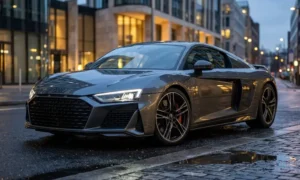
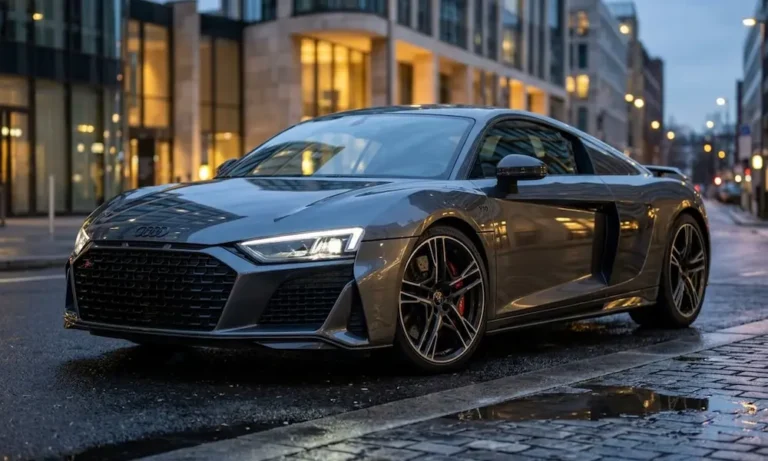
The Audi R8 V10 used a 5.2-liter naturally aspirated engine shared across the Volkswagen Group’s performance lineup. Early versions produced 525 horsepower, with later variants pushing past 600 horsepower. The engine sat mid-mounted, feeding power through Audi’s Quattro all-wheel-drive system.
The R8 remained in production until 2024, making it one of the last new V10 cars you could walk into a dealership and buy.
Audi RS6 Avant C6 (2008–2010)
Audi also dropped a twin-turbocharged 5.0-liter V10 into a family station wagon. The C6 RS6 Avant produced 580 horsepower and 479 lb-ft of torque. Quattro all-wheel drive put the power down in any weather. Zero to 60 mph in 4.4 seconds — in a wagon that could carry five people and their luggage.
It remains one of the most practical insane cars ever built.
Volkswagen Touareg V10 TDI (2004–2007)
Volkswagen took the most unexpected route of anyone on this list. They built a 5.0-liter twin-turbocharged diesel V10 and put it in an SUV. The Touareg V10 TDI produced 310 horsepower but a tire-destroying 553 lb-ft of torque at low rpm. It famously towed a Boeing 747 in a promotional stunt.
Emissions regulations killed it early. Maintenance complexity kept it rare. Its engineering legacy is undeniable.
Italian and Japanese V10 Cars: Acoustic Masterpieces
Lamborghini Gallardo and Huracan (2003–2024)
The Lamborghini Gallardo introduced the 5.0-liter V10 to the Sant’Agata lineup in 2003, eventually selling over 14,000 units — a commercial triumph by supercar standards.
Early Gallardos used split crankpins for an even-firing sequence. Later models, including the Gallardo LP560-4 and its successor the Huracan, switched to an odd-firing setup on shared crankpins. That change removed the balance shaft, cut rotational mass, and allowed the engine to rev faster and respond more violently to throttle inputs.
The Huracan Performante and Huracan Evo pushed the 5.2-liter engine to 640 horsepower, hitting 60 mph in under three seconds. The exhaust note sounds like rapid gunfire at full throttle. Lamborghini confirmed all final Huracan production slots sold out, with assembly ending in 2024. Its successor uses a turbocharged V8 hybrid.
Lexus LFA (2010–2012)
The Lexus LFA took over a decade to develop and cost Toyota enormous resources to build. Lexus scrapped a completed aluminum chassis halfway through development to switch to carbon fiber. They then built the 1LR-GUE engine — a 4.8-liter V10 — from the ground up using the mathematically ideal 72-degree bank angle.
No balance shaft needed. Titanium valves. Titanium connecting rods. A redline of 9,000 rpm. The rotating assembly was so light it could rev from idle to redline in 0.6 seconds — too fast for an analog tachometer needle to follow. Lexus installed a digital gauge instead.
Yamaha’s acoustic division — the same people who build concert grand pianos — tuned the intake and titanium exhaust to replicate the sound of a 1990s Formula One car. Only 500 units were built. Each one is a piece of engineering art.
Complete V10 Production Car Specs at a Glance
| Car | Engine | Output |
|---|---|---|
| Dodge Viper (Gen 5) | 8.4L NA, 90° | 645 hp / 600 lb-ft |
| Porsche Carrera GT | 5.7L NA, 68° | 603 hp / 435 lb-ft |
| Lamborghini Huracan Evo | 5.2L NA, 90° | 640 hp / 442 lb-ft |
| Audi RS6 Avant C6 | 5.0L TT, 90° | 580 hp / 479 lb-ft |
| Audi R8 V10 Plus | 5.2L NA, 90° | 602 hp |
| Lexus LFA | 4.8L NA, 72° | 553 hp / 350 lb-ft |
| BMW M5 E60 | 5.0L NA, 90° | 500 hp / 383 lb-ft |
| Lamborghini Gallardo | 5.0–5.2L NA, 90° | 500–552 hp |
Boutique V10 Cars You’ve Probably Never Heard Of
The availability of Dodge and BMW V10 engines gave smaller manufacturers a shortcut to exotic performance.
- Bristol Fighter — A British coupe using a tuned Viper engine producing over 630 horsepower
- Wiesmann MF5 — A retro-styled German roadster built around the BMW S85
- Spania GTA Spano — A Spanish supercar that eventually turbocharged its Viper-derived engine
- VLF Force 1 — A redesigned, more luxurious take on the Viper platform
None reached mass production, but all proved that the V10’s appeal extended well beyond the major automakers.
V10 Engines in Motorsport: The Golden Era
The Formula One V10 era of the 1990s and early 2000s represents the engineering peak of this configuration. After turbocharged engines were banned from F1 in 1989, manufacturers explored every naturally aspirated option. The V10 won.
It was lighter than a V12, yet more powerful than a V8. Teams like Ferrari, Mercedes, Honda, and Renault developed engines exceeding 19,000 rpm. The BMW-Williams FW25A produced 940 horsepower from just 3.0 liters of displacement — arguably the most power-dense road-racing engine ever built.
Endurance racing saw similar dominance. The Audi R15 TDI used a turbocharged 5.5-liter diesel V10 to dominate Le Mans, winning on efficiency and torque rather than raw speed.
Why V10 Engines Are Disappearing
The answer is straightforward. Large naturally aspirated engines can’t meet modern emissions standards. A turbocharged V8 or V6 now produces more power with lower fuel consumption. Manufacturers have no regulatory reason to keep developing V10 platforms.
The Dodge Viper ended in 2017. The Audi R8 ended in 2024. The Lamborghini Huracan wrapped up the same year. Future high-performance cars from these brands — including the Huracan’s successor — use smaller, turbocharged engines paired with hybrid electric systems.
The naturally aspirated V10 is effectively extinct in new production vehicles. What remains on the road today is all there will ever be.
FAQs About V10 Engines
Does swapping a V10 into a standard car cause handling problems?
Yes, significantly. A V10 block is longer and heavier than most engines. Fitting one often requires cutting the firewall and fabricating custom mounts. The weight over the front axle — especially with cast-iron variants like the Dodge Magnum — causes severe understeer. The entire front suspension geometry typically needs a complete redesign to handle the extra load safely.
Why do high-revving V10s like the BMW S85 have such specific maintenance requirements?
The S85’s tight internal tolerances place enormous stress on rod bearings during high-rpm operation. The protective oil film between the bearing and crankshaft journal can break down if the engine isn’t at full operating temperature first. Owners must use high-viscosity synthetic oil and always warm the engine up before pushing the revs. Skipping that routine often results in total engine failure and a five-figure repair bill.
Why do some V10s use individual throttle bodies while most cars use one?
Individual throttle bodies give each cylinder its own dedicated air source, eliminating the intake competition caused by the V10’s complex firing order. The result is instant throttle response — critical for track use. The downside is cost and complexity. Synchronizing ten separate throttle linkages requires precision manufacturing and expensive calibration, making it impractical for any vehicle not targeting serious performance.
Did the switch from leaded racing fuel affect V10 motorsport engines?
Yes. Early prototype racing V10s relied on high-octane leaded fuel to run extreme compression ratios without detonation. When governing bodies mandated the switch to unleaded fuel, engineers had to redesign combustion chambers, alter cylinder head geometry, and implement advanced electronic ignition management to prevent engine knock from destroying the high-revving blocks under race conditions.
What’s the difference between odd-fire and even-fire V10 engines in terms of real-world feel?
An even-fire V10 — like the early Gallardo or the Lexus LFA — delivers a smooth, linear power build with a high-pitched, almost mechanical scream. An odd-fire V10 — like the Viper — has a deeper, more aggressive character with a slight roughness at idle that disappears the moment you get into the throttle. Neither is objectively better. They just deliver completely different sensory experiences.