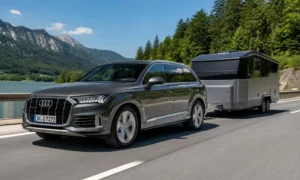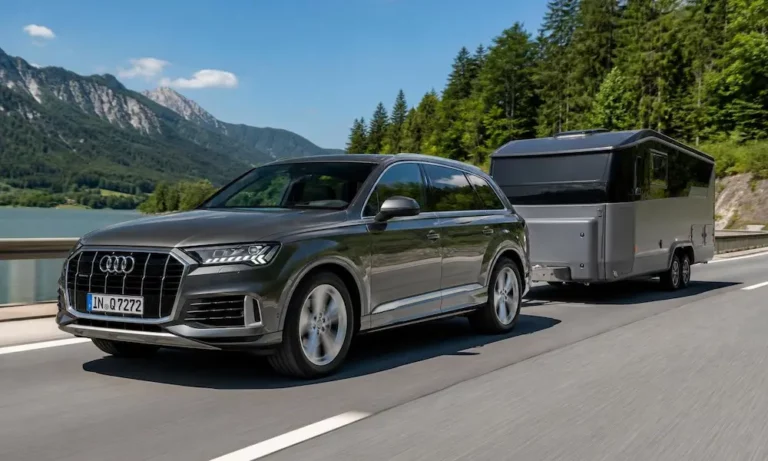
Thinking about towing a boat, camper, or trailer with your Audi Q7? You’re in the right place. This guide breaks down the exact Audi Q7 towing capacity by engine, trim, and model year — plus the rules you must follow to tow safely without damaging your vehicle. Stick around, because one mistake covered in this post could save you thousands in repairs.
How Much Can an Audi Q7 Tow?
The short answer: it depends on which engine you have.
The Audi Q7 towing capacity ranges from 4,400 to 7,700 pounds on current models, depending on the powertrain. The 2.0-liter four-cylinder (45 TFSI) caps out at 4,400 lbs. The 3.0-liter V6 (55 TFSI) and the SQ7’s V8 both hit the maximum of 7,700 lbs — but only when properly equipped with the factory towing package.
Here’s a quick look at how capacity has changed over the years:
| Model Year | Max Towing Capacity | Notes |
|---|---|---|
| 2007–2015 | 6,600 lbs | First-generation platform |
| 2016 | Not available | Redesign transition year |
| 2017–2026 (55 TFSI / SQ7) | 7,700 lbs | Second-generation platform |
| 2017–2026 (45 TFSI) | 4,400 lbs | Four-cylinder models |
The big jump happened with the 2017 redesign, when Audi rebuilt the Q7 on a lighter, stiffer multi-material chassis. That structural upgrade is why the number went from 6,600 to 7,700 lbs — not just a bigger engine.
Breaking Down the Engines: Which One Do You Need?
45 TFSI — The Everyday Hauler
The 45 TFSI is a 2.0-liter turbocharged four-cylinder. It makes 261 horsepower and 273 lb-ft of torque, and it’ll get you to 60 mph in about 6.7 seconds. It handles 4,400 pounds of towing capacity, which is plenty for:
- A single jet ski on a trailer (~1,500 lbs)
- A pop-up camper (~2,500–3,500 lbs)
- A small utility or landscaping trailer
If you’re not regularly hauling heavy loads, the 45 TFSI gets the job done without the premium price tag of the V6.
55 TFSI — The One Most People Need
The 55 TFSI uses a 3.0-liter turbocharged V6 producing 335 hp and 369 lb-ft of torque. This is the engine you want if you’re towing anything above 4,400 lbs. It reaches 60 mph in 5.5 seconds and unlocks the full 7,700-pound towing capacity. It also pairs with a 48-volt mild hybrid system that helps smooth out low-speed trailer maneuvers.
SQ7 — Maximum Power, Same Tow Limit
The SQ7 packs a 4.0-liter twin-turbo V8 with 500 hp and 568 lb-ft of torque — and it’s genuinely fast at 4.3 seconds to 60 mph. But here’s the thing: it still maxes out at 7,700 lbs of towing capacity, the same as the V6.
Why? Because towing capacity on a unibody SUV is limited by the hitch mounting points and braking system — not just engine output. The SQ7 is the choice for drivers who want serious performance alongside serious towing, not more towing because of the engine.
| Feature | 45 TFSI | 55 TFSI | SQ7 (V8) |
|---|---|---|---|
| Horsepower | 261 hp | 335 hp | 500 hp |
| Torque | 273 lb-ft | 369 lb-ft | 568 lb-ft |
| Max Towing | 4,400 lbs | 7,700 lbs | 7,700 lbs |
| 0–60 mph | 6.7 sec | 5.5 sec | 4.3 sec |
| Transmission | 8-speed Tiptronic | 8-speed Tiptronic | 8-speed Tiptronic |
The One Towing Rule You Cannot Break
There’s a critical rule that trips up a lot of Q7 owners: you cannot use a weight distribution hitch (WDH) on the Audi Q7. Ever.
Weight distribution hitches use spring bars to redistribute tongue weight toward the front axle. They’re common on trucks. But the Q7 is a unibody vehicle — the chassis and body are one integrated structure. A WDH applies intense torsional forces to the rear structural member that the Q7 simply wasn’t built to handle.
The result? Severe damage to the hitch mounting points or the chassis itself. We’re talking structural failure — which is dangerous and expensive.
So what does Audi use instead?
Adaptive Air Suspension Does the Heavy Lifting
Higher Q7 trims come with adaptive air suspension. When you hook up a heavy trailer, the system automatically inflates the rear springs to keep the vehicle level. This gives you the leveling benefit of a WDH without the structural risk. For the 2026 model year, adaptive air suspension became standard on the Premium Plus trim — a meaningful upgrade for frequent towers.
A level vehicle keeps your front tires gripping properly, your headlights aimed correctly, and your trailer tracking straight. It’s the Q7’s built-in solution to the WDH problem.
The Factory Towing Package: What’s Actually Included
To hit that 7,700-lb limit, the Q7 must be “properly equipped” — and that means the factory-approved towing package. This isn’t just a bolt-on receiver hitch. It’s a complete system.
Here’s what the package includes:
- Class III receiver hitch — replaces the rear bumper reinforcement bar entirely, transferring towing forces directly into the main chassis members
- Seven-pin adapter — powers trailer lights, turn signals, and brakes
- Trailer control module — tells the vehicle’s computers a trailer is attached and adjusts safety system behavior accordingly
- Enhanced cooling components — protects the engine and transmission from heat buildup during long tows
Don’t Skip the Dealer Coding Step
Here’s where a lot of DIY installs go wrong. After the towing hardware is installed, the vehicle’s software must be electronically coded to recognize the trailer control module. Without this coding step, your trailer lights won’t work and the stability systems won’t know a trailer is attached.
This coding process requires Audi-specific diagnostic tools. It’s not optional — it’s essential.
Safety Tech That Makes Towing Safer
The Q7 doesn’t just tow — it actively works to keep you and your trailer under control.
Electronic Stability Control with Trailer Stabilization
When the seven-pin plug detects a trailer connection, the ESC system monitors for sway. If it detects lateral oscillation — from crosswinds, a sudden lane change, or improper load balance — it applies brakes to individual wheels and reduces engine power automatically. This happens faster than any driver can react.
Quattro All-Wheel Drive
The standard quattro system distributes torque to all four wheels constantly. This is especially helpful on slippery surfaces like wet boat ramps or loose gravel, where rear-wheel spin could be dangerous with a heavy tongue load pressing down.
All-Wheel Steering
Available on select trims, all-wheel steering turns the rear wheels opposite to the fronts at low speeds — which shrinks the turning circle significantly. It’s a big help when backing a trailer into a tight campsite. At highway speeds, the rear wheels turn in the same direction as the fronts, which reduces trailer sway and improves stability during lane changes.
Weight Ratings You Need to Understand
Towing numbers don’t exist in a vacuum. These ratings all work together, and ignoring any one of them creates a safety issue.
Tongue Weight
Tongue weight is how much of the trailer’s load presses down on the hitch ball. For the 55 TFSI and SQ7, the maximum tongue weight is 770 lbs (10% of 7,700 lbs). For the 45 TFSI, it’s 440 lbs.
Keep tongue weight between 10–15% of your total trailer weight. Too low and the trailer sways. Too high and you lose front-wheel traction. Importantly, tongue weight counts toward your total payload — so passengers and cargo eat into that number.
GVWR and Payload
The GVWR for a 2025 Q7 55 TFSI is approximately 6,581 lbs, with a payload capacity of around 1,235 lbs. Fill the Q7 with seven adults and gear, and you may not have enough payload left for a 770-lb tongue weight. Always do the math before hooking up.
| Weight Metric | 45 TFSI | 55 TFSI |
|---|---|---|
| Curb Weight | 4,839 lbs | 5,049 lbs |
| GVWR | 6,393 lbs | 6,581 lbs |
| Max Payload | 1,312 lbs | 1,235 lbs |
| Max Towing (Braked) | 4,400 lbs | 7,700 lbs |
| Max Tongue Weight | 440 lbs | 770 lbs |
Braked vs. Unbraked Trailers
Every towing number you see for the Q7 applies to braked trailers only — trailers with their own independent braking system. The unbraked towing limit drops to roughly 1,650 lbs. Trying to tow a 5,000-lb boat without trailer brakes puts enormous strain on the Q7’s own brakes and dramatically extends stopping distances.
Most states require trailer brakes on anything over 1,500–3,000 lbs. Check your state’s rules before you head out.
Installing a Trailer Brake Controller
The Q7 comes pre-wired for a brake controller. The factory wiring sits under the driver-side dashboard, wrapped in grey foam tape near the steering column or emergency brake pedal. A proportional inertia-based controller is the right choice — it matches brake force on the trailer to how hard the SUV is decelerating.
Standard wiring color codes are:
- Black — Constant 12V power
- White — Ground
- Red — Brake pedal signal
- Blue — Output to trailer brakes
Mount the controller within easy driver reach. Most units include a manual slide so you can apply only the trailer brakes independently — which is the correct move if sway starts, not hitting the SUV’s brakes.
What Can the Q7 Actually Tow?
Here’s how the numbers translate to real life:
Boats: A 22-foot wake boat or mid-sized fiberglass bowrider with trailer and fuel typically weighs 5,000–6,500 lbs. The 55 TFSI handles this confidently. A single jet ski on a trailer (~1,500 lbs) works fine with the 45 TFSI.
Travel trailers: Most 20–24-foot dual-axle trailers weigh 5,500–7,000 lbs loaded. The Q7 55 TFSI can handle these, though the air suspension and trailer stabilization become especially valuable here. Lighter options like teardrop or pop-up campers (1,500–3,500 lbs) pull effortlessly.
Mountain driving: Turbocharged engines handle altitude better than naturally aspirated ones — but expect fuel economy to drop 30–50% hauling heavy loads through mountain passes. Use manual transmission mode on long descents to keep engine braking active and protect your brakes from overheating.
How the Q7 Stacks Up Against Rivals
| Vehicle | Max Towing Capacity | Notes |
|---|---|---|
| Audi Q7 (V6/V8) | 7,700 lbs | Air suspension, trailer stabilization |
| Mercedes-Benz GLE | 7,700 lbs | Primary rival |
| BMW X5 | 7,200 lbs | Slightly lower capacity |
| Acura MDX | 5,000 lbs | Platform-limited |
| Audi Q5 (45 TFSI) | 4,400 lbs | Compact SUV benchmark |
| Mitsubishi Outlander PHEV | 1,500 lbs | Hybrid system limits capacity |
The Q7 matches or beats most competitors on raw capacity. Where it stands out is the depth of electronic integration — trailer stabilization, air suspension, and all-wheel steering working together in a way that rivals often can’t match even when they hit the same weight number.
Keeping the Q7 Healthy When You Tow Regularly
Towing counts as severe-duty use. Here’s what to stay on top of:
Transmission fluid: The 8-speed Tiptronic is tough, but heat degrades fluid over time. Even if the manufacturer says “lifetime fluid,” most service experts recommend changes every 40,000–60,000 miles for vehicles that tow frequently.
Brakes: The added load wears pads and rotors faster — even with trailer brakes doing their share. Check them before any long towing trip. Heat-warped rotors are a common result of skipping this step.
Tires: Inflate to the “full load” pressures shown on the door jamb sticker. Under-inflated tires generate heat under load, and heat is the leading cause of tire failure while towing.
Cooling system: Towing means higher sustained engine load and more heat. Keep coolant at the proper level, and make sure the radiator and auxiliary coolers are clear of debris before long hauls.