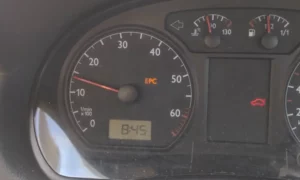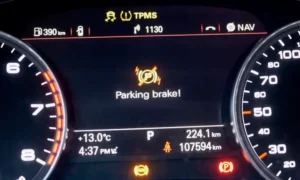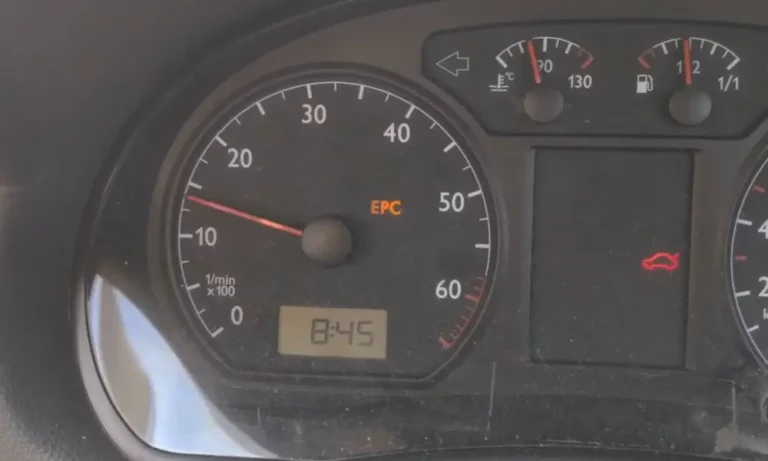
That little yellow “EPC” light just popped up on your dashboard, and now you’re wondering if you should pull over, keep driving, or panic. Good news — it’s probably not as catastrophic as it feels. But it’s also not something you should ignore. Read on to find out what’s triggering it, what happens next, and how much it’ll cost you to fix.
What Does the Audi EPC Light Actually Mean?
EPC stands for Electronic Power Control. It’s Audi’s drive-by-wire system that manages the connection between your foot on the accelerator and the engine’s response. Instead of a physical cable, sensors read your pedal movement, send signals to the Engine Control Unit (ECU), and the ECU commands an electric motor to open or close the throttle.
When the Audi EPC light comes on, it means the ECU spotted something outside of normal operating limits. Think of it as the system’s way of raising its hand and saying, “Something doesn’t add up here.”
Unlike a Check Engine Light that might just mean your gas cap is loose, the EPC light almost always ties to a real driveability issue.
How the EPC System Works (The Short Version)
The EPC system isn’t one single part — it’s a network of sensors and modules talking to each other constantly. Here’s what’s in the loop:
- Accelerator pedal sensors (two of them, for redundancy)
- Electronic throttle body with its own dual position sensors
- Mass Airflow (MAF) sensor
- Crankshaft position sensor
- Brake light switch
- Intake manifold runner controls
The ECU runs a constant plausibility check. If the MAF sensor reports a massive rush of air while the throttle position sensor says the valve is closed, the ECU flags that as impossible. EPC light on. It’s that sensitive — even a loose O-ring or a weak battery can set it off.
Why the Audi EPC Light Comes On: The Most Common Causes
Dirty or Failing Throttle Body
This is the number one culprit. Oil vapors from your engine mix with intake air and leave a sticky carbon residue on the throttle plate. The ECU notices the motor working harder than it should to move the plate, and triggers the EPC warning.
Sometimes a good clean with throttle body cleaner fixes it. Other times, the internal motor or plastic gears have worn out and the whole unit needs replacing. If you’re on an Audi Q5, budget anywhere from $571 to $857 for a full throttle body replacement.
The Brake Light Switch (Seriously)
This one catches people off guard. Your EPC system uses the brake light switch to confirm whether you’re braking or accelerating. If the switch fails, the ECU gets a signal saying you’re hitting the brakes while also flooring the gas. That contradiction triggers the EPC light immediately.
The brake light switch is a cheap fix — usually $100 to $270 total — but it’s easy to miss if you’re not familiar with how the EPC network operates.
MAF Sensor Contamination
The Mass Airflow sensor uses a heated wire to measure how much air enters the engine. Dirt, dust, or excess oil from an aftermarket air filter can coat that wire and throw off its readings. The result? Hesitation, poor fuel economy, and an EPC light staring you down from the dashboard.
MAF sensor replacement on an Audi A4 runs about $409 to $585.
Crankshaft Position Sensor Failure
The crankshaft position sensor tracks engine RPM and piston timing in real time. When it starts to fail — often from heat cycles or oil contamination — you’ll notice stalling, jerking, or a car that won’t start at all. It also feeds directly into the EPC system’s logic. Replacement on an A4 costs between $280 and $421.
Intake Manifold Runner Issues (P2015 Code)
On newer Audi models like the Q5 and B8-generation A4, the intake manifold has plastic flaps that control airflow at different engine speeds. These flaps crack, stick, or break due to carbon buildup. You’ll likely see a P2015 fault code alongside the EPC light. This is one of the pricier fixes — intake manifold replacement can run $750 to $1,500.
Turbocharger Problems
A worn wastegate bushing can cause the turbo to rattle or underperform. When the ECU detects an underboost condition, it limits power and flags the EPC system. This is more common in high-mileage turbocharged TFSI engines.
What Happens When the EPC Light Comes On
Here’s a quick overview of what the EPC warning can trigger depending on severity:
| Situation | What You’ll Notice |
|---|---|
| Minor fault (e.g., brake switch) | EPC light only, car drives normally |
| Moderate fault (e.g., MAF sensor) | EPC + Check Engine light, reduced power |
| Severe fault (e.g., throttle body) | EPC + ESC/ABS lights, limp mode activated |
| Critical fault (e.g., misfire) | Multiple warning lights, rough running, potential damage |
Limp Mode: What It Is and Why It Matters
When the EPC fault is serious, your Audi drops into limp mode — a safety state that protects the engine while letting you move the car to safety.
In limp mode, you’ll experience:
- Hard RPM cap, usually between 2,500 and 4,000 RPM
- Top speed limited to around 40 mph
- Sluggish acceleration, especially in turbocharged models
- Possible loss of Electronic Stability Control (ESC)
Driving more than a few miles in limp mode risks secondary damage. A misfire-related EPC light, for example, can melt your catalytic converter if you keep pushing it. Get it to a shop.
How to Diagnose the Audi EPC Light
Step 1: Plug In a Diagnostic Scanner
Connect a scanner to your OBD-II port and pull the stored fault codes. Generic scanners give you basic P-codes, but for Audi you really want a professional tool like VCDS or ODIS that can read live sensor data.
Here are the codes most commonly linked to the Audi EPC light:
| Fault Code | What It Points To |
|---|---|
| P0121 | Throttle Position Sensor Range/Performance |
| P0101 | Mass Airflow Sensor Range/Performance |
| P0300–P0308 | Random or Cylinder-Specific Misfires |
| P2122 | Accelerator Pedal Position Sensor Low Input |
| P2015 | Intake Manifold Runner Position Sensor Error |
| U0107 | Lost Communication with Throttle Actuator |
Step 2: Check Your Battery
A battery resting below 12.2V or dropping under 10V during cranking can generate phantom EPC codes. The ECU runs a self-test at startup, and unstable voltage corrupts sensor readings. Always test the battery and alternator before chasing expensive parts.
Step 3: Inspect Wiring and Connectors
Corroded terminals, rodent-chewed harnesses, and loose connectors at sensor locations are common — especially in older cars or those driven in salty winter climates. A fault code pointing to a sensor doesn’t always mean the sensor is dead. Sometimes it’s just a bad connection.
Step 4: Throttle Body Adaptation After Cleaning or Replacing
Here’s a step DIYers frequently skip: after you clean or replace the throttle body, the ECU needs to relearn the valve’s physical limits. This is called Throttle Body Adaptation, and you trigger it with a scan tool. Skip this step and the EPC light stays on, plus your idle will be all over the place.
What It’ll Cost You to Fix
Diagnostic fees alone run $159 to $233. From there, the repair cost depends on what’s actually wrong:
| Repair | Estimated Total Cost |
|---|---|
| Diagnostic scan | $159–$233 |
| Brake light switch | $100–$270 |
| Crankshaft position sensor (A3/A4) | $280–$421 |
| MAF sensor (A4) | $409–$585 |
| Throttle body (Q5) | $571–$857 |
| Intake manifold replacement | $750–$1,500 |
Audi Recalls That Connect to EPC Warning Lights
Audi has issued recalls and Technical Service Bulletins (TSBs) tied to EPC-related components. Two worth knowing:
2013–2017 Q5 / 2012–2015 A6: A NHTSA recall (Campaign 17V002000) covered electric coolant pumps prone to overheating. An overheating engine triggers the ECU to limit power — and that means an EPC light. Some Q5 models also had fuel pump flange cracks causing pressure drops, another EPC trigger.
2021–2024 Audi Models: A software error in the instrument cluster could cause warning lights — including the EPC indicator — to fail or display incorrectly. Keeping your ECU software updated through official Audi channels matters more than most owners realize.
Check Audi’s current recall status on KBB to see if your model has any open campaigns.
How to Prevent the EPC Light From Coming Back
Reactive repairs get expensive fast. A few proactive habits can save you hundreds:
- Clean the throttle body every 30,000–40,000 miles — carbon buildup is the top EPC cause
- Get walnut blasting done every 40,000 miles on direct-injection engines to clear intake valves and runners — skipping this often leads to a $1,500 intake manifold replacement
- Use quality air filters — oily aftermarket filters contaminate your MAF sensor
- Check battery health annually — weak batteries trigger phantom codes
- Keep ECU software updated through Audi’s official service channels
A four-year prepaid Audi maintenance plan runs around $1,499 and covers many of the checks that catch EPC-related issues early. That’s a lot cheaper than an intake manifold job.
The Audi EPC light isn’t a death sentence for your car — but it’s not something to sit on either. Pull the codes, check the basics, and address the root cause before limp mode becomes your new normal.