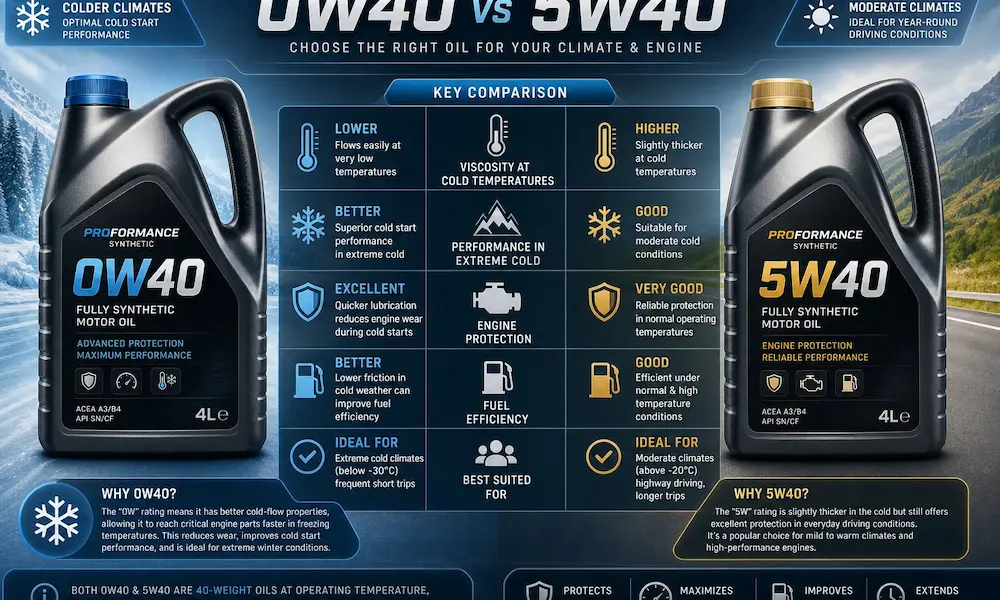
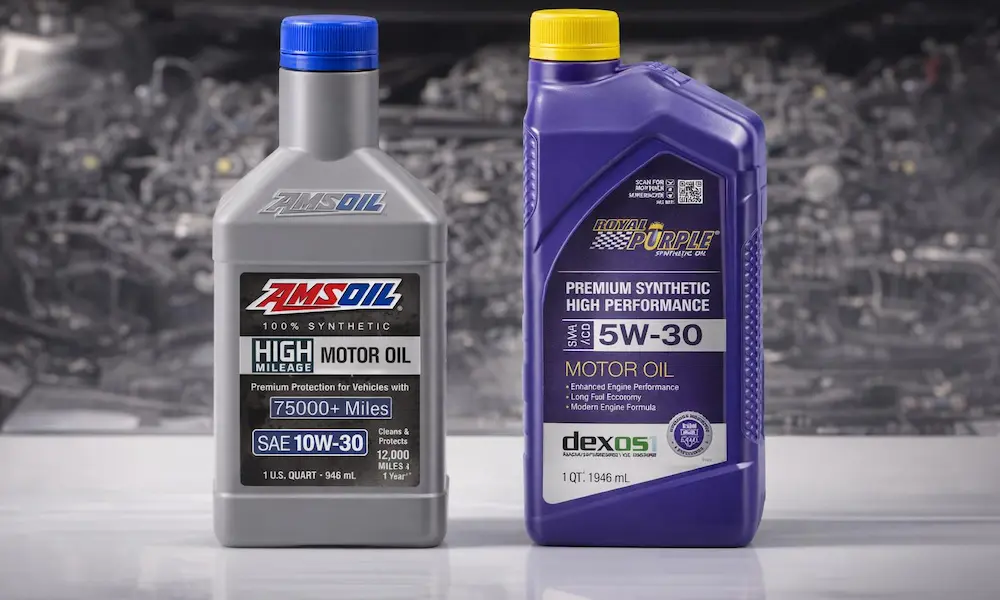
Picking the wrong motor oil can quietly destroy your engine — one cold start at a time. The difference between 5W-30 and 10W-30 sounds minor, but it matters more than most drivers realize. This guide breaks down exactly what separates these two oils, when each one wins, and how to pick the right one for your car, climate, and mileage.
What Do Those Numbers Actually Mean?
The numbers aren’t random. They follow the SAE J300 standard, which grades engine oils across a wide temperature range.
Here’s the simple breakdown:
- The first number (5 or 10) tells you how the oil flows in cold weather. The “W” stands for winter.
- The second number (30) tells you how thick the oil stays at normal engine operating temperature — about 212°F (100°C).
So both 5W-30 and 10W-30 behave identically once your engine warms up. The only real difference is cold-weather performance. That’s where things get interesting.
The Cold Start Problem: Where 5W-30 Pulls Ahead
About 75% of all engine wear happens during cold starts. When you shut the engine off, oil drains back into the pan. Metal surfaces sit dry until oil pressure builds again on the next startup.
In cold weather, thinner oil wins. Here’s why:
- At 0°F, 5W-30 has a cold-cranking viscosity of 6,600 centipoise
- At 0°F, 10W-30 measures a thicker 7,000 centipoise
That difference translates directly into how fast oil reaches your valvetrain:
- 5W-30 arrives in 4.2 seconds on average
- 10W-30 takes 6.5 seconds
That extra 2.3 seconds of oil starvation means metal-on-metal contact — every single cold start. Over time, that adds up to real damage.
At temperatures below 18°F (-8°C), the gap widens fast. According to AMSOIL cold-weather testing, 10W-30 viscosity rises roughly 1.7 times faster than 5W-30 for every 9°F (5°C) drop in temperature. At extreme cold near -22°F (-30°C), 10W-30 can get thick enough to cause pump cavitation — your oil pump starts drawing air instead of oil. That’s catastrophic.
The average engine replacement in the U.S. runs about $2,400. Using the right cold-weather oil can extend engine life by up to 27%.
Cold Performance at a Glance
| Performance Metric | 5W-30 | 10W-30 |
|---|---|---|
| Cold-Cranking Viscosity at 0°F | 6,600 centipoise | 7,000 centipoise |
| Flow Latency to Critical Engine Areas | 4.2 seconds | 6.5 seconds |
| Low-Temperature Pumping Limit | -22°F | -13°F |
| Fuel Economy Impact (Cold Climate) | +1.2% improvement | Baseline |
| Startup Wear (Wrong Viscosity Grade) | Low in freezing temps | Up to 3.2x higher wear |
Hot Engine Performance: Where 10W-30 Holds Its Ground
Once your engine hits operating temperature, both oils perform the same on paper. Both must fall within 9.3 to 12.5 centistokes of kinematic viscosity at 212°F. Under ILSAC GF-6 standards, both must maintain a minimum high-temperature, high-shear viscosity of 2.9 centipoise.
But here’s the catch: the chemistry needed to make these oils work differently at cold temperatures affects how they hold up under stress.
5W-30 uses more polymer additives — called viscosity index improvers — to cover that wider temperature range. These polymers expand at high heat to keep the oil from thinning out. The problem? Under intense mechanical pressure — like piston rings scraping cylinder walls — those polymer chains can break apart and permanently thin the oil.
10W-30 needs fewer polymers. That makes it naturally more shear-stable under heavy load. If you’re towing a trailer in 95°F Texas heat, 10W-30 maintains its design viscosity more reliably.
A useful rule of thumb from tribology: every 20°F rise in engine operating temperature requires one step up in SAE viscosity grade to maintain the same protective film. That’s why climate matters so much in this decision.
Fuel Economy, Regulations, and Why 5W-30 Dominates the Market
The shift toward lighter oils isn’t random — it’s driven by Corporate Average Fuel Economy (CAFE) standards. For every 0.1 mpg a manufacturer misses on fleet averages, they pay a $10-per-vehicle fine. With millions of vehicles produced, that adds up fast.
Thinner oils reduce internal drag and pumping losses. The EPA’s cold-start testing weights fuel economy heavily during warm-up cycles — exactly where a lower winter grade like 5W-30 shines. The result? 5W-30 now commands roughly 47% of the U.S. passenger car motor oil market, while 10W-40 has dropped to just 6%.
To support lighter oils, modern engines use tighter internal tolerances. Precisely machined crankshaft journals and main bearings need thinner fluid to establish a complete oil film. Put 10W-30 in an engine designed for 5W-30, and you can restrict flow, raise operating temperatures, and accelerate sludge formation.
That said, independent wear tests show ultra-thin oils like 0W-20 can produce higher mechanical wear under identical high-shear conditions compared to 5W-30 or 10W-30. There’s always a trade-off between fuel efficiency and outright durability.
Conventional, Synthetic, and High-Mileage: Which Formula Do You Need?
The base oil matters as much as the viscosity grade.
Conventional oil is refined from crude petroleum. It gets the job done but contains molecular inconsistencies that reduce stability. Expect change intervals of 3,000 to 5,000 miles.
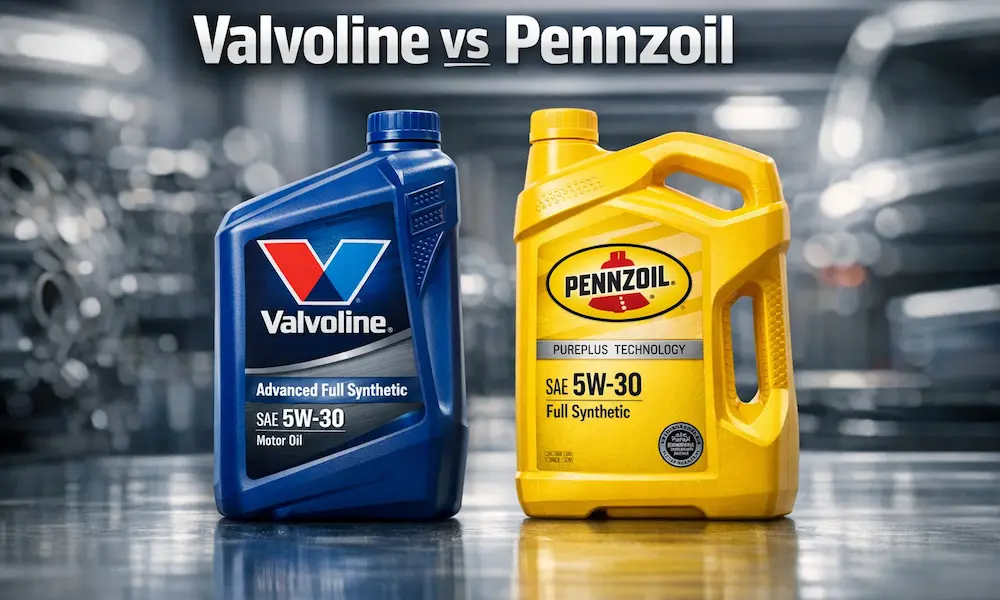
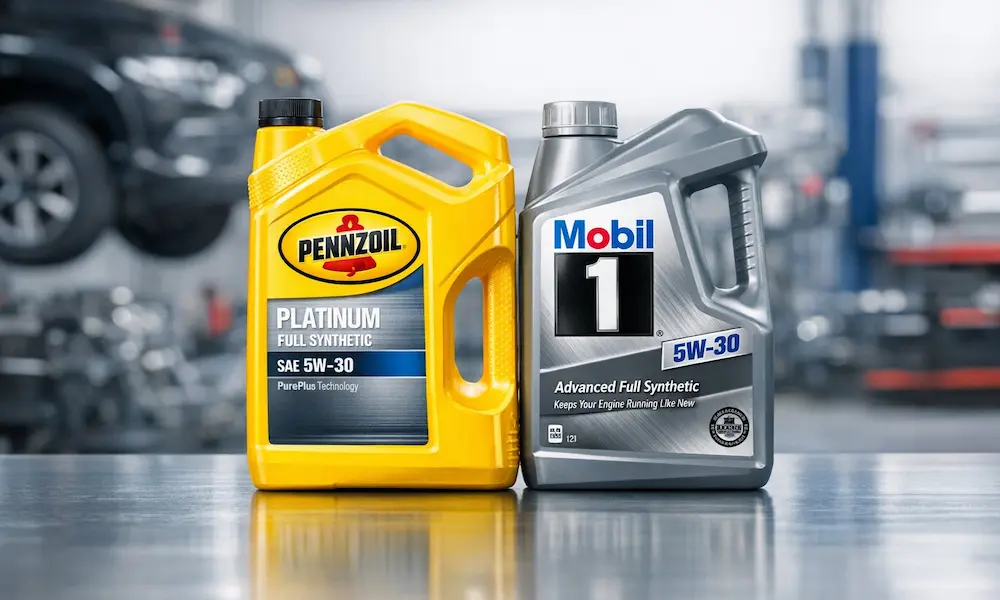
Full synthetic oil uses engineered chemical compounds for a uniform molecular structure. Better thermal stability, better oxidation resistance, better cold-flow performance. Change intervals typically run 7,500 to 10,000 miles. Not all synthetics are identical — Pennzoil uses gas-to-liquid technology from natural gas, while most competitors use polyalphaolefins or Group III hydrocracked stocks.
Synthetic blends split the difference — roughly 20-30% synthetic base stock — offering balanced performance at a lower price point.
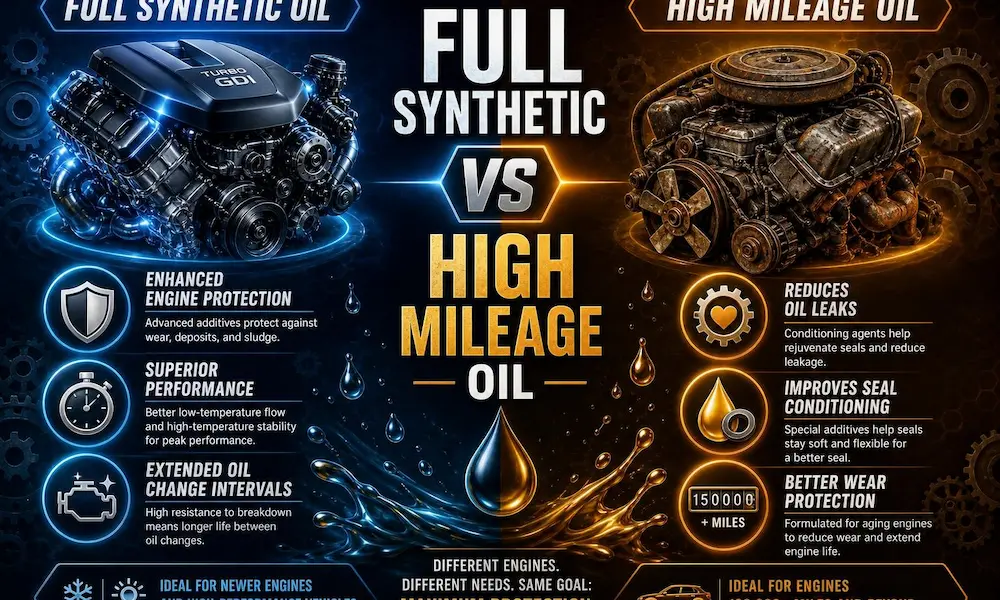
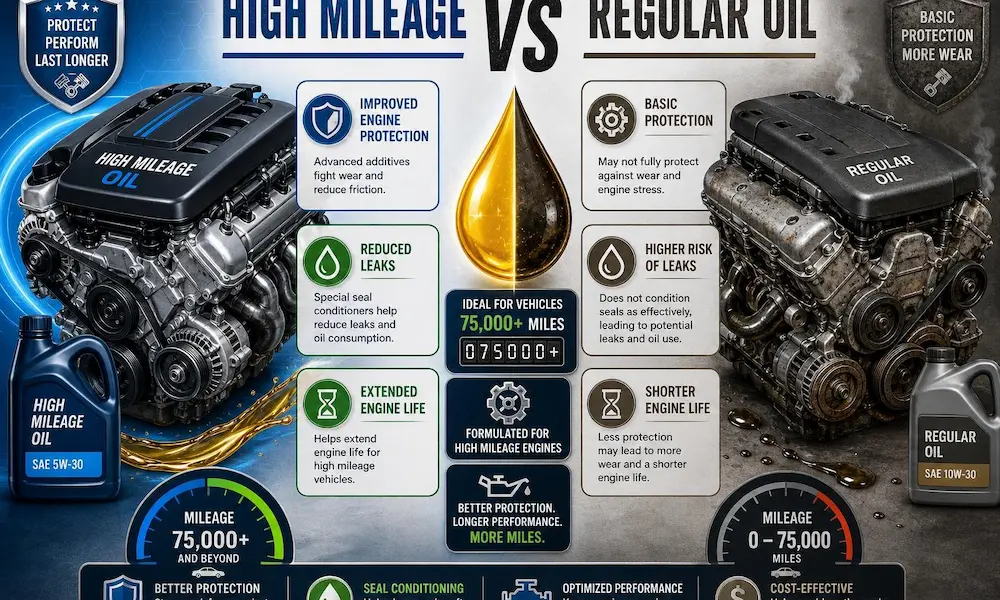
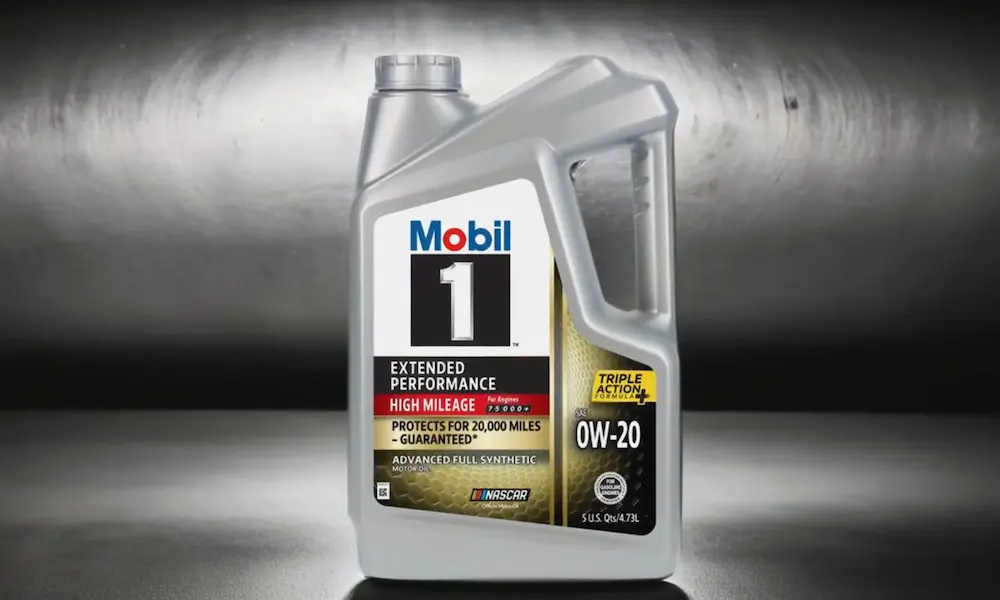
High-mileage oil kicks in once your engine crosses 75,000 miles. Rubber seals and gaskets dry out, shrink, and crack over time. High-mileage formulas add seal conditioners, detergents, and friction modifiers to address exactly that.
What’s Inside High-Mileage Motor Oil
| Additive Type | How It Works | What It Does for Your Engine |
|---|---|---|
| Seal Conditioners | Plasticizers swell dried elastomer seals | Stops oil weeping at gaskets |
| Heavy Detergents | Break down carbon deposits and lacquers | Cleans pistons, prevents ring sticking |
| Dispersant Additives | Encapsulate soot and moisture particles | Suspends debris before it clogs oil passages |
| Volatility Reducers | Heavy-molecule base oils resist evaporation | Cuts oil consumption and blue exhaust smoke |
| Anti-Wear Compounds | Form protective boundary films | Guards cam lobes and worn bearings |
One important warning: once you start using high-mileage oil with seal conditioners, your seals rely on those plasticizers to stay expanded. Switch back to standard oil, and those gaskets can shrink and crack worse than before. Stick with it once you start.
Castrol High Mileage also includes phosphorus-reduction technology. Phosphorus poisons catalytic converters over time — reducing its concentration in exhaust gases protects your emissions system from early failure.
5W-30 vs 10W-30: Real-World Pick by Vehicle Type
Here’s how this plays out for actual vehicles:
1998 Cadillac Eldorado (4.6L Northstar V8): Originally spec’d for 10W-30. A synthetic 5W-30 works safely without increasing wear. Both behave as 30-weight oils when hot, but the 5W-30 gives you faster cold-start protection.
1996 Toyota (high-mileage): The owner’s manual allows 10W-30 above 0°F (-18°C) but recommends switching to 5W-30 when temps drop below 50°F (10°C). Seasonal switching keeps both cold-start and warm-climate bases covered.
2007 Chevy Trailblazer (200,000+ miles, Texas): Transitioning from factory 5W-30 to a high-mileage 10W-30 makes sense here. The slightly thicker baseline viscosity fills expanded bearing clearances, quiets valvetrain clatter, and holds up better under Texas heat.
The Bottom Line: Match Your Oil to Your Conditions
The right answer depends on three things: where you live, how old your engine is, and how hard you push it.
- Cold climates, modern engines, turbocharged setups → 5W-30 wins. Faster cold-start oil flow protects your engine when it’s most vulnerable and delivers a small fuel economy bonus.
- Warm climates, high-mileage engines, heavy towing → 10W-30 earns its keep. Superior shear stability and slightly thicker cold viscosity fill worn clearances and handle the heat.
- Both grades should meet API SP and ILSAC GF-6A standards for full additive protection.
When in doubt, open your owner’s manual. Your manufacturer already ran the numbers — their recommendation is the safest starting point. Then factor in your climate and mileage to fine-tune from there.