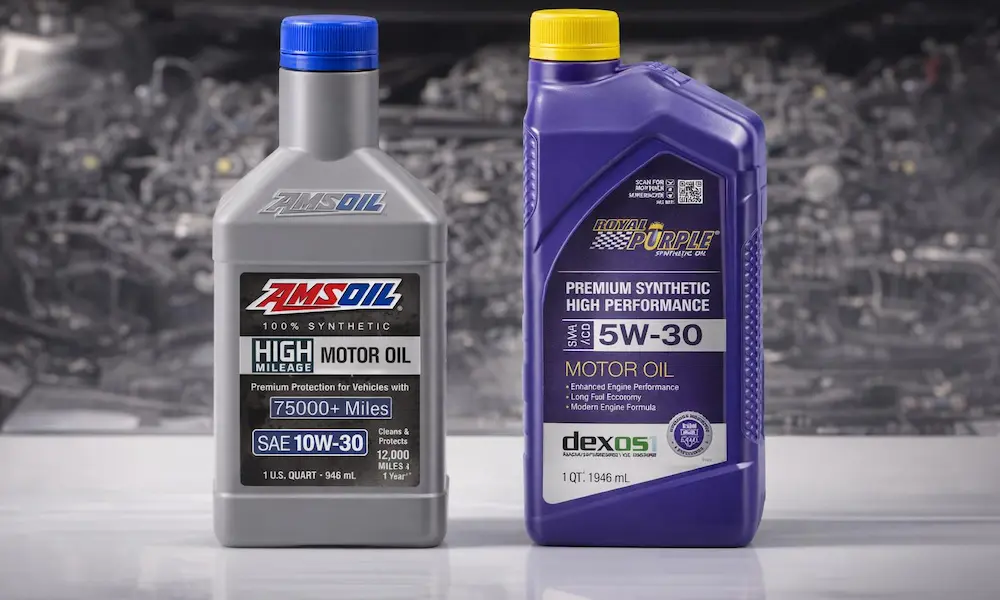
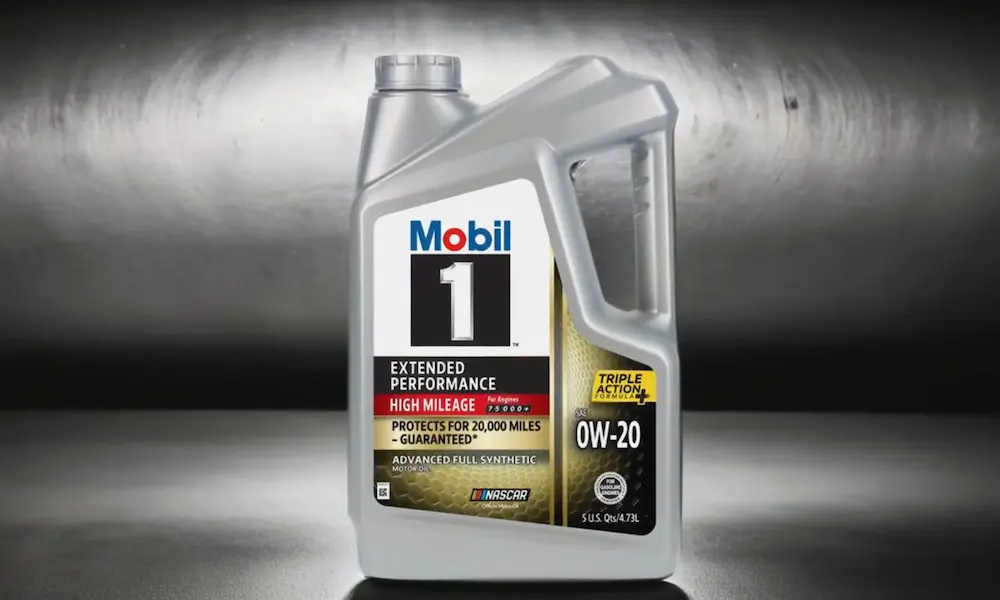
Picking the wrong engine oil can quietly cost you money — at the pump, at the shop, or both. The difference between 5W30 vs 5W40 sounds like a minor detail, but it affects fuel economy, engine wear, and how well your car handles extreme heat or cold. This guide breaks it all down so you can make the right call for your specific car, climate, and driving habits. Read to the end — the last section alone could save you from an expensive mistake.
What Do the Numbers on Engine Oil Actually Mean?
Those numbers aren’t random. They follow the SAE J300 standard, which sets the rules for how engine oils get classified based on viscosity — basically, how thick or thin the oil flows.
Here’s the breakdown:
- The “5W” part refers to winter performance. The “W” stands for Winter, not weight. Both 5W30 and 5W40 share the same cold-weather rating. They both flow smoothly down to -35°C (-31°F), so cold starts in Minnesota winters are handled equally well by either grade.
- The “30” or “40” part tells you how thick the oil gets at normal engine operating temperature — around 100°C (212°F). This is where the two grades split.
At 100°C, 5W30 flows between 9.3 and 12.5 mm²/s, while 5W40 flows between 12.5 and 16.3 mm²/s. That thicker film in 5W40 is the core difference — and it matters more than most people think.
SAE J300 Viscosity Specs at a Glance
| Property | 5W30 | 5W40 |
|---|---|---|
| Max cold cranking viscosity | 6,600 cP at -30°C | 6,600 cP at -30°C |
| Max pumping viscosity | 60,000 cP at -35°C | 60,000 cP at -35°C |
| Kinematic viscosity at 100°C | 9.3 – 12.5 mm²/s | 12.5 – 16.3 mm²/s |
| Min HTHS viscosity at 150°C | 2.9 cP | 2.9 cP (up to 3.5 with Euro specs) |
The Real Difference: How Viscosity Affects Your Engine
Once your engine warms up, those two grades behave very differently under the hood.
Fuel Economy vs. Protective Film
Thinner oil creates less internal drag, which means your engine doesn’t work as hard to circulate it. Research by Chevron Oronite confirms this directly. Switching from a 40-weight oil to a 30-weight oil improves fuel economy by up to 1%. That’s real money over thousands of miles, especially for high-mileage commuters.
On the flip side, 5W40’s thicker film provides stronger protection under heat and pressure. This becomes critical in what engineers call High-Temperature High-Shear (HTHS) conditions — the extreme stress points inside connecting rod bearings and piston rings. European performance specs like ACEA C3 push 5W40’s minimum HTHS viscosity to 3.5 cP, which gives the oil more resistance to tearing apart under high torque.
Viscosity Behavior Compared
| Parameter | 5W30 | 5W40 |
|---|---|---|
| Film thickness at operating temp | Thinner, less drag | Thicker, stronger barrier |
| Fluid friction | Minimal, better throttle response | Higher, slight efficiency loss |
| Best use case | Fuel economy, tight clearances | Heavy loads, extreme heat |
What Your Car Manufacturer Actually Wants You to Use
This is the most important section. Ignore viscosity debates entirely if your owner’s manual specifies one grade over the other. Your manufacturer engineered the engine around a specific oil viscosity, and deviating from it carries real risk.
American and Asian Vehicles: 5W30 Is Usually the Answer
Most modern domestic and Asian-market cars — think Toyota, Honda, Ford, Chevrolet — call for 5W30. These engines use tight internal clearances designed for thinner oil. General Motors’ dexos1 specification covers grades like 0W-20, 5W-20, and 5W-30. It doesn’t include 5W-40 at all.
Additionally, the latest API SP standard — introduced in May 2020 — targets modern turbocharged gasoline direct injection (TGDI) engines specifically. These engines are prone to low-speed pre-ignition (LSPI), a destructive event where oil droplets ignite before the spark plug fires. API SP-rated 5W30 oils contain additives that actively suppress LSPI. Using 5W40 in a car spec’d for 5W30 can actually increase this risk while also reducing fuel efficiency and adding unnecessary drag.
One important note for classic car owners: modern API oils restrict zinc dialkyldithiophosphate (ZDDP) to protect catalytic converters. If you’re running a flat-tappet camshaft engine, you need an oil with higher ZDDP levels — look for specific classic car formulations rather than just bumping up to a thicker grade.
European Vehicles: 5W40 Is Usually the Right Call
If you drive a BMW, Mercedes-Benz, Volkswagen, Audi, or Porsche, 5W40 is almost certainly what you need. Mobil 1 FS European Formula 5W-40 meets BMW Longlife-01, Mercedes-Benz 229.5, VW 502.00, and Porsche A40 specs. Valvoline European Vehicle 5W-40 hits the same approvals.
These manufacturer approvals exist because European engines run hotter, often use longer drain intervals, and are designed around the higher shear stability of 40-weight oil. GM even took this route with the Corvette, approving Mobil 1 ESP Formula 0W-40 as the first dexos2-certified oil for track-driven performance applications.
The NHTSA dexos documentation confirms that dexos2 covers both gasoline and light-duty diesel European vehicles and includes 5W-40 among its approved grades.
Climate and Driving Conditions: Does Your Location Change the Equation?
Geography genuinely matters here. The U.S. spans drastically different temperature extremes, and your climate should factor into your oil decision.
| Driving Scenario | 5W30 Suitability | 5W40 Suitability |
|---|---|---|
| Sub-zero winters (northern states) | Excellent — flows at -35°C | Excellent — identical cold-start behavior |
| Moderate four-season climates | Ideal — balances efficiency and protection | Acceptable but adds unnecessary drag |
| Southwest heat (40°C+ ambient) | Marginal — risk of film thinning under stress | Superior — maintains film integrity up to 50°C |
| Heavy towing or trailer hauling | Less suitable — film can break down | Ideal — high shear stability protects bearings |
If you live in Phoenix and regularly tow a trailer, 5W40 gives your engine a meaningful buffer against the localized film breakdown that heat and load create together. If you’re commuting in Seattle, 5W30 keeps your fuel costs down without sacrificing protection.
High-Mileage Engines: Thicker Isn’t Always Smarter
Once an engine crosses 75,000 to 100,000 miles, things get more nuanced. Worn cylinder walls, wider bearing clearances, and aging seals all change what your engine actually needs.
Some owners switch to 5W40 to boost oil pressure and slow consumption. It can temporarily mask excessive clearances, but it’s a short-term fix that adds cold-start strain and can restrict flow through narrow passages. Your oil pump wasn’t built for that extra workload.
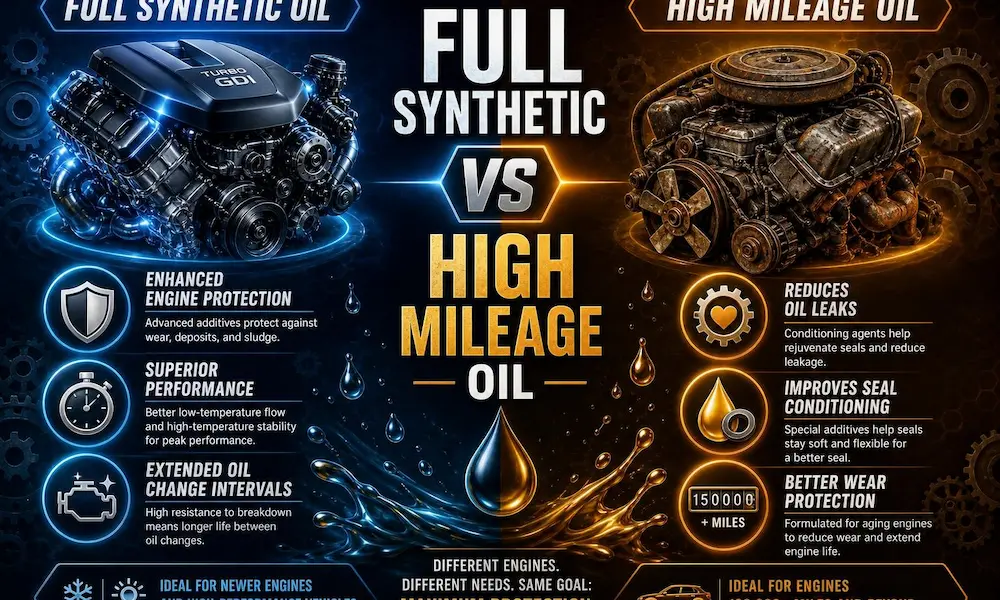
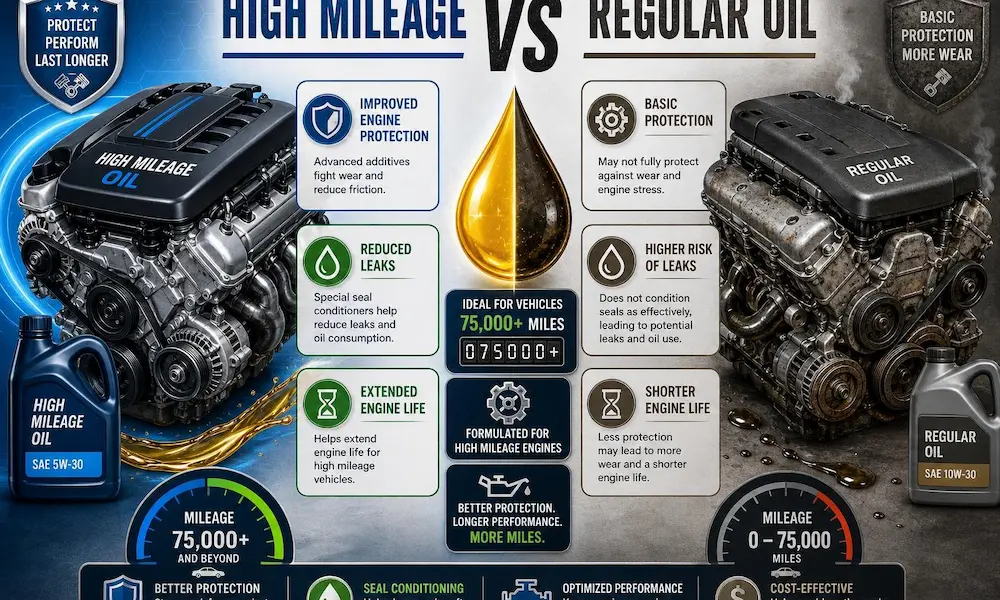
A smarter move? Stay with 5W30 and switch to a high-mileage formulation with seal conditioners. Over time, elastomeric seals shrink and harden from persistent heat exposure. Seal swell agents chemically restore their flexibility — stopping leaks from the inside out rather than just masking them with thicker oil.
High-mileage synthetics also often use ester base stocks. These polar base oils cling to metal surfaces even when the engine sits overnight, which means metal-on-metal contact during cold startup is dramatically reduced.
| High-Mileage Problem | Switching to 5W40 | Using High-Mileage 5W30 |
|---|---|---|
| External gasket seepage | Ineffective — thick oil still seeps through degraded seals | Highly effective — seal swell agents restore flexibility |
| Internal bearing wear | Temporarily cushions worn clearances | Targeted anti-wear additives address the root cause |
| Oil burning / consumption | Minimal impact, increases pump load | Low-volatility synthetics reduce burn-off |
| Fuel economy loss | Makes it worse due to higher drag | Restores efficiency while protecting aging components |
The Bottom Line: Which Grade Do You Actually Need?
Stop guessing. Use your owner’s manual as the starting point, then factor in your climate and driving demands.
| Your Vehicle | Recommended Grade | Why |
|---|---|---|
| Modern American or Asian car | 5W30 | Tight tolerances, LSPI protection, API SP / dexos1 compliance |
| European import (gas or diesel) | 5W40 | Meets BMW, Mercedes, VW, Porsche manufacturer approvals |
| High-mileage commuter (75K+ miles) | 5W30 High-Mileage | Seal conditioning + efficiency without extra pump strain |
| Heavy tow vehicle or severe-duty fleet | 5W40 | Superior film strength under sustained high heat and load |
Not sure what your car needs? Use a VIN-based oil lookup tool to pull the exact spec for your make, model, and year. It takes 30 seconds and removes any guesswork from the equation entirely.
The 5W30 vs 5W40 debate doesn’t have a universal winner. The right answer lives in your glove box — and now you know exactly how to read it.