Got a 7.3 Powerstroke and not sure how much oil it actually takes? You’re about to find out — and why getting this wrong can kill your injectors. This engine isn’t like other diesels. Its oil does double duty, and the capacity spec isn’t negotiable. Stick around and we’ll cover everything from the exact quart count to the filters, viscosity grades, and what happens if you overfill it.
How Much Oil Does a 7.3 Powerstroke Take?
The 7.3 Powerstroke oil capacity is 15 quarts (14.2 liters) when you replace the oil filter at the same time — which you always should.
That’s a lot of oil. But there’s a reason for it. This engine runs a Hydraulically Actuated Electronically Controlled Unit Injector (HEUI) system, which uses pressurized engine oil to fire fuel into the cylinders. More on that in a second.
Here’s a quick reference table so you’ve always got the numbers handy:
| Condition | US Quarts | Liters |
|---|---|---|
| Full refill with new filter | 15.0 | 14.2 |
| Refill without filter change | 13.0 | 12.3 |
| Absolute maximum safe fill | 16.0 | 15.1 |
| Pre-1994 7.3L IDI (for comparison) | 10.0 | 9.5 |
That 2-quart difference between changing and not changing the filter matters. The Motorcraft FL-1995-A — the OEM filter for every 1994–2003 7.3 Powerstroke — holds nearly two quarts of oil when fully saturated. Skip the filter swap and you’ll come up short every time.
Why the 7.3 Powerstroke Needs 15 Quarts
Your 7.3 doesn’t just lubricate its parts with oil. It uses oil as a hydraulic fluid to drive injection pressure.
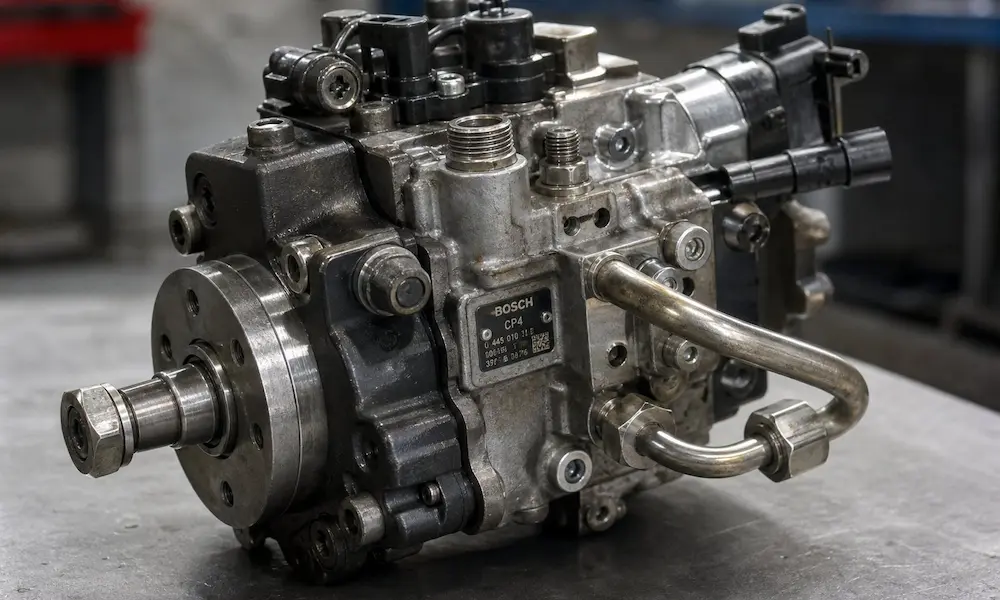
Here’s how it works: The Low-Pressure Oil Pump (LPOP) pulls oil from the pan and sends it through the cooler and filter. A portion of that oil gets diverted to the HPOP reservoir — a small buffer tank sitting in the engine valley. The High-Pressure Oil Pump (HPOP) then pressurizes that oil to thousands of PSI, which drives the injectors.
That’s why capacity matters so much. When you fire up the engine after an oil change, the system has to fill:
- The empty oil filter
- The HPOP reservoir
- All the oil galleries running to the turbo and cylinder heads
If you only put in 13 quarts thinking the filter holds nothing, the engine will run low during that startup phase. You’ll get rough running, low injection pressure, and unnecessary wear.
What Happens If You Overfill or Underfill?
Both situations are bad, but in different ways.
Overfilling past 16 quarts causes the crankshaft counterweights to whip air into the oil. That aeration makes oil compressible, which destroys the hydraulic efficiency your HEUI injectors depend on. Foamy oil can’t build injection pressure reliably. You’ll get inconsistent timing, poor fuel atomization, and rough power delivery.
Underfilling risks oil starvation during hard cornering or steep grades. If the HPOP pickup tube comes out of the oil, it ingests air immediately. The result? Instant power loss or a stall — and potential long-term damage to the pump and injectors.
Stick between 15 and 16 quarts. That window exists for a reason.
The Right Oil Filter for the 7.3 Powerstroke
The correct filter is the Motorcraft FL-1995-A. Full stop.
It’s one of the largest consumer diesel filters on the market, and it’s built specifically for the flow demands of a big-displacement diesel. Here’s what makes it different:
| Specification | Motorcraft FL-1995-A |
|---|---|
| Media type | Synthetic blend |
| Drainback valve | Heavy-duty silicone |
| Micron rating | Optimized for diesel soot and wear metals |
| Vehicle fitment | F-Series, E-Series, Excursion (7.3L only) |
A lot of people try to use cheaper aftermarket filters that fit the thread. Don’t do it. Filters without a proper anti-drainback valve let oil drain out of the upper galleries when the engine sits. Every cold start becomes a “dry start” — which accelerates wear on the main bearings and turbocharger before the oil pressure even builds.
You can find the Motorcraft FL-1995-A at most diesel parts suppliers, and it’s worth every cent.
What Oil Viscosity Does the 7.3 Powerstroke Need?
The factory spec is SAE 15W-40 for most climates. But as these trucks age and synthetic oils improve, viscosity recommendations have evolved.
| Ambient Temp | Recommended Viscosity | Why It Matters |
|---|---|---|
| Above 0°C (32°F) | 15W-40 | Best film strength for towing and high loads |
| -10°C to 0°C | 10W-30 | Balanced flow for moderate conditions |
| Below 0°C (32°F) | 5W-40 | Faster pressure buildup, less cold-start wear |
| Below -20°C (-4°F) | 0W-30 synthetic | Extreme cold starts only |
The “W” rating is critical for HEUI engines. When it’s cold, thick oil moves slowly through the tiny tolerances of the injector spool valves. That leads to a problem called stiction — where the valves stick or respond slowly, causing rough cold starts and white smoke. Using a 5W-40 synthetic in cold climates helps the HPOP build injection pressure faster during startup and reduces strain on your starter and batteries.
API Oil Ratings: CK-4 vs CJ-4
The 7.3 Powerstroke was originally specced for API CI-4 or CJ-4 oils. When API CK-4 launched in 2016, some owners got nervous about compatibility.
Here’s the short version: quality CK-4 oils are fine for your 7.3. Early concerns were about shear stability in older HEUI systems, but reputable brands like Motorcraft, Shell Rotella, and Hot Shot’s Secret have formulated their CK-4 products with the anti-foaming and shear-stability properties this engine demands.
To be safe, look for oils that meet Ford WSS-M2C171-F1 specification. That’s the clearest indicator of compatibility with the HEUI system.
Stiction: When Oil Quality Degrades Injector Performance
Stiction is what happens when burnt oil leaves behind varnish and carbon deposits inside the HEUI injectors. Those deposits act like glue on the injector spool valves, slowing their response to the solenoid’s command.
You’ll notice it most on cold starts. The symptoms include:
- Rough idle for the first 5–10 minutes
- White smoke on startup that clears as the engine warms up
- Misfires and sluggish power until operating temperature
- Fault codes like P1211 or cylinder contribution codes
Stiction builds up gradually as the oil’s additive package depletes and the base oil oxidizes under the extreme heat and pressure inside the injector. The good news? It’s often reversible.
Additives like Hot Shot’s Secret Stiction Eliminator or Archoil AR9100 can dissolve those deposits and restore smooth injector operation. Ford officially doesn’t endorse additives, but the 7.3 community has decades of real-world experience confirming these products extend injector life significantly — and injectors aren’t cheap to replace.
Oil Change Intervals for the 7.3 Powerstroke
The 15-quart capacity gives you a buffer, but it doesn’t mean you can slack on maintenance. The HEUI system chews through oil’s additive package faster than a standard diesel.
| Duty Cycle | Conditions | Recommended Interval |
|---|---|---|
| Normal | Highway driving, light use, moderate temps | 5,000 miles / 6 months |
| Severe | Frequent towing, city driving, excessive idling | 3,000 miles / 3 months |
| Extreme | Off-road, construction, sub-zero winters | 2,500 miles / 2 months |
If you run full synthetic, you can sometimes stretch to 7,500 miles — but validate that with Used Oil Analysis (UOA). UOA is especially valuable here because it can detect fuel dilution from leaking injector O-rings or excess soot buildup, both of which accelerate wear on the HPOP and injectors before you notice anything driving.
Oil Pan and Dipstick Adapter: Common Leak Points
The 7.3 Powerstroke oil pan is stamped steel, and in rust-belt states, it corrodes. Here’s the kicker: you can’t drop the oil pan without pulling the engine. The front crossmember blocks it completely. That means a rusted-through pan turns into a multi-thousand-dollar repair bill fast.
Owners in corrosive climates should inspect the pan regularly and consider upgrading to an aftermarket option like a Moroso oil pan with zinc phosphate and epoxy coatings.
The other common leak point? The dipstick adapter. The O-ring on this adapter shrinks with age and starts seeping. Don’t try to overtighten the nut from outside — doing so drops the internal flange into the oil pan, which means engine removal. Aftermarket billet dipstick adapter repair kits let you fix this seal from the outside without that risk.
Other Fluid Capacities to Know
When you’re doing a full service on your 7.3, here are the other specs you’ll need:
| System | Capacity | Spec |
|---|---|---|
| Engine oil (with filter) | 15.0 qts | See viscosity guide above |
| Engine coolant | 32.75 qts | Ford Premium green + SCA |
| Automatic trans (4R100) | 17.7 qts | MERCON / MERCON V |
| Manual trans (ZF-6) | 5.8 qts | Synthetic ATF (MERCON) |
| Transfer case | 2.0 qts | MERCON ATF |
| Rear axle (10.5″) | 6.9 pts | 75W-140 synthetic |
| Rear axle (Dana 80) | 8.3 pts | 75W-90 synthetic |
One thing people overlook: the coolant system on the 7.3 requires Supplemental Coolant Additives (SCAs). Without them, you get cavitation — air bubbles collapsing against the cylinder liners hard enough to pit the metal. That eventually causes coolant-to-oil leaks, which is a nightmare diagnosis nobody wants.
Quick Recap: Get the 7.3 Powerstroke Oil Capacity Right Every Time
The 7.3 Powerstroke oil capacity of 15 quarts isn’t just a number — it’s a system requirement built around one of the most unique injection architectures in diesel history. Here’s what to remember:
- Always use 15 quarts when replacing the filter — 13 if you’re not
- Never exceed 16 quarts — aeration will hurt your injectors
- Use the Motorcraft FL-1995-A — no substitutes
- Match viscosity to climate — 15W-40 for warm, 5W-40 synthetic for cold
- Change oil on schedule — the HEUI system is hard on oil chemistry
- Watch for stiction symptoms — treat early before injectors fail
Respect the capacity, use quality oil, and this engine will outlast everything else on the road.