You’re staring at garage door quotes, and the insulated option costs $800 more. That’s real money. You need to know if you’ll actually see that investment pay off—or if it’s just clever marketing. This breakdown gives you the hard numbers, performance data, and situations where it’s absolutely worth it (and where it’s not).
The Short Answer: It Depends on Your Garage Setup
Here’s the thing: are insulated garage doors worth it isn’t a yes-or-no question. It’s a “what’s your garage situation?” question.
If your garage is attached to your home, shares a wall with a bedroom, or has living space above it, an insulated door isn’t optional—it’s essential. You’ll see measurable energy savings, quieter operation, and a stronger door that resists dents.
But if you’ve got a detached, unheated garage you only use for storage? You’re throwing money away. The door won’t pay for itself because there’s no energy to save.
The real kicker: a new garage door replacement delivered a 194% return on investment in 2024, making it the single most profitable home improvement project you can do. That ROI alone changes the entire calculation.
What Makes a Garage Door “Insulated”
It’s All About Layers
A basic garage door is just one sheet of steel. It blocks rain and wind, but that’s it. It won’t stop heat or cold.
An insulated door is a composite product. It’s built with an energy-saving core sandwiched between panel layers. This core creates a buffer zone that slows heat transfer between inside and outside.
Think of it like a Thermos for your garage. The insulation doesn’t just make the space warmer in winter or cooler in summer—it makes the temperature more stable, which means your home’s HVAC system doesn’t have to work as hard.
The Three Construction Types
Insulated doors come in three tiers:
Single-Layer (Non-Insulated): One layer of steel. No insulation. It’s cheap, loud, and dents easily.
Two-Layer: A steel panel with insulation adhered to the back, often covered by a vinyl backing. This is your entry-level insulated door. It offers moderate thermal resistance and some noise reduction.
Three-Layer: The premium option. A thick insulation core is sandwiched between two steel skins (one facing out, one facing in). This construction delivers the highest R-value, energy efficiency, and durability.
Here’s what most people miss: the three-layer design isn’t just better insulation. It’s a fundamentally stronger product. The composite structure makes the entire door thicker, sturdier, and less likely to dent. It also decreases vibration and sound when the door moves.
Steel-Back vs. Vinyl-Back: The Material Choice That Matters
Within the two-layer and three-layer categories, you’ve got a critical choice: what’s facing the inside of your garage?
Vinyl-Back Doors: This is the most affordable option. The insulation is covered by a vinyl layer that looks like thick wallpaper. It’s lightweight and inexpensive, but it’s also less durable and can become brittle over time.
Steel-Back Doors: This is the three-layer sandwich construction. An additional steel layer fully encloses the insulation. This steel backing provides excellent durability and can withstand serious temperature swings without degrading.
When you pair steel-back construction with injected polyurethane foam (more on that next), you get the most durable and energy-efficient garage door on the market.
Polyurethane vs. Polystyrene: The Insulation Showdown
Once you’ve decided on a multi-layer door, the next choice is what’s inside it. This decision affects your door’s thermal performance, strength, and how quiet it runs. The two options are polystyrene and polyurethane.
Polystyrene: The Budget-Friendly Baseline
Polystyrene is rigid foam—basically Styrofoam. It’s manufactured in pre-cut foam boards or sheets that get adhered to the back of the steel panel (in two-layer doors) or fit between the panels (in three-layer doors).
It offers reliable insulation with R-values typically ranging from R-4 to R-9, though some thicker applications reach R-12.9. It’s cost-effective.
But here’s the catch: because it’s a rigid, pre-formed board, installation can result in potential air gaps that compromise energy efficiency. The material is also more prone to cracks and edge chipping. Most importantly, it doesn’t add much strength to the door itself.
Polyurethane: The High-Performance Champion
Polyurethane is a thermoset polymer applied as a liquid foam. This application method is what makes it superior.
During manufacturing, liquid foam is injected or sprayed into the cavity between the two steel skins. The foam expands to fill all the spaces inside the door, then hardens and bonds to all surfaces.
This creates a single, solid composite unit. The foam and steel fuse together.
R-values typically range from R-12 to R-18, with some premium models reaching R-20.4.
Head-to-Head Performance Comparison
Thermal Performance: Polystyrene’s rigid boards leave gaps. Polyurethane expands to fill 100% of the cavity, creating a seamless barrier with no thermal shortcuts.
Structural Durability: Polystyrene is just placed inside the door. Polyurethane bonds to the steel skins, creating a composite structure that makes the entire door stronger, more solid, and more rigid. This bonded construction provides excellent durability and makes the door significantly more dent-resistant.
Noise Dampening: The dense, seamless, bonded nature of polyurethane is outstanding at reducing vibrations and sound. It’s widely cited as the best choice if you want a garage door that operates more quietly. Polystyrene offers only basic reduction—the effect is limited.
Moisture Resistance: Polyurethane’s closed-cell structure acts as an effective moisture barrier that helps prevent condensation buildup, water absorption, mold, and corrosion.
| Feature | Polystyrene | Polyurethane |
|---|---|---|
| How It’s Installed | Pre-cut foam boards adhered or placed between panels | Liquid foam injected and expands to fill cavity |
| R-Value | R-4 to R-12.9 (prone to air gaps) | R-12 to R-20.4 (seamless barrier) |
| Strength | Doesn’t add much structural support | Bonds to steel to create rigid composite |
| Noise Reduction | Basic/Limited | Excellent/Outstanding |
| Moisture Control | Good | Excellent (closed-cell barrier) |
Bottom line: a polyurethane-insulated door isn’t just better insulated. It’s a fundamentally stronger, quieter, more durable product.
R-Value vs. U-Factor: The Metric That Actually Matters
When you’re shopping for garage doors, you’ll see two competing numbers: R-Value and U-Factor. Understanding the difference is critical because one of them is often misleading.
What R-Value Really Tells You (and What It Hides)
R-Value measures thermal resistance—a material’s ability to impede the flow of heat. Higher numbers mean better insulation.
But here’s the problem: the R-Value for a garage door is a calculated metric, not a tested one. It only considers the insulating effect through the center of a door section. It measures the foam itself, not the entire door system.
This hides the biggest sources of energy loss. Heat and cold bypass high R-value foam through uninsulated joints between door sections, air leakage around the perimeter, and thermal bridging through the frame. R-value calculations ignore these “thermal shortcuts.”
It’s also difficult to accurately measure the R-value of panels that aren’t completely flat, like those with grooves or decorative patterns.
Why U-Factor Is the Superior Standard
U-Factor (or U-value) measures thermal transmittance—the rate at which heat is transferred through a material. Lower numbers mean better insulation and less heat transfer.
The superiority of U-Factor lies in how it’s measured. It’s not a simple calculation of one component. U-Factor evaluates the performance of the entire installed assembly, including section joints.
This testing is conducted in a lab according to the nationally recognized ANSI/DASMA 105 standard. It accounts for the entire system—thermal breaks, weather seals, air infiltration—providing a real-world performance rating for the whole door.
This is why U-Factor is the standard used in all major U.S. building codes, including the IECC, IBC, and IRC. Look for doors with U-Factor certification from the Door & Access Systems Manufacturers Association (DASMA) Thermal Performance Verification Program.
In short: R-value is what a manufacturer claims about their foam. U-Factor is what a third-party verifies about the entire installed door.
| Attribute | R-Value | U-Factor |
|---|---|---|
| What It Measures | Thermal resistance (ability to stop heat flow) | Thermal transmittance (rate of heat flow) |
| What’s Better? | Higher is better | Lower is better |
| How It’s Measured | Calculated based on insulation type and thickness | Tested (ANSI/DASMA 105) on entire door assembly |
| What’s Included | Only the center of an individual door section | Entire door system (joints, seals, thermal shortcuts) |
| Reliability | Can be misleading; ignores air leakage and thermal bridging | More accurate; used in all major building codes |
What “Good” Numbers Look Like
While U-Factor is superior, R-value is still widely marketed. Here are general benchmarks:
- R-8 to R-13: Suitable for moderate climates
- R-14 to R-18: Recommended for regions with more extreme weather conditions
- R-16 and above: Strongly recommended for garages that are actively heated or cooled for use as a workshop or home gym
These recommendations apply to both cold and hot climates. In cold climates, insulation prevents heat loss. In hot climates, the same thermal barrier is equally essential for keeping out the heat.
One important note: the U.S. government’s ENERGY STAR program does not have a specification for garage doors. The reasoning is twofold: garages are typically unconditioned space, and properly insulating a garage door without also air-sealing the wall between the garage and house can inadvertently pull toxic fumes from cars, paints, and chemicals into the home’s living space.
The priority should always be insulating the wall between the house and garage first.
The Financial Breakdown: Cost, Payback, and ROI
Let’s talk money. The “worth” of an insulated garage door comes down to three numbers: what you pay upfront, how long it takes to recoup through energy savings, and what you gain in home value.
What You’ll Pay Upfront
An insulated door costs more than a non-insulated model. The premium depends on size, construction type, and insulation material.
Baseline (Non-Insulated): A standard single-layer door typically costs between $755 and $1,696.
Insulated (General): An insulated door costs around $1,500 on average, with a typical range between $500 and $2,500 or more.
For a Two-Car Garage: Cost estimates for a standard double insulated garage door converge on a range of $1,500 to $3,700+. Other analyses suggest similar ranges of $2,186 to $3,348 or a wider band of $800 to $5,000 depending on materials.
The Insulation Premium: The upgrade cost for insulation can be as low as a few hundred dollars or as high as $1,000 for a high-performance model.
The specific insulation type drives this cost. Polyurethane is more expensive—homeowner quotes show a $300 premium for polyurethane over polystyrene for the same door. Market analysis suggests polyurethane’s specialized manufacturing process makes it 30% to 40% more expensive than basic insulation options.
The Energy Savings Payback Period
The payback period is how long it takes for cumulative energy savings to offset the initial cost premium. This metric is highly variable and depends on your home’s construction, climate, and energy costs.
Homeowners and industry sources report that an insulated door in an attached garage can reduce heating and cooling expenses by 10% to 20%. In a typical home, this can translate to tangible savings of $200 to $400 per summer season alone.
Based on these savings, estimated payback periods vary:
Optimistic Scenarios: Some analyses show a rapid payback of 3 to 5 years or 3 to 7 years.
Pessimistic Scenarios: Other models, likely factoring in milder climates or less shared wall area, project a longer payback of 8 to 15 years.
The critical takeaway: this payback is only relevant for attached garages. For detached, unconditioned garages, the payback period can be so long that it may not justify the investment.
The Resale Value Game-Changer
Here’s where the financial case gets compelling. Forget the 15-year energy payback—the return on investment at resale happens immediately.
The 2024 Remodeling magazine Cost vs. Value report identified garage door replacement as the #1 home improvement project for ROI, outperforming kitchen remodels, siding replacements, and deck additions.
The data is definitive:
- National Ranking: #1
- Return on Investment: An astounding 194% return nationwide
- Cost vs. Value Breakdown: An average job cost of $4,513 adds an average resale value of $8,751
This exceptional ROI is primarily driven by the substantial impact a new door has on curb appeal. Real estate agents affirm that a new garage door can increase a home’s list price by 1% to 4%.
The enhanced energy efficiency of an insulated model serves as an additional attractive selling point for discerning buyers.
The investment is recouped (and nearly doubled) not over a decade of utility bills, but almost immediately in your home’s market value.
| Financial Metric | Non-Insulated | Insulated (Polystyrene) | Insulated (Polyurethane) |
|---|---|---|---|
| Upfront Cost (2-Car Avg) | $1,500 | $2,000 | $2,300 – $2,700+ |
| Insulation Premium | (Baseline) | +$500 | +$800 – $1,200 |
| Annual Energy Savings | $0 | 10-20% | 15-20%+ (superior seal) |
| Energy Payback Period | N/A | 3-15 years (highly situational) | 3-10 years (shorter due to higher efficiency) |
| Resale ROI (2024) | N/A | 194% | 194% |
When It’s Worth It (and When It’s Not)
The financial data says “yes.” But that value only shows up in specific situations. Here’s who should buy an insulated door and why.
Scenario 1: Attached Garage (The Non-Negotiable)
Verdict: Essential Purchase
Your garage door is the largest opening in your home. When the garage is attached, it shares at least one wall with your interior living space.
An uninsulated door becomes a massive thermal liability. It allows outside temperatures to infiltrate the garage and then leech warmth or radiate heat into adjacent rooms. This forces your air conditioners and furnaces to work overtime, directly increasing utility bills.
An insulated door creates a necessary thermal buffer.
Secondary Benefit: If a bedroom or quiet living area shares a wall with the garage, the noise-dampening properties of an insulated door become a significant quality-of-life improvement.
Scenario 2: Living Space Above (Maximum Performance Required)
Verdict: Essential Purchase (Polyurethane Recommended)
This is the most critical scenario for both energy efficiency and comfort. A bonus room above a garage is notoriously difficult to heat and cool.
The unconditioned garage acts as a furnace in the summer and an icy space in the winter, with extreme temperatures passing directly through the floor of the room above.
An insulated garage door is a critical component in stabilizing the garage temperature, which in turn stabilizes the room above.
Important: An insulated garage door alone won’t solve this problem. It’ll have minimal impact if the garage walls and, most critically, the garage ceiling (the floor of the bonus room) aren’t also insulated.
The correct solution is systemic: insulate the garage ceiling and install a high-performance (R-16+ or low U-Factor) polyurethane insulated garage door to create a fully conditioned buffer zone.
Scenario 3: Detached Garage (When to Skip It)
Verdict: Not Worth It (for storage only)
If your garage is a separate, detached structure that’s not heated or cooled and is used only for parking or storage, an insulated door is generally an unnecessary expense.
In this scenario, there’s no energy to save, so the long-term payback from energy savings is nonexistent. The higher initial cost and limited benefits make a basic, non-insulated door the best option for savings.
Scenario 4: Workshop or Home Gym (Comfort Is the Priority)
Verdict: Worth It
This scenario fundamentally changes the detached garage equation. As soon as you intend to use the space as a workshop, home gym, hobby space, or music room, comfort becomes a priority.
If the space will be heated or cooled, even occasionally, it becomes conditioned space. An insulated door is equally valuable here to make the space livable and reduce the cost of heating or cooling it.
For an actively heated garage, a door with a minimum R-value of R-12 is recommended. For a dedicated, frequently used workshop, an R-16 or higher door is the proper choice.
Scenario 5: Hot vs. Cold Climates (Both Need Insulation)
Cold Climates: This is the most intuitive use case. The primary goal is to prevent heat loss. A homeowner in Northern Alberta, where temperatures drop to -23°F, noted their garage heater ran constantly with old wooden doors. An insulated door can keep an unheated garage 10 to 12 degrees Fahrenheit warmer in winter.
Hot Climates (Florida, Texas, Arizona): This is the non-obvious but equally critical use case. Insulation works both ways. In hot climates, the insulated barrier is essential to keep the heat out.
Uninsulated garages in states like Florida and Texas are described as ovens that can reach temperatures well over 100°F. This intense heat then radiates through shared walls into the attached home.
An insulated door is a must to keep your garage cool, protect stored items (like chemicals, batteries, and tires) from heat damage, and, most importantly, reduce the load on your HVAC system. An insulated door can keep a garage up to 25 degrees Fahrenheit cooler in the summer.
| Your Situation | Verdict | Why |
|---|---|---|
| Attached Garage (Storage Only) | Essential | Energy savings; reduces HVAC load on entire home |
| Attached Garage (Bedroom/Living Space Adjoins) | Essential | Energy savings + critical noise reduction |
| Attached Garage (Bonus Room Above) | Essential (High-Performance) | Fixes cold/hot room syndrome; must pair with ceiling insulation |
| Detached Garage (Storage Only) | Not Worth It | No energy to save; payback period is nonexistent |
| Detached Garage (Heated/Cooled Workshop or Gym) | Worth It | Prioritizes comfort; makes space usable and less expensive to heat/cool |
| Very Cold Climate | Essential (if attached) | Prevents heat loss; reduces heating bills; protects vehicles |
| Very Hot Climate | Essential (if attached) | Prevents heat gain; reduces A/C bills; protects stored items |
DIY Insulation Kits vs. New Factory-Insulated Doors
If you’ve got an existing, functional, non-insulated door, you’re probably wondering: should I buy a new insulated door or just retrofit the one I have with a DIY kit?
What DIY Kits Actually Deliver
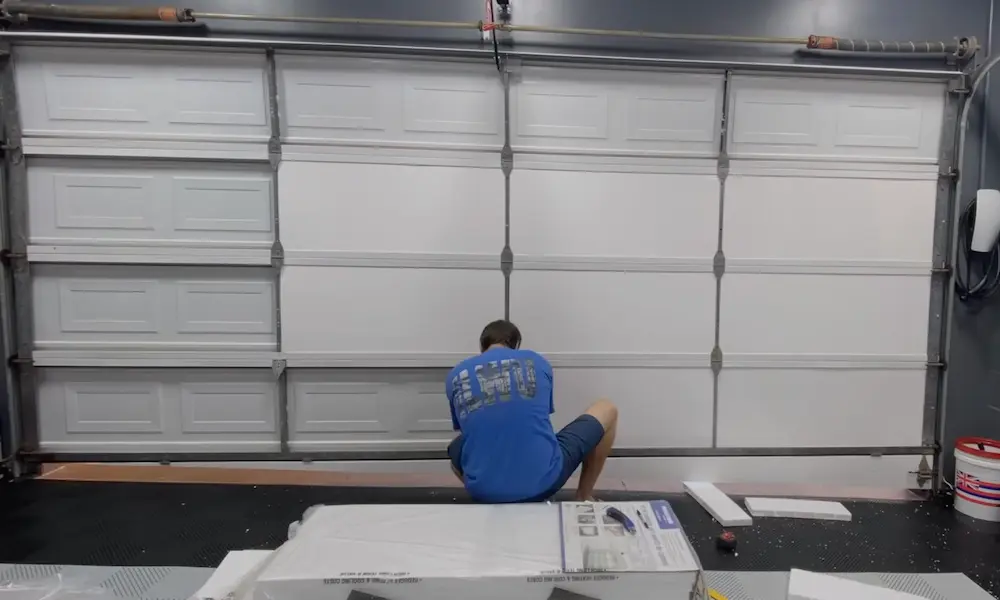
DIY insulation kits are an appealing low-cost alternative. A kit for a standard door costs around $150, whereas the premium for a new factory-insulated door can be $400 to $1,000.
These kits typically come in three forms:
Rigid Foam (Polystyrene): The most common and effective type. These kits provide pre-cut or customizable rigid foam panels that get inserted into the door’s framework.
Fiberglass Batts: These offer high R-values but have significant downsides. The fiberglass sags over time, collects moisture and gets moldy, and can become hospitable to pests.
Reflective Foil: This type (bubble wrap with a foil layer) is technically not insulation. Its R-value claims are often just marketing, as it primarily reflects radiant heat rather than resisting conductive heat flow.
Effective DIY foam kits can add a legitimate R-value of approximately R-4.8 to R-6. Users often report that these kits make a huge difference in garage comfort.
The Hidden Costs and Performance Gaps
Despite their low cost, a DIY-retrofitted door is not the same product as a factory-manufactured, three-layer insulated door. This was confirmed by a case study where a homeowner ordered a factory-insulated CHI 5251 door but received an uninsulated CHI 5250 and a separate insulation kit. The manufacturer (CHI) confirmed these were not equivalent in value/quality.
The performance gaps are significant:
No Structural Benefit: A DIY kit adds insulation but no durability. The foam is simply stuffed into the panels. A three-layer factory door, particularly one with polyurethane, is bonded into a rigid composite structure that’s stronger and dent-resistant.
Inferior Acoustic Performance: A DIY kit offers only basic noise reduction. A three-layer polyurethane door offers excellent noise reduction because the dense, bonded foam dampens panel vibration.
Incomplete Seal: A factory door is designed as a system with a snug fit and superior seal. A DIY kit can’t insulate the joints between panels, where significant air infiltration occurs.
Warranty and Safety Risks: Applying a DIY kit may void your garage door warranty. More importantly, a kit adds 16 to 20 pounds of weight to the door. This will unbalance the door, putting strain on the opener and requiring a torsion spring adjustment. This adjustment is extremely dangerous for a non-professional and can lead to serious injury.
The Bottom Line on DIY vs. Factory
A DIY kit is a viable and cost-effective budget upgrade for a homeowner with an existing uninsulated door who isn’t planning to replace it soon.
However, if you’re buying a new door, opting for a non-insulated door with the intent to “DIY it later” is a poor financial decision. The small premium for a factory-installed two-layer door results in a superior, warranty-protected, and properly balanced system.
A three-layer polyurethane door is a completely different, high-performance product that a DIY kit cannot replicate.
Federal Tax Credits: What You Can Actually Claim
You may be able to leverage federal tax credits to offset a small portion of the cost, but the regulations are specific and often misunderstood.
The Program: The Energy Efficient Home Improvement Credit (Section 25C) is available for improvements made through December 31, 2025.
The Opportunity: The credit provides 30% of the cost for qualifying “Exterior Doors” (with a limit of $250 per door and $500 total for all doors) and for “Insulation materials” that meet specific IECC standards.
The Contradiction: This creates significant confusion. As established, ENERGY STAR does not have a certification for garage doors.
How to Qualify: To be eligible, the garage door must be purchased and certified as an “Exterior Door” that meets applicable ENERGY STAR requirements. The only way to verify this is to:
- Obtain the door’s NFRC Certified Product Directory (CPD) number from the manufacturer
- Use the ENERGY STAR Climate Zone Finder to determine your climate zone
- Search for the CPD number in the NFRC directory. If the product is certified for that climate zone, it’s eligible.
The maximum benefit of $500 is a minor financial incentive and shouldn’t be the primary driver of your purchase decision. Local utility providers may also offer rebates for energy-efficient upgrades, which requires consultation with local companies.
Final Verdict: Purchase Recommendations Based on the Data
The determination of “worth” for an insulated garage door is unambiguous: the financial, performance, and comfort benefits are substantial and well-documented.
On Financial Worth: The 194% return on investment at resale makes a new garage door replacement the single most profitable home improvement project. This fact alone justifies the investment, turning the cost into immediate profit in home equity.
On Performance Worth: The secondary benefits provide daily value. The multi-layer, insulated construction creates a door that’s demonstrably more durable, more dent-resistant, and significantly quieter than its non-insulated counterpart.
On Situational Worth: This value is only realized in specific contexts. The investment is essential for attached garages, garages with living spaces above them, and any garage (attached or detached) that’s actively heated or cooled. It’s not worth it for unconditioned, detached storage spaces.
Based on this comprehensive analysis, here are the purchase recommendations:
- If your garage is attached to your home, an insulated door is an essential purchase. The benefits in energy savings, comfort, and noise reduction are immediate.
- If your garage is detached and unheated, don’t buy an insulated door. A non-insulated door is the most cost-effective choice.
- If you’re buying a new door, opt for a factory-insulated model. Don’t purchase a non-insulated door with the intent to add a DIY kit—the factory-installed product is a superior, safer, and better-value system.
- Prioritize a three-layer, steel-backed door with injected polyurethane insulation. The 30%-40% cost premium over polystyrene is a worthwhile investment for a product that’s significantly stronger, quieter, and provides a superior thermal seal.
- When purchasing, demand the DASMA-certified U-Factor, not the R-Value. The U-Factor is the only true, third-party-verified measure of the entire door’s thermal performance.