Trying to figure out the Chevy 350 engine weight? It’s not a single number — it depends entirely on how the engine is built. This guide breaks down every configuration, every component, and every upgrade that changes the final weight on your scale. Stick around to the end, because the savings from aluminum components alone might surprise you.
Why There’s No Single Answer for Chevy 350 Engine Weight
People throw around numbers like “the 350 weighs 500 pounds” all the time. That’s technically correct, but it’s also technically useless without context.
The Chevrolet small-block V8 launched in 1955 and eventually became one of the most produced engines in American automotive history. The 350 cubic-inch version arrived in 1967 and powered everything from family sedans to Corvettes to marine vessels.
Because the platform is so modular, the same engine architecture can weigh drastically different amounts depending on:
- Assembly stage (bare block vs. fully dressed)
- Block material (cast iron vs. aluminum)
- Cylinder head material (iron vs. aluminum)
- Accessories bolted on (water pump, intake, headers)
A bare iron block and a turnkey dressed engine are not the same animal. Let’s go through each stage.
Chevy 350 Weight by Assembly Stage
The industry uses four standard assembly stages to describe engine completeness. Each one adds significant mass.
Bare Block: The Foundation
Strip everything off the 350 — internals, heads, accessories — and you’re left with the bare block. It’s just the machined iron or aluminum housing with cylinders, oil passages, and water jackets.
A factory cast-iron bare 350 block weighs approximately 200 pounds. Four-bolt main versions run slightly heavier than two-bolt units because the lower web structure is beefier.
Aftermarket cast aluminum bare blocks? Those drop to 110–140 pounds, cutting 60–90 pounds instantly with zero internal changes.
Short Block: Add the Rotating Assembly
A short block installs the crankshaft, connecting rods, pistons, rings, wrist pins, and bearings into the bare block. No heads, no camshaft, no intake.
With cast iron as the foundation, a 350 short block lands just under 300 pounds. Shipping weights from remanufacturers often list around 375 pounds — but that number includes wooden crates and packaging materials.
Fun reference point: plastic mock-up dummy blocks that replicate the exact dimensions of a 350 short block weigh around 20 pounds. That gap tells you how dense the iron and steel internals truly are.
Long Block: Add the Top End
A long block adds the camshaft, timing set, lifters, pushrods, cylinder heads, rocker arms, valve covers, and oil pan. This is where the weight jumps hard because cylinder heads are dense.
A long block with factory cast-iron heads comes in at 400–420 pounds. High-performance crate versions with iron blocks and aluminum heads package out around 465–475 pounds when boxed for freight.
Swap to aluminum cylinder heads on that same long block and the physical weight drops to approximately 350 pounds. That’s a 50-pound swing from one component choice.
Fully Dressed Engine: Ready to Run
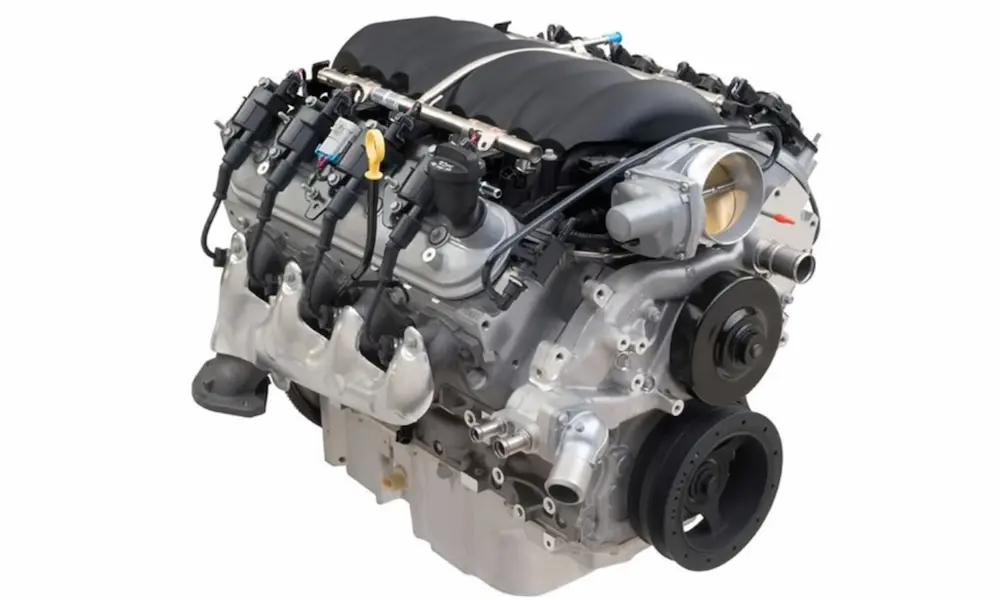
This is the complete engine as it sits in the bay — long block plus intake manifold, carburetor or fuel injection, distributor, water pump, harmonic balancer, spark plugs, fuel pump, pulleys, and exhaust manifolds.
Here’s the full picture:
| Engine Assembly Configuration | Standard Cast-Iron Build | Aluminum-Upgraded Build |
|---|---|---|
| Bare Block | ~200 lbs | 110–140 lbs |
| Short Block | ~300 lbs | ~220–240 lbs |
| Long Block (with heads) | ~400–420 lbs | ~350 lbs |
| Fully Dressed (turnkey) | 550–585.7 lbs | ~500 lbs |
The heaviest version on record? General Motors officially listed the 1989–1991 L98 350 in the C4 Corvette at 585.7 pounds dressed and dry. That engine used aluminum heads but carried the enormous Tuned Port Injection system, which added mass back to the top end.
How Block Casting Affects Weight
Not every 350 iron block is identical. Identifying your specific block means finding the casting number on the top rear ledge of the driver’s side.
Common casting numbers include:
- 140029 — produced 1980–1984
- 366245 — high-performance “Bowtie” block, 1978–1979
- 3858618 — produced 1968–1976
Two-bolt main blocks are lighter. Four-bolt main blocks are slightly heavier because the lower web is thicker to handle extra fastener torque. Standard two-bolt main cap bolts require 70 ft-lbs; four-bolt inner bolts also take 70 ft-lbs, while the outer 3/8-inch bolts need 40 ft-lbs.
High-performance Bowtie racing blocks sit at the top of the weight range for iron castings. Thicker walls and denser bulkheads add mass — but they also prevent catastrophic failure under serious power.
Cylinder Heads: The Biggest Weight Variable on Top
Cylinder heads cap the engine block and house the combustion chambers, valve assemblies, and intake/exhaust runners. Because they sit at the highest point of the engine, their mass directly affects the vehicle’s center of gravity.
Cast Iron Heads: Heavy and Slow to Cool
Factory cast-iron heads are inexpensive and durable. They also retain heat aggressively, which raises combustion chamber temperatures and increases the risk of detonation under load.
They’re still valid for specific applications. World Products S/R cast-iron heads remain popular in racing classes that mandate iron castings, featuring 1.940-inch intake valves and hardened exhaust seats for unleaded fuel compatibility.
Aluminum Heads: Lighter, Cooler, Better
Switching to aluminum cylinder heads is consistently the most impactful single upgrade on the small-block platform. You save 40–50 pounds total — roughly 20–25 pounds per head.
Beyond weight savings, aluminum dissipates heat far faster than iron. That cooler combustion chamber lets engine builders run higher compression ratios on pump gas without inducing knock.
Popular aluminum head options include:
- Flashark aluminum heads — 200cc intake runners, 64cc chambers, dramatically improved airflow
- Brodix Iron Killer (IK) series — A-356 virgin aluminum, 180cc or 200cc runners
- Trick Flow DHC series — A356-T61 aluminum, 175cc or 200cc runners, 60cc or 64cc chambers
- Speedway Motors aluminum “double hump” replica — vintage appearance, 180cc runners, saves 40 pounds from the front axle
All aluminum heads use hardened ductile iron or steel valve seats and bronze valve guides to compensate for aluminum’s softer surface hardness.
| Cylinder Head Material | Weight Impact | Thermal Behavior | Best Use Case |
|---|---|---|---|
| Factory Cast Iron | Heavy (baseline) | Poor heat dissipation | Stock builds, heavy towing, marine |
| Aftermarket Cast Iron | Similar to baseline | Poor heat dissipation | Mandated racing classes |
| Cast Aluminum Alloy | -40 to 50 lbs total | Excellent heat dissipation | Performance, street rods, weight reduction |
Intake Manifolds: 10–15 Pounds from the Top of the Engine
The intake manifold sits in the valley between the two cylinder banks and distributes the air-fuel charge to the heads. Early factory manifolds and marine-specific units were cast iron. The GM 14096242 cast-iron marine intake manifold weighs 25–30 pounds and is prized for saltwater corrosion resistance.
In performance and street applications, iron manifolds are essentially obsolete. Modern aluminum alternatives cut that weight nearly in half:
- Holley 300-931 single-plane aluminum intake — 14.8 pounds
- Edelbrock Performer 2104 dual-plane — 14.6 pounds
- Top Street Performance dual-plane aluminum — comparable weight with improved runner geometry
Removing 10–15 pounds from the tallest point of the engine lowers the center of gravity, improves throttle response, and unlocks significant volumetric efficiency gains.
The Internal Rotating Assembly: Where Steel Gets Heavy
Crankshafts
The crankshaft is the heaviest single moving part in the engine. Factory cast nodular iron cranks handle standard street use, but high-performance builds demand forged or billet steel.
Callies Performance billet crankshafts for the 350 average 47–48 pounds for the Magnum series. CNC-lightened versions — the Magnum XL and XB — drop to approximately 44 pounds through precision counterweight machining that also reduces oil windage.
Pistons and Connecting Rods
Original cast aluminum pistons gave way to modern hypereutectic and forged aluminum designs. Hypereutectic pistons contain higher silicon content, which limits thermal expansion and allows tighter wall clearances — reducing wear and keeping reciprocating mass tight. Connecting rods in modern builds use forged powder metal or 4340 steel H-beam designs to handle the RPM demands.
Flywheels and Flexplates: Rotational Inertia by the Pound
The flywheel bolts to the crankshaft flange and connects the engine to the drivetrain. Steel flywheels store enormous rotational inertia — useful for towing and smooth street driving but a liability when you need fast revs.
Factory and performance steel flywheels come in 153-tooth or 168-tooth configurations and weigh:
- Ram Clutch 1531LW 168-tooth steel flywheel — 25 pounds
- Centerforce 153-tooth performance steel — 29 pounds
- PRW billet steel 168-tooth — 21.4 pounds
Aluminum flywheels cut that figure dramatically:
- Speedway Motors 153-tooth cast aluminum — 16.2 pounds
- Hardin Marine billet aluminum — 12 pounds
Dropping 10–15 pounds off the crankshaft flange means the engine spends less energy overcoming inertia. The result is sharper throttle response and faster rev matching during downshifts.
Exhaust: Cast Iron Manifolds vs. Tubular Headers
Factory cast-iron “rams horn” exhaust manifolds are thick, durable, and restrictive. A stock pair weighs approximately 33 pounds.
Stainless steel shorty headers for the SBC weigh around 13.2 pounds per set — a clean 20-pound reduction from the outer edges of the block. Beyond the weight, the mandrel-bent primary tubes reduce back pressure and improve scavenging, which directly adds horsepower and torque without touching the internals.
Accessory Drive: Starter, Water Pump, Alternator
These bolt-on components add up fast. The good news is they’re easy to swap.
Water Pumps
Factory cast-iron water pumps weigh 10.3–13.65 pounds. Aluminum replacements weigh 6.95–9 pounds. That’s 4–6 pounds gone, plus aluminum units often feature better-curved impeller designs that improve coolant distribution to both cylinder banks equally.
Starter Motors
Old direct-drive factory starters weigh over 18 pounds. Modern gear-reduction mini-starters weigh 7.5–11.8 pounds and generate up to 190 ft-lbs of cranking torque — more than enough for high-compression builds. They also clear large aftermarket headers that original starters couldn’t.
Alternators and Brackets
Compact one-wire racing alternators weigh 6.5–8 pounds. Pairing them with CNC-machined billet aluminum bracket kits eliminates the heavy stamped-steel factory mounting hardware entirely.
Here’s the full component-by-component weight reduction summary:
| Component | Traditional Weight | Lightweight Version | Savings |
|---|---|---|---|
| Cylinder Heads (pair) | 80–90 lbs | 40–50 lbs | ~40–50 lbs |
| Intake Manifold | 25–30 lbs | 14.6–14.8 lbs | ~10–15 lbs |
| Exhaust Manifolds/Headers | ~33 lbs | ~13.2 lbs | ~20 lbs |
| Water Pump | 10.3–13.65 lbs | 6.95–9.0 lbs | ~4–6 lbs |
| Starter Motor | 18+ lbs | 7.5–11.8 lbs | ~8–10 lbs |
| Flywheel | 25–31.6 lbs | 12–16.2 lbs | ~13–15 lbs |
Work through this list and you’re looking at 95–116 pounds of mass reduction without changing a single internal engine component.
Late-Model 350 Variants: L98, LT1, and LT4
L98 (1985–1991)
The L98 in the C4 Corvette paired an iron block with aluminum heads. But the Tuned Port Injection system added mass back to the top end. GM officially listed the fully dressed L98 at 585.7 pounds — the heaviest factory 350 configuration on record. It made 245–250 horsepower and moved the Corvette with a remarkably balanced 51/49 front-to-rear weight split.
LT1 and LT4 (1992–1997)
The Generation II LT1 introduced reverse-flow cooling — cold coolant hit the aluminum heads first instead of the iron block. That change allowed compression ratios of 10.4:1–10.5:1, pushing output to 300 horsepower. The LT4 pushed compression to 10.8:1 for 330 horsepower. Both engines retained iron blocks but used aluminum heads and a lighter aluminum intake, keeping weight roughly comparable to the L98 while improving clearance and performance significantly.
Chevy 350 vs. LS: The Weight Gap Explained
The LS platform launched in 1997 as a clean-sheet design. The LS1 debuted in the C5 Corvette with an all-aluminum deep-skirt block featuring six-bolt main caps. Its bare block weighed just 115 pounds versus the 350’s 200-pound iron counterpart.
The LS also replaced cast-aluminum intake manifolds with thermoplastic composite units — lightweight plastic assemblies that resist heat soak and weigh almost nothing.
When fully dressed, the LS1 weighs 430–470 pounds. That’s 100–145 pounds lighter than a dressed traditional iron 350, with superior airflow, better factory rotating assemblies, and a more advanced fuel injection system built in from the factory.
What Engine Weight Actually Does to Your Vehicle
Engine mass isn’t just a bragging-rights number. It has direct consequences for how your car drives.
Center of Gravity
Removing 50–70 pounds from the cylinder heads and intake — the highest points on the engine — lowers the vehicle’s center of gravity. Less body roll in corners. Better suspension geometry. More consistent tire contact with the road.
Weight Distribution and Understeer
A heavy iron engine over the front axle pushes the weight distribution toward the nose. That creates understeer — the front tires wash wide instead of turning. Strip 50–100 pounds off the front with aluminum components and the steering sharpens, the car rotates better through corners, and the handling balance moves closer to the ideal 50/50 split.
Braking
Less front-end weight means less demand on the front brake rotors under hard stops. The brakes run cooler, fade resistance improves, and the tires maintain grip longer before ABS engages.
Power-to-Weight Ratio
Less total vehicle mass means faster acceleration from the same horsepower number. This shows up in quarter-mile times, highway passing, and every short burst of throttle in between. A lighter chassis makes the same 350 engine feel notably quicker without changing a single internal component.
The Chevy 350 engine weight isn’t fixed — it’s a variable you can engineer. A full cast-iron build sits near 575 pounds dressed. A comprehensive aluminum build with upgraded accessories can sit near 400 pounds with the same displacement and far better performance characteristics. Every component choice on this engine platform is a weight decision. Make them count.