Got a rough idle, a misfire, or just replaced your distributor cap? Getting the Chevy 4.3 firing order wrong will cause serious headaches. This guide covers every 4.3-liter engine GM ever built — V6, V8, old-school HEI, flat cap Vortec, and modern EcoTec3. Read to the end before touching a single spark plug wire.
First, Which 4.3 Do You Actually Have?
This is critical. GM used the “4.3-liter” label on very different engines across seven decades. Applying the wrong firing order to any of them guarantees misfires, backfires, or a no-start condition.
Here’s a quick breakdown of every engine wearing the 4.3 badge:
| Engine | Years | Config | Firing Order |
|---|---|---|---|
| Chevy 90° V6 (Gen I / Vortec) | 1985–2014 | V6 | 1-6-5-4-3-2 |
| EcoTec3 LV3 / LV1 | 2014–present | V6 | 1-6-5-4-3-2 |
| Small Block 265 V8 (first-gen) | 1955 | V8 | 1-8-4-3-6-5-7-2 |
| Generation II L99 V8 | 1994–1996 | V8 | 1-8-4-3-6-5-7-2 |
Count your cylinders before anything else. Six cylinders? The firing order is 1-6-5-4-3-2. Eight cylinders? It’s 1-8-4-3-6-5-7-2. Mixing these two up on engines with the same displacement is a very common and very damaging mistake.
Chevy 4.3 V6 Firing Order: 1-6-5-4-3-2
The Chevy 4.3-liter V6 firing order is 1-6-5-4-3-2. This applies to every version of the 90-degree V6 — carbureted, throttle body injection, central port injection, and multi-port fuel injection.
This sequence didn’t happen by accident. GM engineers designed it to alternate combustion events between the left and right cylinder banks. That keeps heat spread evenly, reduces stress on the crankshaft’s main bearings, and extends the life of the rotating assembly.
Cylinder Number Layout
Before routing a single wire, know where the cylinders sit. Here’s the layout for all 4.3-liter V6 engines:
Driver side (left bank): 1 — 3 — 5 (front to rear)
Passenger side (right bank): 2 — 4 — 6 (front to rear)
Cylinder #1 sits at the front of the driver’s side bank. It’s positioned slightly further forward than cylinder #2 on the passenger side. That small offset exists because both connecting rods share the same crankshaft journal.
The distributor rotor spins clockwise when viewed from the top.
The Two Distributor Cap Designs (And Why One Causes Chaos)
The 4.3 V6 went through a major ignition system change in the mid-1990s. Which cap you have completely changes how you route the wires.
Early HEI Round Cap (1985–Early 1990s)
The early High Energy Ignition system uses a large, round distributor cap with wire towers arranged in a visible circle. The ignition coil is often built directly into the top of the cap.
Wiring it is straightforward. Find the terminal marked for cylinder #1. Attach that wire. Then continue clockwise around the cap, connecting wires for cylinders 6, 5, 4, 3, and 2. The physical layout matches the firing sequence. Easy.
Vortec Flat “Crab Style” Cap (Mid-1990s–2014)
This is where things get tricky. The Vortec-era 4.3 introduced a horizontal flat distributor cap — sometimes called the crab-style cap — and it’s responsible for more wiring errors than any other part on this engine.
GM designed it to solve a packaging problem. Trucks like the Chevy Astro, S-10 Blazer, and full-size Silverado didn’t have enough clearance above the rear distributor for a tall round cap. So engineers laid the terminals flat, pointing left and right toward each cylinder bank.
Here’s the external terminal layout:
- Driver side of cap: Three terminals pointing left. From front to back: cylinders 3, 1, 5
- Passenger side of cap: Four terminals pointing right. The rearmost connects to the coil wire. Moving forward: cylinders 6, 4, 2
Notice something? The terminals don’t run in firing order sequence along the outside of the cap. That’s intentional. Inside the cap, a complex matrix of embedded conductive traces routes the spark in the correct 1-6-5-4-3-2 sequence internally.
Do not attempt to wire the flat cap by following the firing order around the outside. Trust the numbers stamped on the cap itself. Connect each wire to the terminal that matches its cylinder number. That’s it.
The Flat Cap’s Biggest Weakness: Crossfire
The flat cap’s internal trace design creates a unique vulnerability that the old round HEI cap never had.
Because high-voltage traces run over and under each other inside the molded plastic housing, any moisture or insulation breakdown causes the spark to jump between channels. This is called crossfire — the spark fires the wrong cylinder at the wrong moment.
How Moisture Gets In
Many GM trucks and SUVs route the air conditioning lines along the firewall directly above the distributor. Condensation drips from these cold lines straight onto the cap. Over time, moisture enters the cap’s ventilation screens. Inside, it mixes with ozone generated by the rotor’s electrical arcing. That combination creates a corrosive environment that eats terminal contacts and leaves conductive carbon tracks across the plastic surfaces separating the traces.
Symptoms of flat cap crossfire include:
- Random misfire codes stored in the ECM
- Severe hesitation under acceleration
- Rough idle
- Stalling during heavy rain or after washing the vehicle
Replace the cap and rotor with quality parts that use solid brass terminals. Apply dielectric silicone grease to every spark plug wire boot. Don’t skip this step.
Distributor Drive Gear Wear: The Silent Engine Killer
Beyond the cap itself, watch the distributor drive gear. It meshes directly with the camshaft deep inside the engine block. After high mileage, the gear teeth wear to a thin, knife-edge profile.
Worn gear teeth introduce timing fluctuations because the rotor no longer spins in tight sync with the camshaft. The result? Persistent misfire codes and an idle that won’t smooth out no matter what you replace.
Here’s the part that gets serious: the distributor shaft also drives the oil pump. If the gear teeth shear completely, you lose oil pressure instantly. Total engine failure follows within seconds. Check that gear whenever you pull the distributor.
How to Install the Distributor Correctly
Wrong distributor installation is the top cause of no-start conditions after maintenance on this engine. It’s not just about aligning marks.
The Exhaust Stroke Problem
The camshaft completes one full revolution for every two crankshaft revolutions. When you align the timing notch on the harmonic balancer, cylinder #1 is at the top of its travel — but that could be the compression stroke or the exhaust stroke.
If you drop the distributor in while the engine sits on the exhaust stroke, ignition timing runs 180 degrees out of phase. The engine cranks but won’t run.
Confirming True Top Dead Center
Follow these steps to nail the compression stroke every time:
- Remove the spark plug from cylinder #1 (front, driver side)
- Place your finger firmly over the plug hole
- Slowly rotate the crankshaft clockwise using a socket on the harmonic balancer bolt
- When air pushes against your finger, the piston is rising on the compression stroke
- Keep rotating until the timing notch aligns with the mark on the timing cover
- Now install the distributor — account for the rotor twist caused by the helical gear mesh
- When fully seated, the rotor tip should point toward the cast alignment mark on the distributor body (often marked with a “6” or an alignment notch)
After installation, use a scan tool to set the Camshaft Position Retard. Hold the engine above 1,200 RPM to stabilize the signal. Rotate the distributor housing until the scan tool reads 0 degrees — within ±2 degrees. This step is non-negotiable on Vortec engines.
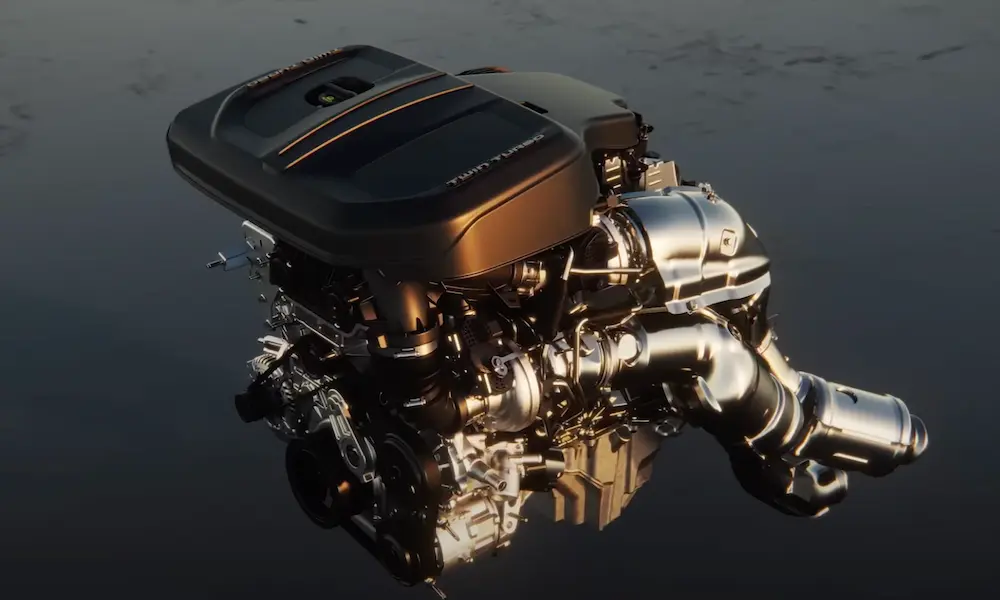
Modern EcoTec3 4.3 V6: Same Firing Order, No Distributor
In 2014, GM retired the 90-degree V6 architecture in the Silverado and Sierra. The new EcoTec3 LV3 engine runs the same 4.3-liter displacement and the same 1-6-5-4-3-2 firing order — but with a completely different ignition system.
The EcoTec3 uses coil-on-plug ignition. Each cylinder gets its own dedicated ignition coil bolted directly above the valve cover, connected to the spark plug with a short wire. The ECM fires each coil in the 1-6-5-4-3-2 sequence with digital precision. No rotor, no distributor gear, no flat cap to corrode.
This design eliminates every mechanical failure point that plagued the older distributor system.
One EcoTec3 Maintenance Issue to Watch
The LV3 uses direct fuel injection — fuel sprays directly into the combustion chamber rather than behind the intake valves. That’s great for efficiency, but it removes the natural cleaning effect that gasoline used to provide on valve backsides.
Oil vapor from the crankcase ventilation system bakes onto the intake valves over time. This carbon buildup restricts airflow, causes rough idle and sputtering, and kills performance. Most LV3 owners need an intake valve cleaning around 80,000–100,000 miles — typically done with abrasive walnut shell blasting through the intake ports.
The LV1 variant (used in the Express and Savana vans from 2018 on) is mechanically identical to the LV3 but omits the Active Fuel Management cylinder deactivation hardware. GM made that call specifically for long-term fleet reliability.
4.3-Liter V8 Firing Order: 1-8-4-3-6-5-7-2
If your engine has eight cylinders — either the original 1955 Small Block 265 V8 or the mid-1990s L99 — the firing order is completely different.
The 4.3-liter 265 cubic inch V8 firing order is 1-8-4-3-6-5-7-2.
This sequence proved so effective at balancing crankshaft harmonics that it became the standard for virtually every Gen I and Gen II Small Block Chevy ever built — regardless of displacement increases to 283, 327, 350, or beyond.
The L99 V8 from the 1994–1996 Caprice uses the exact same firing order. Its front-mounted Opti-Spark distributor handles spark delivery differently, but the combustion sequence doesn’t change.
V8 cylinder layout:
- Driver side: 1 — 3 — 5 — 7 (front to rear)
- Passenger side: 2 — 4 — 6 — 8 (front to rear)
Never apply the V6 firing order to a V8. They share a displacement number and nothing else in terms of ignition sequencing.
Quick Reference: All Chevy 4.3 Firing Orders
| Engine | Config | Firing Order | Ignition Type |
|---|---|---|---|
| 90° V6 Gen I / Vortec (1985–2014) | V6 | 1-6-5-4-3-2 | Distributor (round or flat cap) |
| EcoTec3 LV3 / LV1 (2014–present) | V6 | 1-6-5-4-3-2 | Coil-on-plug |
| Small Block 265 V8 (1955) | V8 | 1-8-4-3-6-5-7-2 | Distributor |
| L99 Gen II V8 (1994–1996) | V8 | 1-8-4-3-6-5-7-2 | Opti-Spark distributor |
The Chevy 4.3 firing order for every V6 version is 1-6-5-4-3-2. Every V8 version runs 1-8-4-3-6-5-7-2. Identify your engine first, follow the correct sequence, and trust the numbers marked on your distributor cap rather than the physical layout of the terminals. Get that right, and you’ll avoid the misfires, backfires, and no-start headaches that trip up even experienced technicians on this engine family.