Got a check engine light blazing and a suspicious rotten egg smell coming from your Equinox? Your catalytic converter might be on its way out. This guide breaks down everything you need to know about Chevy Equinox catalytic converter replacement — costs, causes, warning signs, and how to avoid getting burned twice.
What Does a Catalytic Converter Actually Do?
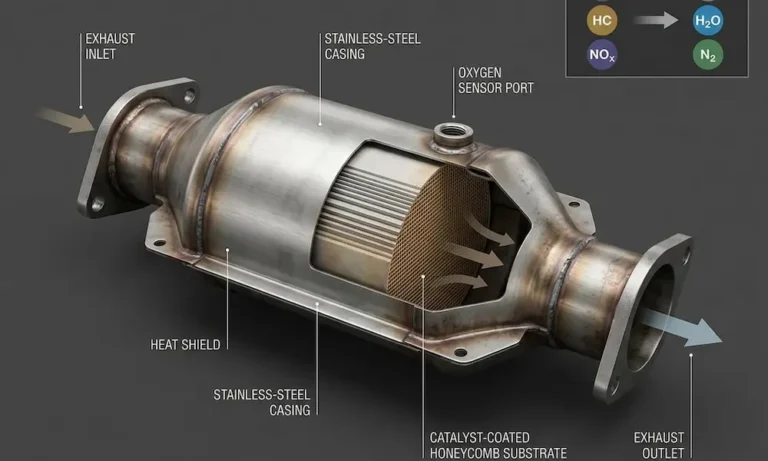
Your Equinox’s catalytic converter sits in the exhaust system and acts like a chemical cleanup crew. Hot exhaust gases pass through a ceramic honeycomb coated with platinum, palladium, and rhodium. These precious metals trigger rapid chemical reactions that transform toxic gases into harmless water vapor, carbon dioxide, and nitrogen.
Without it, your Equinox pumps carbon monoxide, unburned hydrocarbons, and nitrogen oxides straight into the air. That’s a legal problem, a performance problem, and an environmental problem — all in one.
Which Equinox Engine Do You Have? It Matters More Than You Think
The Chevrolet Equinox has used several different engines across its generations. Your specific engine determines the converter’s location, design, and replacement cost.
- 2.4-liter naturally aspirated four-cylinder (2010–2017): Single converter, mounted close to the engine block for fast heat-up
- 3.6-liter six-cylinder: Dual converters — one per cylinder bank — which doubles the potential repair cost
- 1.5-liter and 2.0-liter turbocharged four-cylinder (2020+): Forced-induction engines produce higher exhaust heat under load, so these converters use different thermal tolerances and washcoat formulations
All-wheel drive models also route exhaust differently than front-wheel drive models. That means different parts, different fitment, and sometimes different labor times.
Why Chevy Equinox Catalytic Converters Fail
The EPA notes that a properly functioning catalytic converter should last over 100,000 miles. It has no moving parts. So when it fails early, something upstream caused it. Here are the most common culprits in the Equinox specifically.
Oil Consumption in the 2.4-Liter Engine
This is the big one. The 2.4-liter engine found in 2010–2017 Equinox models has a well-documented problem with excessive oil consumption due to piston ring wear. When oil burns in the combustion chamber, it sends ash, phosphorus, and zinc into the exhaust stream. Over time, these particles coat the precious metal washcoat inside the converter, physically blocking the chemical reactions.
The result? A dead converter. But here’s the critical part — if you replace the converter without fixing the oil consumption issue, the new one will fail just as fast.
Cracked Exhaust Manifold
The 2.4-liter engine also has a high tendency to develop cracked exhaust manifolds. A crack lets outside air sneak into the exhaust stream. The oxygen sensor reads this as a lean condition. The engine control module responds by dumping more fuel into the cylinders. That excess unburned fuel hits the superheated converter and ignites inside it. Internal temperatures can spike beyond 1,600°F — hot enough to melt the ceramic honeycomb completely. Once it melts, it’s gone.
Physical Damage and Thermal Shock
Driving through deep puddles can cause thermal shock — the sudden temperature drop cracks the ceramic internally. Road debris and hard impacts can shatter it outright. When the ceramic breaks apart, you’ll hear a distinct rattling sound from underneath the car, especially during acceleration.
Warning Signs Your Equinox Needs a New Catalytic Converter
Don’t ignore these symptoms. They get worse — and more expensive — the longer you wait.
- Check engine light: Usually a P0420 code (“Catalyst System Efficiency Below Threshold”)
- Loss of power: Clogged converter creates exhaust back-pressure, choking the engine
- Rough idle or stalling: The engine can’t breathe properly at low speeds
- Poor fuel economy: The ECM compensates by injecting extra fuel
- Rotten egg smell: Failed chemical conversion releases hydrogen sulfide
- Rattling under the car: Broken ceramic substrate bouncing around inside the housing
A technician can confirm the failure using a back-pressure test or by comparing exhaust temperatures before and after the converter with an infrared pyrometer. A healthy converter runs hotter at the outlet than the inlet. If the temps are equal — or reversed — the chemical process has stopped.
Chevy Equinox Catalytic Converter Replacement Cost Breakdown
Here’s where it gets uncomfortable. Replacing a catalytic converter is one of the more expensive repairs you’ll face. Two things drive the cost: precious metals and labor.
Why Parts Cost So Much
That small ceramic brick contains rare metals traded on global commodities markets. Here’s what those metals cost per ounce:
| Precious Metal | Function Inside the Converter | Price Per Troy Ounce | Typical Quantity Per Unit |
|---|---|---|---|
| Platinum | Oxidizes carbon monoxide & hydrocarbons | $900 – $1,000 | 3–7 grams |
| Palladium | Oxidizes carbon monoxide & hydrocarbons | $900 – $1,100 | 2–7 grams |
| Rhodium | Reduces nitrogen oxides | $7,000 – $10,000 | 1–2 grams |
Even small amounts of rhodium add serious cost to every unit. When commodities prices spike, parts prices follow immediately.
Labor Costs
Shop rates for exhaust and emission work typically run between $70 and $130 per hour. A straightforward direct-fit swap takes one to three hours. But on older Equinoxes with rusted hardware — especially common in northern states — seized bolts and stripped oxygen sensor threads can push that to five hours or more.
Total Cost by Replacement Strategy
| Replacement Option | Part Type | Est. Parts Cost | Est. Labor Cost | Total Estimate |
|---|---|---|---|---|
| Aftermarket Direct-Fit | Federal-compliant | $350 – $700 | $150 – $300 | $500 – $1,000 |
| OEM (Genuine GM) | Factory specification | $1,700 – $2,202 | $200 – $400 | $1,900 – $2,602 |
| CARB-Compliant State | Certified aftermarket | $420 – $980 | $150 – $300 | $570 – $1,280 |
RepairPal estimates the average replacement across platforms at $2,293–$2,468. Edmunds puts it at $2,164–$2,483 on average, with Equinox-specific costs slightly lower at $1,730–$1,964 for OEM parts.
OEM vs. Aftermarket: Which Should You Choose?
OEM (Original Equipment Manufacturer)
Genuine GM converters match factory specs exactly. They contain higher precious metal concentrations, typically last twice as long as aftermarket units, and carry the best warranty coverage. The downside? They cost 40–60% more than aftermarket options. For an older Equinox already past 150,000 miles, that investment may not make financial sense.
Aftermarket Direct-Fit
These bolt straight in without custom fabrication. Reputable direct-fit units meet federal emissions standards and can save you 40–70% compared to OEM pricing. They’re the sweet spot for most owners balancing cost and quality.
Universal Converters
These are the cheapest option upfront — often $100–$500 — but they require cutting and welding into the exhaust pipe. The fabrication labor often wipes out the savings. Cheaper precious metal loading also means a shorter lifespan and a higher chance of triggering a P0420 code shortly after installation.
Federal and State Regulations You Can’t Ignore
Installing a catalytic converter isn’t just a mechanical job — it’s a legal compliance procedure.
Federal EPA Rules
Under the Clean Air Act, removing or bypassing a catalytic converter is a federal violation. It applies to repair shops, fleet operators, and individual owners alike. The EPA also mandates that manufacturers warranty catalytic converters for 8 years or 80,000 miles. If your Equinox is still within that window, the replacement may cost you nothing.
CARB States: Stricter Rules Apply
California, New York (post-January 2023), Colorado (post-January 2021), and Maine all require CARB-compliant converters for any replacement installation.
CARB-compliant units must:
- Carry an Executive Order (EO) number stamped on the housing
- Be installed within 3 inches of the original factory location
- Match your exact vehicle’s make, model, engine, and test group
- Include a 5-year/50,000-mile warranty on parts and labor
- Be compatible with your OBD system
A smog inspector will physically check that EO number against your Equinox’s specific certification. Use the wrong one — even if the part fits perfectly — and you fail inspection. CARB-compliant parts typically cost 20–40% more than federal-only alternatives.
Installation Tips That Protect Your Investment
Dealing With Seized Hardware
Penetrating oil applied hours before the repair dissolves rust on studs and flanges. For badly corroded fasteners, technicians heat the nut with a torch and apply paraffin wax directly to the threads. The heat melts the wax, pulling it deep into the thread pitch and preventing the stud from snapping during removal.
Always replace the oxygen sensors if they’re fouled or damaged during removal. Installing a fresh converter with sluggish sensors compromises the entire system and puts the new unit at risk.
The Break-In Procedure Most People Skip
This step matters more than most people realize. Inside the converter, the ceramic honeycomb is held in place by an intumescent mat — a heat-expanding material that cushions and locks the ceramic against vibration.
When a converter is brand new, that mat contains moisture and chemical binders. Drive aggressively right away and those materials off-gas too fast, loosening the ceramic. Eventually, it shifts, vibrates, and shatters.
The correct break-in process:
- Start the engine and let it idle until it reaches full operating temperature
- Drive at sustained highway speeds for up to one hour without aggressive acceleration
- This allows the matting to expand and lock the ceramic permanently into position
Skip this and you risk destroying a brand-new part within weeks.
Protecting Your Converter from Theft
Equinox SUVs sit high enough off the ground for thieves to slide under with a battery-powered saw. A converter can be stolen in under 90 seconds. Anti-theft shields from companies like Miller CAT bolt directly to the undercarriage using tamper-resistant hardware. They add time and noise to any theft attempt — which is usually enough to send thieves elsewhere.
Even when a converter fails legitimately, the scrapped unit still has value. Specialized recyclers extract the remaining platinum, palladium, and rhodium, and returning a large GM OEM converter can recover 20–50% of your replacement cost. Just know that reselling a used converter for re-installation is illegal under federal guidelines and Colorado’s Regulation 20. Scrap value only.
Frequently Asked Questions
Does car insurance cover catalytic converter replacement?
Standard comprehensive and collision insurance won’t cover mechanical failure from oil fouling or age — that’s on you. However, if the converter is physically stolen or damaged in a covered collision, your comprehensive policy typically covers parts and labor, minus your deductible. The federal 8-year/80,000-mile emissions warranty may also cover you if the failure isn’t caused by neglect or modifications.
Can a blocked catalytic converter damage the transmission?
Yes. When severe exhaust back-pressure threatens the powertrain, the engine control module can trigger limp-home mode. This restricts throttle response and signals the transmission control module to lock into a lower gear, preventing high engine speeds that could cause serious mechanical damage.
Will aftermarket performance tunes damage my catalytic converter?
Absolutely. Performance software often commands richer fuel mixtures to prevent engine knock under load. That excess unburned fuel enters the exhaust system and ignites inside the converter. The resulting temperature spike rapidly degrades the precious metal washcoat and causes premature failure.
Is it safe to handle a shattered catalytic converter without protection?
No. A broken ceramic substrate pulverizes into highly abrasive dust. The intumescent matting inside the housing may also contain refractory ceramic fibers. Always wear respiratory protection, safety glasses, and gloves when handling a damaged unit.
How do hybrid systems affect catalytic converter performance?
Hybrids frequently shut off the combustion engine during low-speed or deceleration phases. This causes the exhaust system to cool rapidly. Hybrid catalytic converters typically sit closer to the exhaust manifold and use washcoat formulations designed to activate at lower temperatures, ensuring they’re ready the moment the engine restarts.