Got a Check Engine light, a rotten egg smell, or worse — a deafening roar when you start your Nissan? Your catalytic converter might be done. This guide covers everything from why they fail to what you’ll actually pay for a Nissan catalytic converter replacement, plus the legal stuff most people skip. Stick around — the details here could save you thousands.
What Does a Catalytic Converter Actually Do?
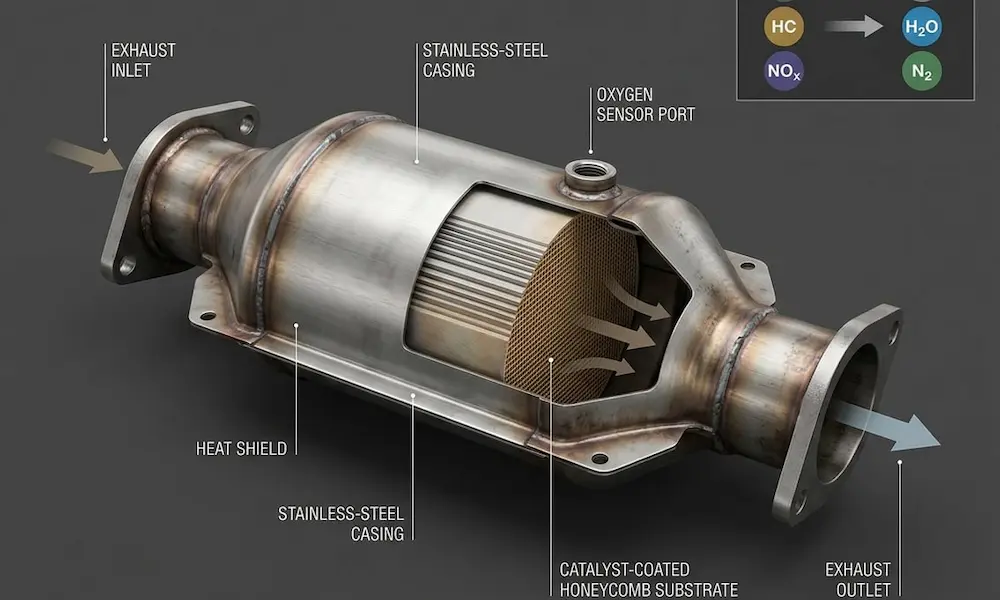
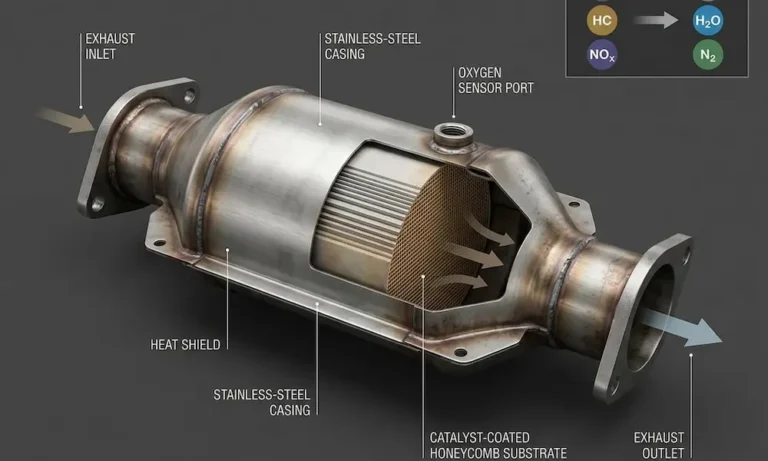
Your Nissan’s catalytic converter is a chemical reactor built into your exhaust system. It transforms toxic exhaust gases — carbon monoxide, nitrogen oxides, and unburned hydrocarbons — into harmless water vapor, nitrogen, and carbon dioxide.
Here’s the quick version of how it works:
- Exhaust gases enter the converter’s honeycomb-shaped ceramic core
- The core is coated with precious metals: platinum, palladium, and rhodium
- At temperatures between 500°F and 1,200°F, these metals trigger chemical reactions that neutralize the toxic gases
- Oxygen sensors before and after the converter feed data to your engine control module (ECM), keeping the fuel mixture perfectly balanced
No moving parts. No filters. Just chemistry — and very expensive precious metals doing the heavy lifting.
Why Nissan Catalytic Converters Fail
Converters don’t usually die on their own. They’re the last domino in a chain of upstream problems. Here’s what actually causes them to fail:
Engine Oil Burning
Worn piston rings or valve seals let motor oil sneak into the combustion chamber. Modern synthetic oils contain zinc and phosphorus additives. When those burn, they coat and permanently poison the catalyst’s surface, killing its ability to process exhaust.
Coolant Leaks Into the Engine
A blown head gasket lets coolant into the combustion cycle. The silicates in antifreeze create a glassy film over the honeycomb cells, both poisoning the catalyst and physically blocking exhaust flow.
Engine Misfires and Overheating
A bad ignition coil, fouled spark plug, or leaking injector pushes raw, unburned fuel into the exhaust. When that fuel hits a converter already running at 1,000°F, it ignites inside the unit. That secondary combustion spike can hit 2,000°F — literally melting the ceramic core into a solid blockage.
Short-Trip Driving
Exclusively driving less than 10 minutes per trip doesn’t give your exhaust system enough time to reach operating temperature. Over time, hydrocarbon deposits build up inside the converter. Fix: drive at highway speeds for at least 15 minutes periodically to burn them off.
Physical Damage
Hitting a curb, debris, or a steep driveway approach can dent the converter’s steel housing. Even a small dent crushes the ceramic core inside, which then grinds itself into abrasive dust and clogs the system.
The QR25DE Problem: When Nissan’s Own Engine Destroyed the Converter
This one deserves its own section because it’s still causing headaches for owners of early 2000s Altimas, Sentras, and Frontiers.
The QR25DE 2.5L engine used in 2002–2005 models had a design flaw with serious consequences. Instead of using a traditional exhaust gas recirculation (EGR) valve, Nissan engineers timed the intake and exhaust valves to briefly open simultaneously, creating a vacuum pulse to draw exhaust gases back into the cylinder.
Here’s the problem: that same vacuum pulse also sucked ceramic dust from the deteriorating close-coupled pre-catalyst directly into the engine’s combustion chambers.
The result was a brutal feedback loop:
- The ceramic substrate crumbled and got ingested by the engine
- The abrasive dust scored the cylinder walls and destroyed piston rings
- The engine burned massive amounts of oil
- The oil-contaminated exhaust poisoned what remained of the converter
- Rinse and repeat — until the engine block needed replacement
Nissan dealerships replaced entire engines under warranty during this era. If you’re working on an early Altima or Sentra with heavy oil consumption, always inspect the manifold converter before touching the engine. Replacing the engine without addressing the converter just restarts the cycle.
Diagnosing the Problem: It’s More Than Reading a Code
When your converter drops below efficiency standards, the ECM throws a Check Engine light. Common symptoms include:
- P0420 code — catalyst efficiency below threshold (Bank 1)
- Loss of engine power or sluggish acceleration
- Rough idle or backfiring
- Rotten egg smell from the exhaust
But here’s the thing: a P0420 code doesn’t automatically mean you need a new converter. Technicians need to dig deeper.
What Other Codes Tell You
Codes like P0171, P0174, P1273, and P1283 indicate a lean running condition — too much oxygen, not enough fuel. These often point to a vacuum leak, a cracked exhaust pipe letting outside air in, or faulty air-to-fuel sensors — not a dead converter.
Don’t Skip the Software Check
Before replacing any hardware, check for Technical Service Bulletins (TSBs). Nissan has documented multiple cases where faulty ECM software triggered false converter failure codes.
Bulletin NTB13-056a covers 2007–2008 Altimas where the ECM was misinterpreting normal valve movement as engine knock. The official fix? Pressurize the exhaust system to check for leaks, then reprogram the ECM with Nissan’s CONSULT software. No hardware replacement needed.
Nissan also issued a 2020 voluntary service campaign covering nearly 300,000 vehicles — including the 2019 Sentra, Titan, and NV200 — to fix a software glitch causing continuous battery drain from the variable valve timing solenoid.
Bottom line: Always update the ECM software before condemning a converter. It could save you $2,000.
How Much Does a Nissan Catalytic Converter Replacement Cost?
Brace yourself. This is one of the most expensive repairs you’ll face. The high cost comes from three factors: precious metals inside the unit, complex manifold-integrated designs, and severely corroded hardware that’s a nightmare to remove.
Here’s what you’re looking at across popular Nissan models:
| Nissan Model | Average Total Replacement Cost (USD) |
|---|---|
| Rogue | $1,479 – $1,679 |
| Altima (4-cyl & V6) | $1,644 – $1,747 |
| Pathfinder | $1,798 – $2,417 |
| Versa | $2,066 – $2,115 |
| Frontier | $2,275 – $2,371 |
| Sentra | $2,345 – $2,426 |
| Murano (V6) | $2,473 – $4,125 |
| Maxima (V6) | $2,719 – $3,473 |
Where Does the Money Actually Go?
For a 2017 Nissan Rogue, the part alone runs roughly $996–$997, with labor adding $307–$450. The hardware is the main cost driver.
Labor costs vary significantly based on converter location. A rear underbody converter is a straightforward bolt-off job. A manifold converter bolted directly to the engine block? That’s a multi-hour job involving heat shields, exhaust studs corroded into aluminum cylinder heads, and specialized tools to extract broken hardware without damaging the block.
OEM vs. Aftermarket: Which Should You Buy?
- OEM (Genuine Nissan): Exact precious metal loading, guaranteed fitment, long-term reliability. Most expensive option, but the right call for newer vehicles.
- Direct-fit aftermarket: Bolt-on replacement from reputable brands like MagnaFlow. Significant savings with solid durability. Verify CARB compliance if you’re in a regulated state.
- Universal-fit aftermarket: Must be welded into the exhaust system. Lowest parts cost, but higher labor cost. Only use reputable brands with proper precious metal loading.
- Cheap generic units: Avoid these. Minimal precious metal content means they fail fast and won’t pass emissions tests.
Legal Requirements: What You Must Know Before Buying
Picking a replacement converter isn’t just a budget decision — it’s a legal one.
Federal EPA Rules
The Clean Air Act prohibits removing or bypassing any emissions control device on a highway vehicle. The EPA has aggressively enforced this rule, with penalties reaching $5,580 per non-compliant part, per day. In 2024, enforcement actions totaled over $13 million in fines. The “off-road use only” disclaimer on catless pipes doesn’t protect you.
California (CARB) Standards
California requires aftermarket converters to pass independent lab testing before sale or installation. The rules also ban used converters entirely. California’s standards apply in several other states too — including New York, Colorado, and Maine.
Here’s the critical detail: CARB compliance is matched to your vehicle’s Engine Family Number (EFN), not just the make and model. You’ll find the EFN on the under-hood emissions label. The converter’s CARB Executive Order documentation must list your exact EFN.
| Nissan Model | Year | Engine | Required EFN |
|---|---|---|---|
| Frontier | 1999 | 3.3L | XNSXT03.335A |
| Frontier | 2000 | 3.3L | YNSXT03.335A |
| Frontier | 2001 | 3.3L | 1NSXT03.3C5A |
| Xterra | 2000 | 3.3L | YNSXT03.335A |
| Xterra | 2004 | 3.3L | 4NSXT03.5M7A |
Install a federal-only converter in a CARB state and you’ll fail the visual inspection immediately — even if your tailpipe emissions are clean. You’ll then have to buy the correct unit anyway, plus potentially face state fines. Get the right part the first time.
Catalytic Converter Theft: A Real and Growing Problem
Nissan catalytic converter replacement isn’t always about mechanical failure. Theft is now a massive driver of replacement demand.
Rhodium — one of the three precious metals inside your converter — spiked to over $11,000 per ounce in March 2026. That makes a single converter worth hundreds of dollars in scrap. A thief with a battery-powered saw can cut one off in under 60 seconds. In 2025 alone, over 137,000 catalytic converters were stolen across the US.
How do you know yours was stolen? Your engine will sound like a dragster. Raw exhaust vents straight to the atmosphere, the Check Engine light comes on immediately, and exhaust fumes enter the cabin.
How to Protect Yourself
- Install a catalytic converter shield. These bolt-on steel or aluminum plates physically block access with cutting tools. They’re effective and legal.
- Will a shield void your warranty? No. The Magnuson-Moss Warranty Act protects you. A manufacturer can’t void your warranty for installing an aftermarket accessory unless they prove it directly caused the failure.
- Park strategically. Well-lit, high-traffic areas are less attractive targets than isolated spots.
- Check your insurance. Comprehensive coverage typically covers converter theft. You’ll pay your deductible, but it beats a $2,000+ out-of-pocket hit.
FAQs About Nissan Catalytic Converter Replacement
Does comprehensive auto insurance cover catalytic converter theft?
Yes — if you carry comprehensive coverage, theft is covered as vandalism. You’ll pay your deductible. Since replacement usually runs $1,500–$2,000+, filing a claim almost always makes financial sense. Liability-only policies leave you covering the full cost yourself.
What happens to your old catalytic converter after replacement?
It doesn’t go to landfill. Shops sell spent converters to precious metal recyclers who extract the platinum, palladium, and rhodium for reuse. When you buy a new aftermarket unit, you’ll often pay a core charge upfront — you get it back when you return the old part for recycling.
Can fuel additives fix a clogged catalytic converter?
Barely, and only in mild cases. Catalytic converter cleaner additives can burn off light carbon deposits on the catalyst surface. They can’t fix a melted substrate, a shattered ceramic core, or a converter glazed over with coolant silicates. If there’s structural damage, you need a replacement — full stop.
Do new catalytic converters need a break-in period?
Yes. Start the engine and let it idle without revving. Then drive normally without aggressive acceleration for a set period. This lets the intumescent matting — the material that holds the ceramic core inside the housing — expand and cure properly. Skip this step and you risk cracking the new substrate before it’s even fully seated.