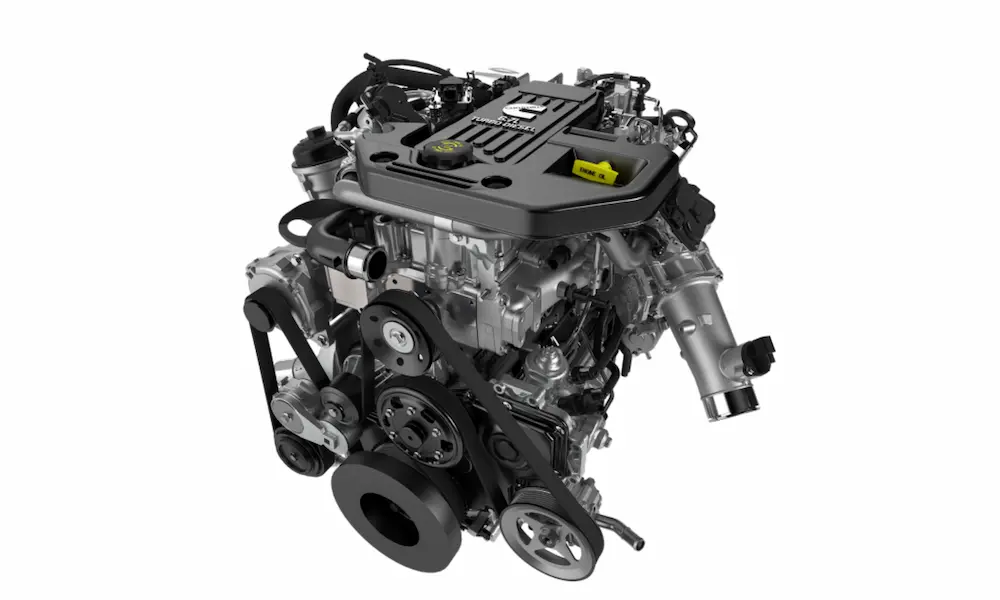
Misfire codes, wrong oxygen sensor replacements, and botched spark plug jobs — they all trace back to one thing: not knowing the Dodge 3.6 firing order and cylinder layout. This post breaks it all down clearly, whether you’re wrenching on a Charger, Grand Caravan, or Wrangler. Stick around — the bank orientation section alone will save you from a very expensive mistake.
What Is the Dodge 3.6 Firing Order?
The Dodge 3.6 firing order is 1-2-3-4-5-6.
That’s it. Clean, sequential, and beautifully logical. The Pentastar’s 60-degree V6 architecture makes this possible. Unlike old V8s that fired in erratic sequences like 1-8-4-3-6-5-7-2 to fight vibration, the Pentastar’s naturally balanced block simply alternates side to side, front to back.
Here’s the ignition sequence in plain terms:
- Cylinder 1 fires first (front right bank)
- Cylinder 2 fires next (front left bank)
- Cylinder 3 fires (middle right bank)
- Cylinder 4 fires (middle left bank)
- Cylinder 5 fires (rear right bank)
- Cylinder 6 fires last (rear left bank) — then the cycle repeats
This smooth alternating pattern keeps the crankshaft rotating evenly. Break that rhythm with a dead coil or a bad spark plug, and you’ll feel it immediately as a shudder and a misfire code.
Cylinder Numbering: Where Are the Cylinders?
Before you touch anything under the hood, know this: the Pentastar treats itself as two separate three-cylinder engines — Bank 1 and Bank 2.
The rule is universal and never changes:
Bank 1 always contains Cylinder 1.
On the bare 3.6 engine block, Cylinder 1 sits at the front of the right side. That makes the right cylinder head Bank 1 and the left cylinder head Bank 2.
| Engine Bank | Side of Block | Cylinders |
|---|---|---|
| Bank 1 | Right side | 1, 3, 5 |
| Bank 2 | Left side | 2, 4, 6 |
All odd-numbered cylinders live on Bank 1. All even-numbered cylinders live on Bank 2. Simple enough — until you drop the engine into a vehicle.
Longitudinal Mount: Rear-Wheel-Drive Vehicles
In rear-wheel-drive and 4WD vehicles, the Pentastar sits north-south in the engine bay. The front of the engine faces the radiator. The back faces the firewall and transmission.
Vehicles with this layout include:
- Dodge Charger
- Dodge Challenger
- Dodge Durango
- Jeep Grand Cherokee
- Jeep Wrangler
- Chrysler 300
- Ram 1500
Standing at the front bumper and looking in, the cylinder layout maps directly to the vehicle’s left and right sides:
| Bank | Vehicle Side | Cylinders | Location Relative to Driver |
|---|---|---|---|
| Bank 1 | Passenger side | 1, 3, 5 | Right of engine bay |
| Bank 2 | Driver side | 2, 4, 6 | Left of engine bay |
So if your scanner throws a P0303 (Cylinder 3 misfire), look at the middle coil on the passenger side. P0306 (Cylinder 6 misfire)? That’s the rear coil on the driver’s side near the firewall.
The catch: Cylinders 1, 3, and 5 on Bank 1 sit underneath the upper intake manifold plenum. You’ll need to pull that intake to reach them. Cylinders 2, 4, and 6 on Bank 2 are wide open and easy to access with basic tools.
Transverse Mount: Front-Wheel-Drive Vehicles
Here’s where most DIYers get confused. In front-wheel-drive vehicles, the Pentastar rotates 90 degrees clockwise to fit alongside the transaxle. The engine now sits east-west in the bay.
That rotation completely changes what you see when you open the hood. Vehicles with transverse-mounted Pentastars include:
- Dodge Grand Caravan
- Dodge Journey
- Chrysler Town & Country
- Chrysler Pacifica
- Chrysler 200
- Jeep Cherokee
In this orientation, the front of the engine block (serpentine belt side) now faces the passenger-side fender. The back of the engine faces the driver-side fender.
Here’s how the banks line up in a transverse engine bay:
| Bank | Engine Bay Location | Cylinders | Direction (Passenger to Driver) |
|---|---|---|---|
| Bank 1 | Rear — firewall side | 1, 3, 5 | Passenger → Driver |
| Bank 2 | Front — radiator side | 2, 4, 6 | Passenger → Driver |
Bank 2 is right there at the front of the engine — easy access, no drama. But Bank 1 is jammed against the firewall, hidden under the cowl and the intake manifold. Replacing a coil on Cylinder 1 in a Grand Caravan means removing the throttle body, vacuum lines, and the entire upper intake. Budget time for that job accordingly.
Oxygen Sensor Locations: Bank 1 and Bank 2
The 3.6 Pentastar uses four oxygen sensors — two per bank. Getting these wrong means replacing a perfectly good sensor and still having a check engine light. The Bank 1 vs Bank 2 rule applies directly here.
- Sensor 1 (upstream): Before the catalytic converter. Monitors combustion and manages fuel trim.
- Sensor 2 (downstream): After the catalytic converter. Monitors converter health. If it mirrors Sensor 1’s readings, you’ll see a P0420 — catalyst efficiency below threshold.
Sensor Locations in Longitudinal Vehicles (Charger, Wrangler, Ram)
| Sensor | Role | Location |
|---|---|---|
| Bank 1, Sensor 1 | Upstream fuel trim | Passenger side, into upper exhaust manifold |
| Bank 1, Sensor 2 | Downstream catalyst monitor | Passenger side, after catalytic converter |
| Bank 2, Sensor 1 | Upstream fuel trim | Driver side, into upper exhaust manifold |
| Bank 2, Sensor 2 | Downstream catalyst monitor | Driver side, after catalytic converter |
Sensor Locations in Transverse Vehicles (Grand Caravan, Journey, Town & Country)
| Sensor | Role | Location |
|---|---|---|
| Bank 1, Sensor 1 | Upstream fuel trim | Rear firewall side, tucked into the exhaust manifold |
| Bank 1, Sensor 2 | Downstream catalyst monitor | Rear underside, after the rear catalytic converter |
| Bank 2, Sensor 1 | Upstream fuel trim | Front radiator side, near the cooling fans |
| Bank 2, Sensor 2 | Downstream catalyst monitor | Front underside, after the front catalytic converter |
In transverse vehicles, the wiring harnesses are often color-coded or mechanically keyed to prevent cross-plugging. Don’t force connectors — if it doesn’t click in naturally, you’ve got the wrong one.
The Pentastar Tick: A Valvetrain Warning You Can’t Ignore
If you own any vehicle with a 3.6 Pentastar, you need to know about the Pentastar Tick. It’s one of the most destructive known failure modes on this engine.
The needle bearings inside the rocker arm rollers can fail over time. When they do, the cam lobe starts hammering against a loose, dead roller instead of rolling over it smoothly. You’ll hear a sharp, rhythmic ticking that speeds up with the engine.
Don’t ignore it. Here’s what happens if you do:
- The cam lobe wears flat and can’t open the valve
- That cylinder stops firing — misfire codes appear
- Metal shavings enter the oiling system
- Those shavings reach the bearings, the connecting rods, and the timing phasers
- You need a new engine
Repair requires removing valve covers, camshafts, and the timing chain components to swap out the failed rocker arms and lash adjusters. It’s a big job, but it’s nowhere near as expensive as a full engine replacement.
Early 2011–2013 Left Cylinder Head Failures
If you’re buying or diagnosing a 2011, 2012, or early 2013 Pentastar vehicle, check whether the left cylinder head has been replaced. Early production engines suffered from premature valve seat wear in Bank 2 — the left head — causing compression loss and persistent misfires.
The giveaway: misfire codes exclusive to P0302, P0304, and P0306 — all even cylinders, all on Bank 2. A leak-down test showing 25% or greater pressure loss confirmed the diagnosis. The fix was a full cylinder head replacement using an updated casting (identifiable by a part number ending in “AC”).
If your used Charger, Wrangler, or Journey has never had this repair, it’s worth verifying before a misfire problem develops.
The Plastic Oil Filter Housing: A Slow-Burn Leak You’ll Miss
The Pentastar hides its oil filter housing deep inside the engine valley underneath the intake manifold. That housing is plastic from the factory, and it cracks or warps over time from constant heat cycling.
The leak pools silently in the valley. You won’t see it until oil spills over the back of the block and drips onto the exhaust, creating smoke and a burning smell. Many mechanics misread this as a rear main seal failure — which means pulling the transmission unnecessarily.
The correct fix: remove both intake manifolds, clean the valley, and replace the housing. Aftermarket aluminum replacements are available and eliminate the cracking problem permanently.
Spark Plug Specs and Ignition System Notes
The 3.6 uses a coil-on-plug ignition system — no plug wires, no distributor. One coil sits directly over each spark plug.
Key specs to know:
- Plug type: Platinum or iridium-tipped (Denso recommended)
- Electrode gap: 0.043 inches
- Torque spec: 10 ft-lbs (aluminum heads strip easily — don’t overtighten)
Replacing plugs on Cylinders 2, 4, and 6 (Bank 2) takes maybe 30 minutes. Cylinders 1, 3, and 5 (Bank 1)? Pull the intake manifold first, and replace the rubber plenum gaskets when you reinstall it. Reusing old gaskets causes vacuum leaks, rough idle, and another check engine light.
The good news: the Pentastar uses a steel timing chain — not a belt. No scheduled timing service required. Just keep the oil fresh and the chain tensioners stay happy for the life of the engine.
The One Rule That Makes Everything Click
Every diagnostic decision on the 3.6 Pentastar starts with one rule:
Bank 1 = Cylinder 1 = Right side of the bare engine block.
In a Charger or Wrangler, that’s the passenger side. In a Grand Caravan or Pacifica, that’s the firewall side. The firing order — 1-2-3-4-5-6 — stays the same regardless of how the engine is mounted. The cylinder locations stay fixed to the block. Only your perspective changes when the engine rotates into a transverse application.
Get that rule locked in, and you’ll locate the right cylinder, the right oxygen sensor, and the right coil the first time — every time.