Finding the right FL22 coolant equivalent shouldn’t feel like defusing a bomb. But with so many “universal” coolants on the shelf and conflicting advice online, it’s easy to grab the wrong one — and wreck your cooling system in the process. Read to the end, and you’ll know exactly what to buy, what to avoid, and why chemistry matters more than color.
What Is FL22 Coolant, and Why Does It Matter?
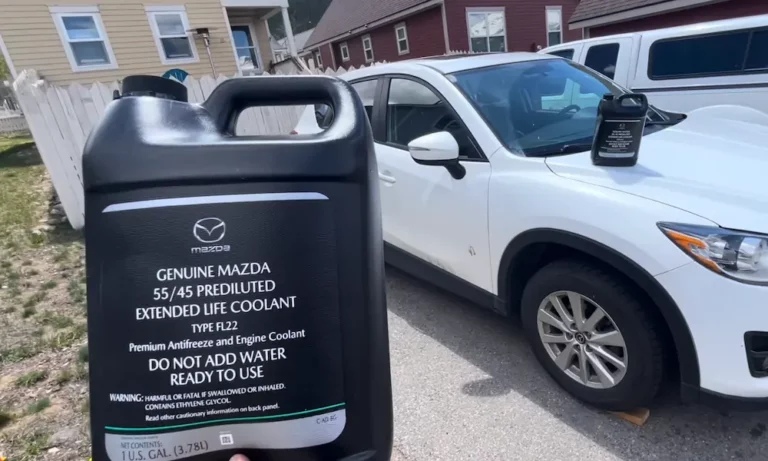
FL22 is Mazda’s factory-fill engine coolant. It uses Phosphated Organic Acid Technology (P-OAT) — a hybrid formula that combines phosphate inhibitors for fast aluminum protection with organic acids for long-term stability.
It’s pre-mixed at a 55/45 ratio (55% ethylene glycol, 45% deionized water) — not the standard 50/50 you’ll find on most shelves. That specific mix gives you:
- Freeze protection down to -34°F (-37°C)
- Boil protection up to 226°F (108°C) unpressurized
- A service life of up to 10 years or 120,000 miles on factory-fill applications
It’s also completely free of silicates, borates, nitrites, and amines. That last point is critical. Asian engine designs — especially Mazda, Honda, and Nissan — use thin-walled aluminum components that don’t play well with silicate-based coolants. Mazda’s own technical service documentation confirms this, and it’s why grabbing a generic green coolant can cause real damage.
FL22 Coolant Equivalent: The Best Options Available
Here’s the good news: you don’t have to use OEM Mazda coolant every time. Several aftermarket options genuinely match the FL22 spec — but only if you use them correctly.
Zerex Asian Vehicle Green
Zerex Asian Vehicle Green from Valvoline is the most accessible FL22 coolant equivalent in North America. It’s a P-HOAT formula that’s silicate-free, borate-free, and nitrite-free — engineered specifically for Mazda, Honda, and Nissan aluminum cooling systems.
It comes as a 50/50 pre-mix or a concentrate. If you’re doing a full flush, the concentrate gives you more control over your final mix ratio.
Ravenol HJC (Hybrid Japanese Coolant)
Ravenol HJC is a German-engineered ethylene glycol coolant built to directly replace Mazda FL22 and Ford WSS-M97B55-A (Specialty Green). One thing that stands out is its high reserve alkalinity (minimum 15 ml 0.1n HCl), which gives the coolant strong resistance to acidification over time.
It’s a solid pick if you want a premium equivalent with well-documented specs.
Beck/Arnley Premium Green Concentrate (252-1001)
Beck/Arnley’s green P-OAT concentrate (Part Number 252-1001) is formulated for Asian nameplates. Here’s the key detail: Beck/Arnley explicitly recommends mixing it at 55/45 for Mazda FL22 applications — not 50/50. That precision matters. Diluting it too much drops your inhibitor concentration and leaves aluminum surfaces vulnerable.
Aisin Extended Life Green
Aisin is an OEM supplier to Toyota and other Asian automakers, and their Extended Life Green coolant carries explicit approval for Mazda MES MN 121J (the FL22 specification). It’s a strong option for PHEVs and hybrid applications, where the coolant also circulates through battery cooling systems.
Quick Comparison Table
| Product | Chemistry | Mix Ratio | Key Approvals |
|---|---|---|---|
| Zerex Asian Green | P-HOAT | 50/50 or concentrate | Mazda FL22, Nissan, Honda |
| Ravenol HJC | P-OAT | Premix or concentrate | Mazda FL22, Ford WSS-M97B55-A |
| Beck/Arnley 252-1001 | P-OAT | Mix at 55/45 for Mazda | Mazda FL22, Hyundai |
| Aisin Extended Life Green | P-OAT | 50/50 premix | Mazda MES MN 121J |
| Peak Asian Green | P-OAT | Premix or concentrate | Mazda, Nissan, Subaru |
What Cars Use FL22 Coolant?
FL22 isn’t just for Mazda. Several other manufacturers use the same P-OAT chemistry under different names.
Mazda (Primary Application)
All modern Mazda vehicles — including the Mazda3, CX-5, CX-30, and CX-60 PHEV — use FL22 from the factory. You can identify an FL22-equipped vehicle by the “FL22” marking on the cooling system pressure cap. According to Mazda’s service bulletin, if you top up an older Mazda with FL22, you must apply an “FL22” sticker to the reserve tank — so future technicians don’t swap it out with a standard 2-year coolant.
Ford (Specialty Green / WSS-M97B55-A)
Ford vehicles with Mazda-derived engines — including the 2.3L and 2.5L Duratec — shipped from the factory with Motorcraft Specialty Green, which is chemically identical to FL22. In 2020, Ford issued TSB 20-2104 approving Motorcraft Yellow (WSS-M97B57-A1/A2) as a backward-compatible replacement for Specialty Green.
Motorcraft Yellow is also P-OAT and offers even longer service life. You can use it to replace Specialty Green, but don’t mix it with older Motorcraft Gold or any IAT coolant.
Other Asian OEMs
| OEM | Proprietary Name | Spec |
|---|---|---|
| Honda | Type E Coolant (08CLAG010S0) | P-OAT |
| Nissan | Anti-freeze Coolant L250 | P-OAT |
| Hyundai/Kia | Long Life Coolant | MS 591-08 |
| Subaru | Super Coolant | P-OAT |
What NOT to Mix with FL22 Coolant
This is where things get dangerous. Mixing the wrong coolants doesn’t just shorten service life — it can destroy your cooling system.
The Gelling Problem
When P-OAT coolants like FL22 mix with silicate-heavy IAT (green conventional) coolants, the inhibitors can precipitate out of solution and form a thick gel. That gel clogs:
- Radiator tubes — reducing heat rejection and causing overheating
- Heater cores — blocking cabin heat and forcing costly replacement
- Water pump seals — causing abrasive wear and external coolant leaks
The Color Trap
Color tells you almost nothing about chemistry. Mazda specifically warns that mixing green FL22 with orange Dex-Cool turns the fluid black. That’s not immediately catastrophic — but it wipes out your ability to spot oil contamination (head gasket warning) or rust (inhibitor depletion) during a visual check. Plus, the service interval drops to the shorter fluid’s schedule.
Universal Coolants Don’t Cut It
Ford has published a position statement warning against universal coolants. These “all makes, all models” products either lack the phosphates that FL22 systems need, or they contain silicates that the OEM explicitly prohibits. Neither outcome is good. Don’t risk it.
How to Maintain FL22 Correctly
Use Deionized Water Only
If you’re diluting a concentrate, tap water is off the table. Calcium and magnesium ions in hard water react with FL22’s phosphates to form scale deposits. That scale coats radiator tubes and engine water jackets, kills heat transfer efficiency, and creates hot spots in turbocharged engines. Use deionized or distilled water only.
Check Specific Gravity Regularly
FL22 must maintain a specific gravity of 1.074 or higher at 68°F (20°C) to ensure proper protection. Use a refractometer — not a hydrometer. Refractometers measure the refractive index of the solution, which correlates accurately to glycol concentration. If the reading drops below the threshold, your inhibitor package is compromised.
Bleed the System Properly
Modern cooling systems — especially on turbocharged and hybrid vehicles — have multiple loops. Air pockets cause:
- Air binding — the water pump can’t move fluid
- Cavitation — bubbles collapse against metal surfaces and pit them
- False sensor readings — temperature sensors not submerged in coolant give bad data to the ECU, preventing cooling fans from engaging
Use a vacuum-fill tool when refilling after a flush.
Know When to Mix (and When to Flush)
If you top up FL22 with a compatible equivalent, you’re fine — as long as the chemistry matches. But if you’ve accidentally added an incompatible coolant, don’t keep driving. A full flush with deionized water, followed by a refill with the correct FL22 equivalent, is the only safe fix.
FL22 and Electric Vehicles: Still Relevant
As more Mazda and Asian brand vehicles shift to PHEVs and EVs, FL22-compatible coolants remain essential. In many hybrid systems, a glycol-based P-OAT coolant circulates through battery cooling plates. The Aisin Extended Life Green coolant is explicitly designed for this dual-purpose use — protecting both the engine and the battery pack in the same loop.
P-OAT chemistry is actually better suited to these complex thermal systems than traditional coolants. It’s free of abrasive silicates, it’s stable over long service intervals, and it won’t degrade solenoids or electric water pump seals.
FL22 Coolant Equivalent at a Glance
You’ve got solid choices when the OEM bottle isn’t available or too expensive:
- Zerex Asian Green — most available, great for everyday use
- Ravenol HJC — premium German-engineered option with strong documentation
- Beck/Arnley 252-1001 — concentrate users: mix it at 55/45, not 50/50
- Aisin Extended Life Green — best for hybrid and PHEV applications
- Motorcraft Yellow — correct replacement for Ford Specialty Green vehicles
Stick to P-OAT, silicate-free formulas. Skip universal coolants. Use deionized water. Keep your mix at 55/45 where specified. Do those things, and your cooling system will stay clean and protected for the long haul.